Short answer: the KEF Q11 Meta. It ranks #103 of 188 floorstanding speakers by sound quality, rated 4.0/5, at $2,499.98. The Magnepan LRS+ ranks #149, rated 3.5/5, at $1,300, $1,199.98 cheaper, which does not close the gap in sound quality.
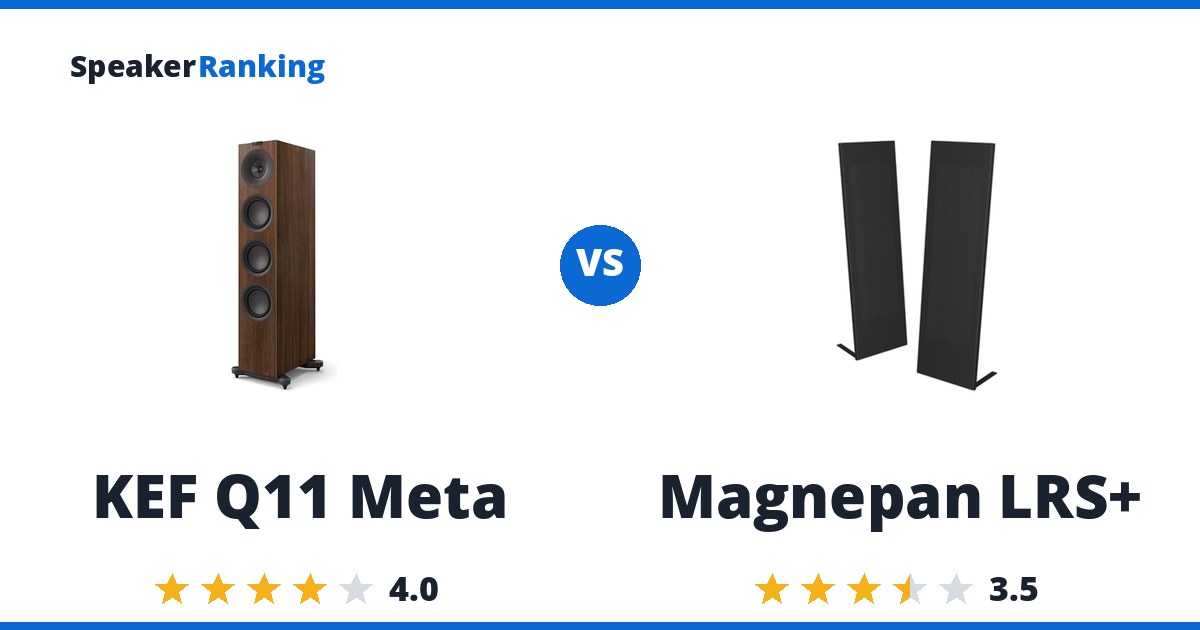
The KEF Q11 Meta is the more accurate, deeper-bass option. Three-way tower design with a coaxial layout: a 3/4” aluminum dome tweeter (with KEF’s Metamaterial Absorption Technology behind it) mounted at the center of a 4” mid-range, plus three 6.5” bass drivers. Its measured preference score, a predictor of how neutral it sounds, is 6.72 against 1.27 for the Magnepan LRS+. Its bass reaches about 60Hz before falling 3dB, against 74Hz for the Magnepan LRS+. The catch: Genuinely dark-sounding on raw on-axis measurement, and needs a typical room with sidewall reflections (within about 6 feet/2 meters) to sound properly neutral: in a large room with little sidewall interaction, it may sound too dull for some listeners.
What the Magnepan LRS+ does well: Thin, two-way planar-magnetic open-baffle/dipole panel design (about 48” tall, just 1” deep). The catch: Extremely current-hungry and power-hungry: even a pair of 600W Macintosh monoblock amplifiers only averaged about 90dB output.
Buy the KEF Q11 Meta. It is rated higher for sound quality, and the $1,199.98 you would save on the Magnepan LRS+ does not close the gap.
Want more options? Browse the full Passive Home rankings.
Specifications Side By Side
| KEF Q11 Meta | Magnepan LRS+ | |
|---|---|---|
| Price | $2,499.98 per pair | $1300 per pair |
| Ranked | #103 of 188 in Large Size Floorstanding Speakers | #149 of 188 in Large Size Floorstanding Speakers |
| Bass Extension (-10dB) | 29Hz (measured, Erin’s Audio Corner) | 67Hz (measured, Erin’s Audio Corner) |
| Bass Extension (-3dB) | 60Hz (measured, Erin’s Audio Corner) | 74Hz (measured, Erin’s Audio Corner) |
| Drivers | 25mm tweeter + dual 165mm drivers | Full-range planar magnetic dipole panel (48” tall x 13.5” wide); quasi-ribbon design, two-way with separate mid/bass and tweeter ribbon sections |
| Weight | 106.9 lbs (48.5 kg) | 30 lbs (13.6 kg) |
| Sensitivity | 88.6dB (measured, Erin’s Audio Corner) | 85.1dB (measured, Erin’s Audio Corner) |
| Impedance | 4 ohms nominal (3.2 ohms minimum, measured, Erin’s Audio Corner) | 4 ohms nominal, 3 ohms minimum (measured, Erin’s Audio Corner) |
| Dimensions | 43.8”H x 12.5”W x 15”D (1112.8 x 317.5 x 381.0 mm) | 48”H x 13.5”W x 1”D (1219.2 x 342.9 x 25.4 mm) |
| Woofer Cabinet | ported, rear | open baffle |
| Spinorama Preference Score | 6.72 | 1.27 |
| Spinorama Preference Score with Perfect Sub | 8.03 | 4.32 |
| DIY Kit | No | No |
Related Speaker Comparisons
More worthwhile head-to-heads for KEF Q11 Meta:
- KEF Q11 Meta vs KEF Blade Two Meta
- KEF Q11 Meta vs MoFi SourcePoint V10 Master Edition
- KEF Q11 Meta vs MoFi SourcePoint 888
- KEF Q11 Meta vs Revel F328Be
- Radiant Acoustics Clarity 66 vs KEF Q11 Meta
Prices on this page were last checked October 9, 2026 at 8:01 AM UTC. Product prices and availability are accurate as of that date/time and are subject to change; the price and availability shown on Amazon at the time of purchase will apply to the purchase of this product.
As an eBay Partner, we may be compensated if you make a purchase.
The Two Speakers In Full
 KEF Q11 Meta: $2,499.98 per pair Amazon eBay
Same family: the KEF Q1 Meta (smallest bookshelf, rated 3.6/5), the KEF Q4 Meta (bookshelf, estimated 3.4/5), the KEF Q3 Meta (bookshelf, rated 3.4/5), the KEF Q Concerto Meta (largest bookshelf, rated 4.6/5), the KEF Q7 Meta (smaller floorstanding, ranked lower, estimated 3.5/5) and the KEF Q6 Meta (center, rated 3.9/5).
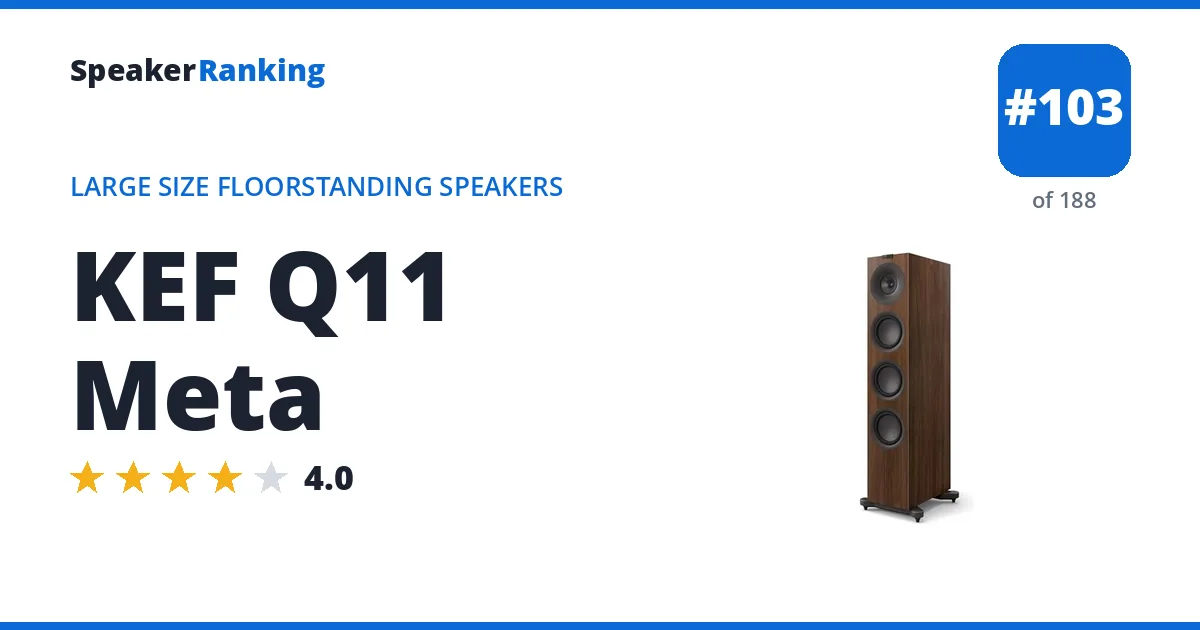
Pros: Three-way tower design with a coaxial layout: a 3/4” aluminum dome tweeter (with KEF’s Metamaterial Absorption Technology behind it) mounted at the center of a 4” mid-range, plus three 6.5” bass drivers. Extremely linear estimated in-room response when placed correctly, thanks to a deliberately declining on-axis response paired with well-controlled directivity: a technically sound design philosophy, even though it reads as “dark” in raw anechoic on-axis measurements. In-room bass extension to about 40-50Hz when placed near a wall, thanks to extended bass-shelf tuning. Sounds excellent whether pointed directly at the listener or toed out a full 30° parallel to the back wall: unusually flexible placement. More vertical listening leeway than standard non-coaxial two-way designs, thanks to the coincident tweeter/midrange. Distortion looks good at both 86dB and 96dB, and multitone distortion holds up well too. Comes with a plinth/outrigger kit for stability given its floorstanding height (about 43-44”). Measured bass extension of 60Hz (-3dB), with a measured sensitivity of 88.6dB.
Cons: Genuinely dark-sounding on raw on-axis measurement, and needs a typical room with sidewall reflections (within about 6 feet/2 meters) to sound properly neutral: in a large room with little sidewall interaction, it may sound too dull for some listeners. Must be placed close to a rear wall (about 1 foot) to get proper bass: pulling it out to the “standard” 3-foot audiophile recommendation causes bass output to drop off noticeably. Horizontal radiation of about ±50° is narrower than the reviewer’s preferred ±60°, giving a slightly less enveloping soundstage than some rivals. Notably darker than sibling KEF models in the same product family: measures 2-5dB less top-end energy than the KEF R3 Meta and a few dB less than the KEF Q Concerto Meta. Minor lingering resonances appear in burst decay measurements between 500Hz-1kHz. The tweeter shows some strain at very high output volumes, a limitation the reviewer notes is common even among more budget-friendly speakers generally.
Full KEF Q11 Meta review and specifications →
| Bass Extension (-10dB) | 29Hz (measured, Erin’s Audio Corner) |
|---|---|
| Bass Extension (-3dB) | 60Hz (measured, Erin’s Audio Corner) |
| DIY Kit | No |
| Dimensions | 43.8”H x 12.5”W x 15”D (1112.8 x 317.5 x 381.0 mm) |
| Drivers | 25mm tweeter + dual 165mm drivers |
| Impedance | 4 ohms nominal (3.2 ohms minimum, measured, Erin’s Audio Corner) |
| Sensitivity | 88.6dB (measured, Erin’s Audio Corner) |
| Spinorama Preference Score | 6.72 |
| Spinorama Preference Score with Perfect Sub | 8.03 |
| Weight | 106.9 lbs (48.5 kg) |
| Woofer Cabinet | ported, rear |
- Links
- Reviews, Comparisons and Sound Samples
- Head-to-Head Comparisons
 Magnepan LRS+: $1300 per pair Magnepan eBay
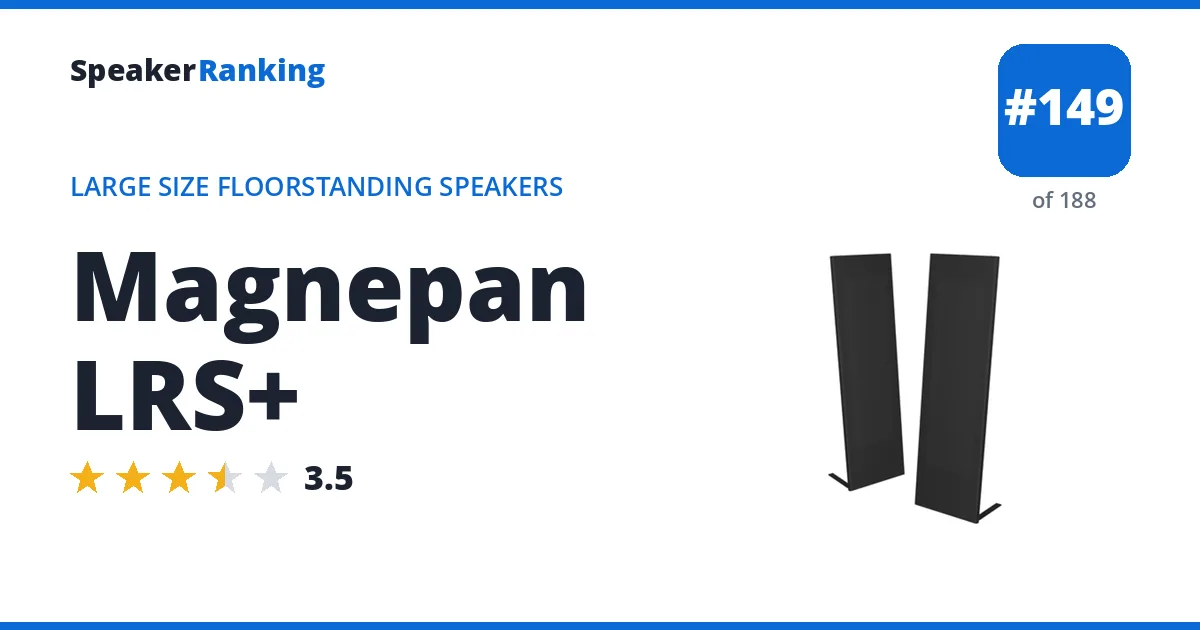
Pros: Thin, two-way planar-magnetic open-baffle/dipole panel design (about 48” tall, just 1” deep). Delivers a uniquely dramatic and enveloping soundstage with genuinely three-dimensional depth effects that work across all music genres, not just classical or orchestral material as commonly assumed. Extremely tight, locked-in center-phantom imaging when set up correctly. Open-baffle design avoids the “boxy” enclosure coloration of conventional cabinet speakers. Multitone distortion is remarkably consistent from low to high frequency, a characteristic the reviewer hasn’t observed in conventional cone-and-dome speakers. Compression at high output stays modest (about 0.5-1dB) through the midrange and treble, giving roughly 20-26dB of usable dynamic range in that region. At its price, a strong contender for a dedicated secondary listening room, even if not a main-system replacement. Measured bass extension of 74Hz (-3dB), with a measured sensitivity of 85.1dB.
Cons: Extremely current-hungry and power-hungry: even a pair of 600W Macintosh monoblock amplifiers only averaged about 90dB output. A robust, high-power amplifier is essentially mandatory, and budget amps won’t cut it. Bass rolls off very quickly (F3 74Hz, F10 67Hz, described as falling off “like a rock”), making a subwoofer an absolute requirement for any low-end content. A roughly 3dB dip in the mid-bass (100-300Hz) region thins out vocal body and fullness compared to a conventional bookshelf speaker. A resonance/bump around 400Hz adds a mild boxy quality, though it responds well to about 2dB of EQ correction. Extraordinarily fussy about exact positioning: both seating height (must align with the acoustic reference point between the panel’s lower tie-down points) and horizontal aiming are unusually critical; moving just a couple of inches can cause treble content above roughly 500-600Hz to nearly vanish. Distinct off-axis cancellation zones exist directly to the sides of the panel, where very little sound is audible at all. Fails badly under extreme dynamic-transient testing in the bass, and the reviewer blew fuses pushing the speaker during testing: not built for high-volume or highly dynamic playback. A genuinely different category from conventional hi-fi speakers, requiring more setup patience and experimentation than a typical monopole design.
Full Magnepan LRS+ review and specifications →
| Bass Extension (-10dB) | 67Hz (measured, Erin’s Audio Corner) |
|---|---|
| Bass Extension (-3dB) | 74Hz (measured, Erin’s Audio Corner) |
| DIY Kit | No |
| Dimensions | 48”H x 13.5”W x 1”D (1219.2 x 342.9 x 25.4 mm) |
| Drivers | Full-range planar magnetic dipole panel (48” tall x 13.5” wide); quasi-ribbon design, two-way with separate mid/bass and tweeter ribbon sections |
| Impedance | 4 ohms nominal, 3 ohms minimum (measured, Erin’s Audio Corner) |
| Sensitivity | 85.1dB (measured, Erin’s Audio Corner) |
| Spinorama Preference Score | 1.27 |
| Spinorama Preference Score with Perfect Sub | 4.32 |
| Weight | 30 lbs (13.6 kg) |
| Woofer Cabinet | open baffle |
- Links
- Reviews, Comparisons and Sound Samples
- Head-to-Head Comparisons
- Magnepan LRS+ vs Infinity Reference 253
- Magnepan LRS+ vs Polk Audio XT60
- Magnepan LRS+ vs JBL Stage 2 280F
- Magnepan LRS+ vs Focal Aria Evo X N°2
- Magnepan LRS+ vs Polk T50
- Magnepan LRS+ vs Definitive Technology BP-9020
- Magnepan LRS+ vs Sony SS-CS3
- Magnepan LRS+ vs JBL Studio 590
- See all 38 comparisons