Short answer: the Morel Avyra 633. It ranks #28 of 73 floorstanding speakers by sound quality, rated 4.4/5, at $2,000; the JBL Studio 698 ranks #30, rated 4.3/5, and costs $2,999.80, which makes this an easy call rather than a real tradeoff.
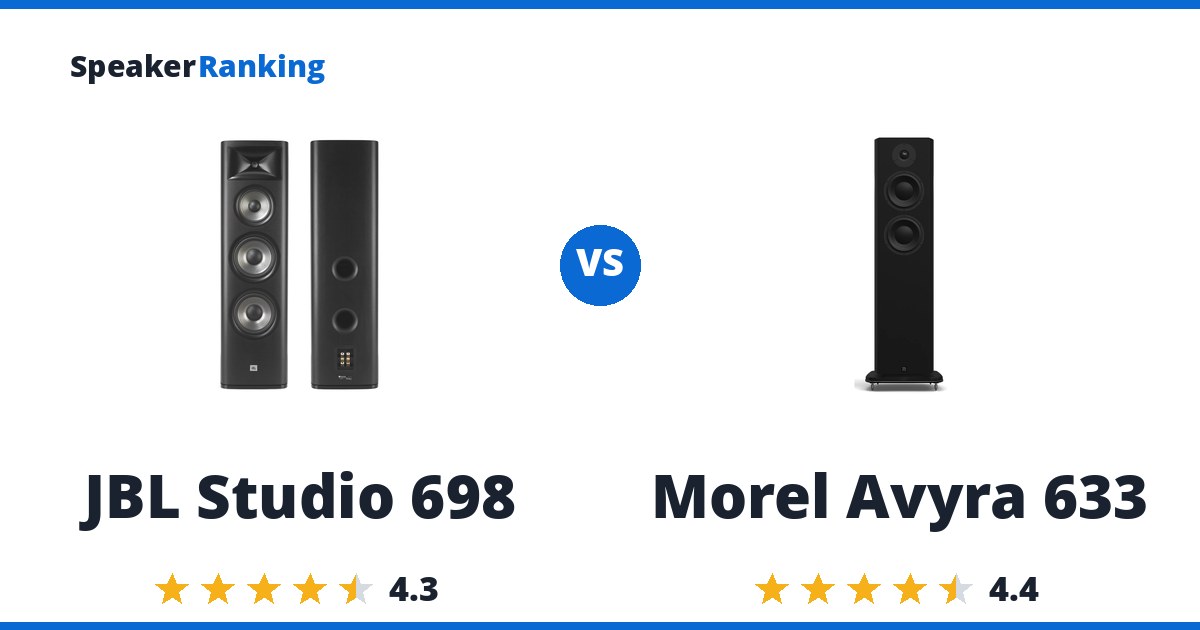
What the JBL Studio 698 does well: High-Definition Imaging (HDI) horn waveguide paired with a 1” compression driver provides excellent high-frequency directivity control and seamless acoustic handoff to the 6” PolyPlas midrange. The catch: Measured response exhibits a prominent mid-bass emphasis bump around 80Hz that can sound overly thick or chesty in smaller rooms without DSP EQ.
What the Morel Avyra 633 does well: A 2.5-way floorstanding tower with two 6” mid-woofers (each with an unusually large 3” voice coil for better power handling) and a dome tweeter; the bottom woofer only covers up to about 250Hz while the top woofer runs all the way to the 2.2kHz crossover point. The catch: A bit bright out of the box: extra tweeter energy in the 4-7kHz region (which also shows up as nonlinearity in the early-reflections directivity data, making it harder to fully correct with EQ) reflects off nearby sidewalls and can sound tipped-up or edgy; a single EQ band (about 4.4kHz, -2dB, Q of 1) or absorption panels placed 60-80° off-axis on the sidewalls resolves it.
Buy the Morel Avyra 633. It is rated higher for sound quality than the JBL Studio 698 and costs less, which makes it the one to get unless you need something the other one does better.
Still deciding? The full Passive Home rankings cover every ranked option.
Specifications Side By Side
| JBL Studio 698 | Morel Avyra 633 | |
|---|---|---|
| Price | $1,398 per pair | $2,000.00 per pair |
| Ranked | #30 of 73 in Large Size Floorstanding Speakers | #28 of 73 in Large Size Floorstanding Speakers |
| Bass Extension (-10dB) | 34Hz (measured, Erin’s Audio Corner) | 32Hz (measured, Erin’s Audio Corner) |
| Bass Extension (-3dB) | 53Hz (measured, Erin’s Audio Corner) | 50Hz (measured, Erin’s Audio Corner) |
| Dimensions | 41.7”H x 11.8”W x 15.7”D (1058 x 300 x 400 mm) | 38.7”H x 12.8”W x 12.2”D (982 x 326 x 310 mm) |
| Impedance | 6 ohms nominal (4.1 ohms minimum above 80Hz, measured by Erin’s Audio Corner) | 4 ohms nominal (3.8 ohms minimum, measured, Erin’s Audio Corner) |
| Sensitivity | 90dB (measured average, Erin’s Audio Corner) | 86.5dB (measured, Erin’s Audio Corner) |
| Drivers | 1 in. High-Definition Imaging compression driver, 6 in. PolyPlas midrange, dual 8 in. PolyPlas woofers | Dome tweeter, two 6” mid-woofers (3” voice coil) |
| Weight | 78.9 lbs (35.8 kg) each | 48.5 lbs (22 kg) each |
| Woofer Cabinet | ported, rear | ported |
| Spinorama Preference Score | 4.20 | 5.43 |
| Spinorama Preference Score with Perfect Sub | 6.14 | 7.20 |
| DIY Kit | No | No |
| Crossover Frequency | - | 250Hz, 2.2kHz |
| Frequency Response | - | 25Hz - 20kHz (±3dB, manufacturer specified) |
| Recommended Power | - | 200-1000W |
| Country | - | Israel |
Related Speaker Comparisons
How Morel Avyra 633 compares with other leading options:
- Revel Concerta2 F35 vs Morel Avyra 633
- Arendal 1961 Tower vs Morel Avyra 633
- Morel Avyra 633 vs KLH Model Five
- JBL Studio 698 vs Revel F206
- JBL Studio 698 vs JBL Studio 590
Prices on this page were last checked September 30, 2026 at 2:57 PM UTC. Product prices and availability are accurate as of that date/time and are subject to change; the price and availability shown on Amazon at the time of purchase will apply to the purchase of this product.
As an eBay Partner, we may be compensated if you make a purchase.
The Two Speakers In Full
 JBL Studio 698: $1,398 per pair Crutchfield eBay
Older model: the JBL Studio 590 (ranked lower, rated 2.8/5).
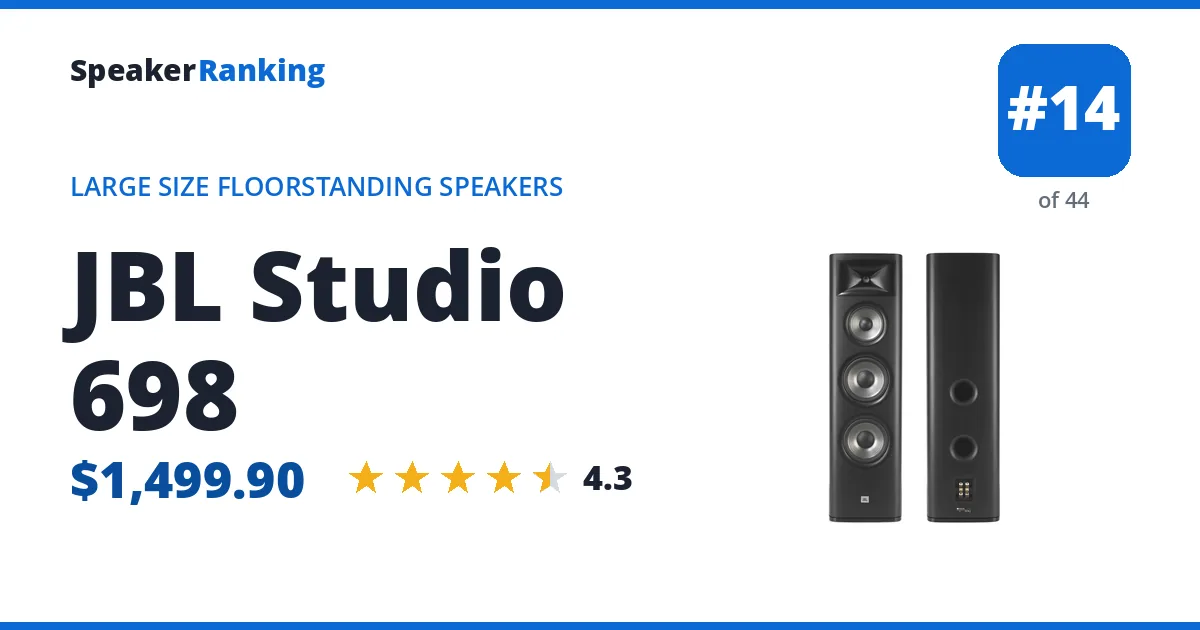
Pros: High-Definition Imaging (HDI) horn waveguide paired with a 1” compression driver provides excellent high-frequency directivity control and seamless acoustic handoff to the 6” PolyPlas midrange. Dual 8” PolyPlas woofers deliver robust low-end authority with solid bass extension down to an F3 of 53Hz and F10 of 34Hz. High voltage sensitivity (90dB SPL at 2.83V/1m) and clean power handling provide effortless dynamic headroom and low distortion for home theater and music listening. Measured bass extension of 53Hz (-3dB), with a measured sensitivity of 90dB.
Cons: Measured response exhibits a prominent mid-bass emphasis bump around 80Hz that can sound overly thick or chesty in smaller rooms without DSP EQ. Treble response lacks top-octave ‘air’ above 12kHz compared to high-end dome or ribbon tweeters. Physically large, heavy cabinet (35.8 kg per speaker) requires careful room placement and a wide acoustic footprint.
Full JBL Studio 698 review and specifications →
| Bass Extension (-10dB) | 34Hz (measured, Erin’s Audio Corner) |
|---|---|
| Bass Extension (-3dB) | 53Hz (measured, Erin’s Audio Corner) |
| DIY Kit | No |
| Dimensions | 41.7”H x 11.8”W x 15.7”D (1058 x 300 x 400 mm) |
| Drivers | 1 in. High-Definition Imaging compression driver, 6 in. PolyPlas midrange, dual 8 in. PolyPlas woofers |
| Impedance | 6 ohms nominal (4.1 ohms minimum above 80Hz, measured by Erin’s Audio Corner) |
| Sensitivity | 90dB (measured average, Erin’s Audio Corner) |
| Spinorama Preference Score | 4.20 |
| Spinorama Preference Score with Perfect Sub | 6.14 |
| Weight | 78.9 lbs (35.8 kg) each |
| Woofer Cabinet | ported, rear |
- Links
- Reviews, Comparisons and Sound Samples
- Head-to-Head Comparisons
- JBL Studio 698 vs JBL HDI-3600
- JBL Studio 698 vs Polk Audio Reserve R700
- JBL Studio 698 vs Arendal 1961 Tower
- JBL Studio 698 vs KEF R11 Meta
- JBL Studio 698 vs PSB Imagine T65
- JBL Studio 698 vs Emotiva Airmotiv T2+
- JBL Studio 698 vs Ascend Acoustics Sierra Titan Tower
- JBL Studio 698 vs ELAC Debut 3.0 DF63
- See all 51 comparisons
 Morel Avyra 633: $2,000.00 per pair eBay
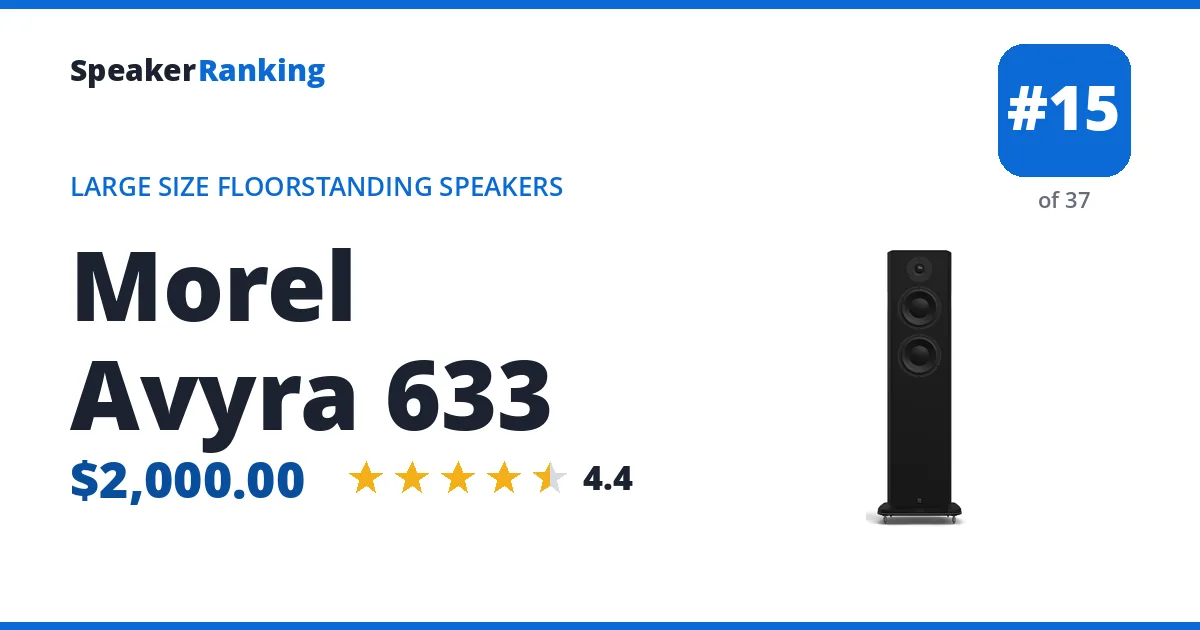
Pros: A 2.5-way floorstanding tower with two 6” mid-woofers (each with an unusually large 3” voice coil for better power handling) and a dome tweeter; the bottom woofer only covers up to about 250Hz while the top woofer runs all the way to the 2.2kHz crossover point. Easy to drive at a nominal 4 ohms (minimum 3.8 ohms). On-axis linearity measures within about ±2.25dB: genuinely impressive for a tower in this class, enough that the reviewer said he’d have guessed a $4,000-5,000 per pair price just from the look and the data alone. F3 of about 50Hz and F10 of about 32Hz give reasonable kick-drum-level bass without a subwoofer. Wide horizontal radiation around ±70° with good continuity outside the treble region. Harmonic distortion stays under 1% THD to about 100Hz at both 86dB and 96dB, and using an 80Hz subwoofer crossover barely changes midrange distortion: a sign the drive units themselves are good quality rather than excursion-limited. About 20dB of usable dynamic range. No through-holes for spikes, so no risk of dropped hardware during setup. Measured bass extension of 50Hz (-3dB), with a measured sensitivity of 86.5dB.
Cons: A bit bright out of the box: extra tweeter energy in the 4-7kHz region (which also shows up as nonlinearity in the early-reflections directivity data, making it harder to fully correct with EQ) reflects off nearby sidewalls and can sound tipped-up or edgy; a single EQ band (about 4.4kHz, -2dB, Q of 1) or absorption panels placed 60-80° off-axis on the sidewalls resolves it. Best aimed directly at the listener rather than toed out, since the top end already rolls off a little at wider angles. Imaging loses a bit of precision specifically in that lower-treble region. Multitone distortion exceeds the reviewer’s 3% comfort threshold at higher output. Real bass extension below 50Hz still needs a subwoofer. Not the same speaker as the Parts Express “Solstice” DIY kit despite surface similarities: different tweeter, different (ported vs. transmission line) enclosure, and measurably different woofers.
Full Morel Avyra 633 review and specifications →
| Bass Extension (-10dB) | 32Hz (measured, Erin’s Audio Corner) |
|---|---|
| Bass Extension (-3dB) | 50Hz (measured, Erin’s Audio Corner) |
| Country | Israel |
| Crossover Frequency | 250Hz, 2.2kHz |
| DIY Kit | No |
| Dimensions | 38.7”H x 12.8”W x 12.2”D (982 x 326 x 310 mm) |
| Drivers | Dome tweeter, two 6” mid-woofers (3” voice coil) |
| Frequency Response | 25Hz - 20kHz (±3dB, manufacturer specified) |
| Impedance | 4 ohms nominal (3.8 ohms minimum, measured, Erin’s Audio Corner) |
| Recommended Power | 200-1000W |
| Sensitivity | 86.5dB (measured, Erin’s Audio Corner) |
| Spinorama Preference Score | 5.43 |
| Spinorama Preference Score with Perfect Sub | 7.20 |
| Weight | 48.5 lbs (22 kg) each |
| Woofer Cabinet | ported |
- Links
- Reviews, Comparisons and Sound Samples
- Head-to-Head Comparisons