Short answer: the JBL PRX908. It ranks #5 of 22 8-inch pa speakers by sound quality, rated 4.0/5, at $799; the LD Systems Stinger 28-A-G3 ranks #17, rated 3.5/5, at $799. The price gap is small enough that the sound-quality ranking should decide it.
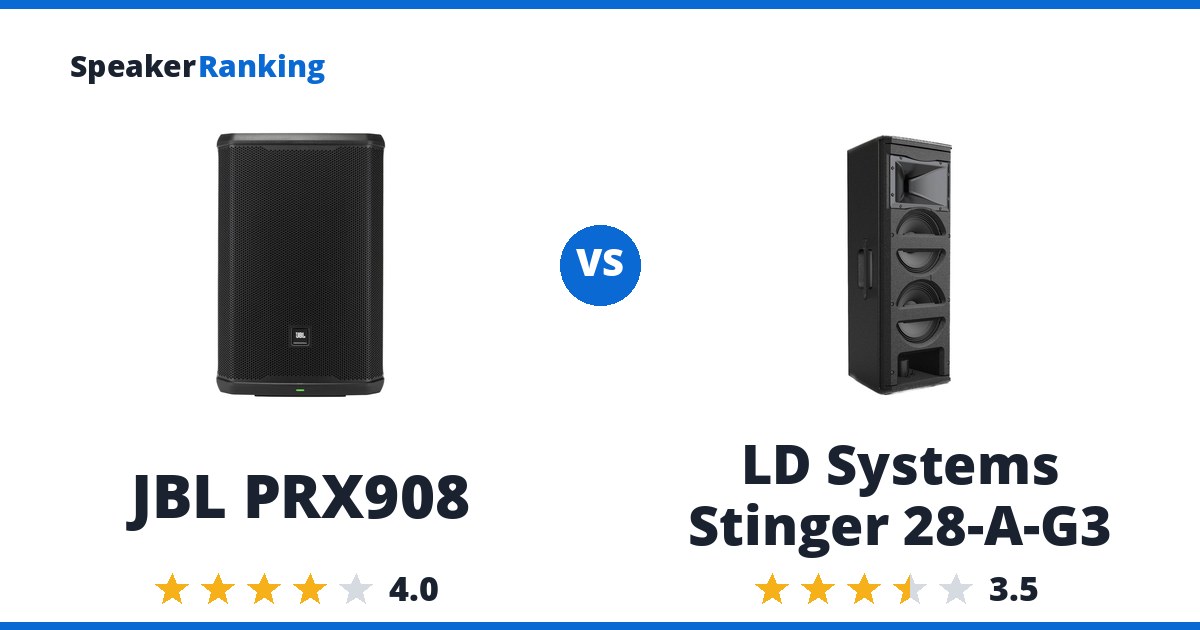
Why pick the JBL PRX908: High-quality vendor data shows a 5.69 ideal-subwoofer preference score with 58Hz measured extension, backed by JBL’s extensive service network. The tradeoff: Its 126dB peak claim is modest for a main speaker, so pairing with a subwoofer matters more here than with the larger PRX modules.
Why pick the LD Systems Stinger 28-A-G3: Two 8-inch woofers give bass to 56Hz at -3dB and about 50Hz at -10dB, deep for an 8-inch design, from a 500W (1000W peak) amplifier rated to 131dB. The catch: Manufacturer measurements show a wide 3.7dB reference band and 0.729 listening-window deviation, so tonal balance is uneven, and the standalone preference score is only 1.96.
Buy the JBL PRX908. It is rated higher for sound quality than the LD Systems Stinger 28-A-G3 at the same price, so only choose the other one for a particular feature it does better.
Want more options? Browse the full PA & Live Sound rankings.
Specifications Side By Side
| JBL PRX908 | LD Systems Stinger 28-A-G3 | |
|---|---|---|
| Price | $799.00 | $799 |
| Ranked | #5 of 22 in 8-Inch PA Speakers | #17 of 22 in 8-Inch PA Speakers |
| Configuration | Active 2-way bass-reflex PA speaker | Active 2-way bass-reflex PA speaker |
| Drivers | 8” woofer, 1.5” compression driver | 2x 8” woofers, BMS compression driver |
| Frequency Response | 55Hz - 20kHz (-10dB, manufacturer specified) | 58Hz - 20kHz (manufacturer specified) |
| Dimensions | 18.9”H x 12.3”W x 11.2”D (479 x 312 x 285 mm) | - |
| Inputs | 2 x XLR/TRS combo, 3.5mm aux; 2 x XLR thru and XLR mix outputs | - |
| Amplifier Power | 2000W peak / 1000W RMS | 500W RMS / 1,000W peak, Class-D |
| Crossover Frequency | 1930Hz | - |
| Cabinet Material | Polypropylene/talc composite | Birch plywood with polyurea coating |
| Rigging | 6 x M10 suspension points; dual 36mm pole sockets | - |
| Coverage | 105° x 60° | 90° x 50° |
| Maximum SPL | 126dB peak (manufacturer specified) | 131dB (manufacturer specified) |
| Bass Extension (-3dB) | 63Hz (measured, vendor Spinorama data) | 56Hz (measured, vendor Spinorama data) |
| DSP | Yes, 12-band parametric EQ and dbx DriveRack | Yes, DynX DSP presets |
| Bluetooth | Yes, control via JBL Pro Connect app | No |
| Weight | 30.2 lbs (13.7 kg) | - |
| Spinorama Preference Score | 3.10 | 1.96 |
| Spinorama Preference Score with Perfect Sub | 5.69 | 4.44 |
| XLR Input | Yes | Yes |
| RCA Input | No | No |
| TRS Input | Yes | Yes |
| Optical Input | No | No |
| Coaxial Input | No | No |
| USB Input | No | No |
| HDMI Input | No | No |
| AES Input | No | No |
| Aux Input | Yes | No |
| Microphone Input | No | No |
| Guitar Input | No | No |
| Bass Extension (-10dB) | - | about 49.6Hz (measured, vendor Spinorama data) |
Related Speaker Comparisons
How JBL PRX908 compares with other leading options:
- QSC K8.2 vs JBL PRX908
- L-Acoustics 108P vs JBL PRX908
- Yamaha DXR8mkII vs JBL PRX908
- L-Acoustics X8 vs JBL PRX908
- JBL PRX908 vs RCF KX 08-A
Prices on this page were last checked September 26, 2026 at 11:14 PM UTC. Product prices and availability are accurate as of that date/time and are subject to change; the price and availability shown on Amazon at the time of purchase will apply to the purchase of this product.
As an eBay Partner, we may be compensated if you make a purchase.
The Two Speakers In Full
 JBL PRX908: $799.00 Amazon B&H Photo Video Guitar Center eBay
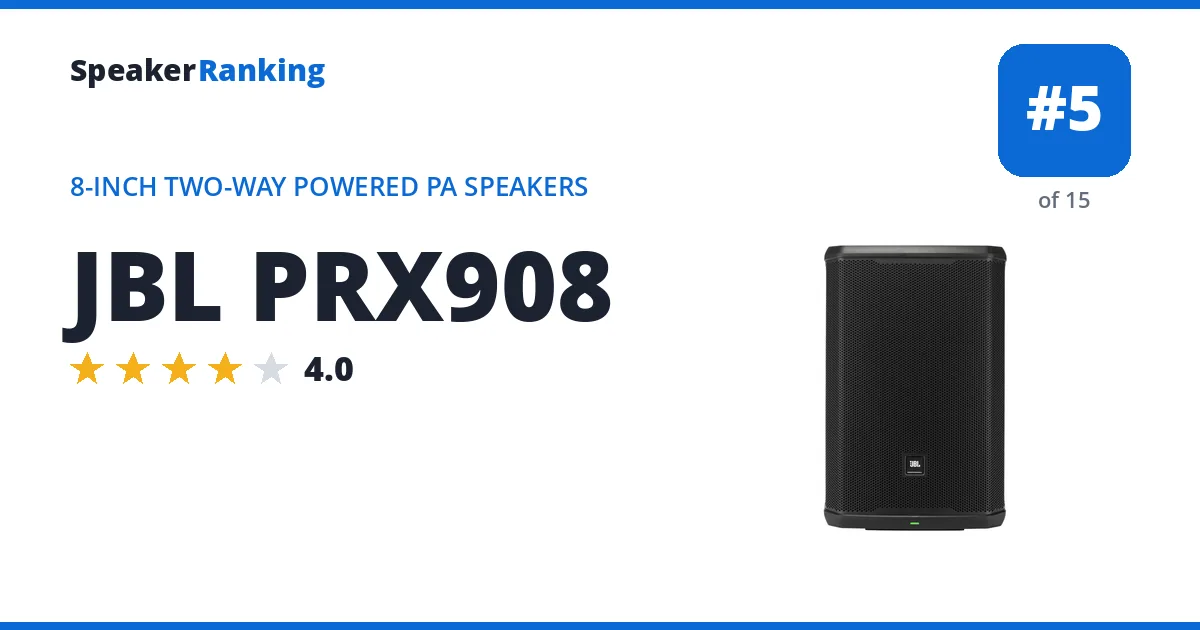
Pros: High-quality vendor data shows a 5.69 ideal-subwoofer preference score with 58Hz measured extension, backed by JBL’s extensive service network. A 12-band parametric EQ with dbx DriveRack feedback suppression and BLE app control carry over the PRX900 series’ engineering into an 8-inch cabinet. Measured bass extension of 63Hz (-3dB).
Cons: Its 126dB peak claim is modest for a main speaker, so pairing with a subwoofer matters more here than with the larger PRX modules.
Full JBL PRX908 review and specifications →
| AES Input | No |
|---|---|
| Amplifier Power | 2000W peak / 1000W RMS |
| Aux Input | Yes |
| Bass Extension (-3dB) | 63Hz (measured, vendor Spinorama data) |
| Bluetooth | Yes, control via JBL Pro Connect app |
| Cabinet Material | Polypropylene/talc composite |
| Coaxial Input | No |
| Configuration | Active 2-way bass-reflex PA speaker |
| Coverage | 105° x 60° |
| Crossover Frequency | 1930Hz |
| DSP | Yes, 12-band parametric EQ and dbx DriveRack |
| Dimensions | 18.9”H x 12.3”W x 11.2”D (479 x 312 x 285 mm) |
| Drivers | 8” woofer, 1.5” compression driver |
| Frequency Response | 55Hz - 20kHz (-10dB, manufacturer specified) |
| Guitar Input | No |
| HDMI Input | No |
| Inputs | 2 x XLR/TRS combo, 3.5mm aux; 2 x XLR thru and XLR mix outputs |
| Maximum SPL | 126dB peak (manufacturer specified) |
| Microphone Input | No |
| Optical Input | No |
| RCA Input | No |
| Rigging | 6 x M10 suspension points; dual 36mm pole sockets |
| Spinorama Preference Score | 3.10 |
| Spinorama Preference Score with Perfect Sub | 5.69 |
| TRS Input | Yes |
| USB Input | No |
| Weight | 30.2 lbs (13.7 kg) |
| XLR Input | Yes |
- Links
- Reviews, Comparisons and Sound Samples
- Head-to-Head Comparisons
 LD Systems Stinger 28-A-G3: $799 Thomann eBay
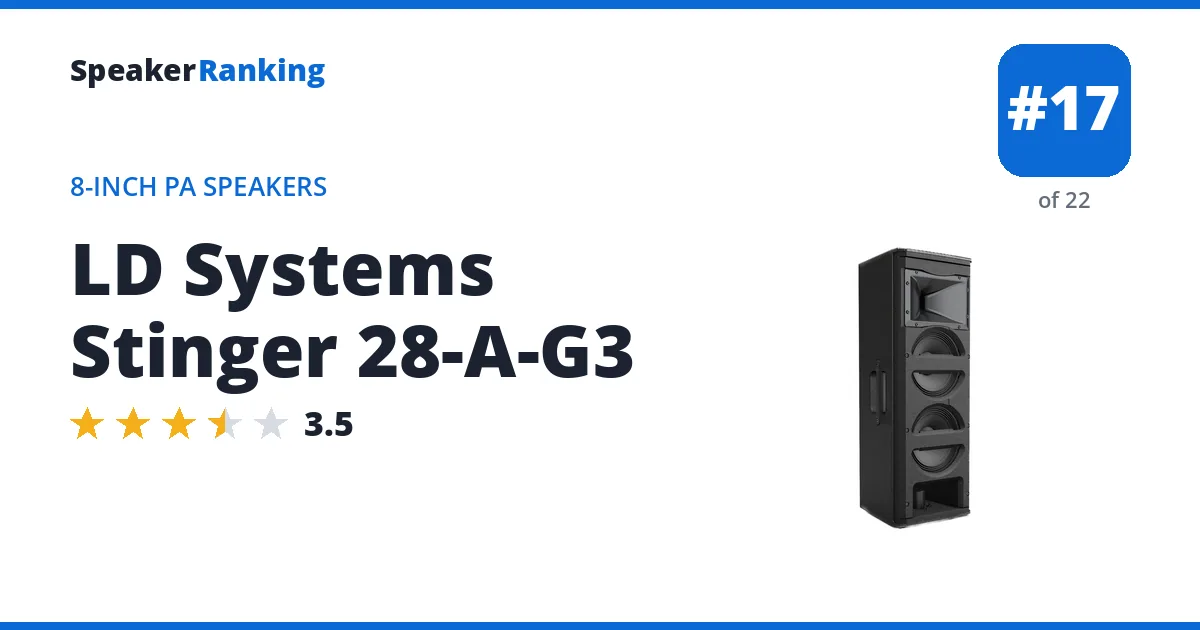
Pros: Two 8-inch woofers give bass to 56Hz at -3dB and about 50Hz at -10dB, deep for an 8-inch design, from a 500W (1000W peak) amplifier rated to 131dB. The birch plywood cabinet has a polyurea coating and steel grille, and DynX DSP presets let it work as a full-range top, satellite or monitor. Measured bass extension of 56Hz (-3dB).
Cons: Manufacturer measurements show a wide 3.7dB reference band and 0.729 listening-window deviation, so tonal balance is uneven, and the standalone preference score is only 1.96. The single-8-inch Stinger 8 A G3 measures better for the money.
Full LD Systems Stinger 28-A-G3 review and specifications →
| AES Input | No |
|---|---|
| Amplifier Power | 500W RMS / 1,000W peak, Class-D |
| Aux Input | No |
| Bass Extension (-10dB) | about 49.6Hz (measured, vendor Spinorama data) |
| Bass Extension (-3dB) | 56Hz (measured, vendor Spinorama data) |
| Bluetooth | No |
| Cabinet Material | Birch plywood with polyurea coating |
| Coaxial Input | No |
| Configuration | Active 2-way bass-reflex PA speaker |
| Coverage | 90° x 50° |
| DSP | Yes, DynX DSP presets |
| Drivers | 2x 8” woofers, BMS compression driver |
| Frequency Response | 58Hz - 20kHz (manufacturer specified) |
| Guitar Input | No |
| HDMI Input | No |
| Maximum SPL | 131dB (manufacturer specified) |
| Microphone Input | No |
| Optical Input | No |
| RCA Input | No |
| Spinorama Preference Score | 1.96 |
| Spinorama Preference Score with Perfect Sub | 4.44 |
| TRS Input | Yes |
| USB Input | No |
| XLR Input | Yes |
- Links
- Reviews, Comparisons and Sound Samples
- Head-to-Head Comparisons