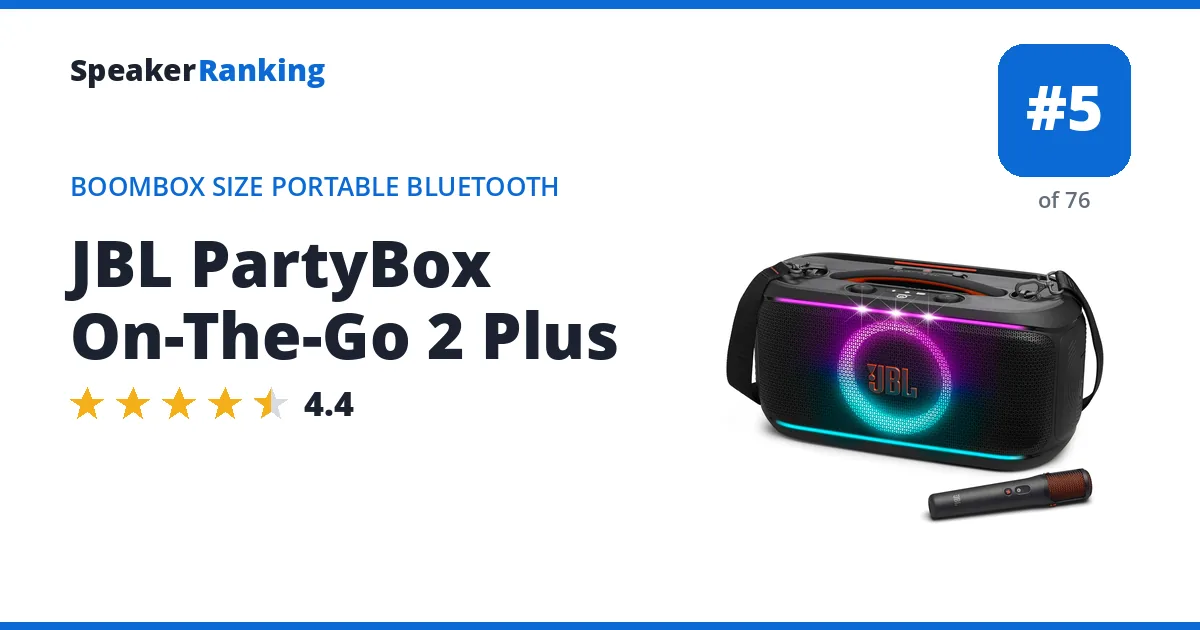
Short answer: the JBL PartyBox On-The-Go 2 Plus. It ranks #5 of 89 boombox speakers by sound quality, rated 4.4/5, at $349.95; the Turtlebox Gen 3 ranks #83, rated 2.1/5, and costs $430, so there is little reason to consider the other one.
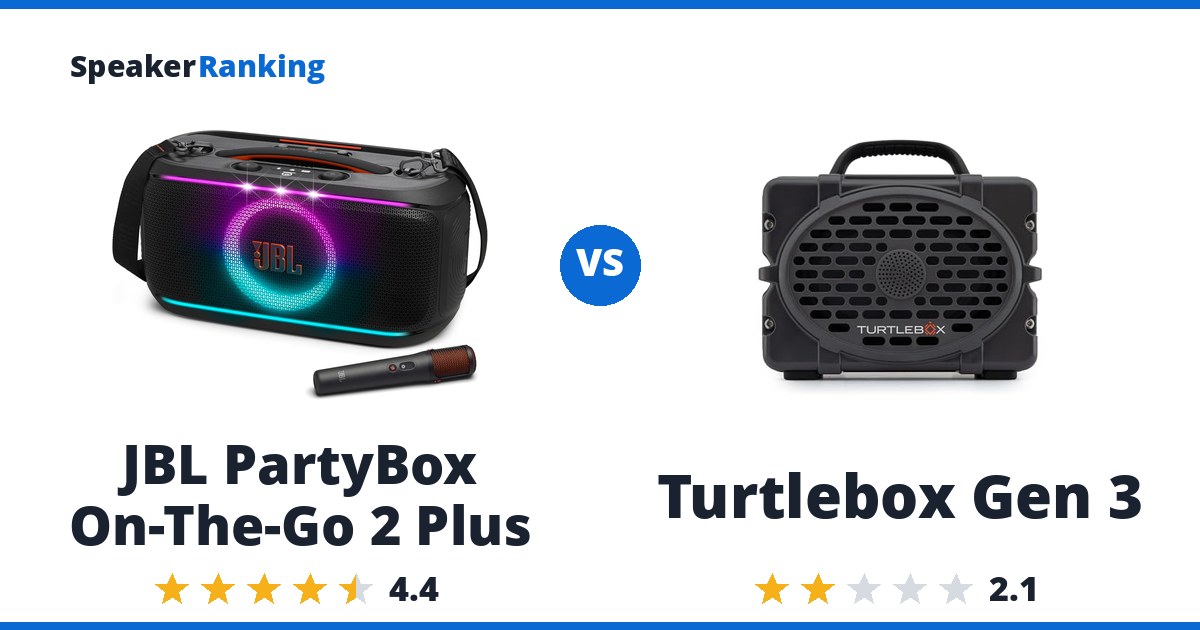
What the JBL PartyBox On-The-Go 2 Plus does well: Well balanced with strong vocals, and its front-firing bass ports give it cleaner, smoother bass than other PartyBoxes, so even the Punchy bass boost setting never overpowers the vocals. The tradeoff: The bass has less kick and physical impact than the Encore 2 or PartyBox Club 120, and the Club 120 gets noticeably louder.
The case for the Turtlebox Gen 3: Waterproof (IP67, and it floats) and crushproof, with stainless steel hardware and quality amplifier parts inside. The tradeoff: Sounds basically identical to the original and the Gen 2: each generation mainly added features, not sound quality.
Buy the JBL PartyBox On-The-Go 2 Plus. It is rated higher for sound quality than the Turtlebox Gen 3 and costs less, so it is the default pick unless a specific strength of the other one matters more to you.
If battery life is a priority, the Turtlebox Gen 3 is rated for 25 hours versus 15 hours for the JBL PartyBox On-The-Go 2 Plus.
There is a real gap in water resistance: the Turtlebox Gen 3 at IP67 (brief submersion) against the JBL PartyBox On-The-Go 2 Plus, which has IPX4 (splashing).
Still deciding? The full Portable Bluetooth rankings cover every ranked option.
Specifications Side By Side
| JBL PartyBox On-The-Go 2 Plus | Turtlebox Gen 3 | |
|---|---|---|
| Price | $349.95 | $430.00 |
| Ranked | #5 of 89 in Boombox Size Portable Bluetooth Speakers | #83 of 89 in Boombox Size Portable Bluetooth Speakers |
| App | Yes (JBL One app) | No |
| Aux Input | Yes | Yes |
| Battery Life | 15 hours (Manufacturer specified) | 25 hours (Manufacturer specified) |
| Built-in Microphone | No | No |
| EQ | Yes (app EQ, Deep and Punchy bass boost) | No |
| IP Rating | IPX4 | IP67 |
| Party Mode | Yes (Auracast) | Yes (Turtlebox Party Mode) |
| Power Bank | Yes (USB-C, 11V/2A) | Yes (USB-C) |
| Power Input | AC Power cord | DC Barrel Connector (15V/3A) |
| Removable Battery | Yes | - |
| Stereo | Partially | Yes |
| Omnidirectional | No | No |
| TWS | Yes | Yes |
| USB Playback | Yes | No |
| Weight | 14.2 lbs (6.45 kg) | 10 lbs (4.54 kg) |
| Wireless Microphones | Yes 1 Included | - |
| Microphone Input | No (wireless only) | Yes (3.5mm) |
| Guitar Input | No | - |
| Bluetooth | Yes | Yes |
| Bluetooth Codecs | SBC, LC3 | SBC |
| Bluetooth Version | 5.4 | 5.4 |
| Amplifier Power | 100W RMS | 50W |
| Dimensions | 19.7” x 10.2” x 8.7” (501 x 258 x 221 mm) | 12” x 7” x 8.7” (305 x 178 x 222 mm) |
| Drivers | 1x 135mm (5.25”) woofer + 2x 20mm (0.75”) dome tweeters | 1x 6x9” (152x228mm) woofer + 1x 1” (25mm) tweeter |
| Frequency Response | 40Hz - 20kHz (-6dB, Manufacturer specified) | - |
| Digital Aux Input | Yes (USB-C) | No |
| Lights | Yes | - |
| Strap | Yes (detachable shoulder strap) | No |
| Bass Extension (-10dB) | - | ~65Hz |
| MicroSD Playback | - | Yes |
| Battery Capacity | - | 85Wh |
| Maximum SPL | - | 102dB (measured by Williston Audio Labs) |
Related Speaker Comparisons
More top alternatives to JBL PartyBox On-The-Go 2 Plus:
- Tribit Stormbox Blast vs JBL PartyBox On-The-Go 2 Plus
- JBL Partybox Encore 2 vs JBL PartyBox On-The-Go 2 Plus
- JBL PartyBox On-The-Go 2 Plus vs JBL Partybox Encore Essential 2
- JBL PartyBox On-The-Go 2 Plus vs JBL Partybox Encore Essential
- JBL PartyBox On-The-Go 2 Plus vs Harman Kardon Onyx Studio 8
Prices on this page were last checked September 30, 2026 at 2:57 PM UTC. Product prices and availability are accurate as of that date/time and are subject to change; the price and availability shown on Amazon at the time of purchase will apply to the purchase of this product.
As an eBay Partner, we may be compensated if you make a purchase.
The Two Speakers In Full
 JBL PartyBox On-The-Go 2 Plus: $349.95 Amazon eBay
Older model: the JBL Partybox On the Go (ranked lower, rated 3/5).
Pros: Well balanced with strong vocals, and its front-firing bass ports give it cleaner, smoother bass than other PartyBoxes, so even the Punchy bass boost setting never overpowers the vocals. It gets a touch louder than the PartyBox Encore 2. EasySing AI vocal removal strips vocals from any song on the speaker itself, with 25%, 50% or 100% removal, and the included rechargeable wireless mic has a tight pickup pattern that rejects handling noise. A removable 34Wh battery shared with the Encore 2 and PartyBox 120, a claimed 15 hours, a padded shoulder strap, USB-C playback and charging, a 3.5mm aux input, Auracast and a light show.
Cons: The bass has less kick and physical impact than the Encore 2 or PartyBox Club 120, and the Club 120 gets noticeably louder. There is no wired microphone or guitar input, so more mics means buying JBL’s EasySing mics separately, and AI vocal removal is disabled while the speaker is linked to other speakers over Auracast. Real world battery life is closer to 7 hours at 80% volume with lights and bass boost on. IPX4 only covers splashes, the grille dents easily, and the battery must be installed for it to run even when plugged in.
Full JBL PartyBox On-The-Go 2 Plus review and specifications →
| Amplifier Power | 100W RMS |
|---|---|
| App | Yes (JBL One app) |
| Aux Input | Yes |
| Battery Life | 15 hours (Manufacturer specified) |
| Bluetooth | Yes |
| Bluetooth Codecs | SBC, LC3 |
| Bluetooth Version | 5.4 |
| Built-in Microphone | No |
| Digital Aux Input | Yes (USB-C) |
| Dimensions | 19.7” x 10.2” x 8.7” (501 x 258 x 221 mm) |
| Drivers | 1x 135mm (5.25”) woofer + 2x 20mm (0.75”) dome tweeters |
| EQ | Yes (app EQ, Deep and Punchy bass boost) |
| Frequency Response | 40Hz - 20kHz (-6dB, Manufacturer specified) |
| Guitar Input | No |
| IP Rating | IPX4 |
| Lights | Yes |
| Microphone Input | No (wireless only) |
| Omnidirectional | No |
| Party Mode | Yes (Auracast) |
| Power Bank | Yes (USB-C, 11V/2A) |
| Power Input | AC Power cord |
| Removable Battery | Yes |
| Stereo | Partially |
| Strap | Yes (detachable shoulder strap) |
| TWS | Yes |
| USB Playback | Yes |
| Weight | 14.2 lbs (6.45 kg) |
| Wireless Microphones | Yes 1 Included |
- Links
- Reviews, Comparisons and Sound Samples
- Head-to-Head Comparisons
- JBL PartyBox On-The-Go 2 Plus vs JBL Partybox Encore 2
- JBL PartyBox On-The-Go 2 Plus vs JBL Partybox Encore Essential 2
- JBL PartyBox On-The-Go 2 Plus vs JBL Partybox Encore Essential
- JBL PartyBox On-The-Go 2 Plus vs Tribit Stormbox Blast
- JBL PartyBox On-The-Go 2 Plus vs Harman Kardon Onyx Studio 8
- JBL PartyBox On-The-Go 2 Plus vs Harman Kardon Onyx Studio 9
- JBL PartyBox On-The-Go 2 Plus vs Zealot ZE51
- JBL PartyBox On-The-Go 2 Plus vs Zealot ZE41
- See all 25 comparisons
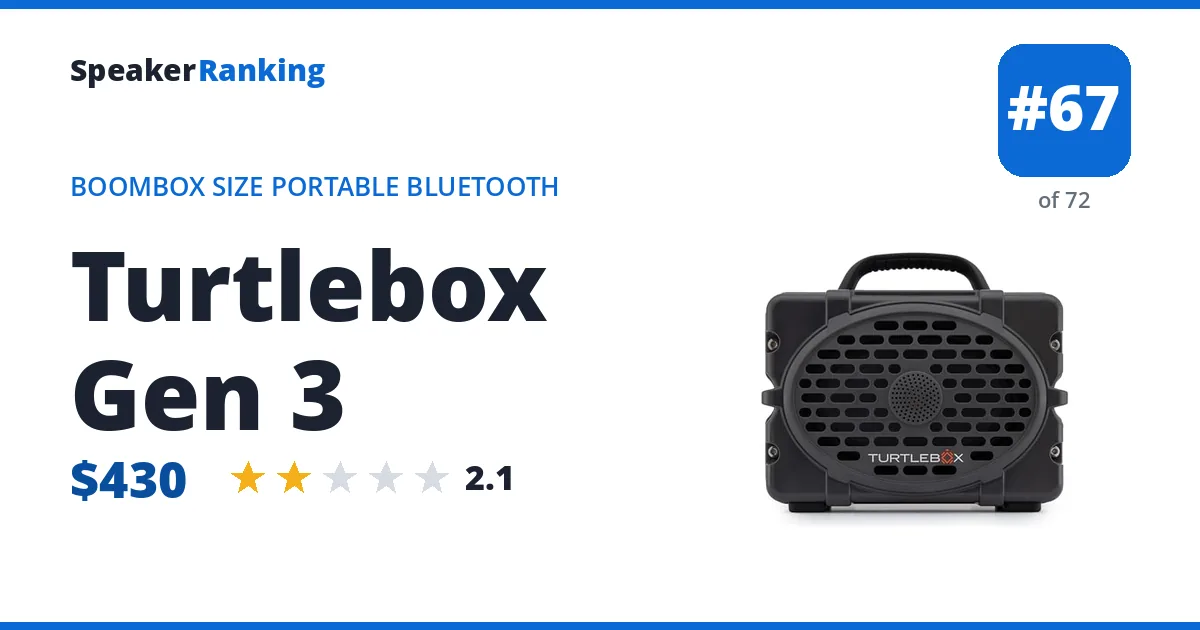
 Turtlebox Gen 3: $430.00 Amazon eBay
Older models: the Turtlebox Gen 2 (ranked lower, rated 2.1/5) and the Turtlebox (ranked lower, rated 2.1/5).
Pros: Waterproof (IP67, and it floats) and crushproof, with stainless steel hardware and quality amplifier parts inside. Loud for its class: Williston Audio Labs measured 102 dB at max volume, well above a Kicker BF400’s 96 dB. A big 85Wh battery rated for 25+ hours, a USB-C output that charges other devices, aux and microphone inputs, and true multi-speaker Party Mode on top of stereo pairing, plus Bluetooth 5.4. Measured bass extension of ~65Hz (-10dB).
Cons: Sounds basically identical to the original and the Gen 2: each generation mainly added features, not sound quality. The amp is tuned to a V shape, with boosted lows and highs and a dip in the mids, but the boost can’t make up for shallow extension: the bass is only down 10dB at about 65Hz, so there’s little real low end despite the boomy upper bass. The amp delivers only about 12W RMS at 1% distortion. In Williston Audio Labs’ side by side test most listeners preferred the much smaller Kicker BF400 for its cleaner sound, and a Pioneer PBM5 played louder at 105 dB. Nowhere near its claimed 120dB at a reasonable measuring distance. Rattles at high volume. It charges only from its own 15V barrel plug brick, not USB-C, and has no app or EQ. Inside is essentially a car audio 6x9 two way speaker in a plastic box.
Full Turtlebox Gen 3 review and specifications →
| Amplifier Power | 50W |
|---|---|
| App | No |
| Aux Input | Yes |
| Bass Extension (-10dB) | ~65Hz |
| Battery Capacity | 85Wh |
| Battery Life | 25 hours (Manufacturer specified) |
| Bluetooth | Yes |
| Bluetooth Codecs | SBC |
| Bluetooth Version | 5.4 |
| Built-in Microphone | No |
| Digital Aux Input | No |
| Dimensions | 12” x 7” x 8.7” (305 x 178 x 222 mm) |
| Drivers | 1x 6x9” (152x228mm) woofer + 1x 1” (25mm) tweeter |
| EQ | No |
| IP Rating | IP67 |
| Maximum SPL | 102dB (measured by Williston Audio Labs) |
| MicroSD Playback | Yes |
| Microphone Input | Yes (3.5mm) |
| Omnidirectional | No |
| Party Mode | Yes (Turtlebox Party Mode) |
| Power Bank | Yes (USB-C) |
| Power Input | DC Barrel Connector (15V/3A) |
| Stereo | Yes |
| Strap | No |
| TWS | Yes |
| USB Playback | No |
| Weight | 10 lbs (4.54 kg) |
- Links
- Reviews, Comparisons and Sound Samples
- Head-to-Head Comparisons
- Turtlebox Gen 3 vs Turtlebox Gen 2
- Turtlebox Gen 3 vs Monster Rockin’ Roller 270
- Turtlebox Gen 3 vs Turtlebox
- Turtlebox Gen 3 vs ION Pathfinder 280
- Turtlebox Gen 3 vs ION Pathfinder 320
- Turtlebox Gen 3 vs Braven XXL 2
- Turtlebox Gen 3 vs Zealot S78
- Turtlebox Gen 3 vs W-King X10
- See all 96 comparisons