Different classes, so treat this as a step-up-or-not question rather than a head-to-head. The JBL PartyBox On-The-Go 2 Plus ranks #5 of 85 boombox speakers by sound quality at $419.95; the Soundboks Rider ranks #26 of 43 party speakers by sound quality at $599.
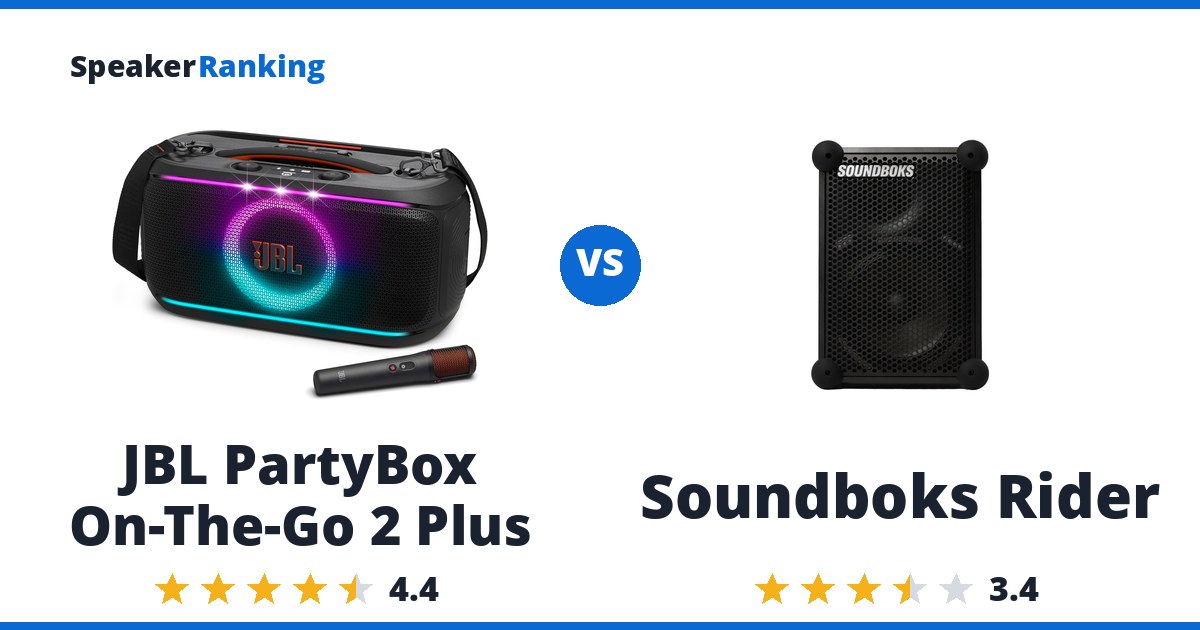
Why pick the JBL PartyBox On-The-Go 2 Plus: Well balanced with strong vocals, and its front-firing bass ports give it cleaner, smoother bass than other PartyBoxes, so even the Punchy bass boost setting never overpowers the vocals. The catch: The bass has less kick and physical impact than the Encore 2 or PartyBox Club 120, and the Club 120 gets noticeably louder.
Why pick the Soundboks Rider: At 6.5 kg it is the lightest Soundboks yet, with a carry handle, IP66 dust and water protection, and the same swappable 100Wh battery as the Mix and Soundboks 4, rated for 35 hours at mid volume and 8 hours at maximum. The catch: Its sealed 8in woofer runs out of real bass at high volume: Xander measured the -6 dB point rising to roughly 75 to 85 Hz at maximum, with 40 Hz some 20 dB down, and M1M heard the bass pulled back toward the upper bass above mid volume.
Buy the JBL PartyBox On-The-Go 2 Plus ($419.95) for a boombox speaker; the Soundboks Rider ($599) suits a party speaker instead.
If battery life is a priority, the Soundboks Rider is rated for 35 hours versus 15 hours for the JBL PartyBox On-The-Go 2 Plus.
Want more options? Browse the full Portable Bluetooth rankings.
Specifications Side By Side
| JBL PartyBox On-The-Go 2 Plus | Soundboks Rider | |
|---|---|---|
| Price | $419.95 | $599.00 |
| Ranked | #5 of 85 in Boombox Size Portable Bluetooth Speakers | #26 of 43 in Party Size Portable Bluetooth Speakers |
| App | Yes (JBL One app) | Yes (Soundboks) |
| Aux Input | Yes | Yes |
| Battery Life | 15 hours (Manufacturer specified) | 35 hours (Manufacturer specified) |
| Built-in Microphone | No | - |
| EQ | Yes (app EQ, Deep and Punchy bass boost) | Yes (6-band EQ + Bass+, Indoor and Outdoor profiles) |
| IP Rating | IPX4 | IP66 |
| Party Mode | Yes (Auracast) | No (no TeamUp) |
| Power Bank | Yes (USB-C, 11V/2A) | - |
| Power Input | AC Power cord | USB-C (65W fast charging) |
| Removable Battery | Yes | Yes |
| Stereo | Partially | No |
| Omnidirectional | No | No |
| TWS | Yes | No |
| USB Playback | Yes | - |
| Weight | 14.2 lbs (6.45 kg) | 14.3 lbs (6.5 kg) |
| Wireless Microphones | Yes 1 Included | - |
| Microphone Input | No (wireless only) | - |
| Guitar Input | No | - |
| Bluetooth Codecs | SBC, LC3 | - |
| Bluetooth Version | 5.4 | - |
| Amplifier Power | 100W RMS | 92W RMS (72W woofer + 20W tweeter) |
| Dimensions | 19.7” x 10.2” x 8.7” (501 x 258 x 221 mm) | - |
| Drivers | 1x 135mm (5.25”) woofer + 2x 20mm (0.75”) dome tweeters | 8” woofer (sealed), 1.2” dome tweeter in horn |
| Frequency Response | 40Hz - 20kHz (-6dB, Manufacturer specified) | 40Hz - 20kHz (Manufacturer specified) |
| Digital Aux Input | Yes (USB-C) | No |
| Lights | Yes | - |
| Strap | Yes (detachable shoulder strap) | No |
| Maximum SPL | - | 113.2dB(C) (measured by M1M Tech Channel) |
Related Speaker Comparisons
More top alternatives to JBL PartyBox On-The-Go 2 Plus:
- JBL Partybox Encore 2 vs JBL PartyBox On-The-Go 2 Plus
- JBL PartyBox On-The-Go 2 Plus vs JBL Partybox Encore Essential 2
- JBL PartyBox On-The-Go 2 Plus vs JBL Partybox On the Go
- JBL Boombox 4 vs Soundboks Rider
- Soundboks Rider vs Turtlebox Gen 3
Prices on this page were last checked September 26, 2026 at 11:14 PM UTC. Product prices and availability are accurate as of that date/time and are subject to change; the price and availability shown on Amazon at the time of purchase will apply to the purchase of this product.
As an eBay Partner, we may be compensated if you make a purchase.
The Two Speakers In Full
 JBL PartyBox On-The-Go 2 Plus: $419.95 Amazon eBay
Older model: the JBL Partybox On the Go (ranked lower, rated 3/5).
Pros: Well balanced with strong vocals, and its front-firing bass ports give it cleaner, smoother bass than other PartyBoxes, so even the Punchy bass boost setting never overpowers the vocals. It gets a touch louder than the PartyBox Encore 2. EasySing AI vocal removal strips vocals from any song on the speaker itself, with 25%, 50% or 100% removal, and the included rechargeable wireless mic has a tight pickup pattern that rejects handling noise. A removable 34Wh battery shared with the Encore 2 and PartyBox 120, a claimed 15 hours, a padded shoulder strap, USB-C playback and charging, a 3.5mm aux input, Auracast and a light show.
Cons: The bass has less kick and physical impact than the Encore 2 or PartyBox Club 120, and the Club 120 gets noticeably louder. There is no wired microphone or guitar input, so more mics means buying JBL’s EasySing mics separately, and AI vocal removal is disabled while the speaker is linked to other speakers over Auracast. Real world battery life is closer to 7 hours at 80% volume with lights and bass boost on. IPX4 only covers splashes, the grille dents easily, and the battery must be installed for it to run even when plugged in.
Full JBL PartyBox On-The-Go 2 Plus review and specifications →
| Amplifier Power | 100W RMS |
|---|---|
| App | Yes (JBL One app) |
| Aux Input | Yes |
| Battery Life | 15 hours (Manufacturer specified) |
| Bluetooth Codecs | SBC, LC3 |
| Bluetooth Version | 5.4 |
| Built-in Microphone | No |
| Digital Aux Input | Yes (USB-C) |
| Dimensions | 19.7” x 10.2” x 8.7” (501 x 258 x 221 mm) |
| Drivers | 1x 135mm (5.25”) woofer + 2x 20mm (0.75”) dome tweeters |
| EQ | Yes (app EQ, Deep and Punchy bass boost) |
| Frequency Response | 40Hz - 20kHz (-6dB, Manufacturer specified) |
| Guitar Input | No |
| IP Rating | IPX4 |
| Lights | Yes |
| Microphone Input | No (wireless only) |
| Omnidirectional | No |
| Party Mode | Yes (Auracast) |
| Power Bank | Yes (USB-C, 11V/2A) |
| Power Input | AC Power cord |
| Removable Battery | Yes |
| Stereo | Partially |
| Strap | Yes (detachable shoulder strap) |
| TWS | Yes |
| USB Playback | Yes |
| Weight | 14.2 lbs (6.45 kg) |
| Wireless Microphones | Yes 1 Included |
- Links
- Reviews, Comparisons and Sound Samples
- Head-to-Head Comparisons
- JBL PartyBox On-The-Go 2 Plus vs JBL Partybox Encore 2
- JBL PartyBox On-The-Go 2 Plus vs JBL Partybox Encore Essential 2
- JBL PartyBox On-The-Go 2 Plus vs JBL Partybox On the Go
- JBL PartyBox On-The-Go 2 Plus vs JBL Partybox Club 120
- JBL PartyBox On-The-Go 2 Plus vs JBL Partybox 130
- JBL PartyBox On-The-Go 2 Plus vs Soundcore Rave 3S
 Soundboks Rider: $599.00 Amazon eBay
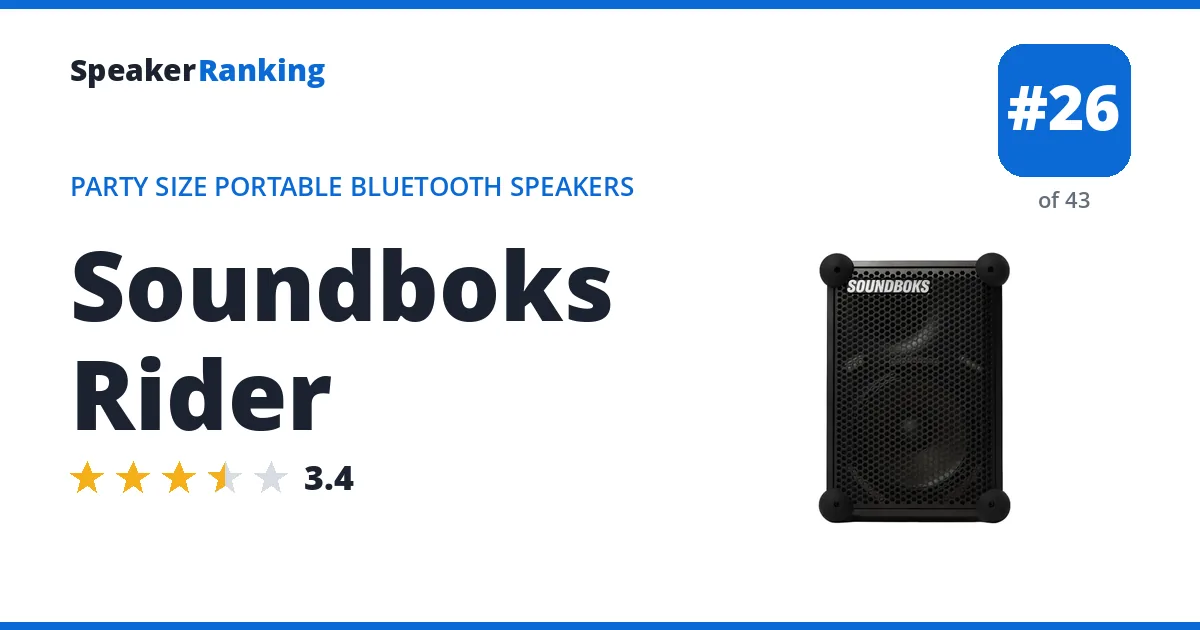
Pros: At 6.5 kg it is the lightest Soundboks yet, with a carry handle, IP66 dust and water protection, and the same swappable 100Wh battery as the Mix and Soundboks 4, rated for 35 hours at mid volume and 8 hours at maximum. Xander’s measurements found its flat profile genuinely flat, with distortion around 0.2 percent at moderate volume and below 2 percent from 500 Hz to 10 kHz even at full output, and the Indoor profile reaching down to 40 Hz at moderate volume. Both Xander and M1M Tech Channel preferred its punchy, controlled kick bass to the larger Soundboks Mix, and the app adds a six-band EQ with saveable presets.
Cons: Its sealed 8in woofer runs out of real bass at high volume: Xander measured the -6 dB point rising to roughly 75 to 85 Hz at maximum, with 40 Hz some 20 dB down, and M1M heard the bass pulled back toward the upper bass above mid volume. It measured 107 dB(C) outdoors for Xander and 113.2 dB(C) for M1M, about 3 dB below the Soundboks Mix and well short of the claimed 118 dB. There is no TeamUp, so it cannot link with other Soundboks speakers, the strap and charger are sold separately, and Xander found the grille causes dispersion artifacts around 5 kHz and judged the price too high for what it delivers.
Full Soundboks Rider review and specifications →
| Amplifier Power | 92W RMS (72W woofer + 20W tweeter) |
|---|---|
| App | Yes (Soundboks) |
| Aux Input | Yes |
| Battery Life | 35 hours (Manufacturer specified) |
| Digital Aux Input | No |
| Drivers | 8” woofer (sealed), 1.2” dome tweeter in horn |
| EQ | Yes (6-band EQ + Bass+, Indoor and Outdoor profiles) |
| Frequency Response | 40Hz - 20kHz (Manufacturer specified) |
| IP Rating | IP66 |
| Maximum SPL | 113.2dB(C) (measured by M1M Tech Channel) |
| Omnidirectional | No |
| Party Mode | No (no TeamUp) |
| Power Input | USB-C (65W fast charging) |
| Removable Battery | Yes |
| Stereo | No |
| Strap | No |
| TWS | No |
| Weight | 14.3 lbs (6.5 kg) |
- Links
- Reviews, Comparisons and Sound Samples
- Head-to-Head Comparisons
- Soundboks Rider vs Ultimate Ears Hyperboom
- Soundboks Rider vs Soundboks Mix
- Soundboks Rider vs Klipsch Gig XXL
- Soundboks Rider vs Soundcore Rave 3S
- Soundboks Rider vs Onn Large Party gen 2
- Soundboks Rider vs Sony SRS-XV500
- Soundboks Rider vs Zealot PT21
- Soundboks Rider vs JBL Partybox 110
- See all 27 comparisons