Short answer: the SHIVAUDYO Point Zero. It ranks #21 of 68 powered bookshelf speakers by sound quality (rated 4.5/5); the JBL M2 Master Reference Monitor ranks #35 (rated 4.3/5).
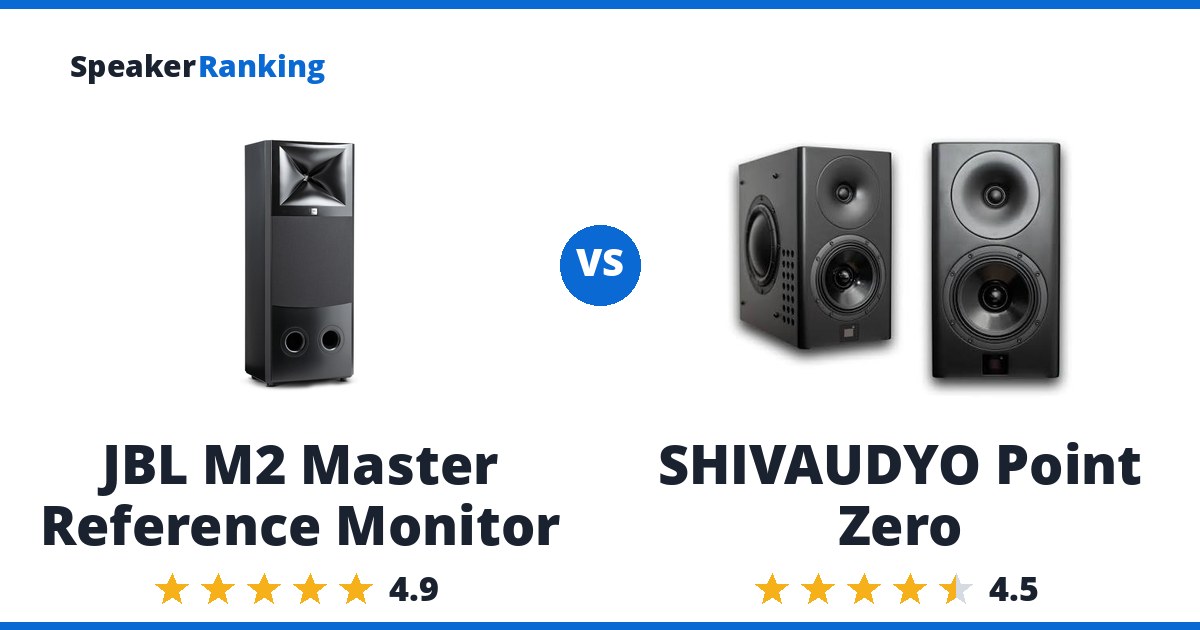
Why pick the JBL M2 Master Reference Monitor: A high-output specialist: Erin’s low-distortion and compression tests support considerable dynamic capability, beyond what a single preference score captures. Watch for: Its 4.1dB response span from 300Hz to 5kHz and 6.58 ideal-subwoofer score do not support a top tonal-accuracy ranking.
What the SHIVAUDYO Point Zero does well: Measured -3dB extension of 31.5Hz and a 7.66 ideal-subwoofer score combine useful bass with broadly balanced sound. The tradeoff: Cardioid control begins around 200Hz rather than extending through all deep bass.
Buy the SHIVAUDYO Point Zero. It is rated higher for sound quality than the JBL M2 Master Reference Monitor.
Looking for alternatives? See the complete Powered Home rankings.
Specifications Side By Side
| JBL M2 Master Reference Monitor | SHIVAUDYO Point Zero | |
|---|---|---|
| Price | $15,000 per pair | €6,500 per pair |
| Ranked | #35 of 68 in Large Size Powered Bookshelf Speakers | #21 of 68 in Large Size Powered Bookshelf Speakers |
| Bass Extension (-3dB) | 34Hz (measured, Erin’s Audio Corner) | 31Hz (measured on-axis, Erin’s Audio Corner) |
| Bass Extension (-10dB) | 21.0Hz (measured, Erin’s Audio Corner) | 22Hz (measured on-axis, Erin’s Audio Corner) |
| Drivers | 15” 2216Nd woofer; D2 compression driver in Image Control Waveguide | 6.5” mid-woofer, 1” waveguide dome tweeter, 2x 8” side-firing subwoofers (opposed, vibration-cancelling) |
| Crossover Frequency | 800Hz active DSP | 120Hz / 1600Hz, 4th-order Linkwitz-Riley |
| Weight | 130.1 lbs (59 kg) each | 36.4 lbs (16.5 kg) each |
| Maximum SPL | 123dB manufacturer specified | 110dB long-term, 116dB short-term, 120dB peak (manufacturer specified) |
| Spinorama Preference Score | 5.74 | 6.59 |
| Spinorama Preference Score with Perfect Sub | 6.58 | 7.66 |
| Amplifier Power | External two-channel amplification and JBL DSP tuning required | 600W total (300W subs + 200W mid-woofer + 100W tweeter, Hypex NCore) |
| Inputs | None (passive cabinet driven by a matched Crown amplifier via speaker-level connection) | XLR, RCA, AES-EBU, S/PDIF, Toslink |
| XLR Input | No | Yes |
| RCA Input | No | Yes |
| TRS Input | No | No |
| Optical Input | No | Yes |
| Coaxial Input | No | Yes |
| USB Input | No | No |
| HDMI Input | No | No |
| AES Input | No | Yes |
| Aux Input | No | No |
| Dimensions | 49.4”H x 20”W x 14”D (1256 x 508 x 355.6 mm) | 15.7”H x 8.7”W x 15.4”D (400 x 220 x 390 mm) |
| Bluetooth | No | No |
| Frequency Response | 20Hz - 40kHz (±3dB) (Manufacturer specified) | 30Hz - 20kHz ±1dB (anechoic, Preset 1) |
| Sensitivity | - | 92.9dB (measured at 0.3V/1m, Erin’s Audio Corner; Erin notes this figure is scaled rather than directly comparable to passive-speaker sensitivity) |
| DSP | - | Yes (Hypex, downloadable software, 3 bass presets) |
| App | - | No |
Related Speaker Comparisons
More top alternatives to SHIVAUDYO Point Zero:
- Kii THREE vs SHIVAUDYO Point Zero
- Genelec 8351B vs SHIVAUDYO Point Zero
- Yamaha HS8 vs SHIVAUDYO Point Zero
- SHIVAUDYO Point Zero vs Kali Audio LP-6 V2
- Devialet Phantom Ultimate 108dB vs SHIVAUDYO Point Zero
Prices on this page were last checked September 29, 2026 at 3:43 PM UTC. Product prices and availability are accurate as of that date/time and are subject to change; the price and availability shown on Amazon at the time of purchase will apply to the purchase of this product.
As an eBay Partner, we may be compensated if you make a purchase.
The Two Speakers In Full
 JBL M2 Master Reference Monitor: $15,000 per pair JBL Professional Dealer Locator eBay
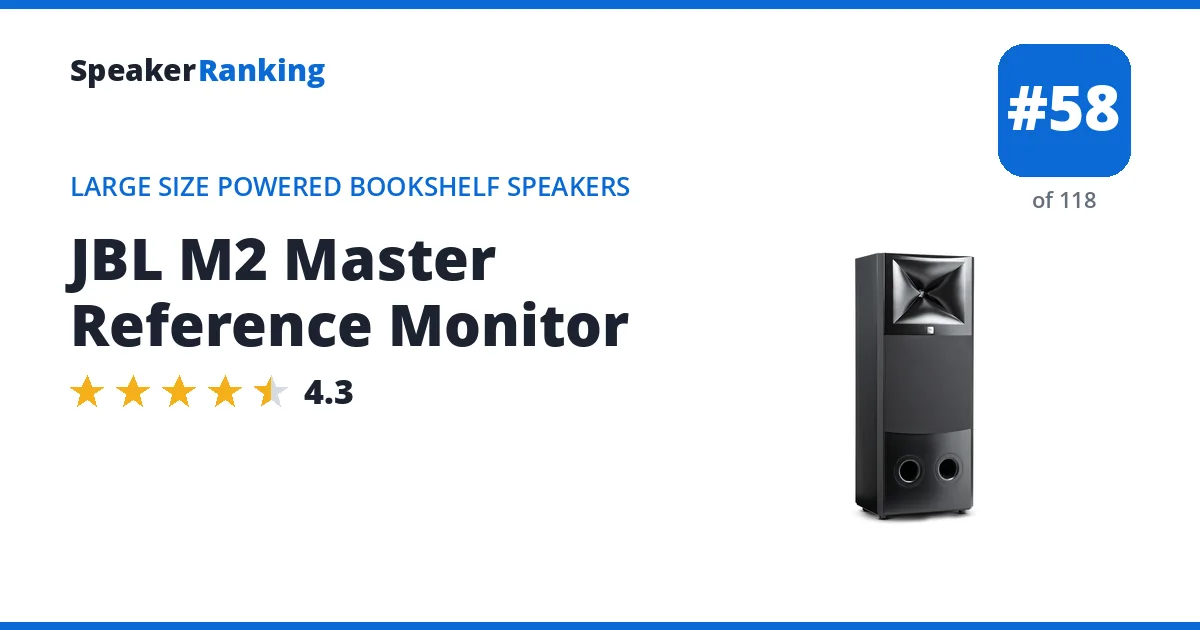
Pros: A high-output specialist: Erin’s low-distortion and compression tests support considerable dynamic capability, beyond what a single preference score captures. Measured -3dB extension is 33.7Hz. The large woofer and waveguide are particularly useful for greater listening distances. Measured bass extension of 34Hz (-3dB).
Cons: Its 4.1dB response span from 300Hz to 5kHz and 6.58 ideal-subwoofer score do not support a top tonal-accuracy ranking. It requires the correct external amplification and DSP rather than a simple built-in amplifier. The very large cabinet, installation cost and possible amplifier fan noise make it impractical for most desks.
Full JBL M2 Master Reference Monitor review and specifications →
| AES Input | No |
|---|---|
| Amplifier Power | External two-channel amplification and JBL DSP tuning required |
| Aux Input | No |
| Bass Extension (-10dB) | 21.0Hz (measured, Erin’s Audio Corner) |
| Bass Extension (-3dB) | 34Hz (measured, Erin’s Audio Corner) |
| Bluetooth | No |
| Coaxial Input | No |
| Crossover Frequency | 800Hz active DSP |
| Dimensions | 49.4”H x 20”W x 14”D (1256 x 508 x 355.6 mm) |
| Drivers | 15” 2216Nd woofer; D2 compression driver in Image Control Waveguide |
| Frequency Response | 20Hz - 40kHz (±3dB) (Manufacturer specified) |
| HDMI Input | No |
| Inputs | None (passive cabinet driven by a matched Crown amplifier via speaker-level connection) |
| Maximum SPL | 123dB manufacturer specified |
| Optical Input | No |
| RCA Input | No |
| Spinorama Preference Score | 5.74 |
| Spinorama Preference Score with Perfect Sub | 6.58 |
| TRS Input | No |
| USB Input | No |
| Weight | 130.1 lbs (59 kg) each |
| XLR Input | No |
- Links
- Reviews, Comparisons and Sound Samples
- Head-to-Head Comparisons
- JBL M2 Master Reference Monitor vs Genelec 8040B
- JBL M2 Master Reference Monitor vs JBL 708P
- JBL M2 Master Reference Monitor vs Klipsch The Nines
- JBL M2 Master Reference Monitor vs JBL 4305P
- JBL M2 Master Reference Monitor vs Genelec 8050B
- JBL M2 Master Reference Monitor vs Kali Audio IN-8 V2
- JBL M2 Master Reference Monitor vs JBL 4329P
- JBL M2 Master Reference Monitor vs Kali Audio LP-6 V2
- See all 23 comparisons
 SHIVAUDYO Point Zero: €6,500 per pair Shivaudyo eBay
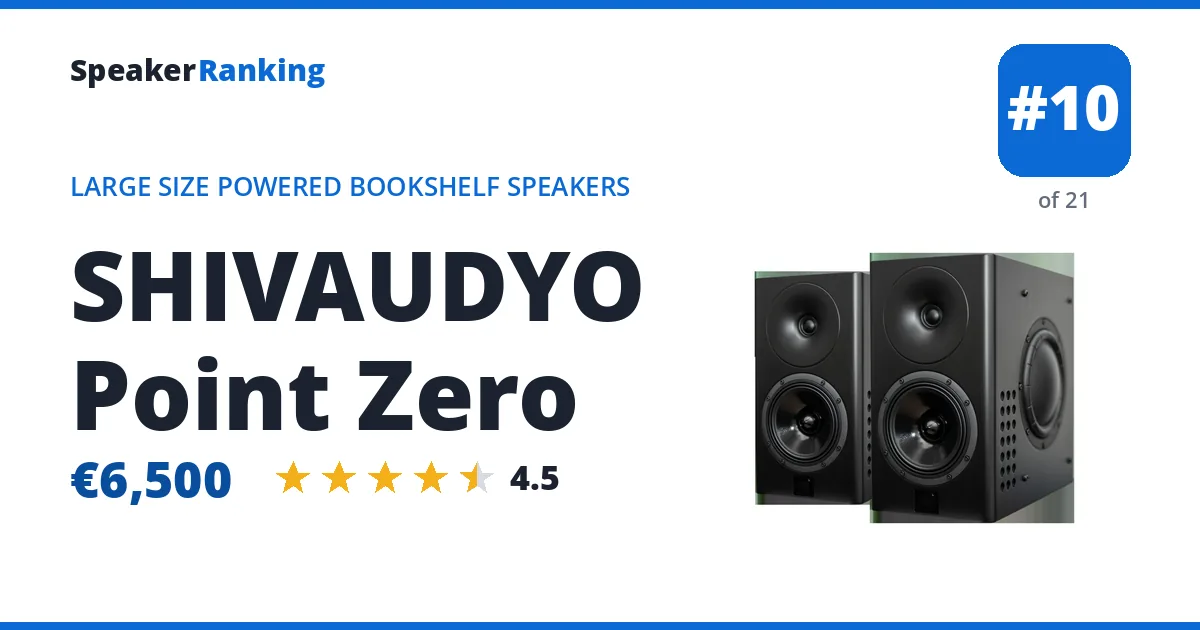
Pros: Measured -3dB extension of 31.5Hz and a 7.66 ideal-subwoofer score combine useful bass with broadly balanced sound. Cardioid control through the low midrange reduces some rearward energy, and selectable bass presets let the listener trade extension for headroom. Measured bass extension of 31Hz (-3dB), with a measured sensitivity of 92.9dB.
Cons: Cardioid control begins around 200Hz rather than extending through all deep bass. Listening height can change vocal weight, and the measured 2.0dB midband span does not capture every directional variation. The deepest bass preset sacrifices output, so its nominal cutoff is not a clean-SPL guarantee.
Full SHIVAUDYO Point Zero review and specifications →
| AES Input | Yes |
|---|---|
| Amplifier Power | 600W total (300W subs + 200W mid-woofer + 100W tweeter, Hypex NCore) |
| App | No |
| Aux Input | No |
| Bass Extension (-10dB) | 22Hz (measured on-axis, Erin’s Audio Corner) |
| Bass Extension (-3dB) | 31Hz (measured on-axis, Erin’s Audio Corner) |
| Bluetooth | No |
| Coaxial Input | Yes |
| Crossover Frequency | 120Hz / 1600Hz, 4th-order Linkwitz-Riley |
| DSP | Yes (Hypex, downloadable software, 3 bass presets) |
| Dimensions | 15.7”H x 8.7”W x 15.4”D (400 x 220 x 390 mm) |
| Drivers | 6.5” mid-woofer, 1” waveguide dome tweeter, 2x 8” side-firing subwoofers (opposed, vibration-cancelling) |
| Frequency Response | 30Hz - 20kHz ±1dB (anechoic, Preset 1) |
| HDMI Input | No |
| Inputs | XLR, RCA, AES-EBU, S/PDIF, Toslink |
| Maximum SPL | 110dB long-term, 116dB short-term, 120dB peak (manufacturer specified) |
| Optical Input | Yes |
| RCA Input | Yes |
| Sensitivity | 92.9dB (measured at 0.3V/1m, Erin’s Audio Corner; Erin notes this figure is scaled rather than directly comparable to passive-speaker sensitivity) |
| Spinorama Preference Score | 6.59 |
| Spinorama Preference Score with Perfect Sub | 7.66 |
| TRS Input | No |
| USB Input | No |
| Weight | 36.4 lbs (16.5 kg) each |
| XLR Input | Yes |
- Links
- Reviews, Comparisons and Sound Samples
- Head-to-Head Comparisons
- SHIVAUDYO Point Zero vs Yamaha HS8
- SHIVAUDYO Point Zero vs Kali Audio LP-6 V2
- SHIVAUDYO Point Zero vs Devialet Phantom Ultimate 108dB
- SHIVAUDYO Point Zero vs Thomann Swissonic A306
- SHIVAUDYO Point Zero vs Genelec 8351B
- SHIVAUDYO Point Zero vs Kii THREE
- SHIVAUDYO Point Zero vs Klipsch The Nines
- SHIVAUDYO Point Zero vs JBL 4329P
- See all 12 comparisons