Short answer: the SHIVAUDYO Point Zero. It ranks #21 of 68 powered bookshelf speakers by sound quality (rated 4.5/5); the Kali Audio LP-6 V2 ranks #25 (rated 4.4/5).
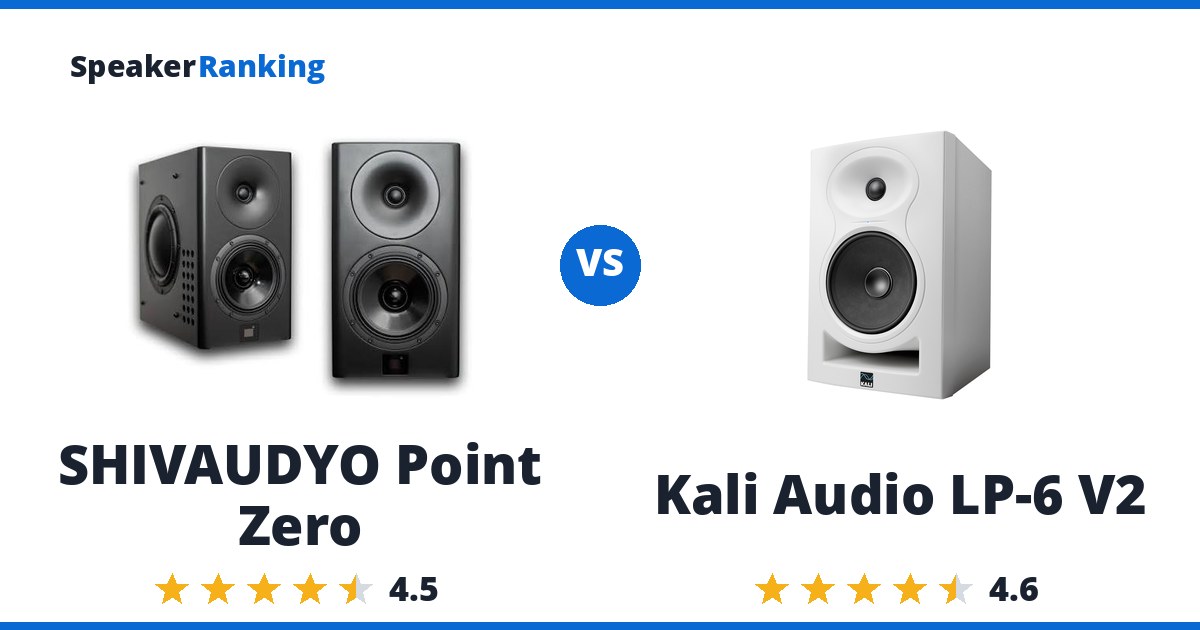
Why pick the SHIVAUDYO Point Zero: Measured -3dB extension of 31.5Hz and a 7.66 ideal-subwoofer score combine useful bass with broadly balanced sound. The catch: Cardioid control begins around 200Hz rather than extending through all deep bass.
Why pick the Kali Audio LP-6 V2: Erin’s measurements give a 7.48 ideal-subwoofer score and 42.5Hz -3dB bass extension, a strong combination for an affordable nearfield monitor. The catch: The 2.5dB response span from 300Hz to 5kHz leaves some tonal unevenness.
Buy the SHIVAUDYO Point Zero. It is rated higher for sound quality than the Kali Audio LP-6 V2.
Still deciding? The full Powered Home rankings cover every ranked option.
Specifications Side By Side
| SHIVAUDYO Point Zero | Kali Audio LP-6 V2 | |
|---|---|---|
| Price | €6,500 per pair | $398 per pair |
| Ranked | #21 of 68 in Large Size Powered Bookshelf Speakers | #25 of 68 in Large Size Powered Bookshelf Speakers |
| Drivers | 6.5” mid-woofer, 1” waveguide dome tweeter, 2x 8” side-firing subwoofers (opposed, vibration-cancelling) | 1” soft-dome tweeter; 6.5” woofer |
| Amplifier Power | 600W total (300W subs + 200W mid-woofer + 100W tweeter, Hypex NCore) | 40W LF + 40W HF per speaker; Bi-amplified Class D |
| Crossover Frequency | 120Hz / 1600Hz, 4th-order Linkwitz-Riley | - |
| Dimensions | 15.7”H x 8.7”W x 15.4”D (400 x 220 x 390 mm) | 14.1”H x 8.8”W x 10.2”D |
| Weight | 36.4 lbs (16.5 kg) each | 15.5 lbs (7.05 kg) each |
| Frequency Response | 30Hz - 20kHz ±1dB (anechoic, Preset 1) | 47Hz - 21kHz (±3dB) (Manufacturer specified) |
| Bass Extension (-3dB) | 31Hz (measured on-axis, Erin’s Audio Corner) | 42Hz (measured, Erin’s Audio Corner) |
| Bass Extension (-10dB) | 22Hz (measured on-axis, Erin’s Audio Corner) | 39.1Hz (measured, Erin’s Audio Corner) |
| Sensitivity | 92.9dB (measured at 0.3V/1m, Erin’s Audio Corner; Erin notes this figure is scaled rather than directly comparable to passive-speaker sensitivity) | - |
| Inputs | XLR, RCA, AES-EBU, S/PDIF, Toslink | XLR, balanced TRS and RCA |
| DSP | Yes (Hypex, downloadable software, 3 bass presets) | Yes; boundary presets and LF/HF trims |
| App | No | - |
| Maximum SPL | 110dB long-term, 116dB short-term, 120dB peak (manufacturer specified) | Approximately 102dB per pair with good measured linearity (Erin’s Audio Corner) (manufacturer specified) |
| Spinorama Preference Score | 6.59 | 5.53 |
| Spinorama Preference Score with Perfect Sub | 7.66 | 7.48 |
| XLR Input | Yes | Yes |
| RCA Input | Yes | Yes |
| TRS Input | No | Yes |
| Optical Input | Yes | No |
| Coaxial Input | Yes | No |
| USB Input | No | No |
| HDMI Input | No | No |
| AES Input | Yes | No |
| Aux Input | No | No |
| Bluetooth | No | No |
Related Speaker Comparisons
How SHIVAUDYO Point Zero compares with other leading options:
- Kii THREE vs SHIVAUDYO Point Zero
- Genelec 8351B vs SHIVAUDYO Point Zero
- Yamaha HS8 vs SHIVAUDYO Point Zero
- Devialet Phantom Ultimate 108dB vs SHIVAUDYO Point Zero
- SHIVAUDYO Point Zero vs Thomann Swissonic A306
Prices on this page were last checked September 29, 2026 at 3:43 PM UTC. Product prices and availability are accurate as of that date/time and are subject to change; the price and availability shown on Amazon at the time of purchase will apply to the purchase of this product.
As an eBay Partner, we may be compensated if you make a purchase.
The Two Speakers In Full
 SHIVAUDYO Point Zero: €6,500 per pair Shivaudyo eBay
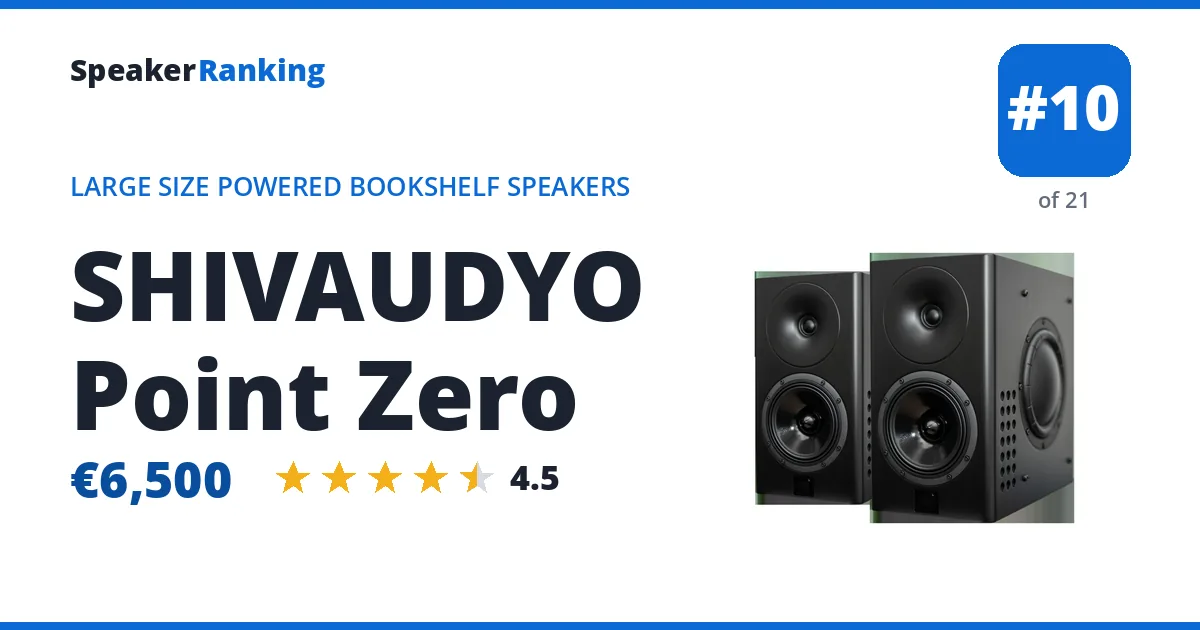
Pros: Measured -3dB extension of 31.5Hz and a 7.66 ideal-subwoofer score combine useful bass with broadly balanced sound. Cardioid control through the low midrange reduces some rearward energy, and selectable bass presets let the listener trade extension for headroom. Measured bass extension of 31Hz (-3dB), with a measured sensitivity of 92.9dB.
Cons: Cardioid control begins around 200Hz rather than extending through all deep bass. Listening height can change vocal weight, and the measured 2.0dB midband span does not capture every directional variation. The deepest bass preset sacrifices output, so its nominal cutoff is not a clean-SPL guarantee.
Full SHIVAUDYO Point Zero review and specifications →
| AES Input | Yes |
|---|---|
| Amplifier Power | 600W total (300W subs + 200W mid-woofer + 100W tweeter, Hypex NCore) |
| App | No |
| Aux Input | No |
| Bass Extension (-10dB) | 22Hz (measured on-axis, Erin’s Audio Corner) |
| Bass Extension (-3dB) | 31Hz (measured on-axis, Erin’s Audio Corner) |
| Bluetooth | No |
| Coaxial Input | Yes |
| Crossover Frequency | 120Hz / 1600Hz, 4th-order Linkwitz-Riley |
| DSP | Yes (Hypex, downloadable software, 3 bass presets) |
| Dimensions | 15.7”H x 8.7”W x 15.4”D (400 x 220 x 390 mm) |
| Drivers | 6.5” mid-woofer, 1” waveguide dome tweeter, 2x 8” side-firing subwoofers (opposed, vibration-cancelling) |
| Frequency Response | 30Hz - 20kHz ±1dB (anechoic, Preset 1) |
| HDMI Input | No |
| Inputs | XLR, RCA, AES-EBU, S/PDIF, Toslink |
| Maximum SPL | 110dB long-term, 116dB short-term, 120dB peak (manufacturer specified) |
| Optical Input | Yes |
| RCA Input | Yes |
| Sensitivity | 92.9dB (measured at 0.3V/1m, Erin’s Audio Corner; Erin notes this figure is scaled rather than directly comparable to passive-speaker sensitivity) |
| Spinorama Preference Score | 6.59 |
| Spinorama Preference Score with Perfect Sub | 7.66 |
| TRS Input | No |
| USB Input | No |
| Weight | 36.4 lbs (16.5 kg) each |
| XLR Input | Yes |
- Links
- Reviews, Comparisons and Sound Samples
- Head-to-Head Comparisons
- SHIVAUDYO Point Zero vs Yamaha HS8
- SHIVAUDYO Point Zero vs Devialet Phantom Ultimate 108dB
- SHIVAUDYO Point Zero vs Thomann Swissonic A306
- SHIVAUDYO Point Zero vs JBL M2 Master Reference Monitor
- SHIVAUDYO Point Zero vs Genelec 8351B
- SHIVAUDYO Point Zero vs Kii THREE
- SHIVAUDYO Point Zero vs Klipsch The Nines
- SHIVAUDYO Point Zero vs JBL 4329P
- See all 12 comparisons
 Kali Audio LP-6 V2: $398 per pair Amazon B&H Photo Video eBay
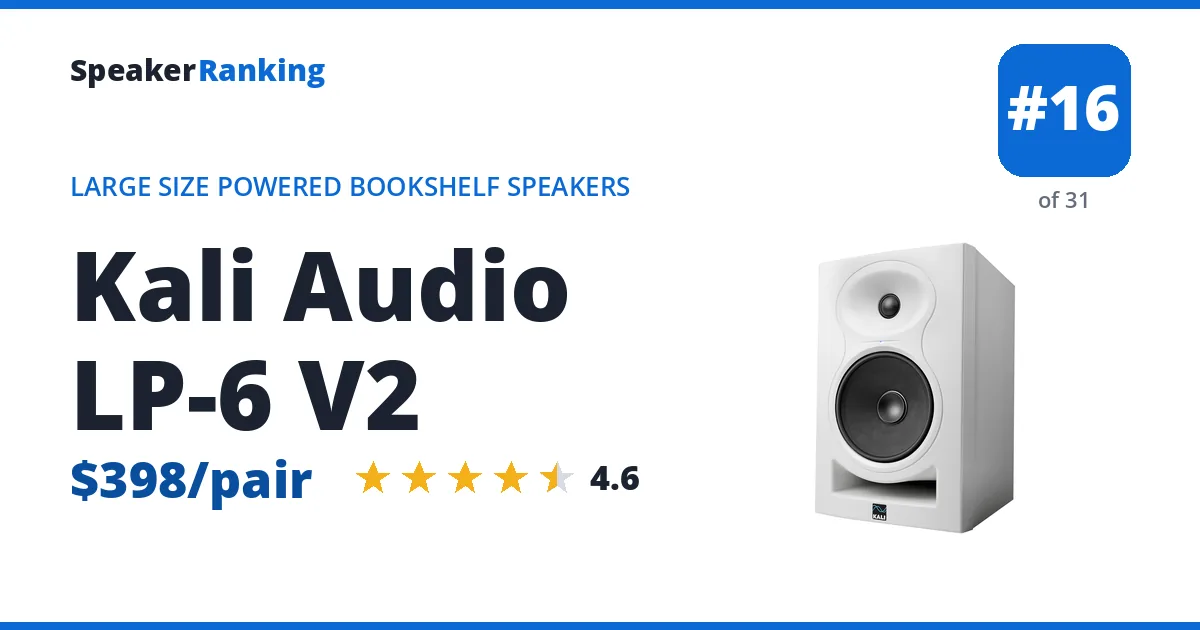
Older model: the Kali Audio LP-6 (ranked lower, rated 4.3/5).
Pros: Erin’s measurements give a 7.48 ideal-subwoofer score and 42.5Hz -3dB bass extension, a strong combination for an affordable nearfield monitor. The waveguide and placement switches help with practical setup, and the second generation improves close-range noise behavior. Measured bass extension of 42Hz (-3dB).
Cons: The 2.5dB response span from 300Hz to 5kHz leaves some tonal unevenness. Vertical crossover behavior makes ear-height placement important, and compression limits loud bass playback. Its good tonal score is not evidence of the output capability of a much larger monitor.
Full Kali Audio LP-6 V2 review and specifications →
| AES Input | No |
|---|---|
| Amplifier Power | 40W LF + 40W HF per speaker; Bi-amplified Class D |
| Aux Input | No |
| Bass Extension (-10dB) | 39.1Hz (measured, Erin’s Audio Corner) |
| Bass Extension (-3dB) | 42Hz (measured, Erin’s Audio Corner) |
| Bluetooth | No |
| Coaxial Input | No |
| DSP | Yes; boundary presets and LF/HF trims |
| Dimensions | 14.1”H x 8.8”W x 10.2”D |
| Drivers | 1” soft-dome tweeter; 6.5” woofer |
| Frequency Response | 47Hz - 21kHz (±3dB) (Manufacturer specified) |
| HDMI Input | No |
| Inputs | XLR, balanced TRS and RCA |
| Maximum SPL | Approximately 102dB per pair with good measured linearity (Erin’s Audio Corner) (manufacturer specified) |
| Optical Input | No |
| RCA Input | Yes |
| Spinorama Preference Score | 5.53 |
| Spinorama Preference Score with Perfect Sub | 7.48 |
| TRS Input | Yes |
| USB Input | No |
| Weight | 15.5 lbs (7.05 kg) each |
| XLR Input | Yes |
- Links
- Reviews, Comparisons and Sound Samples
- Head-to-Head Comparisons
- Kali Audio LP-6 V2 vs Kali Audio IN-8 V2
- Kali Audio LP-6 V2 vs Yamaha HS8
- Kali Audio LP-6 V2 vs Genelec 8050B
- Kali Audio LP-6 V2 vs JBL 4305P
- Kali Audio LP-6 V2 vs JBL 308P MKII
- Kali Audio LP-6 V2 vs Focal Solo6 ST6
- Kali Audio LP-6 V2 vs Genelec S360
- Kali Audio LP-6 V2 vs Thomann Swissonic A306
- See all 45 comparisons