Short answer: the Polk Audio XT15. It ranks #52 of 160 bookshelf speakers by sound quality, rated 3.7/5, at $149; the JBL L52 Classic ranks #119, rated 2.6/5, and costs $999, so there is little reason to consider the other one.
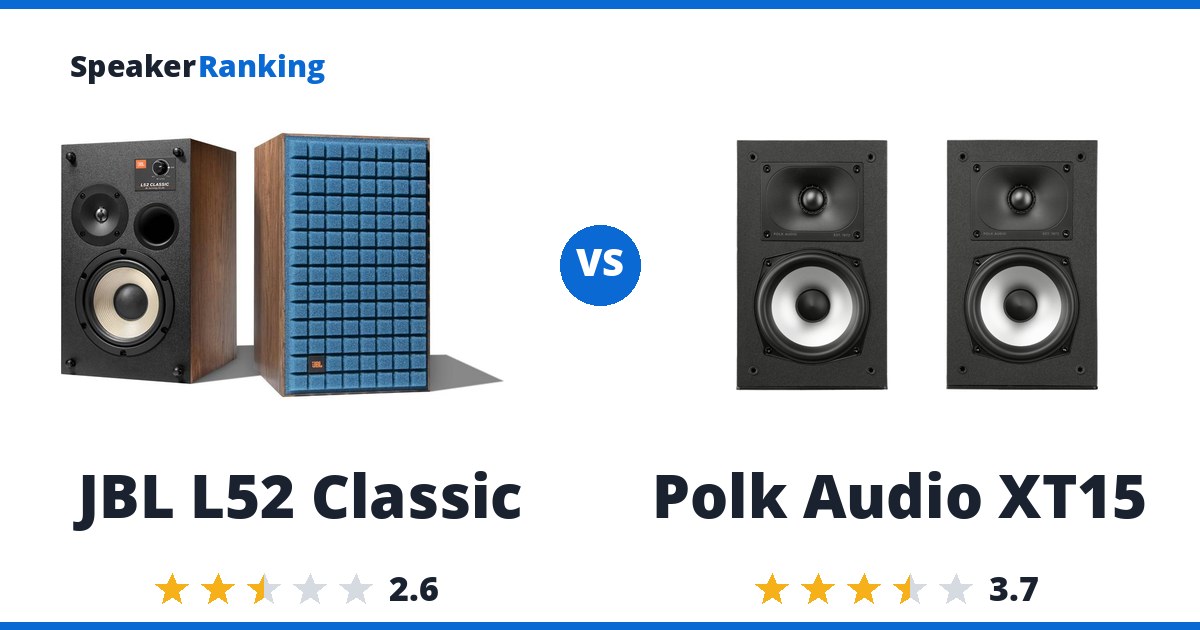
The JBL L52 Classic is the deeper-bass option. Genuine walnut wood veneer cabinet with a retro Quadrex foam grille (black, orange, or dark blue) reviving JBL’s classic L-series look. Its bass reaches about 62Hz before falling 3dB, against 77.6Hz for the Polk Audio XT15. The catch: Measured compression and distortion behavior from about 1-5 kHz was inconsistent (“wonky”) across output levels, and didn’t clean up even at lower volume; adding a subwoofer high-pass didn’t fix the high-frequency distortion either.
The Polk Audio XT15 is the better-sounding choice. Very low $149/pair entry price for a Hi-Res Audio Certified 2-way design that’s Dolby Atmos and DTS:X compatible, and works with either 4- or 8-ohm amplifier outputs so it drops into almost any AVR without matching concerns. The catch: Bass rolls off early, at 77.6Hz (-3dB) and 54.2Hz (-10dB).
Buy the Polk Audio XT15. It is rated higher for sound quality than the JBL L52 Classic and costs less, which makes it the one to get unless you need something the other one does better.
Want more options? Browse the full Passive Home rankings.
Specifications Side By Side
| JBL L52 Classic | Polk Audio XT15 | |
|---|---|---|
| Price | $999.00 per pair | $149.00 per pair |
| Ranked | #119 of 160 in Medium Size Bookshelf Speakers | #52 of 160 in Medium Size Bookshelf Speakers |
| Drivers | 5.25” pure pulp cone woofer, 0.75” titanium dome tweeter with waveguide | 1” Terylene dome tweeter, 5.25” bi-laminate paper woofer |
| Dimensions | 13-1/16”H x 7-13/16”W x 8-11/16”D | 16.51 x 18.24cm (6.5 x 7.18 in), 4.08kg (9 lb) each |
| Weight | 11 lbs (5 kg) each | 9 lbs (4.08 kg) each |
| Impedance | 4 ohms nominal, 3.7 ohms minimum (measured, Erin’s Audio Corner) | 4/8-ohm compatible |
| Sensitivity | 85dB (measured average, Erin’s Audio Corner) | 86dB (1W/1m) |
| Frequency Response | 47Hz - 24kHz (-6dB, manufacturer specified) | - |
| Power Handling | 10-75W RMS | - |
| Bass Extension (-3dB) | 62Hz (measured average, Erin’s Audio Corner) | 77.6Hz (measured, spinorama.org) |
| Bass Extension (-10dB) | 45Hz (measured average, Erin’s Audio Corner) | 54.2Hz (measured, spinorama.org) |
| Crossover Frequency | 2.8kHz | - |
| Spinorama Preference Score | 4.54 | 4.56 |
| Spinorama Preference Score with Perfect Sub | 6.96 | 7.31 |
| DIY Kit | No | No |
| Woofer Cabinet | - | Ported |
Related Speaker Comparisons
More worthwhile head-to-heads for Polk Audio XT15:
- Polk Audio XT15 vs Audio First Fidelia
- Polk Audio XT15 vs Philharmonic Ceramic Mini
- Ascend Sierra 1 v2 vs Polk Audio XT15
- KEF LS50 Meta vs Polk Audio XT15
- Polk Audio XT15 vs XMechanik Mechano23 DIY
Prices on this page were last checked October 9, 2026 at 8:01 AM UTC. Product prices and availability are accurate as of that date/time and are subject to change; the price and availability shown on Amazon at the time of purchase will apply to the purchase of this product.
As an eBay Partner, we may be compensated if you make a purchase.
The Two Speakers In Full
 JBL L52 Classic: $999.00 per pair Amazon eBay
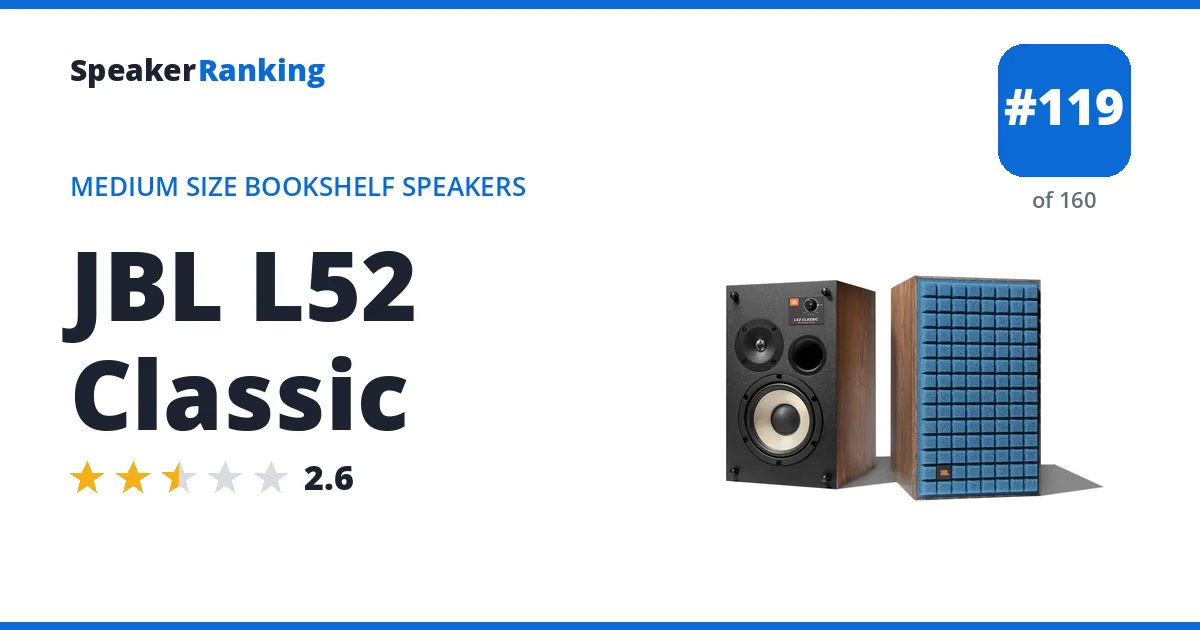
Same family: the JBL L82 Classic (larger bookshelf, rated 3.9/5) and the JBL L100 Classic (larger bookshelf, estimated 3.7/5).
Pros: Genuine walnut wood veneer cabinet with a retro Quadrex foam grille (black, orange, or dark blue) reviving JBL’s classic L-series look. 5.25” pure pulp cone woofer and 0.75” titanium dome tweeter on a waveguide, front-firing bass reflex port, in a compact stand-mount cabinet. A pronounced upper-bass bump around 100 Hz gives kick drums a punchy, textured character. Measured bass extension of 62Hz (-3dB), with a measured sensitivity of 85dB.
Cons: Measured compression and distortion behavior from about 1-5 kHz was inconsistent (“wonky”) across output levels, and didn’t clean up even at lower volume; adding a subwoofer high-pass didn’t fix the high-frequency distortion either. Response rolls off quickly above the upper-bass bump, so there’s punch and impact but not real low-end rumble or fundamental weight below about 60 Hz without a subwoofer. Soundstage width was inconsistent track to track, with imaging not staying locked to where instruments should be. Vocals could sound hot and slightly grainy in the 2.5-5 kHz region; pointing the speakers off-axis reduced that sharpness but also killed high-frequency air.
Full JBL L52 Classic review and specifications →
| Bass Extension (-10dB) | 45Hz (measured average, Erin’s Audio Corner) |
|---|---|
| Bass Extension (-3dB) | 62Hz (measured average, Erin’s Audio Corner) |
| Crossover Frequency | 2.8kHz |
| DIY Kit | No |
| Dimensions | 13-1/16”H x 7-13/16”W x 8-11/16”D |
| Drivers | 5.25” pure pulp cone woofer, 0.75” titanium dome tweeter with waveguide |
| Frequency Response | 47Hz - 24kHz (-6dB, manufacturer specified) |
| Impedance | 4 ohms nominal, 3.7 ohms minimum (measured, Erin’s Audio Corner) |
| Power Handling | 10-75W RMS |
| Sensitivity | 85dB (measured average, Erin’s Audio Corner) |
| Spinorama Preference Score | 4.54 |
| Spinorama Preference Score with Perfect Sub | 6.96 |
| Weight | 11 lbs (5 kg) each |
- Links
- Reviews, Comparisons and Sound Samples
- Head-to-Head Comparisons
- JBL L52 Classic vs Pioneer SP-BS22-LR (Philharmonic AAM Mod)
- JBL L52 Classic vs Dynaudio X14
- JBL L52 Classic vs JBL Stage A120
- JBL L52 Classic vs ELAC BS U5
- JBL L52 Classic vs ELAC Uni-Fi 2.0 UB52
- JBL L52 Classic vs KEF Q100
- JBL L52 Classic vs Q Acoustics 3020i
- JBL L52 Classic vs Dynaudio Emit M10
- See all 34 comparisons
 Polk Audio XT15: $149.00 per pair Amazon B&H Photo Video Crutchfield eBay
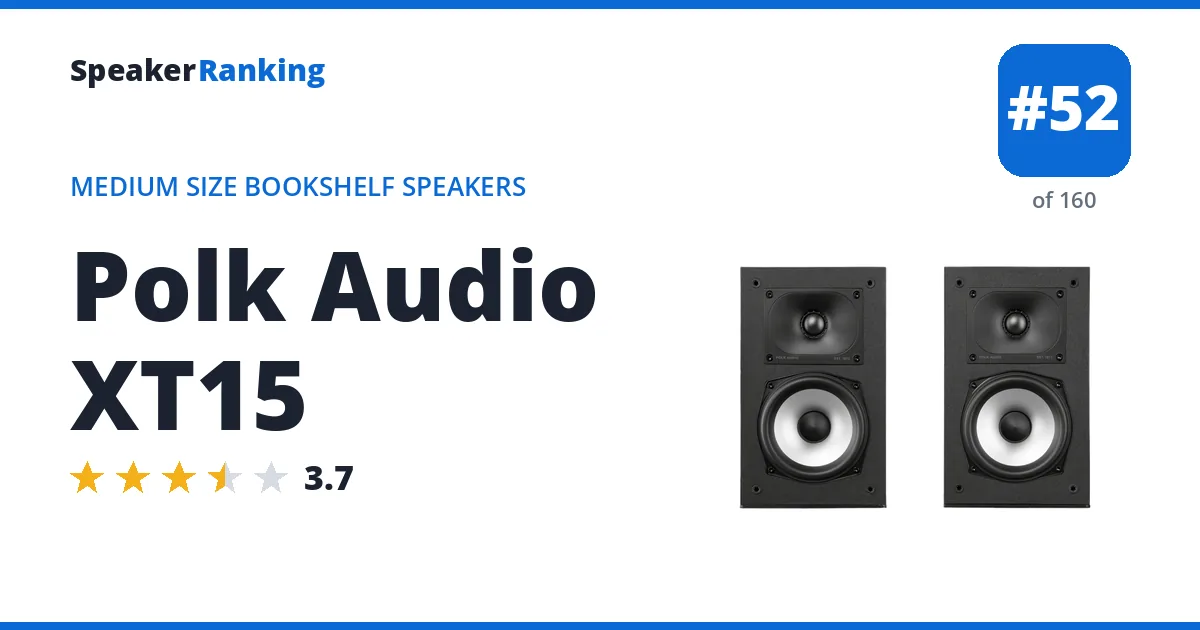
Same family: the Polk Monitor XT20 (larger bookshelf, rated 3.4/5), the Polk Audio XT60 (smaller floorstanding, rated 3.5/5), the Polk Audio XT70 (larger floorstanding, rated 3.6/5), the Polk Audio XT30 (smaller center, rated 3.6/5), the Polk Audio XT35 (larger center, rated 4.1/5), the Polk Audio Monitor XT10 (smaller subwoofer, estimated 3.1/5) and the Polk Audio Monitor XT12 (larger subwoofer, estimated 3.3/5).
Pros: Very low $149/pair entry price for a Hi-Res Audio Certified 2-way design that’s Dolby Atmos and DTS:X compatible, and works with either 4- or 8-ohm amplifier outputs so it drops into almost any AVR without matching concerns. Off axis sound tracks the on axis response reasonably consistently for the price. Measured bass extension of 77.6Hz (-3dB).
Cons: Bass rolls off early, at 77.6Hz (-3dB) and 54.2Hz (-10dB). On-axis response is relatively uneven, with an average deviation of about 0.45dB, and its listening window is less smooth than pricier speakers. Modest 86dB sensitivity wants a reasonably powered amp channel. The 5.25” bi-laminate paper woofer is Polk’s entry-tier driver, not the polypropylene/Turbine cones used in its pricier Signature Elite/Reserve lines.
Full Polk Audio XT15 review and specifications →
| Bass Extension (-10dB) | 54.2Hz (measured, spinorama.org) |
|---|---|
| Bass Extension (-3dB) | 77.6Hz (measured, spinorama.org) |
| DIY Kit | No |
| Dimensions | 16.51 x 18.24cm (6.5 x 7.18 in), 4.08kg (9 lb) each |
| Drivers | 1” Terylene dome tweeter, 5.25” bi-laminate paper woofer |
| Impedance | 4/8-ohm compatible |
| Sensitivity | 86dB (1W/1m) |
| Spinorama Preference Score | 4.56 |
| Spinorama Preference Score with Perfect Sub | 7.31 |
| Weight | 9 lbs (4.08 kg) each |
| Woofer Cabinet | Ported |
- Links
- Reviews, Comparisons and Sound Samples
- Head-to-Head Comparisons
- Polk Audio XT15 vs Wharfedale Diamond 220
- Polk Audio XT15 vs KEF Q150
- Polk Audio XT15 vs Neumi Silk 4
- Polk Audio XT15 vs Boston Acoustics A25
- Polk Audio XT15 vs Radiant Acoustics Clarity 4.2
- Polk Audio XT15 vs Neumi BS5
- Polk Audio XT15 vs ELAC BS41
- Polk Audio XT15 vs Wharfedale Diamond 12.1
- See all 42 comparisons