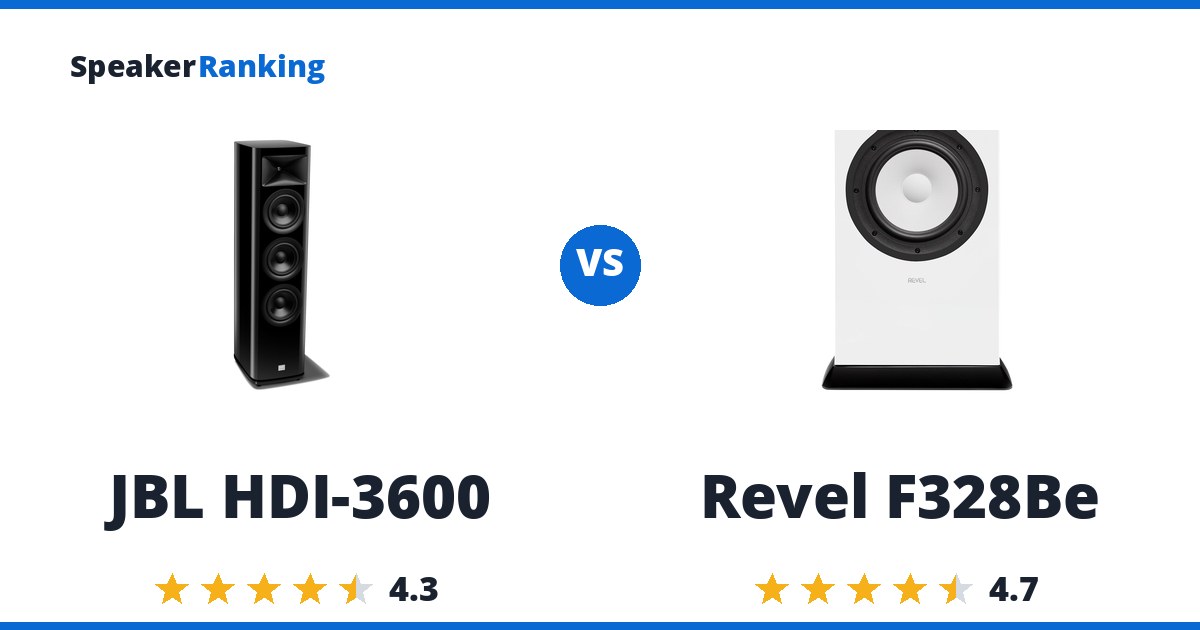
Short answer: the Revel F328Be if sound quality matters most, the JBL HDI-3600 if price matters most. The Revel F328Be ranks #9 of 188 floorstanding speakers, rated 4.7/5, at $19,359.90. The JBL HDI-3600 ranks #58, rated 4.3/5, at $3,800, $15,559.90 cheaper.
What the JBL HDI-3600 does well: CEA2034 spinorama shows a fairly even on-axis response and flat overall frequency response, with high 90dB sensitivity and very low distortion through the midrange. The tradeoff: A wide shelving-down above 2kHz affects the in-room response, and vertical dispersion is a bigger issue than horizontal: the reviewer noted the dip is wider here than on the smaller HDI-1600, making it more audible.
The Revel F328Be is the more accurate option. CEA2034 spinorama shows a quite flat on-axis response with superb directivity and efficiency above 90dB. Its measured preference score, a predictor of how neutral it sounds, is 6.40 against 4.64 for the JBL HDI-3600. Watch for: Vertical directivity is asymmetric: the reviewer recommends staying between -20 and +40 degrees relative to the tweeter axis, reflecting the driver layout of this three-way tower.
Buy the JBL HDI-3600 if the price matters more than sound quality. Buy the Revel F328Be if sound quality matters more than the price.
Want more options? Browse the full Passive Home rankings.
Specifications Side By Side
| JBL HDI-3600 | Revel F328Be | |
|---|---|---|
| Price | $3800 per pair | $19,359.90 per pair |
| Ranked | #58 of 188 in Large Size Floorstanding Speakers | #9 of 188 in Large Size Floorstanding Speakers |
| Bass Extension (-3dB) | 78Hz - the on-axis curve also shows an unusual step/dip around 40-55Hz that may be a near-field-scan artifact for this tower (measured, Audio Science Review) | 74Hz (measured, Audio Science Review) |
| Bass Extension (-10dB) | 62Hz - the on-axis curve also shows an unusual step/dip around 40-55Hz that may be a near-field-scan artifact for this tower (measured, Audio Science Review) | 39Hz (measured, Audio Science Review) |
| Sensitivity | 89.5dB (2.83V/1m, measured, Audio Science Review) | 91dB (measured, Audio Science Review) |
| Impedance | 4 ohms nominal | 8 ohms nominal (3 ohms minimum, measured by Audio Science Review) |
| Frequency Response | 38Hz - 30kHz (+/-3dB) (Manufacturer specified) | - |
| Drivers | 2410H-2 1” compression driver, 3x 6.5” Advanced Aluminum Matrix woofers | Three 8” (200mm) Deep Ceramic Composite aluminum cones, with cast frames woofer, 5-1/4” (130mm) Deep Ceramic Composite aluminum cone, with cast frame midrange, 1” (25mm) Beryllium dome, with acoustic lens waveguide tweeter |
| Weight | 61.7 lbs (28 kg) each | 112.4 lbs (51 kg) each |
| Dimensions | 40.5”H x 10.2”W x 13.5”D (1029 x 260 x 343 mm) | 50.9”H x 13.5”W x 17.6”D (1292.9 x 342.9 x 447 mm) |
| Woofer Cabinet | ported, dual rear-firing | ported, rear |
| Spinorama Preference Score | 4.64 (spinorama.org) | 6.40 |
| Spinorama Preference Score with Perfect Sub | 6.95 (spinorama.org) | 7.81 |
| DIY Kit | No | No |
Related Speaker Comparisons
How Revel F328Be compares with other leading options:
- GR-Research NX-Treme vs Revel F328Be
- KEF Blade Two Meta vs Revel F328Be
- MoFi SourcePoint V10 Master Edition vs Revel F328Be
- MoFi SourcePoint 888 vs Revel F328Be
- Radiant Acoustics Clarity 66 vs Revel F328Be
Prices on this page were last checked October 7, 2026 at 9:25 PM UTC. Product prices and availability are accurate as of that date/time and are subject to change; the price and availability shown on Amazon at the time of purchase will apply to the purchase of this product.
As an eBay Partner, we may be compensated if you make a purchase.
The Two Speakers In Full
 JBL HDI-3600: $3800 per pair Audio Advice eBay
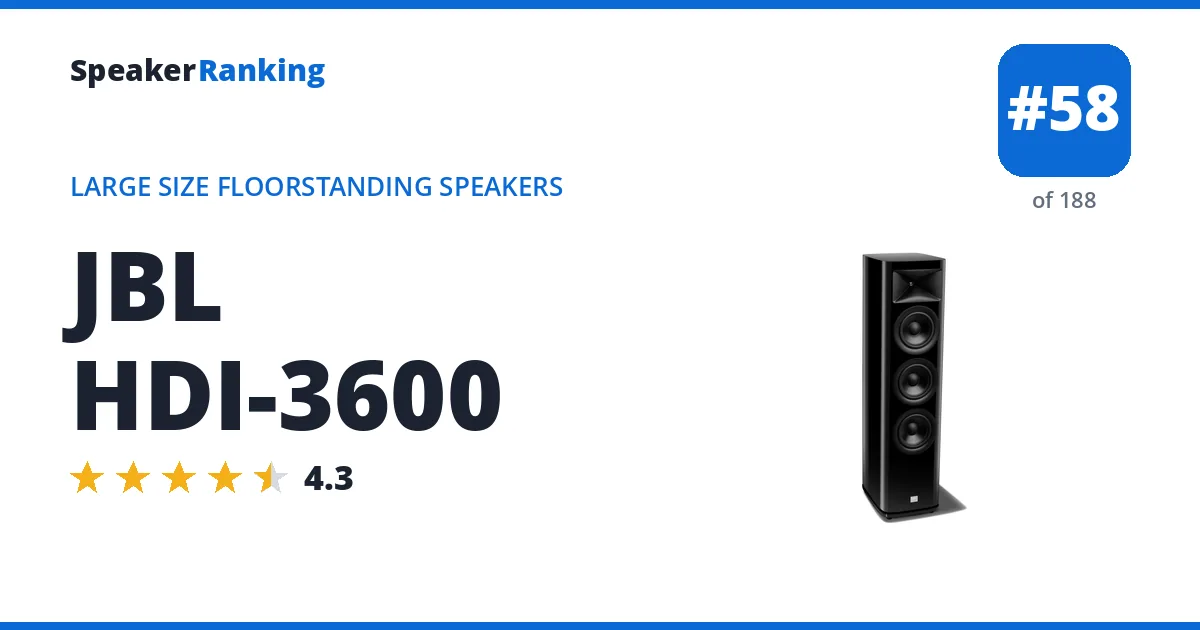
Same family: the JBL HDI-1600 (bookshelf, rated 4.2/5), the JBL HDI-3800 (larger floorstanding, ranked higher, rated 4.5/5) and the JBL HDI-4500 (center, rated 3.7/5).
Pros: CEA2034 spinorama shows a fairly even on-axis response and flat overall frequency response, with high 90dB sensitivity and very low distortion through the midrange. Triple 6.5” Advanced Aluminum Matrix woofers and a 1” compression driver in JBL’s HDI waveguide. Measured bass extension of 78Hz (-3dB), with a measured sensitivity of 89.5dB.
Cons: A wide shelving-down above 2kHz affects the in-room response, and vertical dispersion is a bigger issue than horizontal: the reviewer noted the dip is wider here than on the smaller HDI-1600, making it more audible. Narrow vertical sweet spot means careful listener-height positioning matters more than usual.
Full JBL HDI-3600 review and specifications →
| Bass Extension (-10dB) | 62Hz - the on-axis curve also shows an unusual step/dip around 40-55Hz that may be a near-field-scan artifact for this tower (measured, Audio Science Review) |
|---|---|
| Bass Extension (-3dB) | 78Hz - the on-axis curve also shows an unusual step/dip around 40-55Hz that may be a near-field-scan artifact for this tower (measured, Audio Science Review) |
| DIY Kit | No |
| Dimensions | 40.5”H x 10.2”W x 13.5”D (1029 x 260 x 343 mm) |
| Drivers | 2410H-2 1” compression driver, 3x 6.5” Advanced Aluminum Matrix woofers |
| Frequency Response | 38Hz - 30kHz (+/-3dB) (Manufacturer specified) |
| Impedance | 4 ohms nominal |
| Sensitivity | 89.5dB (2.83V/1m, measured, Audio Science Review) |
| Spinorama Preference Score | 4.64 (spinorama.org) |
| Spinorama Preference Score with Perfect Sub | 6.95 (spinorama.org) |
| Weight | 61.7 lbs (28 kg) each |
| Woofer Cabinet | ported, dual rear-firing |
- Links
- Reviews, Comparisons and Sound Samples
- Head-to-Head Comparisons
- JBL HDI-3600 vs JBL Studio 698
- JBL HDI-3600 vs Perlisten R7t
- JBL HDI-3600 vs Polk Audio Reserve R700
- JBL HDI-3600 vs PSB Imagine T65
- JBL HDI-3600 vs KEF R11 Meta
- JBL HDI-3600 vs Emotiva Airmotiv T2+
- JBL HDI-3600 vs ELAC Debut 3.0 DF63
- JBL HDI-3600 vs Ascend Acoustics Sierra Titan Tower
- See all 43 comparisons
 Revel F328Be: $19,359.90 per pair Crutchfield eBay
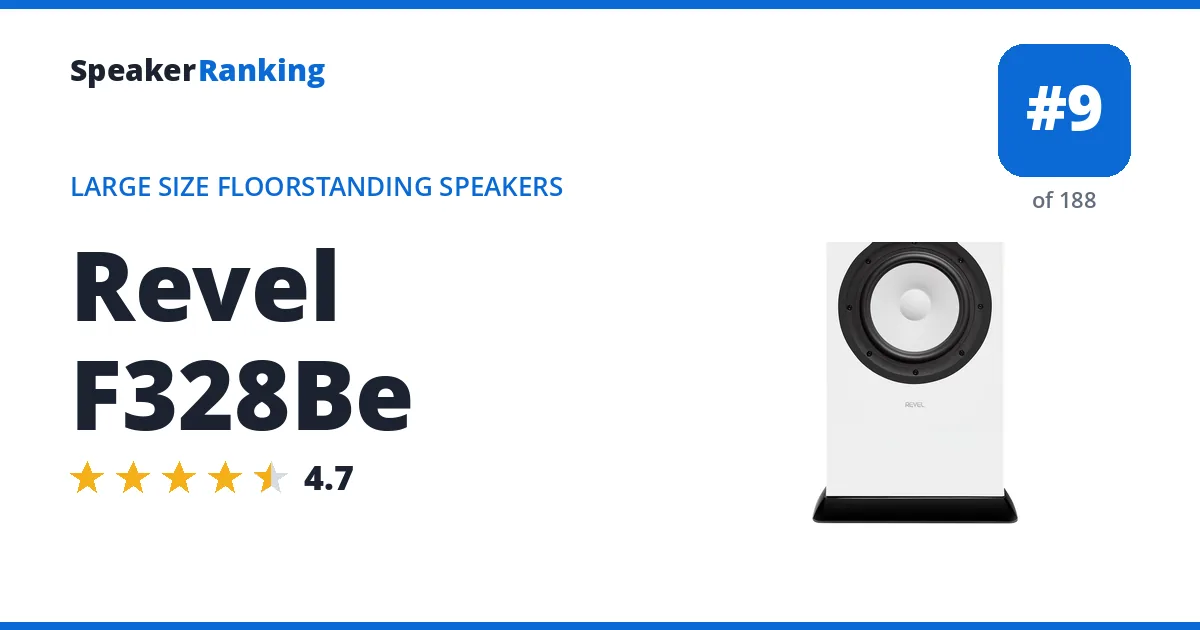
Same family: the Revel M126Be (bookshelf, rated 4.3/5), the Revel F226Be (smaller floorstanding, ranked lower, rated 4.6/5), the Revel F228Be (smaller floorstanding, ranked lower, rated 4.5/5) and the Revel C426Be (center, rated 4/5).
Pros: CEA2034 spinorama shows a quite flat on-axis response with superb directivity and efficiency above 90dB. Predicted in-room response is extremely accurate, with a smooth ~5dB downward slope from bass to treble that suits typical rooms without correction. Early reflections sum very nicely with the direct sound. Horizontal beamwidth of about ±70 degrees is wide and quite smooth. At 96dB SPL/1m distortion stays easily below the reviewer’s audibility threshold across nearly the whole range. Measured bass extension of 74Hz (-3dB), with a measured sensitivity of 91dB.
Cons: Vertical directivity is asymmetric: the reviewer recommends staying between -20 and +40 degrees relative to the tweeter axis, reflecting the driver layout of this three-way tower. Impedance dips to a minimum of 3 ohms with an additional resonance-driven phase swing, calling for an amplifier comfortable with a demanding load. Very expensive and very heavy (51 kg each).
Full Revel F328Be review and specifications →
| Bass Extension (-10dB) | 39Hz (measured, Audio Science Review) |
|---|---|
| Bass Extension (-3dB) | 74Hz (measured, Audio Science Review) |
| DIY Kit | No |
| Dimensions | 50.9”H x 13.5”W x 17.6”D (1292.9 x 342.9 x 447 mm) |
| Drivers | Three 8” (200mm) Deep Ceramic Composite aluminum cones, with cast frames woofer, 5-1/4” (130mm) Deep Ceramic Composite aluminum cone, with cast frame midrange, 1” (25mm) Beryllium dome, with acoustic lens waveguide tweeter |
| Impedance | 8 ohms nominal (3 ohms minimum, measured by Audio Science Review) |
| Sensitivity | 91dB (measured, Audio Science Review) |
| Spinorama Preference Score | 6.40 |
| Spinorama Preference Score with Perfect Sub | 7.81 |
| Weight | 112.4 lbs (51 kg) each |
| Woofer Cabinet | ported, rear |
- Links
- Reviews, Comparisons and Sound Samples
- Head-to-Head Comparisons
- Revel F328Be vs MoFi SourcePoint 888
- Revel F328Be vs Radiant Acoustics Clarity 66
- Revel F328Be vs Ascend Acoustics ELX Ribbon Tower
- Revel F328Be vs MoFi SourcePoint V10 Master Edition
- Revel F328Be vs KEF R5 Meta
- Revel F328Be vs KEF Blade Two Meta
- Revel F328Be vs Revel F226Be
- Revel F328Be vs GR-Research NX-Treme
- See all 39 comparisons