Short answer: the JBL HDI-3600 if sound quality matters most, the Klipsch RP-8000F II if price matters most. The JBL HDI-3600 ranks #58 of 188 floorstanding speakers, rated 4.3/5, at $3,800. The Klipsch RP-8000F II ranks #113, rated 3.9/5, at $1,159.98, $2,640.02 cheaper.
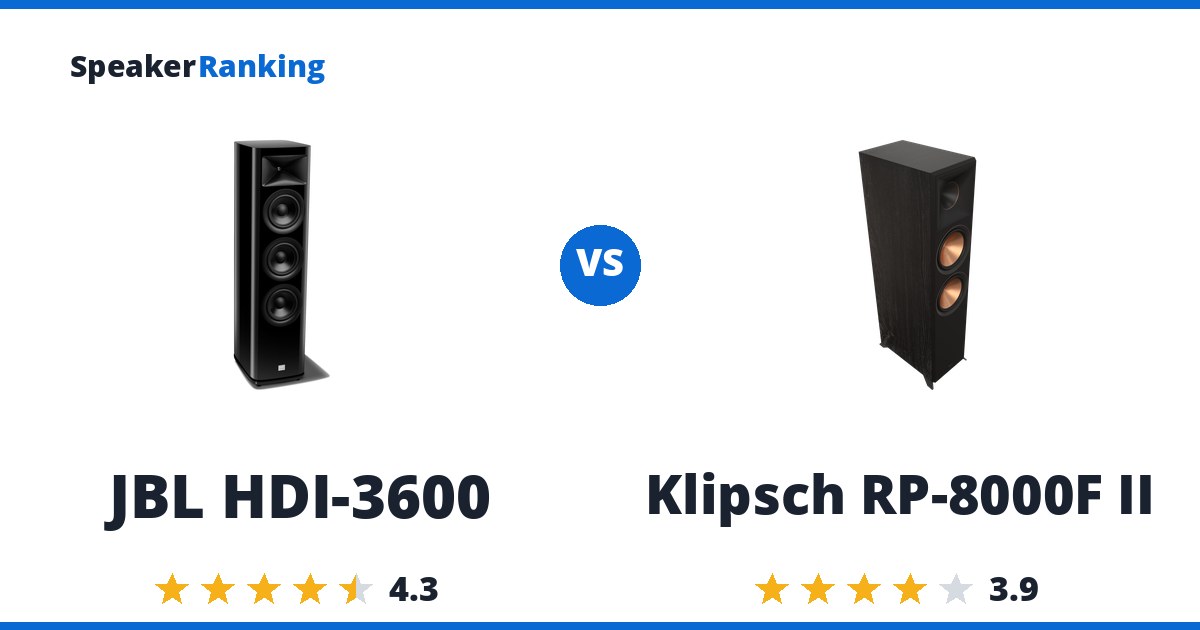
The JBL HDI-3600 is the better-sounding option. CEA2034 spinorama shows a fairly even on-axis response and flat overall frequency response, with high 90dB sensitivity and very low distortion through the midrange. Watch for: A wide shelving-down above 2kHz affects the in-room response, and vertical dispersion is a bigger issue than horizontal: the reviewer noted the dip is wider here than on the smaller HDI-1600, making it more audible.
The Klipsch RP-8000F II is the more accurate, deeper-bass option. Highest sensitivity of the RP II floorstander line (~92dB measured) and the best dynamics/compression behavior of the three under load: the cleanest at high output. Its measured preference score, a predictor of how neutral it sounds, is 5.39 against 4.64 for the JBL HDI-3600. Its bass reaches about 67Hz before falling 3dB, against 78Hz for the JBL HDI-3600. The catch: Mid-bass sounds lean despite the dual 8-inch woofers, and bass extension disappointed for its size: expected to reach 50Hz, didn’t get there in-room.
Buy the JBL HDI-3600 if sound quality matters more than the price. Buy the Klipsch RP-8000F II if the price matters more than sound quality.
Still deciding? The full Passive Home rankings cover every ranked option.
Specifications Side By Side
| JBL HDI-3600 | Klipsch RP-8000F II | |
|---|---|---|
| Price | $3800 per pair | $1,159.98 per pair |
| Ranked | #58 of 188 in Large Size Floorstanding Speakers | #113 of 188 in Large Size Floorstanding Speakers |
| Bass Extension (-3dB) | 78Hz - the on-axis curve also shows an unusual step/dip around 40-55Hz that may be a near-field-scan artifact for this tower (measured, Audio Science Review) | 67Hz (measured, Erin’s Audio Corner) |
| Bass Extension (-10dB) | 62Hz - the on-axis curve also shows an unusual step/dip around 40-55Hz that may be a near-field-scan artifact for this tower (measured, Audio Science Review) | 33Hz (measured, Erin’s Audio Corner) |
| Sensitivity | 89.5dB (2.83V/1m, measured, Audio Science Review) | 92dB (2.83V/1m, measured by Erin’s Audio Corner) |
| Impedance | 4 ohms nominal | 8 ohms nominal (3.7 ohms minimum above 80Hz, measured by Erin’s Audio Corner) |
| Frequency Response | 38Hz - 30kHz (+/-3dB) (Manufacturer specified) | 35Hz - 25kHz (+-3dB, Manufacturer specified) |
| Drivers | 2410H-2 1” compression driver, 3x 6.5” Advanced Aluminum Matrix woofers | 1” titanium tweeter with 90x90 Tractrix horn, dual 8” cerametallic woofers |
| Weight | 61.7 lbs (28 kg) each | 61.3 lbs (27.8 kg) |
| Dimensions | 40.5”H x 10.2”W x 13.5”D (1029 x 260 x 343 mm) | 43.1” x 10.8” x 18.3” (1095 x 275 x 464 mm) |
| Woofer Cabinet | ported, dual rear-firing | ported, rear |
| Spinorama Preference Score | 4.64 (spinorama.org) | 5.39 |
| Spinorama Preference Score with Perfect Sub | 6.95 (spinorama.org) | 7.12 |
| DIY Kit | No | No |
| Crossover Frequency | - | 1630Hz |
| Power Handling | - | 150W continuous, 600W peak |
Related Speaker Comparisons
More top alternatives to JBL HDI-3600:
- JBL HDI-3600 vs KEF Blade Two Meta
- MoFi SourcePoint V10 Master Edition vs JBL HDI-3600
- JBL HDI-3600 vs MoFi SourcePoint 888
- JBL HDI-3600 vs Revel F328Be
- Radiant Acoustics Clarity 66 vs JBL HDI-3600
Prices on this page were last checked October 7, 2026 at 9:25 PM UTC. Product prices and availability are accurate as of that date/time and are subject to change; the price and availability shown on Amazon at the time of purchase will apply to the purchase of this product.
As an eBay Partner, we may be compensated if you make a purchase.
The Two Speakers In Full
 JBL HDI-3600: $3800 per pair Audio Advice eBay
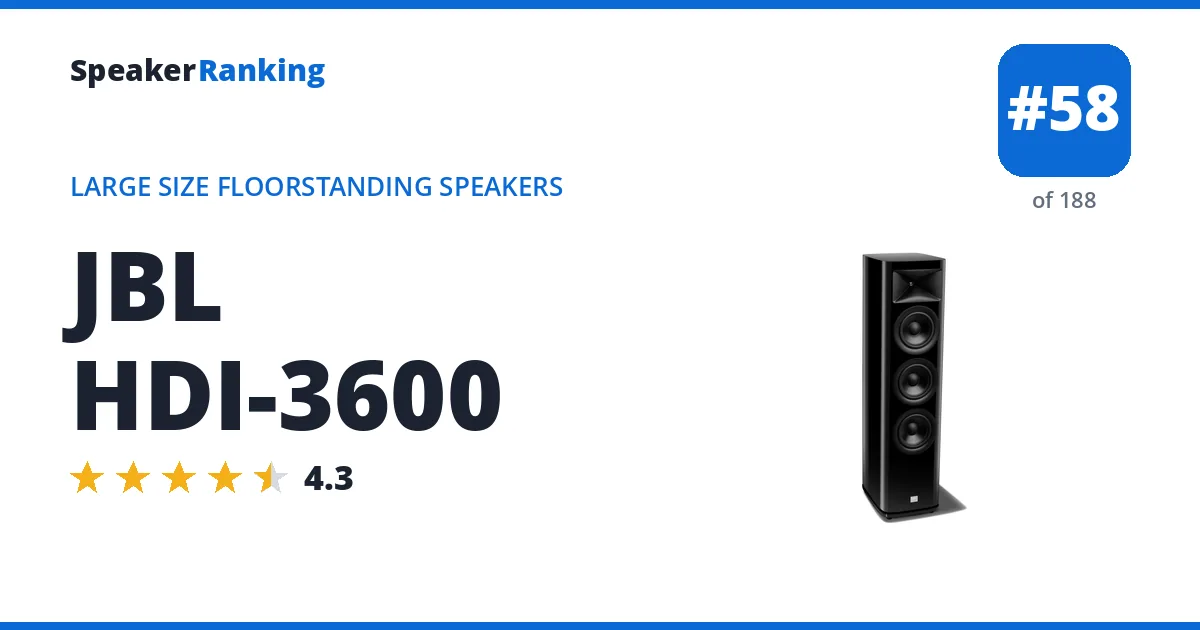
Same family: the JBL HDI-1600 (bookshelf, rated 4.2/5), the JBL HDI-3800 (larger floorstanding, ranked higher, rated 4.5/5) and the JBL HDI-4500 (center, rated 3.7/5).
Pros: CEA2034 spinorama shows a fairly even on-axis response and flat overall frequency response, with high 90dB sensitivity and very low distortion through the midrange. Triple 6.5” Advanced Aluminum Matrix woofers and a 1” compression driver in JBL’s HDI waveguide. Measured bass extension of 78Hz (-3dB), with a measured sensitivity of 89.5dB.
Cons: A wide shelving-down above 2kHz affects the in-room response, and vertical dispersion is a bigger issue than horizontal: the reviewer noted the dip is wider here than on the smaller HDI-1600, making it more audible. Narrow vertical sweet spot means careful listener-height positioning matters more than usual.
Full JBL HDI-3600 review and specifications →
| Bass Extension (-10dB) | 62Hz - the on-axis curve also shows an unusual step/dip around 40-55Hz that may be a near-field-scan artifact for this tower (measured, Audio Science Review) |
|---|---|
| Bass Extension (-3dB) | 78Hz - the on-axis curve also shows an unusual step/dip around 40-55Hz that may be a near-field-scan artifact for this tower (measured, Audio Science Review) |
| DIY Kit | No |
| Dimensions | 40.5”H x 10.2”W x 13.5”D (1029 x 260 x 343 mm) |
| Drivers | 2410H-2 1” compression driver, 3x 6.5” Advanced Aluminum Matrix woofers |
| Frequency Response | 38Hz - 30kHz (+/-3dB) (Manufacturer specified) |
| Impedance | 4 ohms nominal |
| Sensitivity | 89.5dB (2.83V/1m, measured, Audio Science Review) |
| Spinorama Preference Score | 4.64 (spinorama.org) |
| Spinorama Preference Score with Perfect Sub | 6.95 (spinorama.org) |
| Weight | 61.7 lbs (28 kg) each |
| Woofer Cabinet | ported, dual rear-firing |
- Links
- Reviews, Comparisons and Sound Samples
- Head-to-Head Comparisons
- JBL HDI-3600 vs JBL Studio 698
- JBL HDI-3600 vs Perlisten R7t
- JBL HDI-3600 vs Polk Audio Reserve R700
- JBL HDI-3600 vs PSB Imagine T65
- JBL HDI-3600 vs KEF R11 Meta
- JBL HDI-3600 vs Emotiva Airmotiv T2+
- JBL HDI-3600 vs ELAC Debut 3.0 DF63
- JBL HDI-3600 vs Ascend Acoustics Sierra Titan Tower
- See all 43 comparisons
 Klipsch RP-8000F II: $1,159.98 per pair Amazon eBay
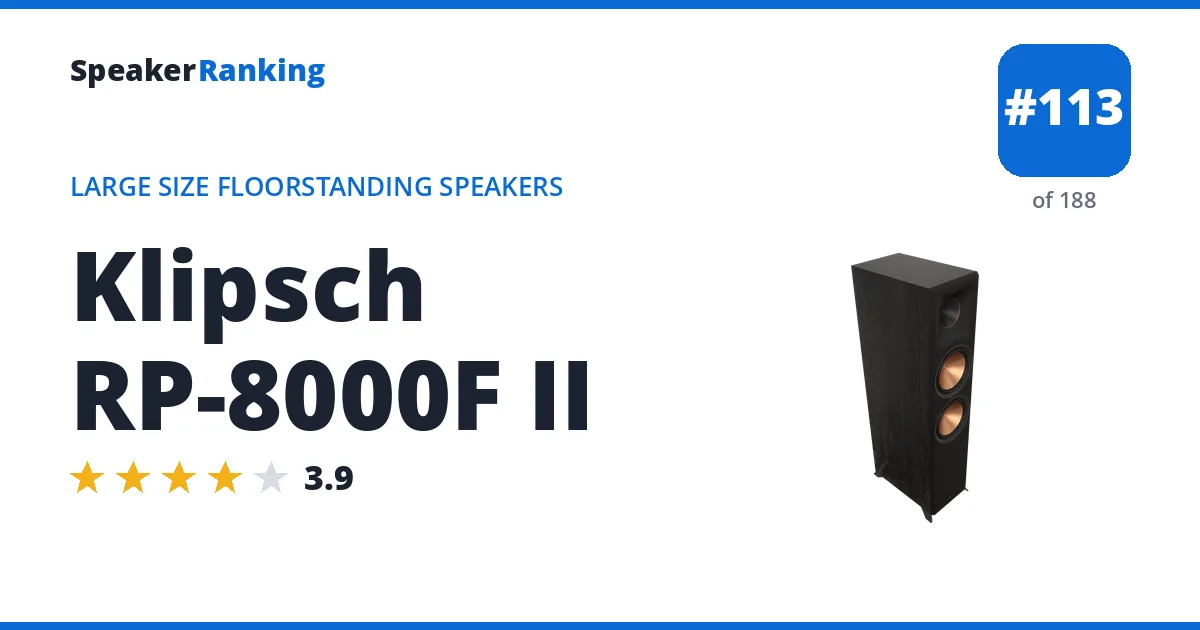
Same family: the Klipsch RP-500M II (smaller bookshelf, rated 4/5), the Klipsch RP-600M II (larger bookshelf, rated 3.7/5), the Klipsch RP-5000F II (smaller floorstanding, ranked higher, rated 4/5), the Klipsch RP-6000F II (smaller floorstanding, ranked lower, rated 3.9/5), the Klipsch RP-404C II (smallest center, rated 3.7/5), the Klipsch RP-500C II (center, rated 3.9/5) and the Klipsch RP-504C II (largest center, rated 3.8/5).
Pros: Highest sensitivity of the RP II floorstander line (~92dB measured) and the best dynamics/compression behavior of the three under load: the cleanest at high output. Dual 8-inch woofers and the highest power handling in the line. Measured bass extension of 67Hz (-3dB), with a measured sensitivity of 92dB.
Cons: Mid-bass sounds lean despite the dual 8-inch woofers, and bass extension disappointed for its size: expected to reach 50Hz, didn’t get there in-room. Has its own edgy upper-mid bump (2-6kHz) that’s harder to EQ out than the other two models’ issues, since it stems from the vertical horn/woofer offset rather than simple tonal balance. The most placement-critical of the three, with the narrowest horizontal (~40-50 degrees) and vertical (+5/-10 degrees) dispersion.
Full Klipsch RP-8000F II review and specifications →
| Bass Extension (-10dB) | 33Hz (measured, Erin’s Audio Corner) |
|---|---|
| Bass Extension (-3dB) | 67Hz (measured, Erin’s Audio Corner) |
| Crossover Frequency | 1630Hz |
| DIY Kit | No |
| Dimensions | 43.1” x 10.8” x 18.3” (1095 x 275 x 464 mm) |
| Drivers | 1” titanium tweeter with 90x90 Tractrix horn, dual 8” cerametallic woofers |
| Frequency Response | 35Hz - 25kHz (+-3dB, Manufacturer specified) |
| Impedance | 8 ohms nominal (3.7 ohms minimum above 80Hz, measured by Erin’s Audio Corner) |
| Power Handling | 150W continuous, 600W peak |
| Sensitivity | 92dB (2.83V/1m, measured by Erin’s Audio Corner) |
| Spinorama Preference Score | 5.39 |
| Spinorama Preference Score with Perfect Sub | 7.12 |
| Weight | 61.3 lbs (27.8 kg) |
| Woofer Cabinet | ported, rear |
- Links
- Reviews, Comparisons and Sound Samples
- Head-to-Head Comparisons
- Klipsch RP-8000F II vs Dynaudio Emit 30
- Klipsch RP-8000F II vs Klipsch RP-6000F II
- Klipsch RP-8000F II vs Klipsch RP-5000F II
- Klipsch RP-8000F II vs KLH Model Five
- Klipsch RP-8000F II vs KEF Q11 Meta
- Klipsch RP-8000F II vs Definitive Technology BP-9020
- Klipsch RP-8000F II vs SVS Ultra Evolution Pinnacle
- Klipsch RP-8000F II vs Klipsch Forte IV
- See all 44 comparisons