Short answer: the JBL Charge Essential 3 SE for better sound quality, the Treblab HD77 for the lower price. The JBL Charge Essential 3 SE ranks #40 of 150 medium speakers, rated 3.7/5, at $199.95. The Treblab HD77 ranks #87, rated 3.1/5, at $69.97, $129.98 cheaper.
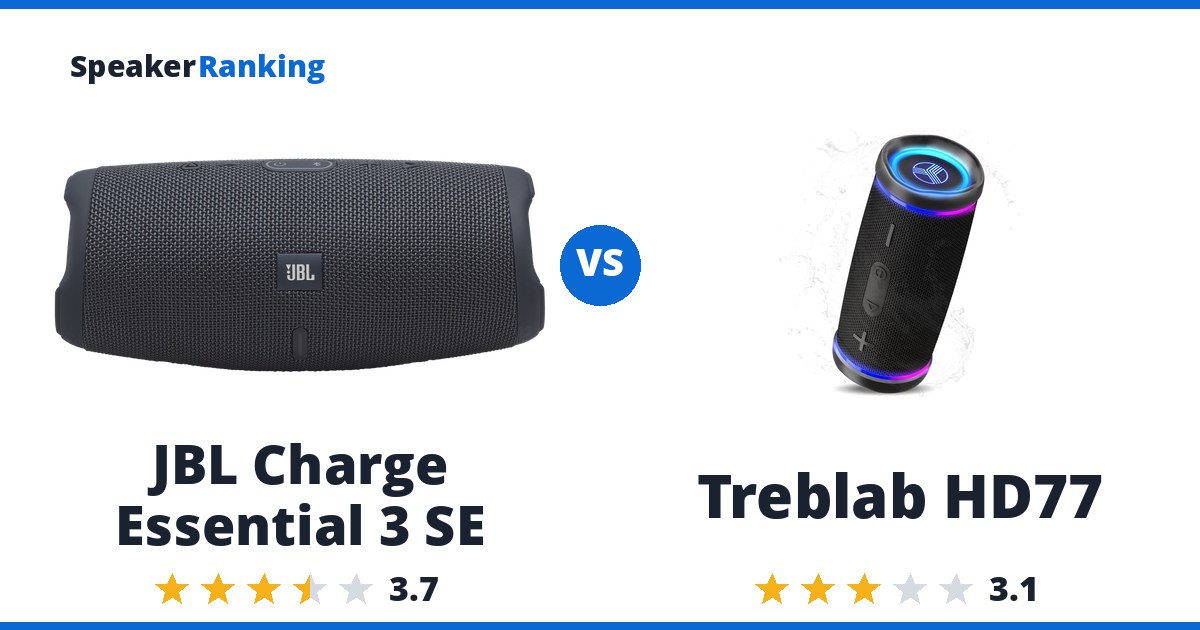
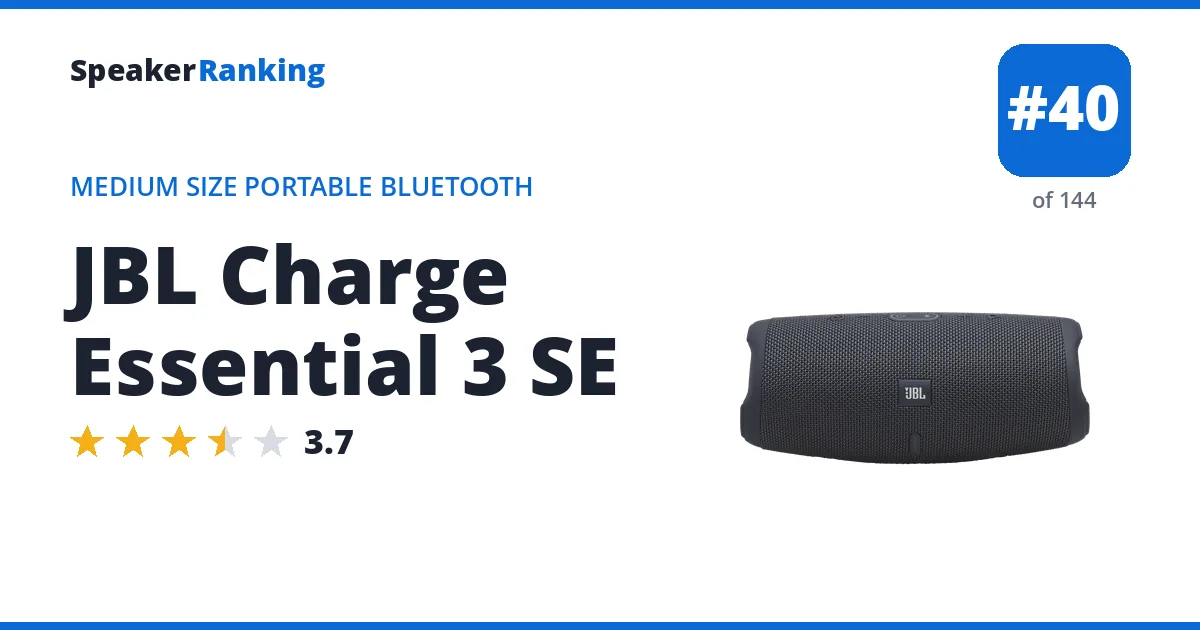
What the JBL Charge Essential 3 SE does well: Gets louder than the Bose SoundLink Flex 2nd Gen and digs deeper in the bass, with a separate 20mm tweeter, two passive radiators and 40W of amplification in the familiar Charge body. The tradeoff: In side-by-side listening against the Charge 6, its bass is weaker and less stable and distorts on bass-heavy tracks even with the bass turned down in the app, while a narrow boost in the upper mids makes it sound less natural.
What the Treblab HD77 does well: Supports TWS pairing with a second HD77 for wider stereo sound. The tradeoff: Lacking quite a bit of bass compared to higher ranked speakers.
Buy the JBL Charge Essential 3 SE if sound quality is the priority over the price, or the Treblab HD77 if the price is the priority over sound quality.
Want more options? Browse the full Portable Bluetooth rankings.
Specifications Side By Side
| JBL Charge Essential 3 SE | Treblab HD77 | |
|---|---|---|
| Price | $199.95 | $69.97 |
| Ranked | #40 of 150 in Medium Size Portable Bluetooth Speakers | #87 of 150 in Medium Size Portable Bluetooth Speakers |
| App | Yes | No |
| Aux Input | No | Yes |
| Battery Life | 20 hours (Manufacturer specified) | 20 hours (Manufacturer specified) |
| Built-in Microphone | No | Yes |
| EQ | Yes | No |
| IP Rating | IP67 | IPX7 |
| Party Mode | Yes (Auracast) | - |
| Power Bank | Yes (USB-C) | - |
| Stereo | No | No (front/rear drivers) |
| Omnidirectional | No | Yes |
| TWS | Yes (Auracast) | Yes |
| Weight | 2.1 lbs (960 g) | 1.4 lbs (637 g) |
| Bluetooth | Yes | Yes |
| Bluetooth Version | 5.4 | 5.0 |
| Bluetooth Codecs | SBC, AAC, LC3 | SBC (additional codecs unverified) |
| Dimensions | 8.8” x 3.8” x 3.7” (223 x 96.5 x 94 mm) | 7.4” x 3” x 3” (187 x 76 x 76 mm) |
| Drivers | 52mm x 90mm racetrack woofer, 20mm tweeter, two passive radiators | 2x 48mm fullrange |
| Amplifier Power | 40W total (30W woofer + 10W tweeter) | 25W RMS |
| Frequency Response | 60Hz - 20kHz (Manufacturer specified) | 50Hz - 20kHz (Manufacturer specified) |
| Power Input | USB-C (5V/3A) | USB-C |
| Digital Aux Input | No | No |
| Strap | No | - |
| Bass Extension (-10dB) | - | ~66Hz |
| Wi-Fi | - | No |
Related Speaker Comparisons
How JBL Charge Essential 3 SE compares with other leading options:
- Earfun Uboom L vs JBL Charge Essential 3 SE
- Soundcore Motion 300 vs JBL Charge Essential 3 SE
- Minirig 4 vs JBL Charge Essential 3 SE
- B&O Beosound A1 2nd gen vs JBL Charge Essential 3 SE
- JBL Charge 6 vs JBL Charge Essential 3 SE
Prices on this page were last checked September 30, 2026 at 2:57 PM UTC. Product prices and availability are accurate as of that date/time and are subject to change; the price and availability shown on Amazon at the time of purchase will apply to the purchase of this product.
As an eBay Partner, we may be compensated if you make a purchase.
The Two Speakers In Full
 JBL Charge Essential 3 SE: $199.95 JBL eBay
Older models: the JBL Charge Essential 2 (ranked higher, rated 3.8/5) and the JBL Charge Essential (ranked lower, rated 3.2/5).
Pros: Gets louder than the Bose SoundLink Flex 2nd Gen and digs deeper in the bass, with a separate 20mm tweeter, two passive radiators and 40W of amplification in the familiar Charge body. IP67 water and dust protection, a claimed 20 hours of battery life, a USB-C power bank output, Auracast stereo pairing and multi-speaker linking, Bluetooth 5.4 with AAC, and app EQ.
Cons: In side-by-side listening against the Charge 6, its bass is weaker and less stable and distorts on bass-heavy tracks even with the bass turned down in the app, while a narrow boost in the upper mids makes it sound less natural. Against the Bose SoundLink Flex 2nd Gen it sounds muddier and more strident, with less detail and a smaller soundstage. At full price it costs as much as the Charge 6, which is the better speaker.
Full JBL Charge Essential 3 SE review and specifications →
| Amplifier Power | 40W total (30W woofer + 10W tweeter) |
|---|---|
| App | Yes |
| Aux Input | No |
| Battery Life | 20 hours (Manufacturer specified) |
| Bluetooth | Yes |
| Bluetooth Codecs | SBC, AAC, LC3 |
| Bluetooth Version | 5.4 |
| Built-in Microphone | No |
| Digital Aux Input | No |
| Dimensions | 8.8” x 3.8” x 3.7” (223 x 96.5 x 94 mm) |
| Drivers | 52mm x 90mm racetrack woofer, 20mm tweeter, two passive radiators |
| EQ | Yes |
| Frequency Response | 60Hz - 20kHz (Manufacturer specified) |
| IP Rating | IP67 |
| Omnidirectional | No |
| Party Mode | Yes (Auracast) |
| Power Bank | Yes (USB-C) |
| Power Input | USB-C (5V/3A) |
| Stereo | No |
| Strap | No |
| TWS | Yes (Auracast) |
| Weight | 2.1 lbs (960 g) |
- Links
- Reviews, Comparisons and Sound Samples
- Head-to-Head Comparisons
- JBL Charge Essential 3 SE vs Earfun Uboom Slim
- JBL Charge Essential 3 SE vs JBL Charge Essential 2
- JBL Charge Essential 3 SE vs Bose Soundlink Flex
- JBL Charge Essential 3 SE vs Xiaomi Sound Outdoor
- JBL Charge Essential 3 SE vs Bose Soundlink Flex 2nd gen
- JBL Charge Essential 3 SE vs JBL Pulse 5
- JBL Charge Essential 3 SE vs Tribit Xsound Plus 2
- JBL Charge Essential 3 SE vs W-King D320
- See all 85 comparisons
 Treblab HD77: $69.97 Amazon eBay
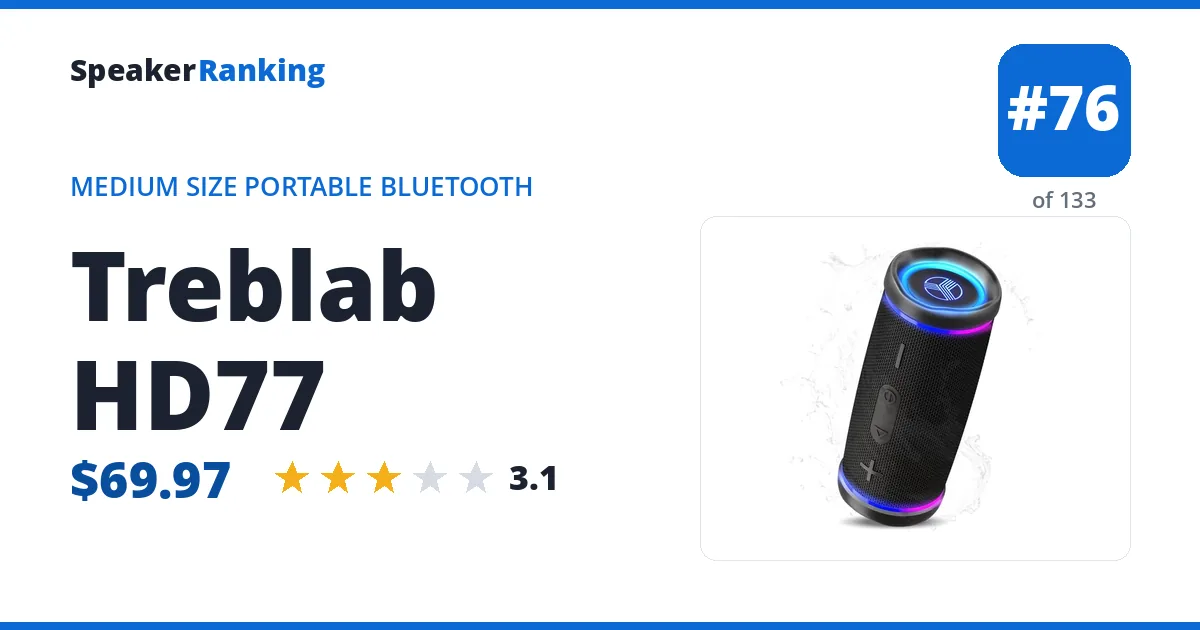
Pros: Supports TWS pairing with a second HD77 for wider stereo sound. Aux input for wired listening. ~20 hour battery at low-medium volume; built-in mic for hands-free calls. Measured bass extension of ~66Hz (-10dB).
Cons: Lacking quite a bit of bass compared to higher ranked speakers. Unable to disable the music flashing lights
Full Treblab HD77 review and specifications →
| Amplifier Power | 25W RMS |
|---|---|
| App | No |
| Aux Input | Yes |
| Bass Extension (-10dB) | ~66Hz |
| Battery Life | 20 hours (Manufacturer specified) |
| Bluetooth | Yes |
| Bluetooth Codecs | SBC (additional codecs unverified) |
| Bluetooth Version | 5.0 |
| Built-in Microphone | Yes |
| Digital Aux Input | No |
| Dimensions | 7.4” x 3” x 3” (187 x 76 x 76 mm) |
| Drivers | 2x 48mm fullrange |
| EQ | No |
| Frequency Response | 50Hz - 20kHz (Manufacturer specified) |
| IP Rating | IPX7 |
| Omnidirectional | Yes |
| Power Input | USB-C |
| Stereo | No (front/rear drivers) |
| TWS | Yes |
| Weight | 1.4 lbs (637 g) |
| Wi-Fi | No |
- Links
- Reviews, Comparisons and Sound Samples
- Head-to-Head Comparisons