Short answer: the Genelec 8320A. It ranks #8 of 100 powered bookshelf speakers by sound quality (rated 4.5/5) at $1,700 and is still sold new; the Presonus Eris E5 ranks #75 (rated 3.3/5) and is discontinued, so it is only an option used. The Presonus Eris E5’s replacement, the PreSonus Eris Studio 5, is rated 3.6/5.
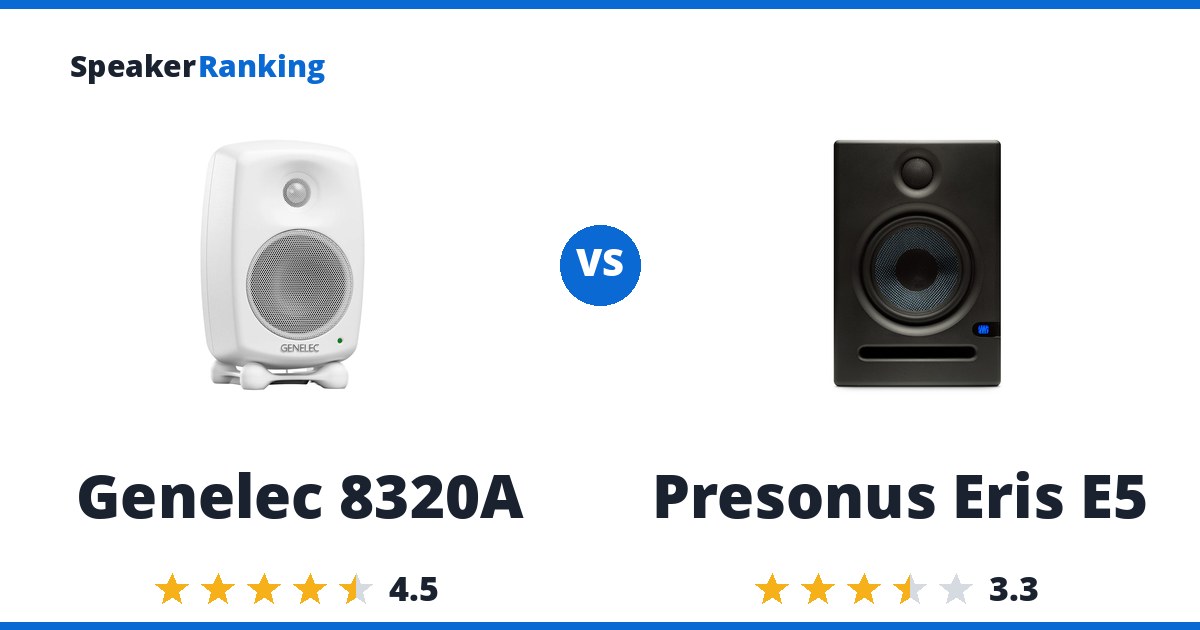
The Genelec 8320A is the better-sounding pick. A measured 1.6dB span from 300Hz to 5kHz and preference scores of 5.52 standalone and 8.04 with an ideal subwoofer support accurate close-range monitoring. The tradeoff: The -3dB point is about 67Hz, making a subwoofer important for lower bass and giving the larger Genelec 8330A a practical advantage without one.
The case for the Presonus Eris E5: Balanced XLR/TRS and RCA inputs plus placement adjustment make the original Eris E5 easy to connect to studio or consumer sources. The catch: A fuller bass balance is not necessarily neutral.
Buy the Genelec 8320A. It is rated higher for sound quality; the Presonus Eris E5 is no longer sold new.
Want more options? Browse the full Powered Home rankings.
Specifications Side By Side
| Genelec 8320A | Presonus Eris E5 | |
|---|---|---|
| Price | $1,700 per pair | $186.98 per pair Discontinued |
| Ranked | #8 of 100 in Medium Size Powered Bookshelf Speakers | #75 of 100 in Medium Size Powered Bookshelf Speakers |
| Enclosure | ported | - |
| Drivers | 0.75” metal dome tweeter, 4.1” cone woofer | 5” (127mm) woofer |
| Dimensions | 9.5”H x 5.9”W x 5.6”D (242 x 151 x 142 mm) | 10.2”H x 7”W x 7.7”D (259.1 x 177.8 x 195.6 mm) |
| Weight | 7.1 lbs (3.2 kg) each | 10.1 lbs (4.6 kg) each |
| Amplifier Power | 100W total (50W woofer, 50W tweeter, Class D) | 80w Per Speaker |
| Frequency Response | 55Hz-23kHz -6dB | 53Hz - 22kHz (Manufacturer specified) |
| Bass Extension (-3dB) | 67.4Hz (measured, Audio Science Review) | - |
| Bass Extension (-10dB) | 53.2Hz (measured, Audio Science Review) | - |
| Warranty | 2 years (5 with product registration) | - |
| Country | Finland | - |
| Maximum SPL | Peak 107dB (manufacturer specified) | - |
| Spinorama Preference Score | 5.52 | - |
| Spinorama Preference Score with Perfect Sub | 8.04 | - |
| Inputs | XLR | TRS, XLR, RCA |
| XLR Input | Yes | Yes |
| RCA Input | No | Yes |
| TRS Input | No | Yes |
| Optical Input | No | No |
| Coaxial Input | No | No |
| USB Input | No | No |
| HDMI Input | No | No |
| AES Input | No | No |
| Aux Input | No | No |
| Bluetooth | No | No |
| App | - | No |
| EQ | - | Yes (Room adjustment) |
Related Speaker Comparisons
How Genelec 8320A compares with other leading options:
- Genelec 8320A vs Genelec 8331A
- Neumann KH120 MKII vs Genelec 8320A
- Genelec 8030C vs Genelec 8320A
- Neumann KH80 DSP vs Genelec 8320A
- Dynaudio LYD 5 vs Genelec 8320A
Prices on this page were last checked October 9, 2026 at 8:01 AM UTC. Product prices and availability are accurate as of that date/time and are subject to change; the price and availability shown on Amazon at the time of purchase will apply to the purchase of this product.
As an eBay Partner, we may be compensated if you make a purchase.
The Two Speakers In Full
 Genelec 8320A: $1,700 per pair B&H Photo Video eBay
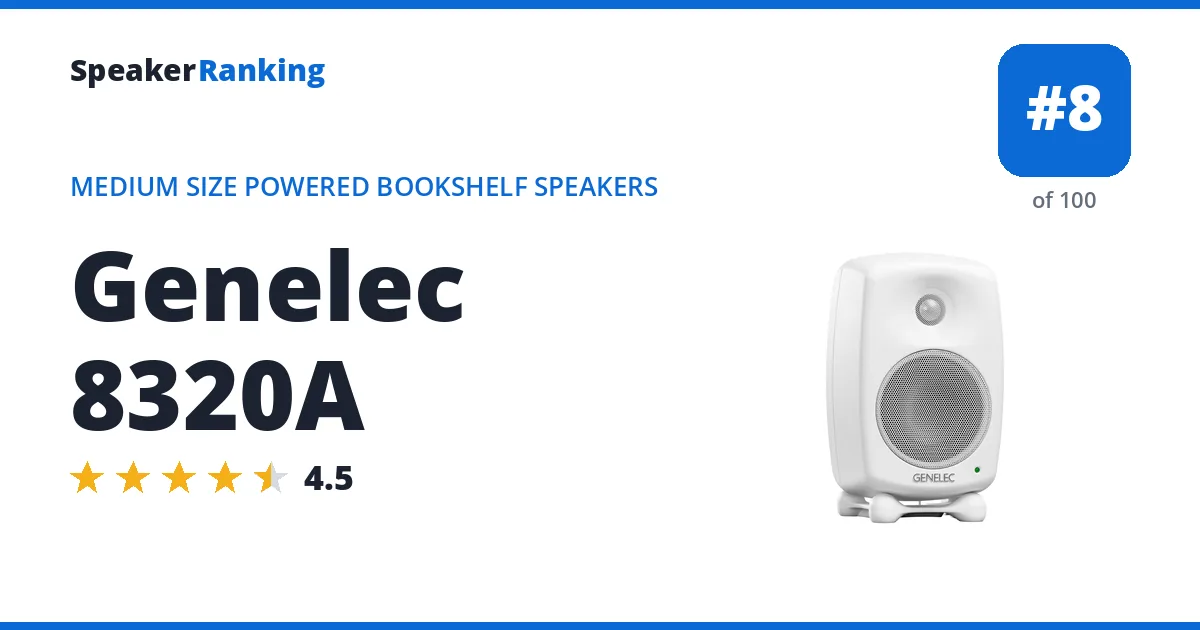
Same family: the Genelec 8330A (larger bookshelf, ranked higher, rated 4.5/5), the Genelec 8340A (larger bookshelf, estimated 4.4/5) and the Genelec 8350A (larger bookshelf, estimated 4.5/5).
Pros: A measured 1.6dB span from 300Hz to 5kHz and preference scores of 5.52 standalone and 8.04 with an ideal subwoofer support accurate close-range monitoring. The waveguide helps control the balance between direct and reflected sound. GLM room calibration is useful for matching levels and placement in a compact setup. Measured bass extension of 67.4Hz (-3dB).
Cons: The -3dB point is about 67Hz, making a subwoofer important for lower bass and giving the larger Genelec 8330A a practical advantage without one. Calibration hardware is sold separately. The small woofer limits its intended listening distance and bass output; a favorable response-fit parameter is not evidence that it has uniquely well-damped bass or unusually high headroom.
Full Genelec 8320A review and specifications →
| AES Input | No |
|---|---|
| Amplifier Power | 100W total (50W woofer, 50W tweeter, Class D) |
| Aux Input | No |
| Bass Extension (-10dB) | 53.2Hz (measured, Audio Science Review) |
| Bass Extension (-3dB) | 67.4Hz (measured, Audio Science Review) |
| Bluetooth | No |
| Coaxial Input | No |
| Country | Finland |
| Dimensions | 9.5”H x 5.9”W x 5.6”D (242 x 151 x 142 mm) |
| Drivers | 0.75” metal dome tweeter, 4.1” cone woofer |
| Enclosure | ported |
| Frequency Response | 55Hz-23kHz -6dB |
| HDMI Input | No |
| Inputs | XLR |
| Maximum SPL | Peak 107dB (manufacturer specified) |
| Optical Input | No |
| RCA Input | No |
| Spinorama Preference Score | 5.52 |
| Spinorama Preference Score with Perfect Sub | 8.04 |
| TRS Input | No |
| USB Input | No |
| Warranty | 2 years (5 with product registration) |
| Weight | 7.1 lbs (3.2 kg) each |
| XLR Input | Yes |
- Links
- Reviews, Comparisons and Sound Samples
- Head-to-Head Comparisons
 Presonus Eris E5: $186.98 per pair Discontinued eBay
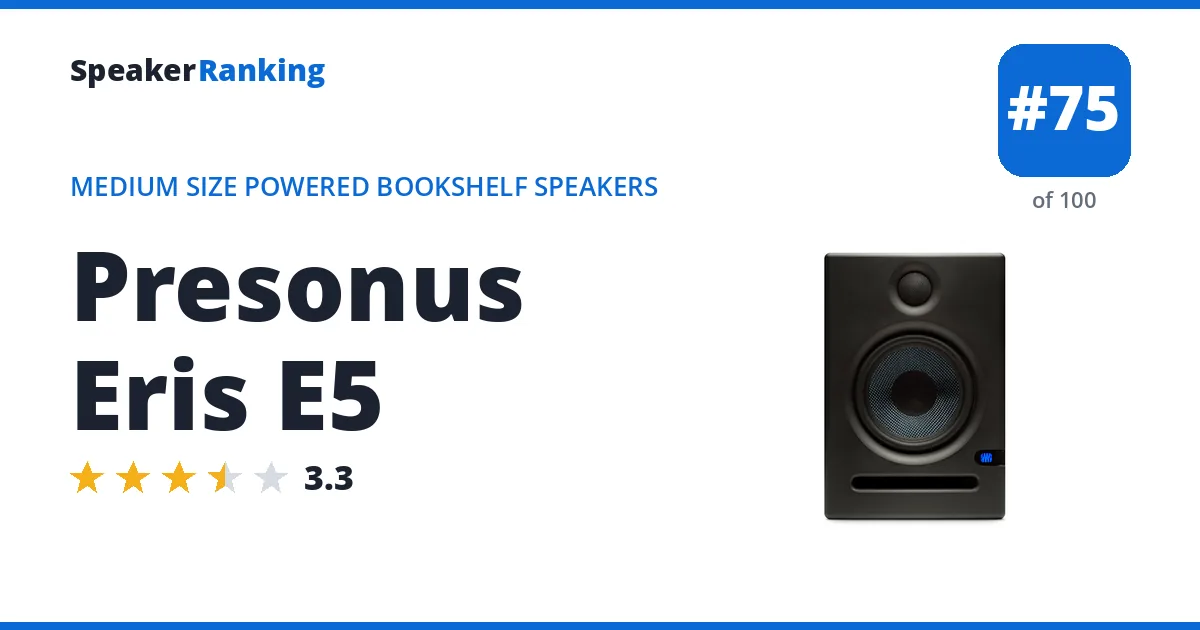
Newer model: the PreSonus Eris Studio 5, ranked higher, estimated 3.6/5.
Same family: the Presonus Eris E3.5 (smaller bookshelf, rated 2.6/5).
Pros: Balanced XLR/TRS and RCA inputs plus placement adjustment make the original Eris E5 easy to connect to studio or consumer sources. Existing listening notes describe a fuller low end than some small, bass-light monitors, which may suit casual nearfield listening.
Cons: A fuller bass balance is not necessarily neutral. Placement adjustment is useful, but it does not replace a properly integrated subwoofer for deep-bass monitoring. Discontinued.
Full Presonus Eris E5 review and specifications →
| AES Input | No |
|---|---|
| Amplifier Power | 80w Per Speaker |
| App | No |
| Aux Input | No |
| Bluetooth | No |
| Coaxial Input | No |
| Dimensions | 10.2”H x 7”W x 7.7”D (259.1 x 177.8 x 195.6 mm) |
| Drivers | 5” (127mm) woofer |
| EQ | Yes (Room adjustment) |
| Frequency Response | 53Hz - 22kHz (Manufacturer specified) |
| HDMI Input | No |
| Inputs | TRS, XLR, RCA |
| Optical Input | No |
| RCA Input | Yes |
| TRS Input | Yes |
| USB Input | No |
| Weight | 10.1 lbs (4.6 kg) each |
| XLR Input | Yes |
- Links
- Reviews, Comparisons and Sound Samples
- DSAUDIO.review: Adam Audio T5V vs Presonus Eris E5 5 Track Comparison More from DSAUDIOreview →
- DSAUDIO.review: Yamaha HS5 vs Presonus Eris E5 Sound Demo
- DSAUDIO.review: Fluid Audio F5 vs Presonus Eris E5 Sound & Frequency Response Comparison
- DSAUDIO.review: M-Audio BX5 D3 vs Presonus Eris E5 5 Track Comparison
- DSAUDIO.review: PreSonus Eris E5 XT vs PreSonus Eris E5 (new vs old) Sound & Frequency Response Comparison
- DSAUDIO.review: JBL 305P MKII vs PreSonus Eris E5 6-Track Comparison
- DSAUDIO.review: Mackie CR5 BT vs Presonus Eris E5 Sound Demo w/ Bass Test
- DSAUDIO.review: KRK Rokit 5 RP5G3 vs Presonus E5 Sound Demo w/ Bass Test
- DSAUDIO.review: JBL LSR305 vs Presonus Eris E5 Sound Demo
- DSAUDIO.review: KRK Rokit 5 G4 RP5G4 vs Presonus Eris E5 Sound & Frequency Response Comparison
- Head-to-Head Comparisons
- Presonus Eris E5 vs Edifier MR5
- Presonus Eris E5 vs Audioengine HD6
- Presonus Eris E5 vs M-Audio BX4 D3
- Presonus Eris E5 vs KRK Classic 5
- Presonus Eris E5 vs Edifier R2000DB
- Presonus Eris E5 vs Edifier S1000W
- Presonus Eris E5 vs Edifier MR4
- Presonus Eris E5 vs Edifier S1000MKII
- See all 50 comparisons