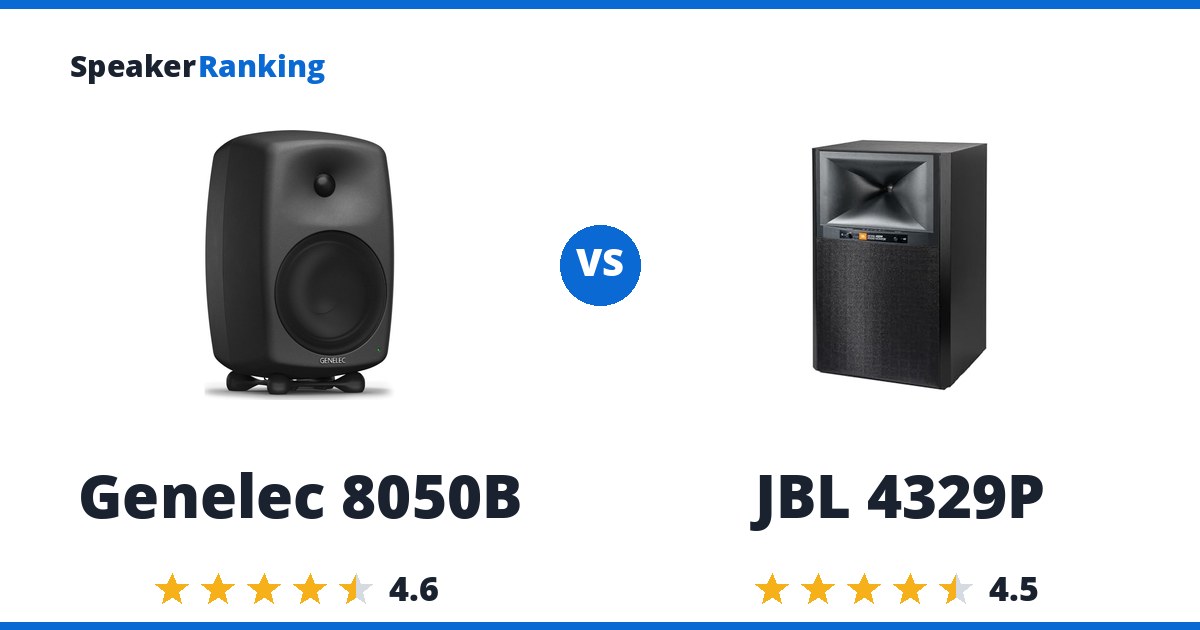
Short answer: both are discontinued, so this only matters if you are buying used. Used, the Genelec 8050B is the better pick: it ranks #27 of 68 powered bookshelf speakers by sound quality (rated 4.4/5), against #45 (rated 4.1/5) for the JBL 4329P. If you want one new, the Neumann KH 150 ranks #8 at $3,398.
What the Genelec 8050B offers: CEA2034 spinorama shows a very good on-axis response with excellent directivity. Watch for: A dip around 2kHz shows up in both the on-axis and predicted in-room measurements.
The case for the JBL 4329P: Genuinely full-range performance for a bookshelf-style speaker - anechoic response extends to 30Hz (measured F3 31Hz), reaching into the low 20s Hz range in-room depending on placement. The tradeoff: No HDMI input, a real drawback if you want to run these directly off a TV’s ARC.
Buy the Genelec 8050B only if you find one used in good condition; both are discontinued, and it is the better rated of the two. For a new speaker, start with the Neumann KH 150 instead.
Still deciding? The full Powered Home rankings cover every ranked option.
Specifications Side By Side
| Genelec 8050B | JBL 4329P | |
|---|---|---|
| Price | $3800 per pair Discontinued | $4,500 per pair Discontinued |
| Ranked | #27 of 68 in Large Size Powered Bookshelf Speakers | #45 of 68 in Large Size Powered Bookshelf Speakers |
| Bass Extension (-3dB) | 35.2Hz (measured, Audio Science Review) | 31Hz (measured, Erin’s Audio Corner) |
| Bass Extension (-10dB) | 28.8Hz (derived, log-interpolated between spinorama.org -9dB/-12dB points) | 27Hz (measured, Erin’s Audio Corner) |
| Dimensions | 17.8”H x 11.3”W x 10.9”D (452.1 x 287 x 276.9 mm) | 20.3”H x 12.6”W x 12.7”D |
| Frequency Response | 32Hz - 25kHz (-6dB) (Manufacturer specified) | 30Hz - 20kHz (anechoic, manufacturer specified) |
| Inputs | XLR | USB, Optical, Bluetooth, Analog, 3.5mm, AirPlay 2 |
| Weight | 31.7 lbs (14.4 kg) each | 34.4 lbs (15.6 kg) (primary), 34.4 lbs (15.6 kg) (secondary) |
| Drivers | 8” (203mm) woofer | 8” midwoofer, 1” compression driver with JBL High-Definition Imaging horn |
| App | No | - |
| Bluetooth | No | Yes, 5.3 |
| EQ | Yes (Room adjustment) | - |
| DSP | No | - |
| Amplifier Power | 270w Per Speaker | 300W RMS per speaker (600W total system power) |
| XLR Input | Yes | No |
| RCA Input | No | No |
| TRS Input | No | No |
| Optical Input | No | Yes |
| Coaxial Input | No | No |
| USB Input | No | Yes |
| HDMI Input | No | No |
| AES Input | No | No |
| Aux Input | No | Yes |
| Sensitivity | - | 102.2dB (measured at 0.3V/1m, Erin’s Audio Corner) |
| Bluetooth Codecs | - | SBC, aptX Adaptive |
| Woofer Cabinet | - | ported |
| Spinorama Preference Score | - | 5.40 |
| Spinorama Preference Score with Perfect Sub | - | 6.72 |
Related Speaker Comparisons
More worthwhile head-to-heads for Genelec 8050B:
- Genelec 8050B vs Genelec 8351B
- Neumann KH420 vs Genelec 8050B
- Genelec 8361A vs Genelec 8050B
- Genelec 8050B vs Genelec 8341A
- Genelec 8050B vs Neumann KH 150
Prices on this page were last checked October 2, 2026 at 10:18 PM UTC. Product prices and availability are accurate as of that date/time and are subject to change; the price and availability shown on Amazon at the time of purchase will apply to the purchase of this product.
As an eBay Partner, we may be compensated if you make a purchase.
The Two Speakers In Full
 Genelec 8050B: $3800 per pair Discontinued B&H Photo Video eBay
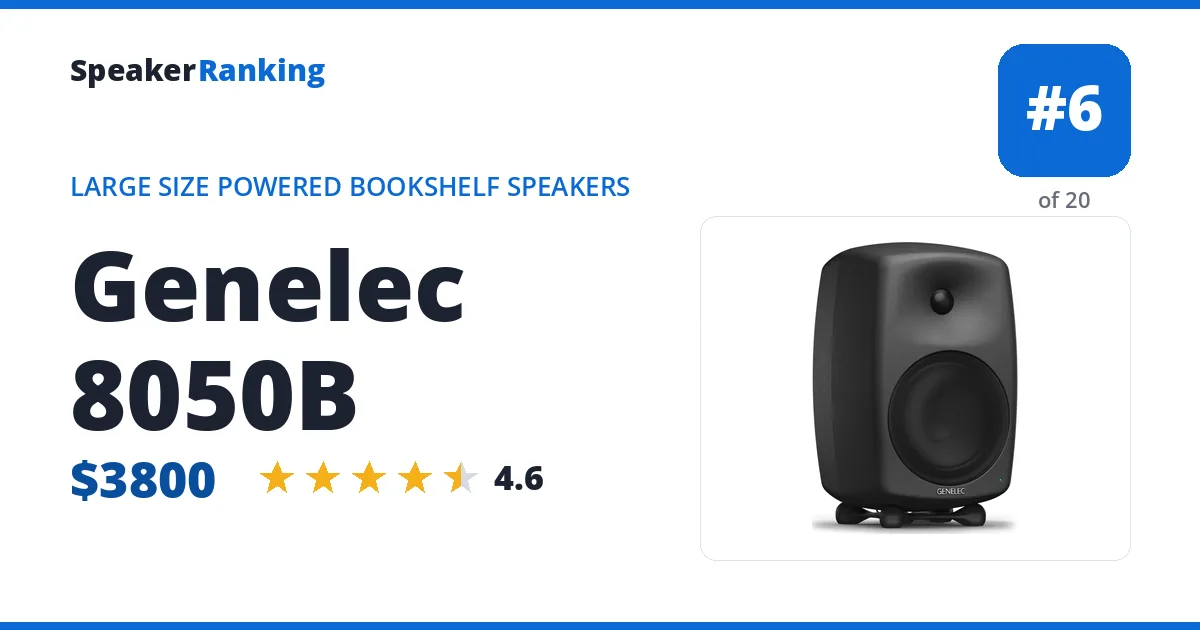
Newer model: the Genelec 8350A. It’s likely to perform similarly, though we don’t have measurements to confirm that yet. It uses the same cabinet and woofer size, adding GLM room calibration and an AES/EBU digital input.
Pros: Measured -3dB extension of 35.2Hz gives the 8050B deeper native bass than many similarly ranked monitors. The 6.49 ideal-subwoofer score supports broadly balanced listening, with a waveguide and analog boundary controls for practical studio placement. Measured bass extension of 35.2Hz (-3dB).
Cons: A 2.7dB response span from 300Hz to 5kHz and a dip around 2kHz keep it below the strongest tonal performers. Port-related response features and high-level distortion also warrant attention. Unlike the SAM models, it does not provide GLM room calibration. Discontinued.
Full Genelec 8050B review and specifications →
| AES Input | No |
|---|---|
| Amplifier Power | 270w Per Speaker |
| App | No |
| Aux Input | No |
| Bass Extension (-10dB) | 28.8Hz (derived, log-interpolated between spinorama.org -9dB/-12dB points) |
| Bass Extension (-3dB) | 35.2Hz (measured, Audio Science Review) |
| Bluetooth | No |
| Coaxial Input | No |
| DSP | No |
| Dimensions | 17.8”H x 11.3”W x 10.9”D (452.1 x 287 x 276.9 mm) |
| Drivers | 8” (203mm) woofer |
| EQ | Yes (Room adjustment) |
| Frequency Response | 32Hz - 25kHz (-6dB) (Manufacturer specified) |
| HDMI Input | No |
| Inputs | XLR |
| Optical Input | No |
| RCA Input | No |
| TRS Input | No |
| USB Input | No |
| Weight | 31.7 lbs (14.4 kg) each |
| XLR Input | Yes |
- Links
- Reviews, Comparisons and Sound Samples
- Head-to-Head Comparisons
 JBL 4329P: $4,500 per pair Discontinued eBay
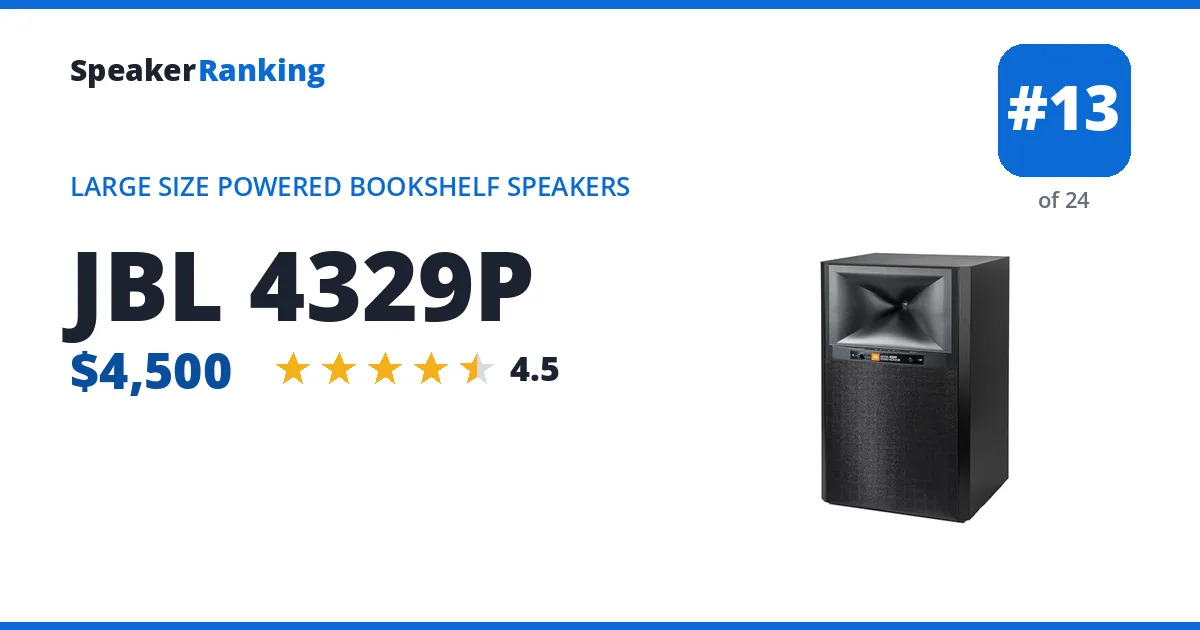
Pros: Measured -3dB extension of 32.2Hz provides deeper native bass than the smaller 4305P. Integrated amplification and streaming make it convenient for a full-range living-room system, and its larger format is useful when scale matters. Measured bass extension of 31Hz (-3dB), with a measured sensitivity of 102.2dB.
Cons: The measured 4.5dB response span from 300Hz to 5kHz includes a notable midrange dip, so it is not as neutral as its size and price might suggest. Its 6.72 ideal-subwoofer score trails the 4305P. There is no HDMI connection for the simplest TV hookup. Discontinued.
Full JBL 4329P review and specifications →
| AES Input | No |
|---|---|
| Amplifier Power | 300W RMS per speaker (600W total system power) |
| Aux Input | Yes |
| Bass Extension (-10dB) | 27Hz (measured, Erin’s Audio Corner) |
| Bass Extension (-3dB) | 31Hz (measured, Erin’s Audio Corner) |
| Bluetooth | Yes, 5.3 |
| Bluetooth Codecs | SBC, aptX Adaptive |
| Coaxial Input | No |
| Dimensions | 20.3”H x 12.6”W x 12.7”D |
| Drivers | 8” midwoofer, 1” compression driver with JBL High-Definition Imaging horn |
| Frequency Response | 30Hz - 20kHz (anechoic, manufacturer specified) |
| HDMI Input | No |
| Inputs | USB, Optical, Bluetooth, Analog, 3.5mm, AirPlay 2 |
| Optical Input | Yes |
| RCA Input | No |
| Sensitivity | 102.2dB (measured at 0.3V/1m, Erin’s Audio Corner) |
| Spinorama Preference Score | 5.40 |
| Spinorama Preference Score with Perfect Sub | 6.72 |
| TRS Input | No |
| USB Input | Yes |
| Weight | 34.4 lbs (15.6 kg) (primary), 34.4 lbs (15.6 kg) (secondary) |
| Woofer Cabinet | ported |
| XLR Input | No |
- Links
- Reviews, Comparisons and Sound Samples
- Head-to-Head Comparisons