Short answer: the Kali Audio IN-8 V2. It ranks #38 of 113 powered bookshelf speakers by sound quality (rated 4.4/5) at $998 and is still sold new; the Focal Twin6 Be ranks #101 (rated 3.8/5) and is discontinued, so it is only an option used. The Focal Twin6 Be’s replacement, the Focal ST6 Twin6, is rated 3.8/5.
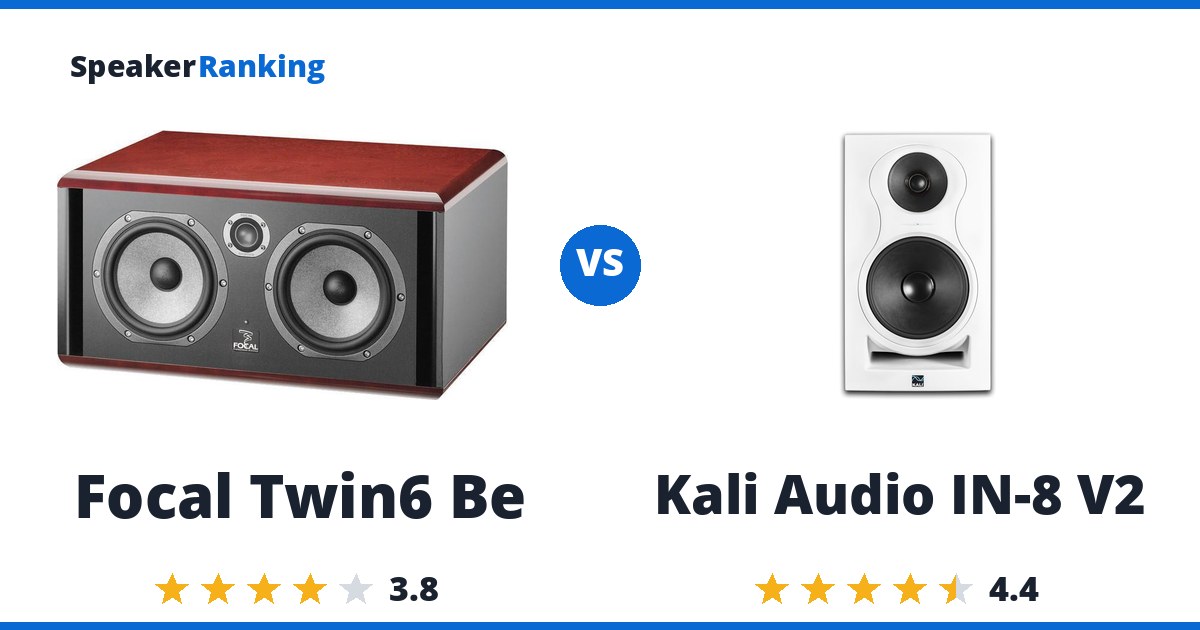
Why pick the Focal Twin6 Be: The dual-woofer arrangement offers useful output capability for studio work, with a 48.3Hz measured -3dB point in the horizontal test. The tradeoff: The horizontal measurement scores 6.06 with an ideal subwoofer and spans 2.9dB from 300Hz to 5kHz.
The Kali Audio IN-8 V2 is the more accurate pick. The IN-8 V2’s coaxial midrange/tweeter supports coherent imaging, and low distortion at ordinary levels complements its 7.30 ideal-subwoofer score. Its measured preference score, a predictor of how neutral it sounds, is 5.36 against 4.04 for the Focal Twin6 Be. The catch: The measured 3.0dB response span from 300Hz to 5kHz includes unevenness that can make some vocals sound forward.
Buy the Kali Audio IN-8 V2. It is rated higher for sound quality; the Focal Twin6 Be is no longer sold new.
Looking for alternatives? See the complete Powered Home rankings.
Specifications Side By Side
| Focal Twin6 Be | Kali Audio IN-8 V2 | |
|---|---|---|
| Price | Discontinued | $998 per pair |
| Ranked | #101 of 113 in Large Size Powered Bookshelf Speakers | #38 of 113 in Large Size Powered Bookshelf Speakers |
| Bass Extension | 40Hz manufacturer specified; Erin measured strong low-frequency linearity | - |
| Bass Extension (-3dB) | 48.3Hz (measured, Erin’s Audio Corner) | 44Hz (measured, Erin’s Audio Corner) |
| Bass Extension (-10dB) | 39.1Hz (measured, Erin’s Audio Corner) | 36Hz (measured, Erin’s Audio Corner) |
| Drivers | 1” inverted beryllium tweeter; dual 6.5” W-cone drivers | 8” (203mm) woofer |
| Amplifier Power | 150W LF + 100W LF/MF + 100W HF | 140w Per Speaker |
| Inputs | Balanced XLR with +4dBu/-10dBV sensitivity | XLR, RCA |
| Spinorama Preference Score | 4.04 | 5.36 |
| Spinorama Preference Score with Perfect Sub | 6.06 | 7.30 |
| XLR Input | Yes | Yes |
| RCA Input | No | Yes |
| TRS Input | No | No |
| Optical Input | No | No |
| Coaxial Input | No | No |
| USB Input | No | No |
| HDMI Input | No | No |
| AES Input | No | No |
| Aux Input | No | No |
| Bluetooth | No | No |
| Dimensions | 9.8” x 19.7” x 13.4” (250 x 500 x 340 mm) (H x W x D) | 17.8”H x 10”W x 11.3”D (452.1 x 254 x 287 mm) |
| Frequency Response | 40Hz - 40kHz (±3dB) (Manufacturer specified) | 45Hz - 21kHz (±3dB) (Manufacturer specified) |
| Weight | 48.5 lbs (22 kg) | 22.9 lbs (10.4 kg) each |
| App | - | No |
| EQ | - | Yes (Room adjustment) |
| DSP | - | No |
| Sensitivity | - | 89dB (measured at 0.3V/1m, Erin’s Audio Corner) |
Related Speaker Comparisons
How Kali Audio IN-8 V2 compares with other leading options:
- Kali Audio IN-8 V2 vs AsciLab C8C
- Kali Audio IN-8 V2 vs Mesanovic CDM65
- Kii THREE vs Kali Audio IN-8 V2
- Genelec 8351B vs Kali Audio IN-8 V2
- Kali Audio IN-8 V2 vs Neumann KH420
Prices on this page were last checked October 9, 2026 at 8:01 AM UTC. Product prices and availability are accurate as of that date/time and are subject to change; the price and availability shown on Amazon at the time of purchase will apply to the purchase of this product.
As an eBay Partner, we may be compensated if you make a purchase.
The Two Speakers In Full
 Focal Twin6 Be Discontinued eBay
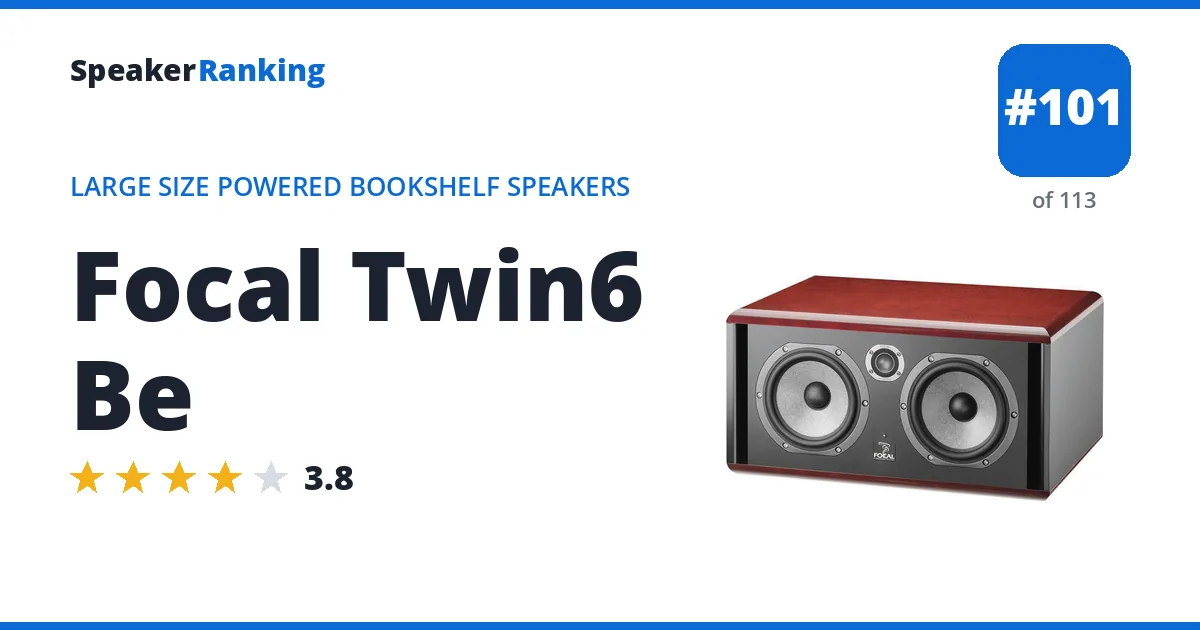
Newer model: the Focal ST6 Twin6, ranked lower, estimated 3.8/5.
Pros: The dual-woofer arrangement offers useful output capability for studio work, with a 48.3Hz measured -3dB point in the horizontal test. Its professional controls and format can suit a dedicated monitoring installation. Measured bass extension of 48.3Hz (-3dB).
Cons: The horizontal measurement scores 6.06 with an ideal subwoofer and spans 2.9dB from 300Hz to 5kHz. Off-axis variation limits tonal consistency across listening positions. Orientation matters, and neither the beryllium tweeter nor the additional woofer makes its measured balance class-leading. Erin suspected intermodulation-related roughness even though harmonic distortion measured low. Discontinued.
Full Focal Twin6 Be review and specifications →
| AES Input | No |
|---|---|
| Amplifier Power | 150W LF + 100W LF/MF + 100W HF |
| Aux Input | No |
| Bass Extension | 40Hz manufacturer specified; Erin measured strong low-frequency linearity |
| Bass Extension (-10dB) | 39.1Hz (measured, Erin’s Audio Corner) |
| Bass Extension (-3dB) | 48.3Hz (measured, Erin’s Audio Corner) |
| Bluetooth | No |
| Coaxial Input | No |
| Dimensions | 9.8” x 19.7” x 13.4” (250 x 500 x 340 mm) (H x W x D) |
| Drivers | 1” inverted beryllium tweeter; dual 6.5” W-cone drivers |
| Frequency Response | 40Hz - 40kHz (±3dB) (Manufacturer specified) |
| HDMI Input | No |
| Inputs | Balanced XLR with +4dBu/-10dBV sensitivity |
| Optical Input | No |
| RCA Input | No |
| Spinorama Preference Score | 4.04 |
| Spinorama Preference Score with Perfect Sub | 6.06 |
| TRS Input | No |
| USB Input | No |
| Weight | 48.5 lbs (22 kg) |
| XLR Input | Yes |
- Links
- Reviews, Comparisons and Sound Samples
- Head-to-Head Comparisons
- Focal Twin6 Be vs Edifier R2850DB
- Focal Twin6 Be vs Ex Machina Pulsar MKII
- Focal Twin6 Be vs Klipsch The Sevens
- Focal Twin6 Be vs Kali Audio LP-8
- Focal Twin6 Be vs Adam Audio T7V
- Focal Twin6 Be vs Adam Audio T8V
- Focal Twin6 Be vs PMC result6
- Focal Twin6 Be vs Ocean Way Audio HR5
- See all 35 comparisons
 Kali Audio IN-8 V2: $998 per pair Amazon eBay
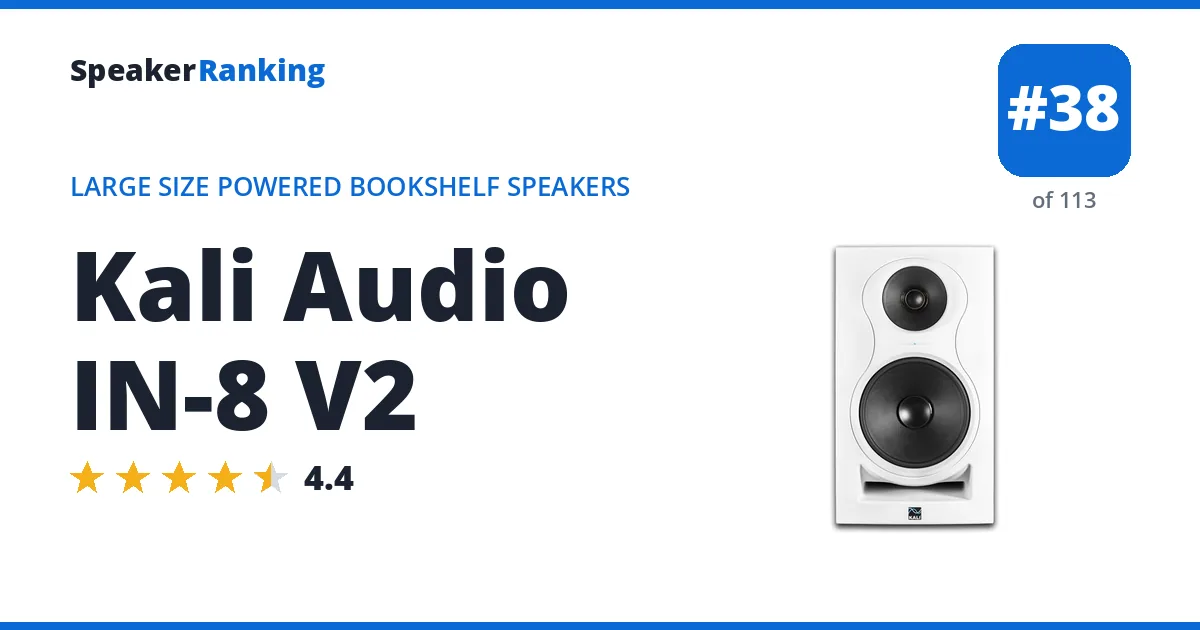
Same family: the Kali Audio IN-5 (smaller bookshelf, rated 4.2/5) and the Kali Audio IN-UNF (larger bookshelf, rated 3.3/5).
Pros: The IN-8 V2’s coaxial midrange/tweeter supports coherent imaging, and low distortion at ordinary levels complements its 7.30 ideal-subwoofer score. Measured -3dB extension of 45.4Hz provides useful bass; boundary settings assist placement. The front port allows placement near a wall without port noise problems. Measured bass extension of 44Hz (-3dB), with a measured sensitivity of 89dB.
Cons: The measured 3.0dB response span from 300Hz to 5kHz includes unevenness that can make some vocals sound forward. Bass and limiter behavior constrain high-level playback. These measurements apply to the V2, not the first-generation IN-8. On-axis, the 4 to 5kHz range sounds forward; Kali recommends about 10° of toe-out, and some EQ helps.
Full Kali Audio IN-8 V2 review and specifications →
| AES Input | No |
|---|---|
| Amplifier Power | 140w Per Speaker |
| App | No |
| Aux Input | No |
| Bass Extension (-10dB) | 36Hz (measured, Erin’s Audio Corner) |
| Bass Extension (-3dB) | 44Hz (measured, Erin’s Audio Corner) |
| Bluetooth | No |
| Coaxial Input | No |
| DSP | No |
| Dimensions | 17.8”H x 10”W x 11.3”D (452.1 x 254 x 287 mm) |
| Drivers | 8” (203mm) woofer |
| EQ | Yes (Room adjustment) |
| Frequency Response | 45Hz - 21kHz (±3dB) (Manufacturer specified) |
| HDMI Input | No |
| Inputs | XLR, RCA |
| Optical Input | No |
| RCA Input | Yes |
| Sensitivity | 89dB (measured at 0.3V/1m, Erin’s Audio Corner) |
| Spinorama Preference Score | 5.36 |
| Spinorama Preference Score with Perfect Sub | 7.30 |
| TRS Input | No |
| USB Input | No |
| Weight | 22.9 lbs (10.4 kg) each |
| XLR Input | Yes |
- Links
- Reviews, Comparisons and Sound Samples
- Head-to-Head Comparisons
- Kali Audio IN-8 V2 vs Genelec 8050B
- Kali Audio IN-8 V2 vs Kali Audio LP-6 V2
- Kali Audio IN-8 V2 vs Yamaha HS8
- Kali Audio IN-8 V2 vs JBL 4305P
- Kali Audio IN-8 V2 vs JBL 308P MKII
- Kali Audio IN-8 V2 vs Genelec S360
- Kali Audio IN-8 V2 vs HEDD Type 20 MK2
- Kali Audio IN-8 V2 vs Focal Solo6 ST6
- See all 42 comparisons