Short answer: the Focal Trio6 ST6. It ranks #37 of 68 powered bookshelf speakers by sound quality, rated 4.2/5, at $6,998. The Ocean Way Audio HR5 ranks #68, rated 2.5/5, at $5,598, $1,400 cheaper, a saving that is not big enough to make up the sound-quality gap.
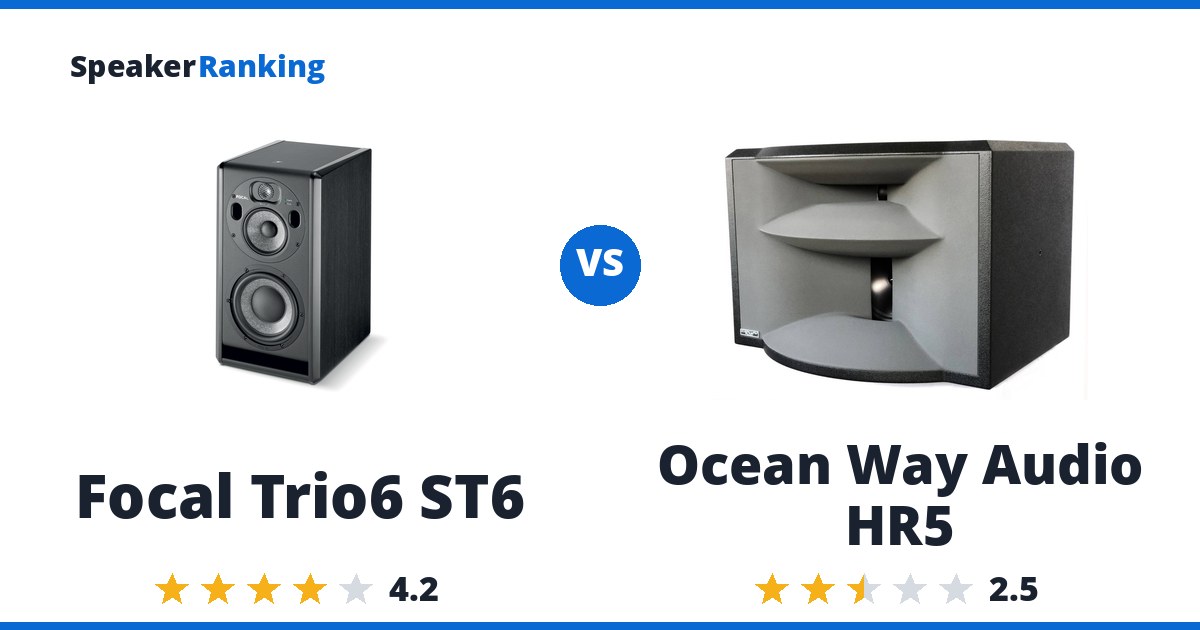
The case for the Focal Trio6 ST6: Sound & Recording’s measurements indicate 37.8Hz -3dB bass extension and a 7.12 ideal-subwoofer score. The catch: The measured balance tilts downward through the treble, with a 2.6dB response span from 300Hz to 5kHz.
The case for the Ocean Way Audio HR5: The active format and substantial drivers can supply useful scale in a studio system. The tradeoff: Scores of 1.78 standalone and 3.86 with an ideal subwoofer reflect substantial response unevenness, including severe upper-treble irregularities.
Buy the Focal Trio6 ST6. It is rated higher for sound quality, and the $1,400 you would save on the Ocean Way Audio HR5 does not close the gap.
Looking for alternatives? See the complete Powered Home rankings.
Specifications Side By Side
| Focal Trio6 ST6 | Ocean Way Audio HR5 | |
|---|---|---|
| Price | $6,998 per pair | $5,598 per pair |
| Ranked | #37 of 68 in Large Size Powered Bookshelf Speakers | #68 of 68 in Large Size Powered Bookshelf Speakers |
| Enclosure | 3-way active, sealed/ported | - |
| Drivers | 1.5” beryllium inverted-dome tweeter, 5” W-composite midrange, 8” W-composite woofer | 7” low-frequency driver, 1” high-frequency driver (horn/waveguide) |
| Dimensions | 21.1”H x 11.5”W x 14.4”D (537 x 292 x 367 mm) | 12H x 17.5W x 14.5D in |
| Weight | 55.1 lbs (25 kg) each | 37.9 lbs (17.2 kg) each |
| Amplifier Power | 250W total (2x 100W Class-G bass/mid, 50W Class-AB tweeter) | 215W total (125W LF, 90W HF) |
| Country | France | - |
| Spinorama Preference Score | 5.46 | 1.78 |
| Spinorama Preference Score with Perfect Sub | 7.12 | 3.86 |
| Inputs | XLR | XLR (analog), XLR AES3 (digital) |
| XLR Input | Yes | Yes |
| RCA Input | No | No |
| TRS Input | No | No |
| Optical Input | No | No |
| Coaxial Input | No | No |
| USB Input | No | No |
| HDMI Input | No | No |
| AES Input | No | Yes |
| Aux Input | No | No |
| Bluetooth | No | No |
| Frequency Response | 35Hz - 40kHz (+/-3dB) (Manufacturer specified) | 45Hz - 20kHz (Manufacturer specified) |
| Bass Extension (-3dB) | - | 52.7Hz (measured, Audio Science Review) |
| Bass Extension (-10dB) | - | 42Hz (derived, log-interpolated between spinorama.org -9dB/-12dB points) |
| App | - | No |
| EQ | - | No |
| DSP | - | No |
Related Speaker Comparisons
How Focal Trio6 ST6 compares with other leading options:
- Focal Trio6 ST6 vs Palmer Orbit 11
- Meyer Sound Amie vs Focal Trio6 ST6
- Dynaudio Core 47 vs Focal Trio6 ST6
- Ex Machina Pulsar MKII vs Focal Trio6 ST6
- Focal Twin6 Be vs Ocean Way Audio HR5
Prices on this page were last checked September 29, 2026 at 3:43 PM UTC. Product prices and availability are accurate as of that date/time and are subject to change; the price and availability shown on Amazon at the time of purchase will apply to the purchase of this product.
As an eBay Partner, we may be compensated if you make a purchase.
The Two Speakers In Full
 Focal Trio6 ST6: $6,998 per pair Amazon eBay
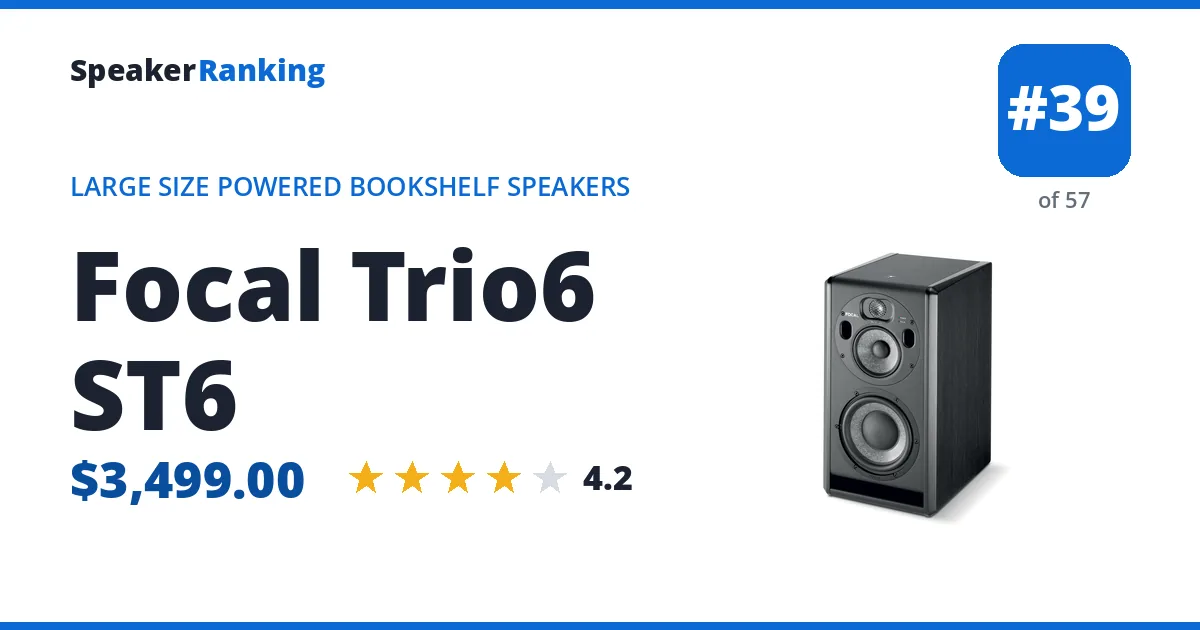
Pros: Sound & Recording’s measurements indicate 37.8Hz -3dB bass extension and a 7.12 ideal-subwoofer score. The three-way format and alternate Focus monitoring modes offer useful flexibility for professional work.
Cons: The measured balance tilts downward through the treble, with a 2.6dB response span from 300Hz to 5kHz. Heavy cabinets and a premium price do not by themselves establish better neutrality, and alternate modes change the result.
Full Focal Trio6 ST6 review and specifications →
| AES Input | No |
|---|---|
| Amplifier Power | 250W total (2x 100W Class-G bass/mid, 50W Class-AB tweeter) |
| Aux Input | No |
| Bluetooth | No |
| Coaxial Input | No |
| Country | France |
| Dimensions | 21.1”H x 11.5”W x 14.4”D (537 x 292 x 367 mm) |
| Drivers | 1.5” beryllium inverted-dome tweeter, 5” W-composite midrange, 8” W-composite woofer |
| Enclosure | 3-way active, sealed/ported |
| Frequency Response | 35Hz - 40kHz (+/-3dB) (Manufacturer specified) |
| HDMI Input | No |
| Inputs | XLR |
| Optical Input | No |
| RCA Input | No |
| Spinorama Preference Score | 5.46 |
| Spinorama Preference Score with Perfect Sub | 7.12 |
| TRS Input | No |
| USB Input | No |
| Weight | 55.1 lbs (25 kg) each |
| XLR Input | Yes |
- Links
- Reviews, Comparisons and Sound Samples
- Head-to-Head Comparisons
 Ocean Way Audio HR5: $5,598 per pair Sweetwater eBay
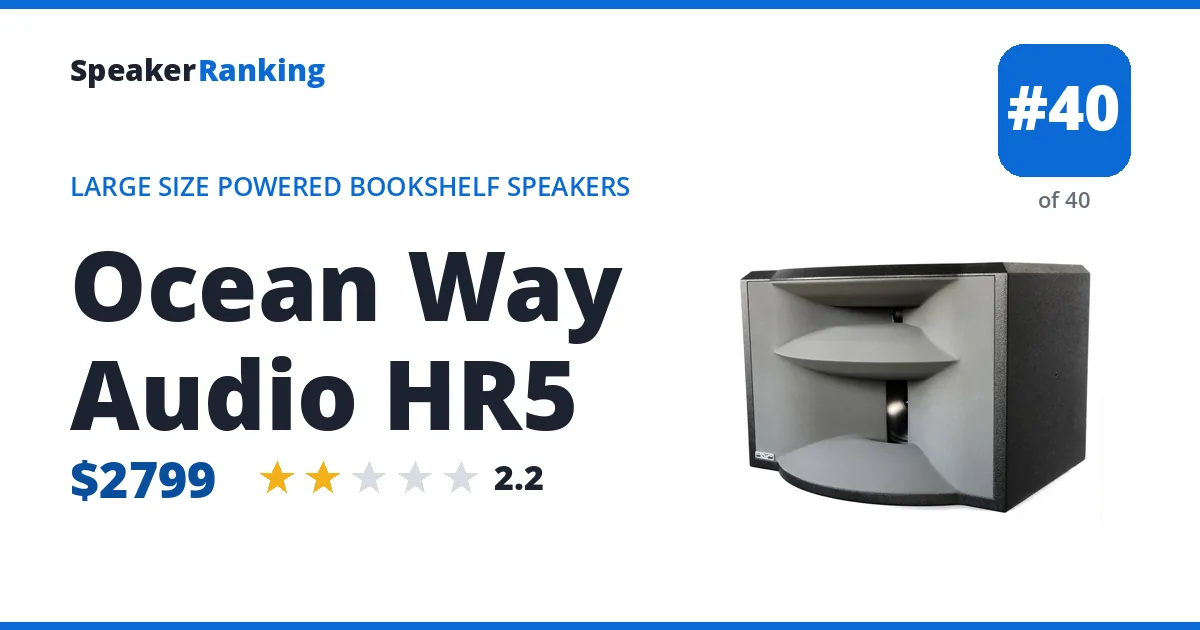
Pros: The active format and substantial drivers can supply useful scale in a studio system. Measured -3dB extension is 52.7Hz, so separate bass support would be appropriate for full-range work. Measured bass extension of 52.7Hz (-3dB).
Cons: Scores of 1.78 standalone and 3.86 with an ideal subwoofer reflect substantial response unevenness, including severe upper-treble irregularities. Narrowing high-frequency coverage further changes the balance across listening positions. Bass support cannot repair those midrange and treble problems, making this difficult to recommend for neutral monitoring.
Full Ocean Way Audio HR5 review and specifications →
| AES Input | Yes |
|---|---|
| Amplifier Power | 215W total (125W LF, 90W HF) |
| App | No |
| Aux Input | No |
| Bass Extension (-10dB) | 42Hz (derived, log-interpolated between spinorama.org -9dB/-12dB points) |
| Bass Extension (-3dB) | 52.7Hz (measured, Audio Science Review) |
| Bluetooth | No |
| Coaxial Input | No |
| DSP | No |
| Dimensions | 12H x 17.5W x 14.5D in |
| Drivers | 7” low-frequency driver, 1” high-frequency driver (horn/waveguide) |
| EQ | No |
| Frequency Response | 45Hz - 20kHz (Manufacturer specified) |
| HDMI Input | No |
| Inputs | XLR (analog), XLR AES3 (digital) |
| Optical Input | No |
| RCA Input | No |
| Spinorama Preference Score | 1.78 |
| Spinorama Preference Score with Perfect Sub | 3.86 |
| TRS Input | No |
| USB Input | No |
| Weight | 37.9 lbs (17.2 kg) each |
| XLR Input | Yes |
- Links
- Reviews, Comparisons and Sound Samples
- Head-to-Head Comparisons