Short answer: both are discontinued, so this only matters if you are buying used. Used, the Focal Chora 816 is the better pick: it ranks #26 of 188 floorstanding speakers by sound quality (rated 4.5/5), against #187 (rated 1.9/5) for the Bose 901 Series V. If you want one new, the Focal Theva N°2 replaces the Focal Chora 816 and is rated 4.4/5 at $999.
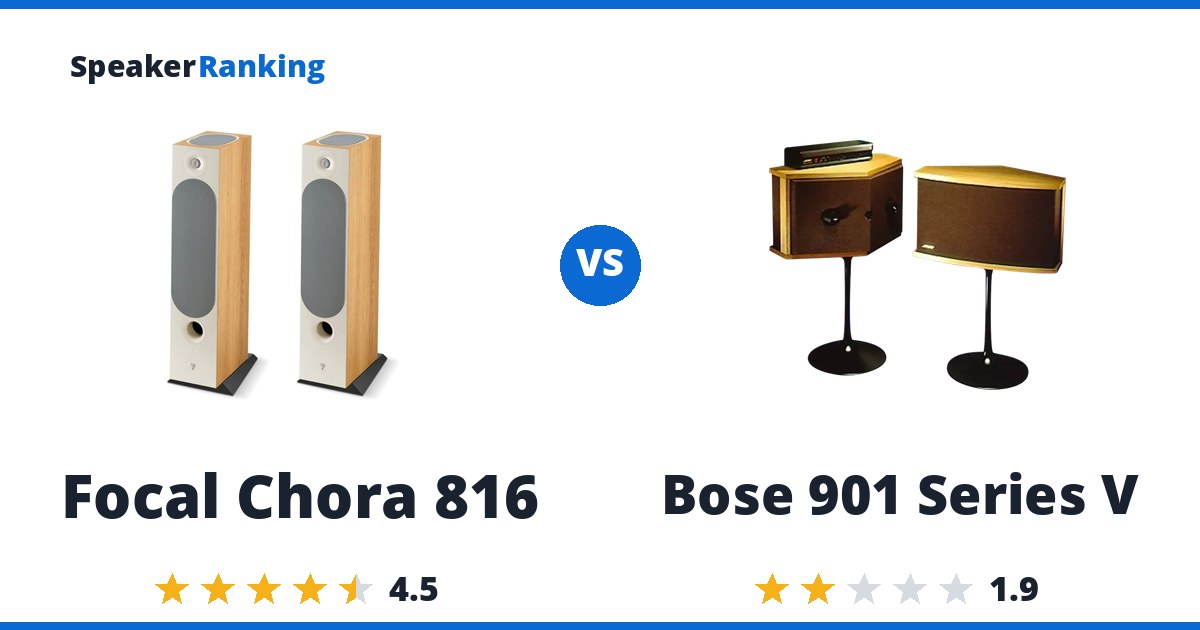
The Focal Chora 816 is the more accurate option. CEA2034 spinorama shows a generally even on-axis response with nice bass extension and high sensitivity. Its measured preference score, a predictor of how neutral it sounds, is 4.30 against 0.43 for the Bose 901 Series V. The tradeoff: Some messiness appears between 500Hz-2kHz on-axis, including a dip around 550Hz.
The case for the Bose 901 Series V: Historically distinctive direct/reflecting architecture uses eight rear-firing and one front-firing full-range drivers to create a very large, room-filling presentation. Watch for: Even with the required EQ, Erin measured only about 81dB sensitivity, grossly non-flat response, numerous impedance/resonance irregularities and very high distortion.
Buy the Focal Chora 816 only if you find one used in good condition; both are discontinued, and it is the better rated of the two. For a new speaker, buy the Focal Theva N°2, which replaces the Focal Chora 816.
Still deciding? The full Passive Home rankings cover every ranked option.
Specifications Side By Side
| Focal Chora 816 | Bose 901 Series V | |
|---|---|---|
| Price | $900 per pair used, Discontinued | Discontinued |
| Ranked | #26 of 188 in Large Size Floorstanding Speakers | #187 of 188 in Large Size Floorstanding Speakers |
| Bass Extension (-10dB) | 35Hz (measured, Audio Science Review) | 34.5Hz (measured, Erin’s Audio Corner) |
| Bass Extension (-3dB) | 60Hz (measured, Audio Science Review) | 55.8Hz (measured, Erin’s Audio Corner) |
| Dimensions | 40.7”H x 11.8”W x 15.3”D (1033.8 x 299.7 x 388.6 mm) | 21”H x 21”W x 12.6”D (533.4 x 533.4 x 320.7 mm) |
| Impedance | 8 ohms nominal (3.9 ohms minimum, measured, Audio Science Review) | 6.2 ohms minimum (measured, Erin’s Audio Corner) |
| Drivers | 6.5” (16.5cm) Slatefiber woofer, 6.5” (16.5cm) Slatefiber midrange, 1” (25mm) TNF Al/Mg inverted dome tweeter | Nine full-range drivers: eight rear-firing, one front-firing |
| Sensitivity | 91dB (measured, Audio Science Review) | Approximately 81dB/2.83V/1m with tested EQ setting (measured, Erin’s Audio Corner) |
| Weight | 40.8 lbs (18.5 kg) each | 35.3 lbs (16 kg) each |
| Woofer Cabinet | ported, front | - |
| Spinorama Preference Score | 4.30 | 0.43 |
| Spinorama Preference Score with Perfect Sub | 6.37 | 2.11 |
| DIY Kit | No | No |
| Bass Extension | - | Strongly dependent on supplied active equalizer and room (measured, Erin’s Audio Corner) |
| DSP | - | External analog active equalizer required |
Related Speaker Comparisons
More top alternatives to Focal Chora 816:
- KEF Blade Two Meta vs Focal Chora 816
- Focal Chora 816 vs MoFi SourcePoint 888
- Revel F328Be vs Focal Chora 816
- KEF R5 Meta vs Focal Chora 816
- Revel F226Be vs Focal Chora 816
Prices on this page were last checked October 9, 2026 at 8:01 AM UTC. Product prices and availability are accurate as of that date/time and are subject to change; the price and availability shown on Amazon at the time of purchase will apply to the purchase of this product.
As an eBay Partner, we may be compensated if you make a purchase.
The Two Speakers In Full
 Focal Chora 816: $900 per pair used Discontinued eBay
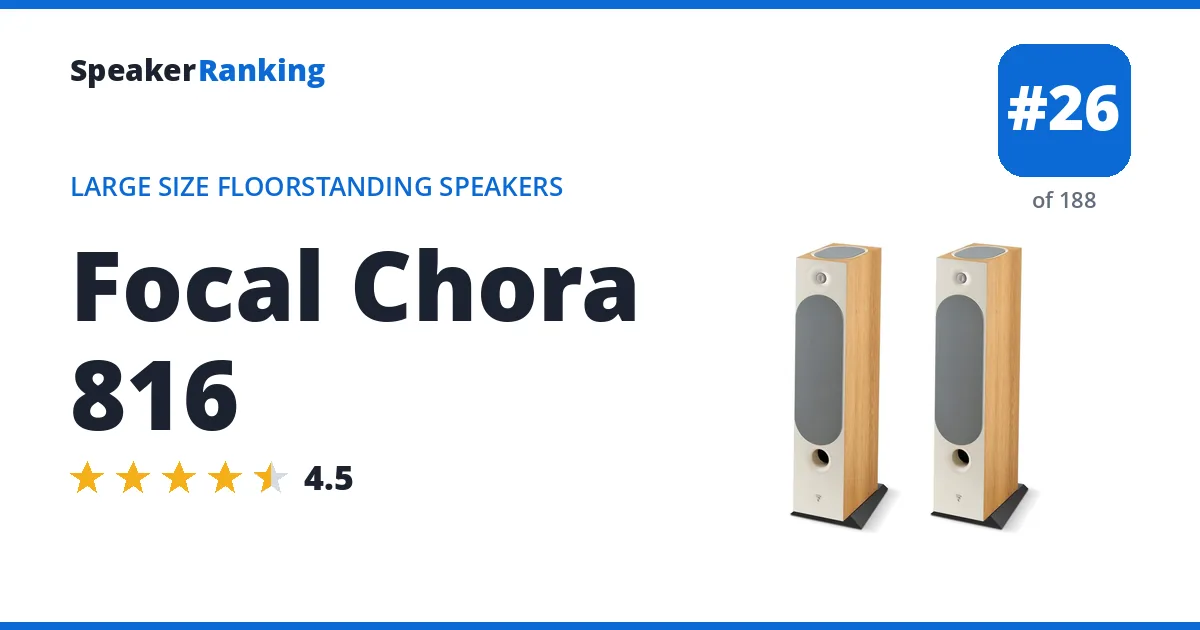
Newer model: the Focal Theva N°2, ranked lower, estimated 4.4/5.
Pros: CEA2034 spinorama shows a generally even on-axis response with nice bass extension and high sensitivity. Predicted in-room response is very good aside from a peak around 8kHz. Horizontal beamwidth of about ±60 degrees is typical and fairly controlled. Distortion is very low at 86dB SPL/1m and still usable at 96dB SPL/1m. Measured bass extension of 60Hz (-3dB), with a measured sensitivity of 91dB.
Cons: Some messiness appears between 500Hz-2kHz on-axis, including a dip around 550Hz. Vertical directivity narrows a little, so listening height matters more than with a coincident design. Cumulative spectral decay (waterfall) shows a fair bit of resonances lingering across the midrange. Distortion rises substantially in the 1-2kHz region at 96dB SPL/1m. Minimum impedance dips to about 3.9 ohms. Discontinued.
Full Focal Chora 816 review and specifications →
| Bass Extension (-10dB) | 35Hz (measured, Audio Science Review) |
|---|---|
| Bass Extension (-3dB) | 60Hz (measured, Audio Science Review) |
| DIY Kit | No |
| Dimensions | 40.7”H x 11.8”W x 15.3”D (1033.8 x 299.7 x 388.6 mm) |
| Drivers | 6.5” (16.5cm) Slatefiber woofer, 6.5” (16.5cm) Slatefiber midrange, 1” (25mm) TNF Al/Mg inverted dome tweeter |
| Impedance | 8 ohms nominal (3.9 ohms minimum, measured, Audio Science Review) |
| Sensitivity | 91dB (measured, Audio Science Review) |
| Spinorama Preference Score | 4.30 |
| Spinorama Preference Score with Perfect Sub | 6.37 |
| Weight | 40.8 lbs (18.5 kg) each |
| Woofer Cabinet | ported, front |
- Links
- Reviews, Comparisons and Sound Samples
- Head-to-Head Comparisons
 Bose 901 Series V Discontinued eBay
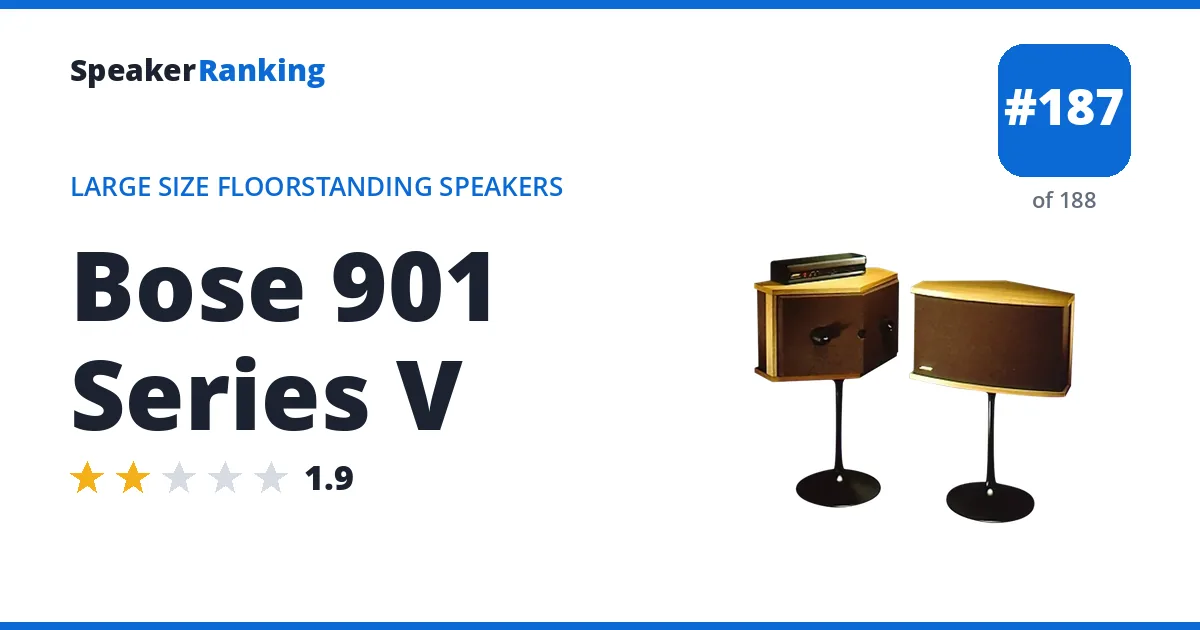
Pros: Historically distinctive direct/reflecting architecture uses eight rear-firing and one front-firing full-range drivers to create a very large, room-filling presentation. Erin measured a benign 6.2-ohm minimum impedance, so the raw electrical load is easier than many modern four-ohm speakers. The supplied active equalizer offers user-adjustable tonal balance and is integral to obtaining usable bandwidth. Measured bass extension of 55.8Hz (-3dB), with a measured sensitivity of 81dB.
Cons: Even with the required EQ, Erin measured only about 81dB sensitivity, grossly non-flat response, numerous impedance/resonance irregularities and very high distortion. Output above roughly 90-95dB at his seat became audibly poor; multitone testing reached only about 98dB before the distortion limit. The reflection-dominant radiation prevents precise imaging and makes results strongly room-dependent. It requires the proprietary equalizer and substantial amplifier power despite its benign impedance. Discontinued.
Full Bose 901 Series V review and specifications →
| Bass Extension | Strongly dependent on supplied active equalizer and room (measured, Erin’s Audio Corner) |
|---|---|
| Bass Extension (-10dB) | 34.5Hz (measured, Erin’s Audio Corner) |
| Bass Extension (-3dB) | 55.8Hz (measured, Erin’s Audio Corner) |
| DIY Kit | No |
| DSP | External analog active equalizer required |
| Dimensions | 21”H x 21”W x 12.6”D (533.4 x 533.4 x 320.7 mm) |
| Drivers | Nine full-range drivers: eight rear-firing, one front-firing |
| Impedance | 6.2 ohms minimum (measured, Erin’s Audio Corner) |
| Sensitivity | Approximately 81dB/2.83V/1m with tested EQ setting (measured, Erin’s Audio Corner) |
| Spinorama Preference Score | 0.43 |
| Spinorama Preference Score with Perfect Sub | 2.11 |
| Weight | 35.3 lbs (16 kg) each |
- Reviews, Comparisons and Sound Samples
- Head-to-Head Comparisons
- Bose 901 Series V vs Triangle Esprit Antal Ez
- Bose 901 Series V vs JBL Studio 590
- Bose 901 Series V vs Sony SS-CS3
- Bose 901 Series V vs Børresen X3
- Bose 901 Series V vs JBL Stage 2 280F
- Bose 901 Series V vs Magnepan LRS+
- Bose 901 Series V vs Infinity Reference 253
- Bose 901 Series V vs Focal Aria Evo X N°2
- See all 24 comparisons