Short answer: the JTR Noesis 210HT, if you are buying new. The ELAC VELA BS 403 measures as well as it (#35 vs #40 of 131 bookshelf speakers, 4.3/5 vs 4.3/5) but is discontinued, so only consider it used; the JTR Noesis 210HT is still sold new at $3,998.
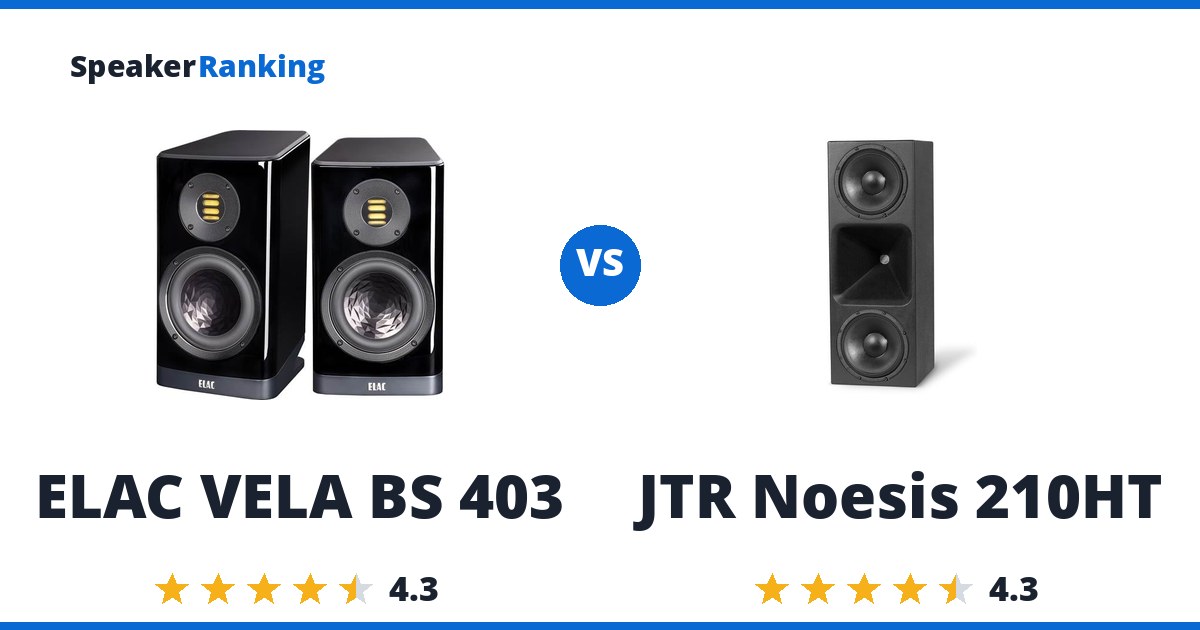
What the ELAC VELA BS 403 does well: JET 5 folded ribbon tweeter pairs with a 6” aluminum/paper sandwich woofer for extended, well-controlled bass: Erin measured usable in-room extension to about 50 Hz, deeper than JBL’s competing L52 Classic despite lacking that speaker’s mild upper-bass bump. The catch: Deliberate dip-and-peak voicing in the crossover region around 2 kHz reduces attack and clarity in the mids and highs: intentional per ELAC’s design, but not to Erin’s personal preference.
The case for the JTR Noesis 210HT: Exceptionally high-output sealed loudspeaker: Erin measured 92.5dB/2.83V/1m sensitivity, less than 3% distortion at both 86dB and 96dB test levels, and excellent compression behavior. The tradeoff: Erin measured F3 at 76Hz and F10 at 43Hz, so the 210HT is designed to hand bass duties to subwoofers rather than operate full-range.
Buy the JTR Noesis 210HT if you want one new; the ELAC VELA BS 403 is discontinued, so only look for it used.
Still deciding? The full Passive Home rankings cover every ranked option.
Specifications Side By Side
| ELAC VELA BS 403 | JTR Noesis 210HT | |
|---|---|---|
| Price | $2,899 per pair Discontinued | $3,998 per pair |
| Ranked | #35 of 131 in Large Size Bookshelf Speakers | #40 of 131 in Large Size Bookshelf Speakers |
| Drivers | JET 5 folded ribbon tweeter, 6” aluminum/paper sandwich cone woofer | Dual 10” woofers; coaxial compression driver on 60° x 60° horn |
| Dimensions | 14-3/16”H x 7-1/2”W x 9-3/8”D | 34”H x 12.25”W x 14”D |
| Weight | 15.7 lbs (7.1 kg) each | 85.1 lbs (38.6 kg) each |
| Impedance | 4 ohms nominal, 3.2 ohms minimum (measured, Erin’s Audio Corner) | Approximately 3 ohms minimum at 100-200Hz (measured, Erin’s Audio Corner) |
| Sensitivity | 84.3dB (measured average, Erin’s Audio Corner) | 92.5dB/2.83V/1m (measured, Erin’s Audio Corner) |
| Frequency Response | 41Hz - 50kHz (manufacturer specified) | - |
| Recommended Power | up to 100W RMS | - |
| Bass Extension (-3dB) | 59Hz (measured average, Erin’s Audio Corner) | 76Hz (measured, Erin’s Audio Corner) |
| Bass Extension (-10dB) | 46Hz (measured average, Erin’s Audio Corner) | 43Hz (measured, Erin’s Audio Corner) |
| Crossover Frequency | 2.4kHz | Approximately 850Hz |
| Spinorama Preference Score | 3.94 | 2.66 |
| Spinorama Preference Score with Perfect Sub | 6.28 | 5.41 |
| DIY Kit | No | No |
| Woofer Cabinet | - | sealed |
Related Speaker Comparisons
More top alternatives to ELAC VELA BS 403:
- Wharfedale Super Linton vs ELAC VELA BS 403
- Dynaudio Heritage Special vs ELAC VELA BS 403
- Selah Audio Purezza vs ELAC VELA BS 403
- Wharfedale Linton 85 vs ELAC VELA BS 403
- Revel M126Be vs ELAC VELA BS 403
Prices on this page were last checked September 29, 2026 at 3:43 PM UTC. Product prices and availability are accurate as of that date/time and are subject to change; the price and availability shown on Amazon at the time of purchase will apply to the purchase of this product.
As an eBay Partner, we may be compensated if you make a purchase.
The Two Speakers In Full
 ELAC VELA BS 403: $2,899 per pair Discontinued eBay
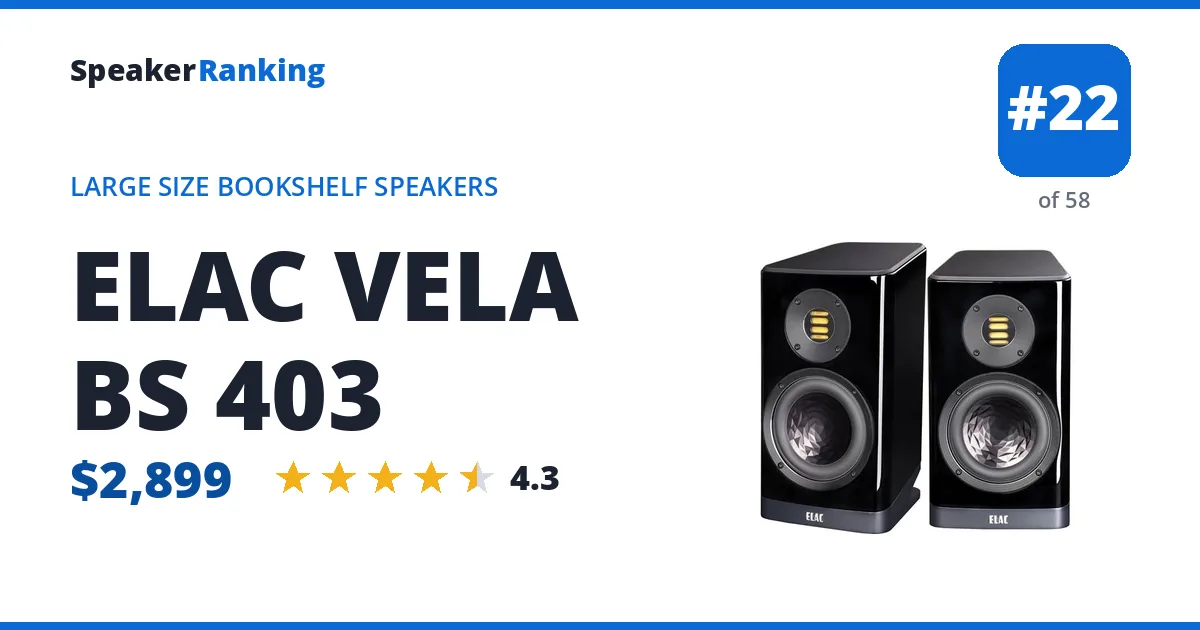
Newer model: the ELAC Vela BS 403.2. It’s likely to perform similarly, though we don’t have measurements to confirm that yet.
Pros: JET 5 folded ribbon tweeter pairs with a 6” aluminum/paper sandwich woofer for extended, well-controlled bass: Erin measured usable in-room extension to about 50 Hz, deeper than JBL’s competing L52 Classic despite lacking that speaker’s mild upper-bass bump. Compression stays within about 1 dB above 100 Hz up to 102 dB, on the better side of normal for a bookshelf this size, indicating good dynamic and transient capability. Wide, spacious soundstage radiation. Overall neutral voicing that Erin called “a really good speaker,” from the looks to the sound. Measured bass extension of 59Hz (-3dB), with a measured sensitivity of 84.3dB.
Cons: Deliberate dip-and-peak voicing in the crossover region around 2 kHz reduces attack and clarity in the mids and highs: intentional per ELAC’s design, but not to Erin’s personal preference. Lower measured sensitivity (84.3 dB) means it wants more amplifier power than average to reach the same levels. Multitone distortion roughly triples, from about 1% to 3%, between 88 dB and 96 dB output, so it’s happiest at moderate listening levels. A minor distortion bump shows up around 800 Hz in the data, though Erin didn’t hear it. Discontinued and no longer sold new.
Full ELAC VELA BS 403 review and specifications →
| Bass Extension (-10dB) | 46Hz (measured average, Erin’s Audio Corner) |
|---|---|
| Bass Extension (-3dB) | 59Hz (measured average, Erin’s Audio Corner) |
| Crossover Frequency | 2.4kHz |
| DIY Kit | No |
| Dimensions | 14-3/16”H x 7-1/2”W x 9-3/8”D |
| Drivers | JET 5 folded ribbon tweeter, 6” aluminum/paper sandwich cone woofer |
| Frequency Response | 41Hz - 50kHz (manufacturer specified) |
| Impedance | 4 ohms nominal, 3.2 ohms minimum (measured, Erin’s Audio Corner) |
| Recommended Power | up to 100W RMS |
| Sensitivity | 84.3dB (measured average, Erin’s Audio Corner) |
| Spinorama Preference Score | 3.94 |
| Spinorama Preference Score with Perfect Sub | 6.28 |
| Weight | 15.7 lbs (7.1 kg) each |
- Reviews, Comparisons and Sound Samples
- Head-to-Head Comparisons
- ELAC VELA BS 403 vs Philharmonic BMR (v1)
- ELAC VELA BS 403 vs Revel M126Be
- ELAC VELA BS 403 vs Wharfedale Linton 85
- ELAC VELA BS 403 vs Selah Audio Purezza
- ELAC VELA BS 403 vs Emotiva Airmotiv XB2
- ELAC VELA BS 403 vs ELAC Debut 3.0 DB63
- ELAC VELA BS 403 vs Dynaudio Heritage Special
- ELAC VELA BS 403 vs JBL HDI-1600
- See all 14 comparisons
 JTR Noesis 210HT: $3,998 per pair JTR Speakers eBay
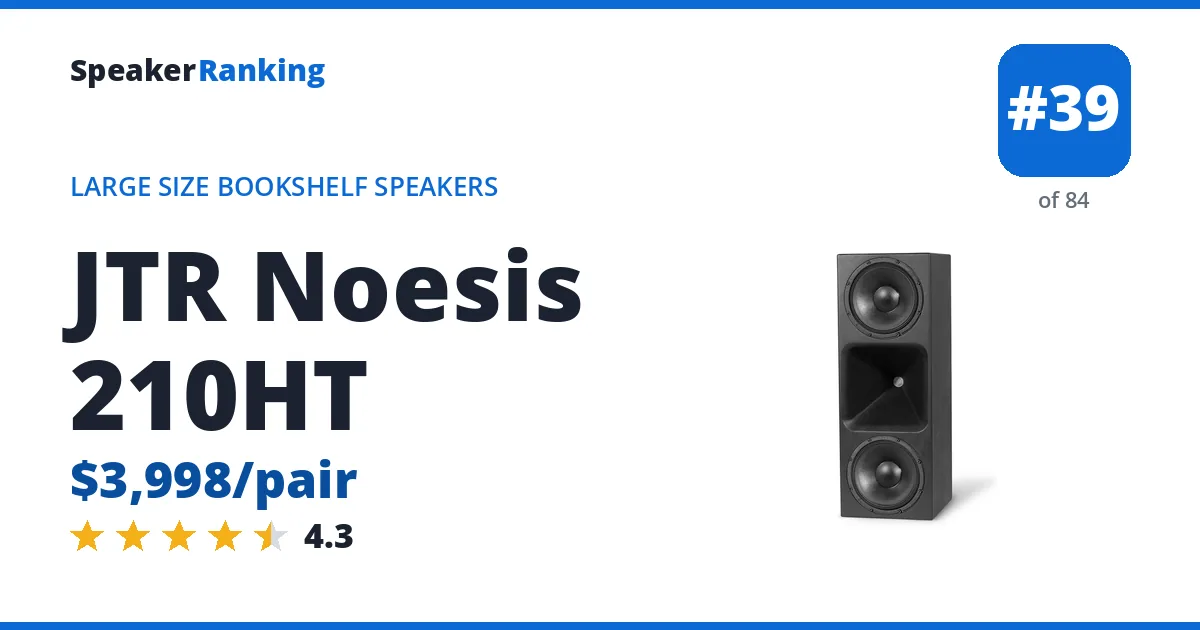
Pros: Exceptionally high-output sealed loudspeaker: Erin measured 92.5dB/2.83V/1m sensitivity, less than 3% distortion at both 86dB and 96dB test levels, and excellent compression behavior. The coaxial compression driver and dual 10-inch woofers cross at roughly 850Hz into a nominal 60° x 60° pattern, keeping radiation controlled enough that broad response errors remain amenable to EQ. Its sealed 12dB/octave bass roll-off simplifies subwoofer integration, while Baltic-birch construction and professional-grade drivers suit reference-level cinema use. Measured bass extension of 76Hz (-3dB), with a measured sensitivity of 92.5dB.
Cons: Erin measured F3 at 76Hz and F10 at 43Hz, so the 210HT is designed to hand bass duties to subwoofers rather than operate full-range. The impedance falls to approximately 3 ohms through 100-200Hz (Erin), making a stable separate amplifier preferable. Midrange resonances and the horn-to-woofer directivity transition raise the predicted in-room treble balance; careful toe-in, room treatment and DSP are advisable. Each enclosure is unusually large and heavy for a stand-mount, and the narrow coverage is less forgiving across a wide seating area.
Full JTR Noesis 210HT review and specifications →
| Bass Extension (-10dB) | 43Hz (measured, Erin’s Audio Corner) |
|---|---|
| Bass Extension (-3dB) | 76Hz (measured, Erin’s Audio Corner) |
| Crossover Frequency | Approximately 850Hz |
| DIY Kit | No |
| Dimensions | 34”H x 12.25”W x 14”D |
| Drivers | Dual 10” woofers; coaxial compression driver on 60° x 60° horn |
| Impedance | Approximately 3 ohms minimum at 100-200Hz (measured, Erin’s Audio Corner) |
| Sensitivity | 92.5dB/2.83V/1m (measured, Erin’s Audio Corner) |
| Spinorama Preference Score | 2.66 |
| Spinorama Preference Score with Perfect Sub | 5.41 |
| Weight | 85.1 lbs (38.6 kg) each |
| Woofer Cabinet | sealed |
- Links
- Reviews, Comparisons and Sound Samples
- Head-to-Head Comparisons