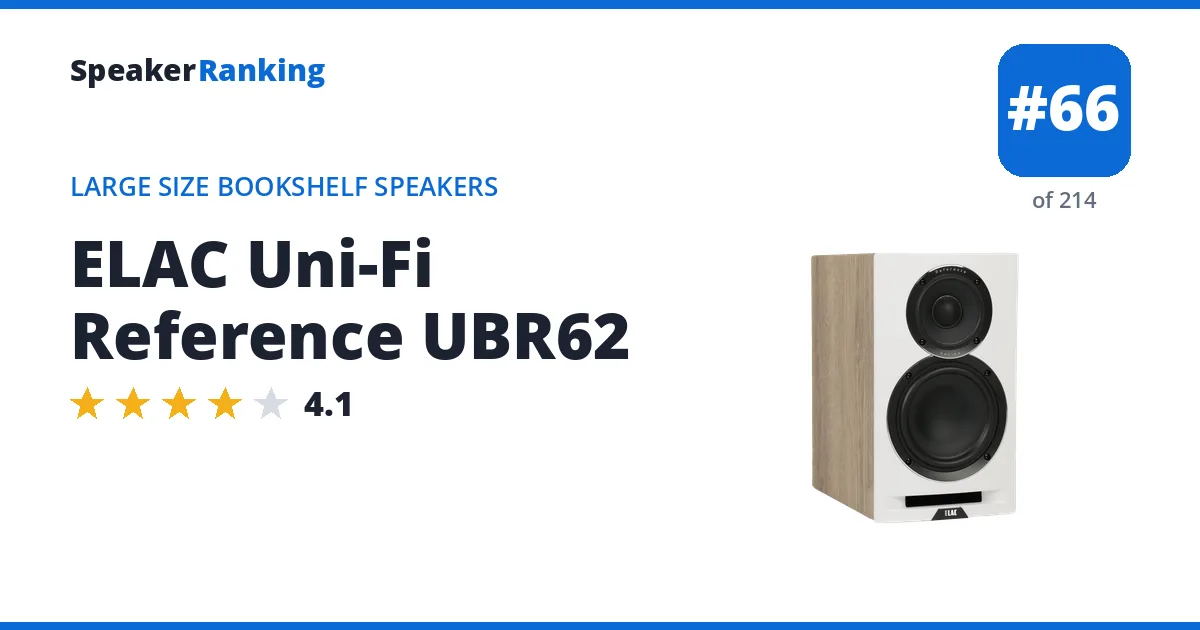
Short answer: the ELAC Uni-Fi Reference UBR62. It ranks #54 of 131 bookshelf speakers by sound quality, rated 4.1/5, at $1,199. The Polk R200 ranks #99, rated 3.2/5, at $799, $400 cheaper, not enough of a saving to outweigh the sound-quality gap.
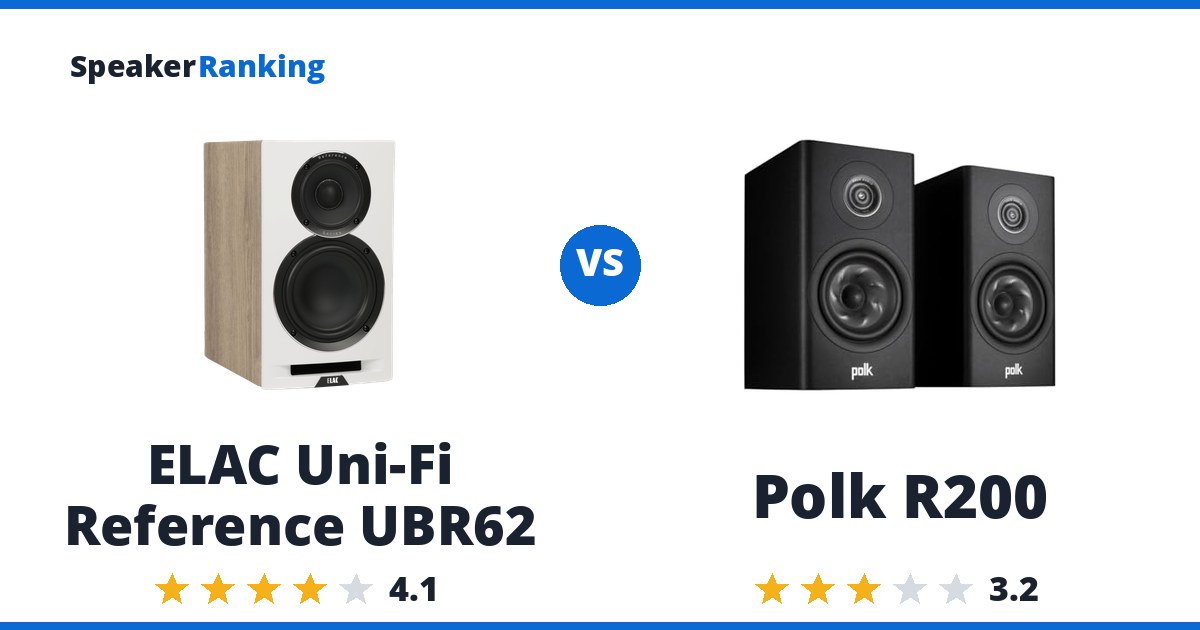
What the ELAC Uni-Fi Reference UBR62 does well: True three-way stand-mount using a 1-inch tweeter concentrically mounted in a 4-inch aluminum midrange plus a dedicated 6.5-inch aluminum woofer. Watch for: Erin measured very low 83dB/2.83V/1m sensitivity; his 110W Parasound was insufficient for the high-level test and the more powerful HINT 6 was needed.
The case for the Polk R200: Two-way design with a 6.5” midwoofer and 1” ring radiator tweeter, giving reasonably tight, well-defined imaging. The tradeoff: A resonance and associated distortion increase around 800Hz-1kHz creates a “tinny,” occasionally glaring quality on certain instruments and vocals, confirmed both by ear and in the frequency-response and distortion measurements.
Buy the ELAC Uni-Fi Reference UBR62. It is rated higher for sound quality, and the $400 saving on the Polk R200 is not enough to make up the difference.
Looking for alternatives? See the complete Passive Home rankings.
Specifications Side By Side
| ELAC Uni-Fi Reference UBR62 | Polk R200 | |
|---|---|---|
| Price | $1,199 per pair | $799.00 per pair |
| Ranked | #54 of 131 in Large Size Bookshelf Speakers | #99 of 131 in Large Size Bookshelf Speakers |
| Bass Extension | 41Hz manufacturer specified; Erin’s response-linearity graph shows limited high-output bass headroom | - |
| Bass Extension (-3dB) | 58.6Hz (measured, Erin’s Audio Corner) | 74Hz (measured, Erin’s Audio Corner) |
| Bass Extension (-10dB) | 41.9Hz (measured, Erin’s Audio Corner) | 50Hz (measured, Erin’s Audio Corner) |
| Sensitivity | 83dB/2.83V/1m (measured, Erin’s Audio Corner) | 85dB |
| Impedance | 4 ohms minimum near 50Hz (measured, Erin’s Audio Corner) | 4 ohms nominal, 3.8 ohms minimum (measured, Erin’s Audio Corner) |
| Drivers | 1” tweeter coaxial with 4” midrange; 6.5” woofer | 25mm soft dome + 165mm woofer |
| Dimensions | 14.1”H x 8.2”W x 13.1”D | 14.1”H x 7.5”W x 13.9”D (359.0 x 190.0 x 353.8 mm) |
| Woofer Cabinet | ported, dual front slot vents | ported, rear |
| Weight | 23.5 lbs (10.68 kg) each | 31.3 lbs (14.2 kg) |
| Spinorama Preference Score | 5.44 (measured, spinorama.org) | 5.09 |
| Spinorama Preference Score with Perfect Sub | 7.7 (measured, spinorama.org) | 7.61 |
| DIY Kit | No | No |
Related Speaker Comparisons
How ELAC Uni-Fi Reference UBR62 compares with other leading options:
- AsciLab C6B vs ELAC Uni-Fi Reference UBR62
- KEF R3 Meta vs ELAC Uni-Fi Reference UBR62
- KEF Q Concerto Meta vs ELAC Uni-Fi Reference UBR62
- KEF R3 vs ELAC Uni-Fi Reference UBR62
- Ascend Acoustics CMT-340 SE2 vs ELAC Uni-Fi Reference UBR62
Prices on this page were last checked September 26, 2026 at 11:14 PM UTC. Product prices and availability are accurate as of that date/time and are subject to change; the price and availability shown on Amazon at the time of purchase will apply to the purchase of this product.
As an eBay Partner, we may be compensated if you make a purchase.
The Two Speakers In Full
 ELAC Uni-Fi Reference UBR62: $1,199 per pair Amazon eBay
Pros: True three-way stand-mount using a 1-inch tweeter concentrically mounted in a 4-inch aluminum midrange plus a dedicated 6.5-inch aluminum woofer. Erin found the directivity and overall tonality well controlled, with dual front slot vents minimizing placement sensitivity and cabinet bracing suppressing obvious coloration. The mostly 5-ohm-or-higher load is manageable for a genuinely 4-ohm-capable amplifier, and the coherent concentric upper range supports stable imaging across seats. Measured bass extension of 58.6Hz (-3dB), with a measured sensitivity of 83dB.
Cons: Erin measured very low 83dB/2.83V/1m sensitivity; his 110W Parasound was insufficient for the high-level test and the more powerful HINT 6 was needed. Impedance reaches 4 ohms near 50Hz (Erin), while woofer excursion and bass output were less capable than expected for the cabinet size. A broad 500-700Hz rise and associated lower/female-vocal coloration were audible, and the slightly subdued listening-window treble is necessary to avoid an overly bright in-room balance rather than evidence of ruler-flat axial tuning.
Full ELAC Uni-Fi Reference UBR62 review and specifications →
| Bass Extension | 41Hz manufacturer specified; Erin’s response-linearity graph shows limited high-output bass headroom |
|---|---|
| Bass Extension (-10dB) | 41.9Hz (measured, Erin’s Audio Corner) |
| Bass Extension (-3dB) | 58.6Hz (measured, Erin’s Audio Corner) |
| DIY Kit | No |
| Dimensions | 14.1”H x 8.2”W x 13.1”D |
| Drivers | 1” tweeter coaxial with 4” midrange; 6.5” woofer |
| Impedance | 4 ohms minimum near 50Hz (measured, Erin’s Audio Corner) |
| Sensitivity | 83dB/2.83V/1m (measured, Erin’s Audio Corner) |
| Spinorama Preference Score | 5.44 (measured, spinorama.org) |
| Spinorama Preference Score with Perfect Sub | 7.7 (measured, spinorama.org) |
| Weight | 23.5 lbs (10.68 kg) each |
| Woofer Cabinet | ported, dual front slot vents |
- Links
- Reviews, Comparisons and Sound Samples
- Head-to-Head Comparisons
- ELAC Uni-Fi Reference UBR62 vs ELAC DBR62
- ELAC Uni-Fi Reference UBR62 vs Power Sound Audio MT-110-M
- ELAC Uni-Fi Reference UBR62 vs Yamaha NS-800A
- ELAC Uni-Fi Reference UBR62 vs Definitive Technology Demand D11
- ELAC Uni-Fi Reference UBR62 vs Revel Concerta2 M16
- ELAC Uni-Fi Reference UBR62 vs Technics SB-C700
- ELAC Uni-Fi Reference UBR62 vs Dynaudio Contour 20i
- ELAC Uni-Fi Reference UBR62 vs SVS Ultra Bookshelf
- See all 24 comparisons
 Polk R200: $799.00 per pair Amazon eBay
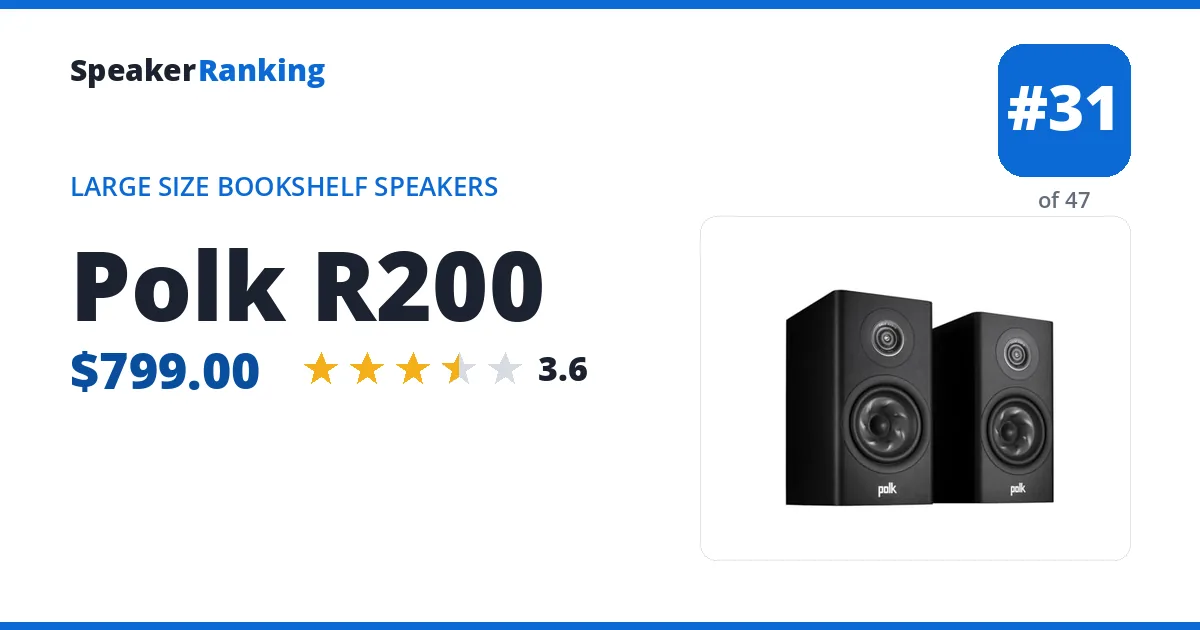
Pros: Two-way design with a 6.5” midwoofer and 1” ring radiator tweeter, giving reasonably tight, well-defined imaging. Neutral through most of the midrange (roughly 200Hz-1kHz). On-axis response holds within about 1.5dB up to 10kHz. About 20dB of usable dynamic range (76dB to 96dB) before more significant compression sets in. Reasonably close to a 4-ohm nominal load, giving some flexibility with amplifier choice, though a dedicated 4-ohm-capable amp is still recommended. Measured bass extension of 74Hz (-3dB).
Cons: A resonance and associated distortion increase around 800Hz-1kHz creates a “tinny,” occasionally glaring quality on certain instruments and vocals, confirmed both by ear and in the frequency-response and distortion measurements. Above about 10kHz, the ring-radiator tweeter takes on an artificial, “digital-esque” quality, then falls off quickly above 16kHz. F3 of 74Hz and F10 of 50Hz mean there’s essentially no meaningful bass “thump” below about 60Hz - a subwoofer is strongly recommended even just to restore basic kick-drum presence. The ring radiator tweeter’s dispersion narrows sharply above about 8kHz, so the speaker should be aimed close to on-axis (no more than 5-10° of toe-out). Vertical listening position is fairly critical - moving more than a few degrees above or below the tweeter line causes a noticeable timbre shift due to a gap in the crossover region. Multitone distortion spikes substantially (to around 10%) in the 600Hz-1kHz region at higher output levels (around 96dB/1m), meaning the glare gets worse the louder it’s played. At the highest tested output (102dB, 26dB of dynamic range), the woofer shows clear signs of struggling; crossing to a subwoofer around 80-100Hz helps prevent bottoming out but doesn’t fully eliminate the compression.
Full Polk R200 review and specifications →
| Bass Extension (-10dB) | 50Hz (measured, Erin’s Audio Corner) |
|---|---|
| Bass Extension (-3dB) | 74Hz (measured, Erin’s Audio Corner) |
| DIY Kit | No |
| Dimensions | 14.1”H x 7.5”W x 13.9”D (359.0 x 190.0 x 353.8 mm) |
| Drivers | 25mm soft dome + 165mm woofer |
| Impedance | 4 ohms nominal, 3.8 ohms minimum (measured, Erin’s Audio Corner) |
| Sensitivity | 85dB |
| Spinorama Preference Score | 5.09 |
| Spinorama Preference Score with Perfect Sub | 7.61 |
| Weight | 31.3 lbs (14.2 kg) |
| Woofer Cabinet | ported, rear |
- Links
- Reviews, Comparisons and Sound Samples
- Head-to-Head Comparisons