Short answer: the Dayton Audio M4. It ranks #52 of 100 powered bookshelf speakers by sound quality, rated 3.8/5, at $249.98; the Edifier S2000MKIII ranks #69, rated 3.5/5, and costs $529.99, so there is little reason to consider the other one.
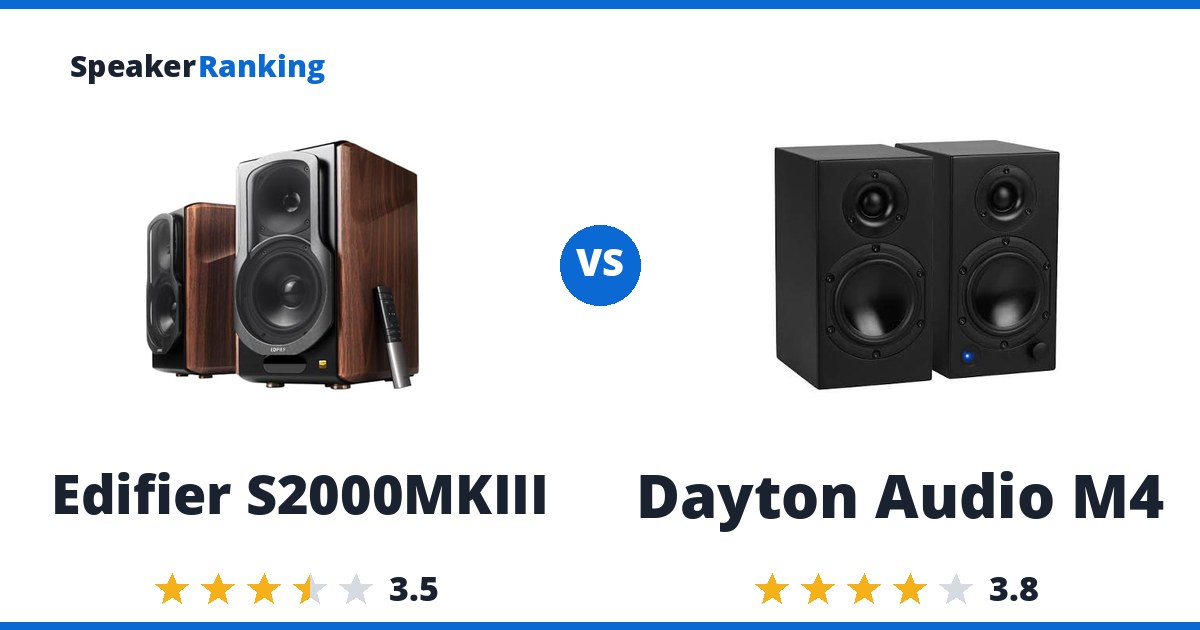
The case for the Edifier S2000MKIII: The available digitized response suggests substantial bass reach, with a -3dB estimate around 41Hz. It supports aptX HD Bluetooth, which the Dayton Audio M4 lacks. The catch: The 4.0dB midrange span and uneven predicted room response suggest meaningful coloration.
The case for the Dayton Audio M4: A compact powered pair with a subwoofer output, useful source connections and a solid cabinet. It keeps a wired aux input, which the Edifier S2000MKIII lacks. The tradeoff: Existing listening and output notes describe limited bass, a balance that changes with distance, and distortion rising above roughly 93dB.
Buy the Dayton Audio M4. It is rated higher for sound quality than the Edifier S2000MKIII and costs less, so only choose the other one for a particular feature it does better.
Want more options? Browse the full Powered Home rankings.
Specifications Side By Side
| Edifier S2000MKIII | Dayton Audio M4 | |
|---|---|---|
| Price | $529.99 per pair | $249.98 per pair |
| Ranked | #69 of 100 in Medium Size Powered Bookshelf Speakers | #52 of 100 in Medium Size Powered Bookshelf Speakers |
| Dimensions | 13.5”H x 7.8”W x 10.8”D (342.9 x 198.1 x 274.3 mm) | 5” x 6.5” x 9.5” (127 x 165 x 241 mm) (W x D x H) |
| Frequency Response | 40.5Hz at -3dB; 37Hz at -6dB (Spinorama) | 40Hz - 20kHz (Manufacturer specified) |
| Spinorama Preference Score | 4.24 | - |
| Inputs | Bluetooth, 2x RCA Input, Digital Optical, Digital Coax | RCA, USB-C, Bluetooth |
| Outputs | None | Subwoofer (20Hz-200Hz) |
| Drivers | 5.5” (140mm) woofer | 4” aluminum woofer, 1” silk dome tweeter |
| App | No | No |
| Bluetooth | Yes | Yes |
| Bluetooth Version | 5.0 | 5.0 |
| Bluetooth Codecs | SBC, aptX HD | SBC, aptX |
| EQ | No | - |
| Amplifier Power | 65w RMS Per Speaker | 75W RMS (150W peak) |
| Weight | 20.7 lbs (9.4 kg) | 6.2 lbs (2.81 kg) (active), 5.1 lbs (2.31 kg) (passive) |
| Spinorama Preference Score with Perfect Sub | 5.99 | - |
| XLR Input | No | No |
| RCA Input | Yes | Yes |
| TRS Input | No | No |
| Optical Input | Yes | No |
| Coaxial Input | Yes | No |
| USB Input | No | Yes |
| HDMI Input | No | No |
| AES Input | No | No |
| Aux Input | No | Yes (RCA) |
| Bass Extension (-3dB) | - | 121Hz (measured, Erin’s Audio Corner) |
| Bass Extension (-10dB) | - | 60Hz (measured, Erin’s Audio Corner) |
| Digital Aux Input | - | Yes (USB-C DAC, up to 192kHz/32-bit) |
| Stereo | - | Yes |
| Power Input | - | AC Power cord |
| Subwoofer Output | - | Yes |
Related Speaker Comparisons
More top alternatives to Dayton Audio M4:
- Neumann KH120 MKII vs Dayton Audio M4
- Genelec 8030C vs Dayton Audio M4
- Neumann KH80 DSP vs Dayton Audio M4
- Dynaudio LYD 5 vs Dayton Audio M4
- Genelec 8320A vs Dayton Audio M4
Prices on this page were last checked October 7, 2026 at 9:25 PM UTC. Product prices and availability are accurate as of that date/time and are subject to change; the price and availability shown on Amazon at the time of purchase will apply to the purchase of this product.
As an eBay Partner, we may be compensated if you make a purchase.
The Two Speakers In Full
 Edifier S2000MKIII: $529.99 per pair Amazon eBay
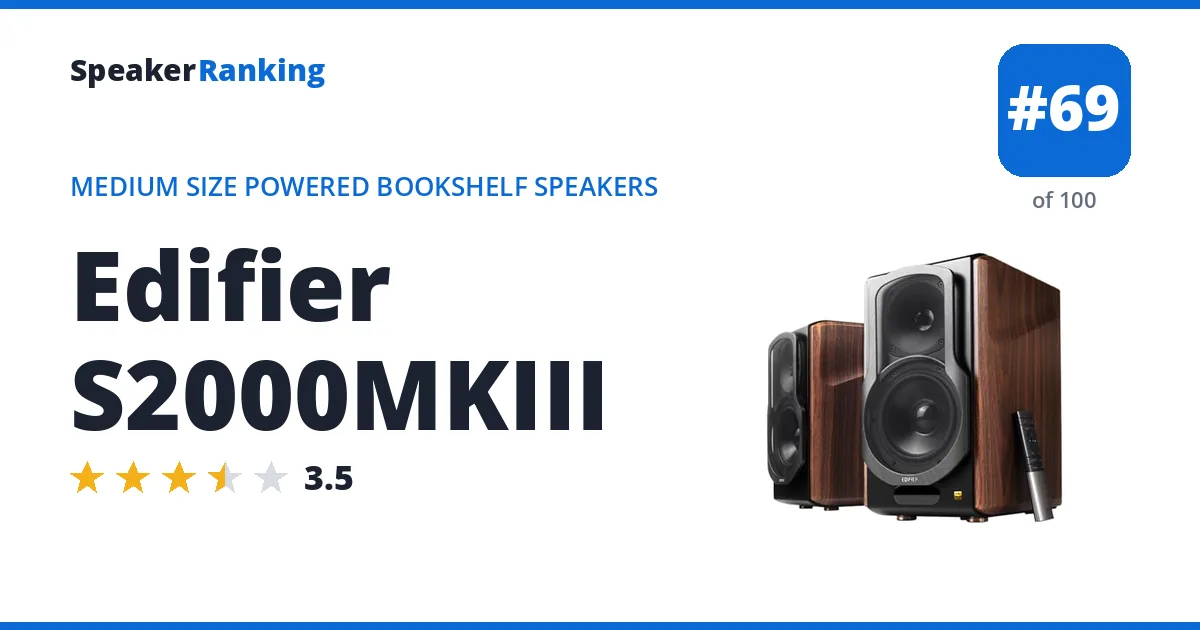
Older model: the Edifier S2000 Pro (ranked higher, rated 3.7/5).
Pros: The available digitized response suggests substantial bass reach, with a -3dB estimate around 41Hz. Scores are 4.24 standalone and 5.99 with an ideal subwoofer. Digital inputs and a self-contained stereo-pair format are convenient for general music listening. Digital input handles high-resolution audio up to 192kHz/24-bit.
Cons: The 4.0dB midrange span and uneven predicted room response suggest meaningful coloration. Favorable modeled EQ results should not be treated as the sound of the stock speaker or as proof that all dispersion issues are correctable.
Full Edifier S2000MKIII review and specifications →
| AES Input | No |
|---|---|
| Amplifier Power | 65w RMS Per Speaker |
| App | No |
| Aux Input | No |
| Bluetooth | Yes |
| Bluetooth Codecs | SBC, aptX HD |
| Bluetooth Version | 5.0 |
| Coaxial Input | Yes |
| Dimensions | 13.5”H x 7.8”W x 10.8”D (342.9 x 198.1 x 274.3 mm) |
| Drivers | 5.5” (140mm) woofer |
| EQ | No |
| Frequency Response | 40.5Hz at -3dB; 37Hz at -6dB (Spinorama) |
| HDMI Input | No |
| Inputs | Bluetooth, 2x RCA Input, Digital Optical, Digital Coax |
| Optical Input | Yes |
| Outputs | None |
| RCA Input | Yes |
| Spinorama Preference Score | 4.24 |
| Spinorama Preference Score with Perfect Sub | 5.99 |
| TRS Input | No |
| USB Input | No |
| Weight | 20.7 lbs (9.4 kg) |
| XLR Input | No |
- Links
- Reviews, Comparisons and Sound Samples
- DSAUDIO.review: DSAUDIO.review Edifier S1000MKII vs Edifier S2000MKIII sound.DEMO More from DSAUDIOreview →
- DSAUDIO.review: DSAUDIO.review Edifier S2000MKIII vs Klipsch The Three II sound.DEMO
- DSAUDIO.review: DSAUDIO.review Edifier R2850DB vs Edifier S2000MKIII sound.DEMO
- DSAUDIO.review: Edifier S2000MKIII vs Edifier S3000PRO Sound & Frequency Response Comparison
- Archimago Measurements (spinorama.org)
- Head-to-Head Comparisons
- Edifier S2000MKIII vs Edifier MR4
- Edifier S2000MKIII vs Presonus Eris E5 XT
- Edifier S2000MKIII vs Edifier MR4.5
- Edifier S2000MKIII vs KRK Classic 5
- Edifier S2000MKIII vs Palmer STUDIMON 5
- Edifier S2000MKIII vs Adam Audio A4V
- Edifier S2000MKIII vs M-Audio BX4 D3
- Edifier S2000MKIII vs Yamaha HS5
- See all 72 comparisons
 Dayton Audio M4: $249.98 per pair Parts Express eBay
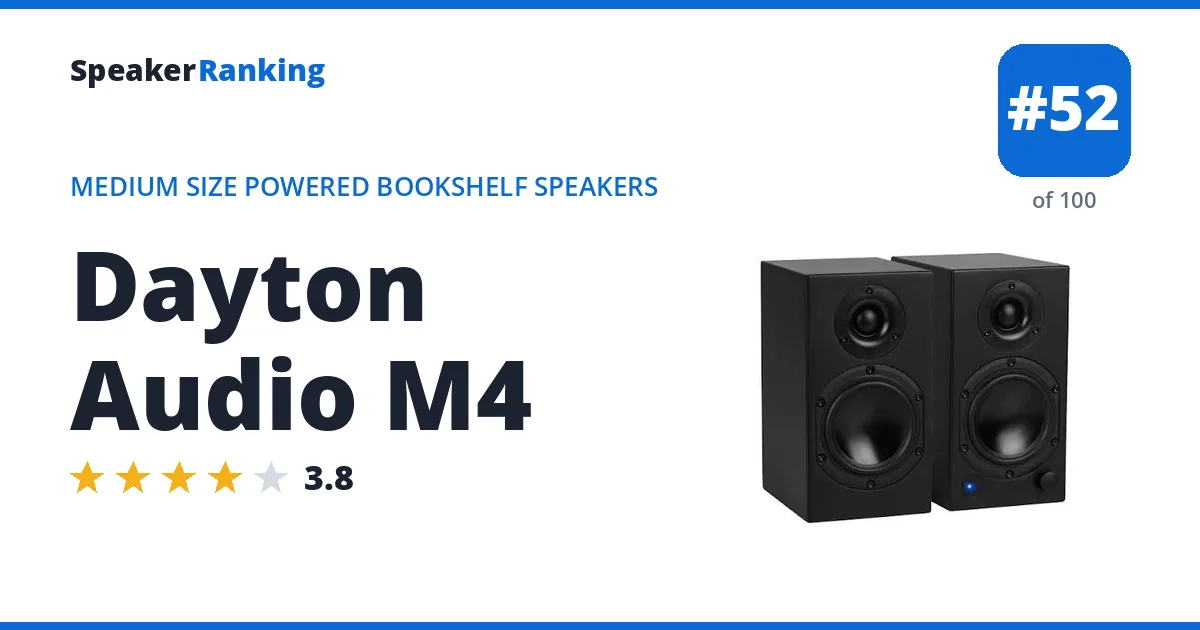
Pros: A compact powered pair with a subwoofer output, useful source connections and a solid cabinet. The existing review describes reasonable linearity for the price and a subdued upper treble that avoids an aggressively bright presentation. It is best considered for a close desktop setup. Measured bass extension of 121Hz (-3dB).
Cons: Existing listening and output notes describe limited bass, a balance that changes with distance, and distortion rising above roughly 93dB. The soft treble is a tonal preference, not evidence of reference neutrality; a subwoofer does not establish greater midrange headroom.
Full Dayton Audio M4 review and specifications →
| AES Input | No |
|---|---|
| Amplifier Power | 75W RMS (150W peak) |
| App | No |
| Aux Input | Yes (RCA) |
| Bass Extension (-10dB) | 60Hz (measured, Erin’s Audio Corner) |
| Bass Extension (-3dB) | 121Hz (measured, Erin’s Audio Corner) |
| Bluetooth | Yes |
| Bluetooth Codecs | SBC, aptX |
| Bluetooth Version | 5.0 |
| Coaxial Input | No |
| Digital Aux Input | Yes (USB-C DAC, up to 192kHz/32-bit) |
| Dimensions | 5” x 6.5” x 9.5” (127 x 165 x 241 mm) (W x D x H) |
| Drivers | 4” aluminum woofer, 1” silk dome tweeter |
| Frequency Response | 40Hz - 20kHz (Manufacturer specified) |
| HDMI Input | No |
| Inputs | RCA, USB-C, Bluetooth |
| Optical Input | No |
| Outputs | Subwoofer (20Hz-200Hz) |
| Power Input | AC Power cord |
| RCA Input | Yes |
| Stereo | Yes |
| Subwoofer Output | Yes |
| TRS Input | No |
| USB Input | Yes |
| Weight | 6.2 lbs (2.81 kg) (active), 5.1 lbs (2.31 kg) (passive) |
| XLR Input | No |
- Links
- Reviews, Comparisons and Sound Samples
- Head-to-Head Comparisons