Short answer: the EAW MKC80. It ranks #9 of 22 8-inch pa speakers by sound quality (rated 3.9/5); the Meyer Sound Ultra X40 ranks #11 (rated 3.8/5).
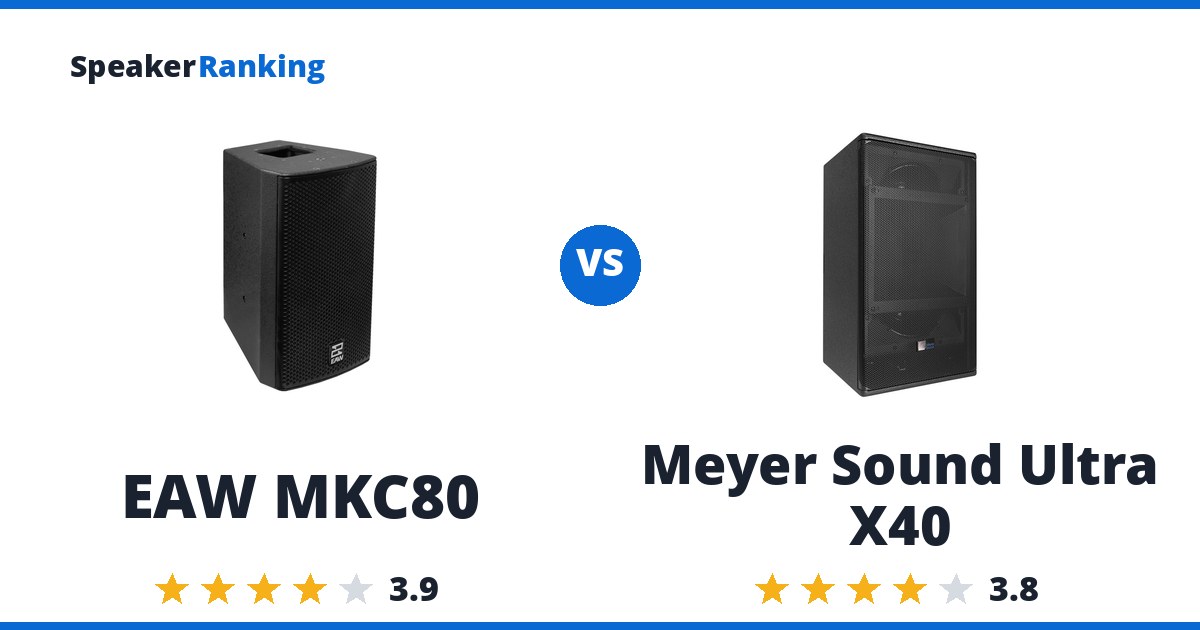
What the EAW MKC80 does well: Vendor Spinorama data gives preference scores of 4.08 standalone and 7.10 with an ideal subwoofer. The tradeoff: Bass reaches only about 85Hz (-3dB), and listening-window narrow-band deviation is 0.321, so the tonal balance is less even than the best 8-inch models.
Why pick the Meyer Sound Ultra X40: Bass reaches 65Hz at -3dB and about 57Hz at -10dB, deep for a pair of 8-inch woofers, and manufacturer measurements give a 5.43 preference score with an ideal subwoofer. Watch for: The 3.8dB reference band and 0.66 listening-window deviation make its tonal balance rougher than the Ultra X20’s, with a 2.73 standalone score.
Buy the EAW MKC80. It is rated higher for sound quality than the Meyer Sound Ultra X40.
Looking for alternatives? See the complete PA & Live Sound rankings.
Specifications Side By Side
| EAW MKC80 | Meyer Sound Ultra X40 | |
|---|---|---|
| Price | - | - |
| Ranked | #9 of 22 in 8-Inch PA Speakers | #11 of 22 in 8-Inch PA Speakers |
| Configuration | Passive 2-way coaxial PA speaker | Self-powered 2-way concentric loudspeaker |
| Drivers | 8” cone woofer with 2” voice coil, 1” exit compression driver with CSA coaxial loading | 2x 8” cone woofers, concentric 3” compression driver |
| Frequency Response | 60Hz - 20kHz (manufacturer specified) | 56Hz - 19kHz (manufacturer specified) |
| Dimensions | 16.6”H x 10”W x 10.5”D (422 x 255 x 267 mm) | 22.3”H x 12.5”W x 14”D (567 x 318 x 356 mm) |
| Amplifier Power | Passive speaker; requires external amplification within the 450W handling rating | 1,950W peak, 3-channel Class D |
| Power Handling | 450W at 8 ohms (manufacturer specified) | - |
| Maximum SPL | 132dB (manufacturer specified) | 127dB linear peak (manufacturer specified) |
| Coverage | 90° x 60° (rotatable) | 110° x 50° Constant-Q horn |
| Sensitivity | 93dB | - |
| DSP | No (passive) | Yes, Galileo GEN-1 networked processing |
| Rigging | Integrated M10 mounting points, pole mount | - |
| Weight | 22 lbs (10 kg) | Under 55.1 lbs (25 kg) |
| Bass Extension (-3dB) | 85Hz (measured, vendor Spinorama data) | 65Hz (measured, vendor Spinorama data) |
| Bluetooth | No | No |
| Spinorama Preference Score | 4.08 | 2.73 |
| Spinorama Preference Score with Perfect Sub | 7.10 | 5.43 |
| XLR Input | No | Yes |
| RCA Input | No | No |
| TRS Input | No | No |
| Optical Input | No | No |
| Coaxial Input | No | No |
| USB Input | No | No |
| HDMI Input | No | No |
| AES Input | No | No |
| Aux Input | No | No |
| Microphone Input | No | No |
| Guitar Input | No | No |
| Bass Extension (-10dB) | - | about 56.8Hz (measured, vendor Spinorama data) |
| Network Control | - | Galileo GEN-1 networked audio and DSP control |
Related Speaker Comparisons
More worthwhile head-to-heads for EAW MKC80:
- L-Acoustics X8 vs EAW MKC80
- EAW MKC80 vs Vue Audiotechnik A-8
- EAW MKC80 vs DAS Audio ARTEC 508A
- Meyer Sound Ultra X40 vs LD Systems Stinger 8-A-G3
- Meyer Sound Ultra X40 vs Coda Audio HOPS8
Prices on this page were last checked September 26, 2026 at 11:14 PM UTC. Product prices and availability are accurate as of that date/time and are subject to change; the price and availability shown on Amazon at the time of purchase will apply to the purchase of this product.
As an eBay Partner, we may be compensated if you make a purchase.
The Two Speakers In Full
 EAW MKC80 Passive Full Compass eBay
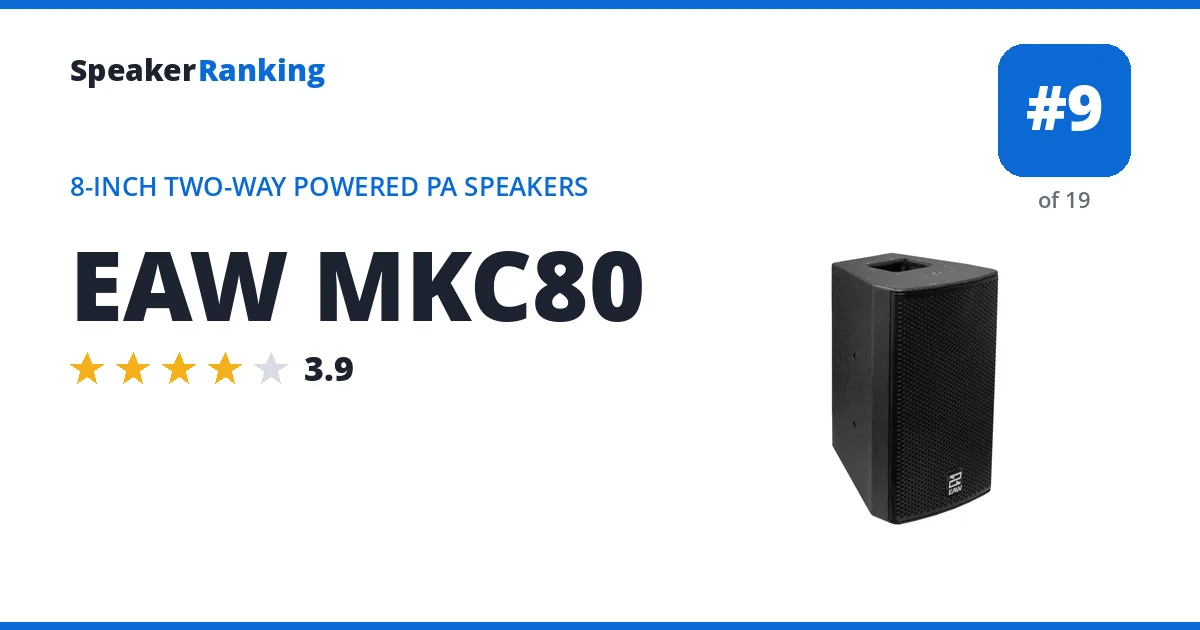
Pros: Vendor Spinorama data gives preference scores of 4.08 standalone and 7.10 with an ideal subwoofer. A 93dB sensitivity and 450W handling deliver a 132dB peak rating from a 10kg cabinet, and the rotatable 90° x 60° coaxial horn suits horizontal or vertical placement. Measured bass extension of 85Hz (-3dB).
Cons: Bass reaches only about 85Hz (-3dB), and listening-window narrow-band deviation is 0.321, so the tonal balance is less even than the best 8-inch models. It is passive, so an amplifier and processor with EAW presets are needed to play it.
Full EAW MKC80 review and specifications →
| AES Input | No |
|---|---|
| Amplifier Power | Passive speaker; requires external amplification within the 450W handling rating |
| Aux Input | No |
| Bass Extension (-3dB) | 85Hz (measured, vendor Spinorama data) |
| Bluetooth | No |
| Coaxial Input | No |
| Configuration | Passive 2-way coaxial PA speaker |
| Coverage | 90° x 60° (rotatable) |
| DSP | No (passive) |
| Dimensions | 16.6”H x 10”W x 10.5”D (422 x 255 x 267 mm) |
| Drivers | 8” cone woofer with 2” voice coil, 1” exit compression driver with CSA coaxial loading |
| Frequency Response | 60Hz - 20kHz (manufacturer specified) |
| Guitar Input | No |
| HDMI Input | No |
| Maximum SPL | 132dB (manufacturer specified) |
| Microphone Input | No |
| Optical Input | No |
| Power Handling | 450W at 8 ohms (manufacturer specified) |
| RCA Input | No |
| Rigging | Integrated M10 mounting points, pole mount |
| Sensitivity | 93dB |
| Spinorama Preference Score | 4.08 |
| Spinorama Preference Score with Perfect Sub | 7.10 |
| TRS Input | No |
| USB Input | No |
| Weight | 22 lbs (10 kg) |
| XLR Input | No |
- Links
- Reviews, Comparisons and Sound Samples
- Head-to-Head Comparisons
 Meyer Sound Ultra X40 eBay
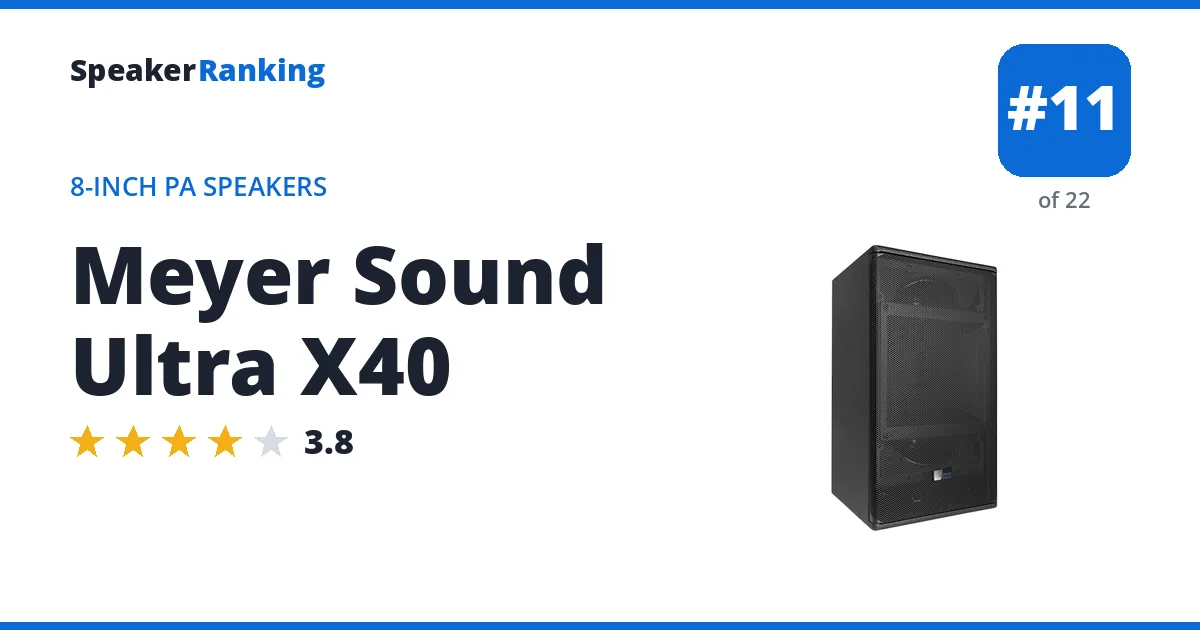
Pros: Bass reaches 65Hz at -3dB and about 57Hz at -10dB, deep for a pair of 8-inch woofers, and manufacturer measurements give a 5.43 preference score with an ideal subwoofer. The concentric 3-inch compression driver and 110° x 50° Constant-Q horn give wide, even coverage, and the built-in 1,950W peak amplifier reaches 127dB. Networked Galileo processing and a sub-25kg weight make it easy to fly or pole-mount. Measured bass extension of 65Hz (-3dB).
Cons: The 3.8dB reference band and 0.66 listening-window deviation make its tonal balance rougher than the Ultra X20’s, with a 2.73 standalone score. It is sold through pro dealers with no published price, and Sweetwater requires a sales engineer to order it.
Full Meyer Sound Ultra X40 review and specifications →
| AES Input | No |
|---|---|
| Amplifier Power | 1,950W peak, 3-channel Class D |
| Aux Input | No |
| Bass Extension (-10dB) | about 56.8Hz (measured, vendor Spinorama data) |
| Bass Extension (-3dB) | 65Hz (measured, vendor Spinorama data) |
| Bluetooth | No |
| Coaxial Input | No |
| Configuration | Self-powered 2-way concentric loudspeaker |
| Coverage | 110° x 50° Constant-Q horn |
| DSP | Yes, Galileo GEN-1 networked processing |
| Dimensions | 22.3”H x 12.5”W x 14”D (567 x 318 x 356 mm) |
| Drivers | 2x 8” cone woofers, concentric 3” compression driver |
| Frequency Response | 56Hz - 19kHz (manufacturer specified) |
| Guitar Input | No |
| HDMI Input | No |
| Maximum SPL | 127dB linear peak (manufacturer specified) |
| Microphone Input | No |
| Network Control | Galileo GEN-1 networked audio and DSP control |
| Optical Input | No |
| RCA Input | No |
| Spinorama Preference Score | 2.73 |
| Spinorama Preference Score with Perfect Sub | 5.43 |
| TRS Input | No |
| USB Input | No |
| Weight | Under 55.1 lbs (25 kg) |
| XLR Input | Yes |
- Links
- Reviews, Comparisons and Sound Samples
- Head-to-Head Comparisons