Short answer: the Dynaudio Emit 30, if you are buying new. The KEF R5 ranks higher than it (#40 vs #114 of 188 floorstanding speakers, 4.4/5 vs 3.9/5) but is discontinued, so only consider it used; the Dynaudio Emit 30 is still sold new at $1,274.25.
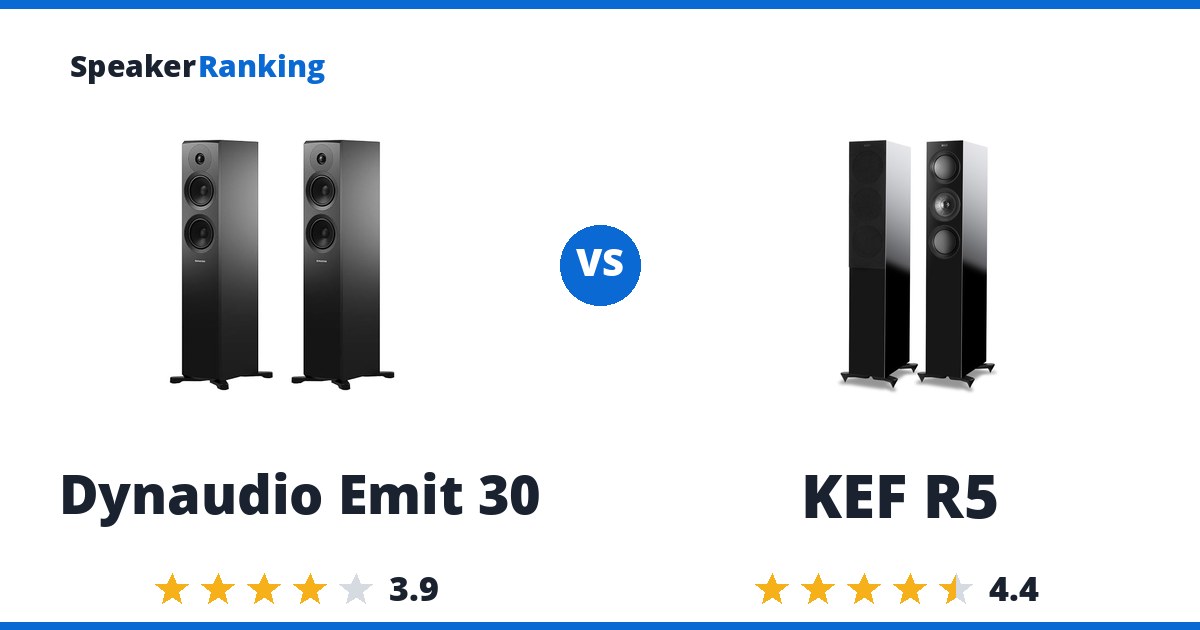
The Dynaudio Emit 30 is the deeper-bass pick. A 2.5-way floorstander: two 5.25” mid-woofers paired with a roughly 1” dome tweeter, driven through dual rear bass-reflex ports. Its bass reaches about 44Hz before falling 3dB, against 77Hz for the KEF R5. Watch for: A dip and inconsistency in the lower-treble presence region (roughly 2-5kHz) makes the top end sound uneven (sometimes soft, sometimes forward) depending on the specific instrument or frequency being reproduced; male vocals can lack presence and cymbals can lack sizzle as a result.
The KEF R5 is the more accurate choice. Slim three-way tower with the acoustic advantages of KEF’s coincident Uni-Q midrange/tweeter: horizontal and vertical off-axis responses track the direct sound smoothly, producing stable imaging and a well-behaved directivity index. Its measured preference score, a predictor of how neutral it sounds, is 5.78 against 3.84 for the Dynaudio Emit 30. Watch for: The unusual gap between 77Hz F3 and 33Hz F10 indicates a gradual bass contour rather than flat deep-bass output; a subwoofer and roughly 80Hz high-pass are recommended for high-level playback.
Buy the Dynaudio Emit 30 if you want one new; the KEF R5 is discontinued, so only look for it used.
Still deciding? The full Passive Home rankings cover every ranked option.
Specifications Side By Side
| Dynaudio Emit 30 | KEF R5 | |
|---|---|---|
| Price | $1,274.25 per pair | $2,999 per pair Discontinued |
| Ranked | #114 of 188 in Large Size Floorstanding Speakers | #40 of 188 in Large Size Floorstanding Speakers |
| Bass Extension (-10dB) | 36Hz (measured, Erin’s Audio Corner) | 33Hz (measured, Erin’s Audio Corner) |
| Bass Extension (-3dB) | 44Hz (measured, Erin’s Audio Corner) | 77Hz (measured, Erin’s Audio Corner) |
| Drivers | Dual 5.25” mid-woofers, 1” soft dome tweeter | 1” aluminum tweeter coaxial with 5” midrange; dual 5.25” woofers |
| Weight | 34.2 lbs (15.5 kg) | 59.5 lbs (27 kg) each |
| Sensitivity | 87dB | Approximately 86dB/2.83V/1m (measured, Erin’s Audio Corner) |
| Impedance | 4 ohms | Approximately 3.5 ohms minimum near 150Hz (measured, Erin’s Audio Corner) |
| Dimensions | 35.4”H x 6.7”W x 10.7”D (900.0 x 170.0 x 272.0 mm) | 40.4”H x 6.9”W x 13.5”D |
| Woofer Cabinet | ported, rear (dual) | ported, rear |
| Frequency Response | 44Hz - 25kHz (±3dB, manufacturer specified) | - |
| Power Handling | 180W (IEC rated) | - |
| Country | Denmark | - |
| Spinorama Preference Score | 3.84 | 5.78 |
| Spinorama Preference Score with Perfect Sub | 5.69 | 7.40 |
| DIY Kit | No | No |
Related Speaker Comparisons
More worthwhile head-to-heads for KEF R5:
- KEF Blade Two Meta vs KEF R5
- MoFi SourcePoint 888 vs KEF R5
- Revel F328Be vs KEF R5
- KEF R5 Meta vs KEF R5
- Revel F226Be vs KEF R5
Prices on this page were last checked October 7, 2026 at 9:25 PM UTC. Product prices and availability are accurate as of that date/time and are subject to change; the price and availability shown on Amazon at the time of purchase will apply to the purchase of this product.
As an eBay Partner, we may be compensated if you make a purchase.
The Two Speakers In Full
 Dynaudio Emit 30: $1,274.25 per pair Amazon eBay
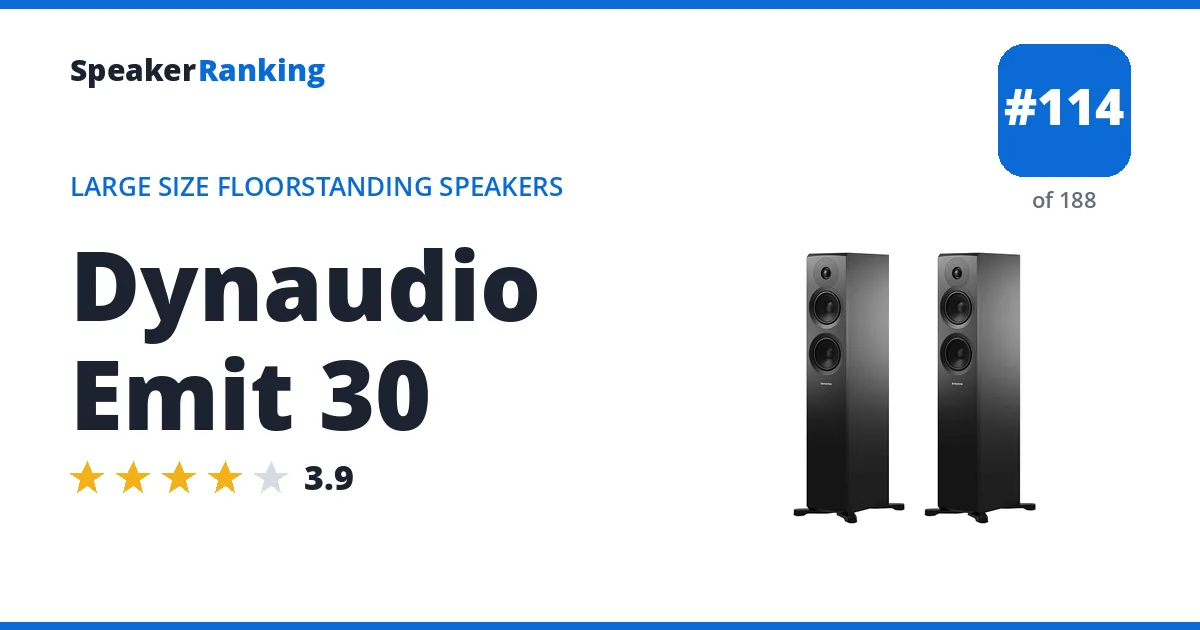
Same family: the Dynaudio Emit 10 (smaller bookshelf, estimated 3.2/5), the Dynaudio Emit 20 (larger bookshelf, rated 3.6/5), the Dynaudio Emit 50 (larger floorstanding, ranked higher, estimated 4.2/5) and the Dynaudio Emit 25C (center, estimated 3.7/5).
Pros: A 2.5-way floorstander: two 5.25” mid-woofers paired with a roughly 1” dome tweeter, driven through dual rear bass-reflex ports. The two woofers hand off at staggered crossover points (around 1kHz and 3.5kHz) rather than sharing one, which avoids the acoustic lobing a shared crossover point would cause between the tweeter and the lower woofer, and adds a few dB of sensitivity in the process. Genuinely deep bass for a speaker around this price: measured F3 near 44Hz and extends audibly down to about 40Hz in-room without much difficulty. Harmonic distortion measures clean and low at both 86dB and 96dB SPL/1m. Good CTA-2034 sound power and uniform directivity mean the speaker takes EQ correction well if a listener wants to dial in its one tonal weak point. Dynamic range and compression performance are strong overall, with only a minor, high-Q compression artifact tied to a cone-edge resonance that’s unlikely to be audible. Wide, consistent horizontal dispersion around ±70° with just a small ~10° narrowing between 1-3kHz, and a reasonably forgiving ±20° vertical window centered on the tweeter axis. Measured bass extension of 44Hz (-3dB).
Cons: A dip and inconsistency in the lower-treble presence region (roughly 2-5kHz) makes the top end sound uneven (sometimes soft, sometimes forward) depending on the specific instrument or frequency being reproduced; male vocals can lack presence and cymbals can lack sizzle as a result. A cone-edge surround resonance shows up around 1-1.3kHz in burst-decay measurements (a trait the reviewer has also seen on other Dynaudio models) and lines up with elevated multitone distortion across roughly 600Hz-1.5kHz. An enclosure resonance appears around 350Hz in the impedance curve. Placed too close to a rear wall, the dual ports make the bass noticeably boomy: pulling the speaker out is needed to keep the low end from overloading the room. Fully resolving the top-end inconsistency needs a modest EQ correction (roughly +2dB with a Q of about 1, centered 3-6kHz), so out-of-the-box tonal accuracy in that band isn’t quite class-leading despite otherwise strong measured performance.
Full Dynaudio Emit 30 review and specifications →
| Bass Extension (-10dB) | 36Hz (measured, Erin’s Audio Corner) |
|---|---|
| Bass Extension (-3dB) | 44Hz (measured, Erin’s Audio Corner) |
| Country | Denmark |
| DIY Kit | No |
| Dimensions | 35.4”H x 6.7”W x 10.7”D (900.0 x 170.0 x 272.0 mm) |
| Drivers | Dual 5.25” mid-woofers, 1” soft dome tweeter |
| Frequency Response | 44Hz - 25kHz (±3dB, manufacturer specified) |
| Impedance | 4 ohms |
| Power Handling | 180W (IEC rated) |
| Sensitivity | 87dB |
| Spinorama Preference Score | 3.84 |
| Spinorama Preference Score with Perfect Sub | 5.69 |
| Weight | 34.2 lbs (15.5 kg) |
| Woofer Cabinet | ported, rear (dual) |
- Links
- Reviews, Comparisons and Sound Samples
- Head-to-Head Comparisons
- Dynaudio Emit 30 vs Klipsch RP-6000F II
- Dynaudio Emit 30 vs Klipsch RP-8000F II
- Dynaudio Emit 30 vs Klipsch RP-5000F II
- Dynaudio Emit 30 vs Definitive Technology BP-9020
- Dynaudio Emit 30 vs SVS Ultra Evolution Pinnacle
- Dynaudio Emit 30 vs KEF Q11 Meta
- Dynaudio Emit 30 vs Polk T50
- Dynaudio Emit 30 vs Klipsch Forte IV
- See all 46 comparisons
 KEF R5: $2,999 per pair Discontinued eBay
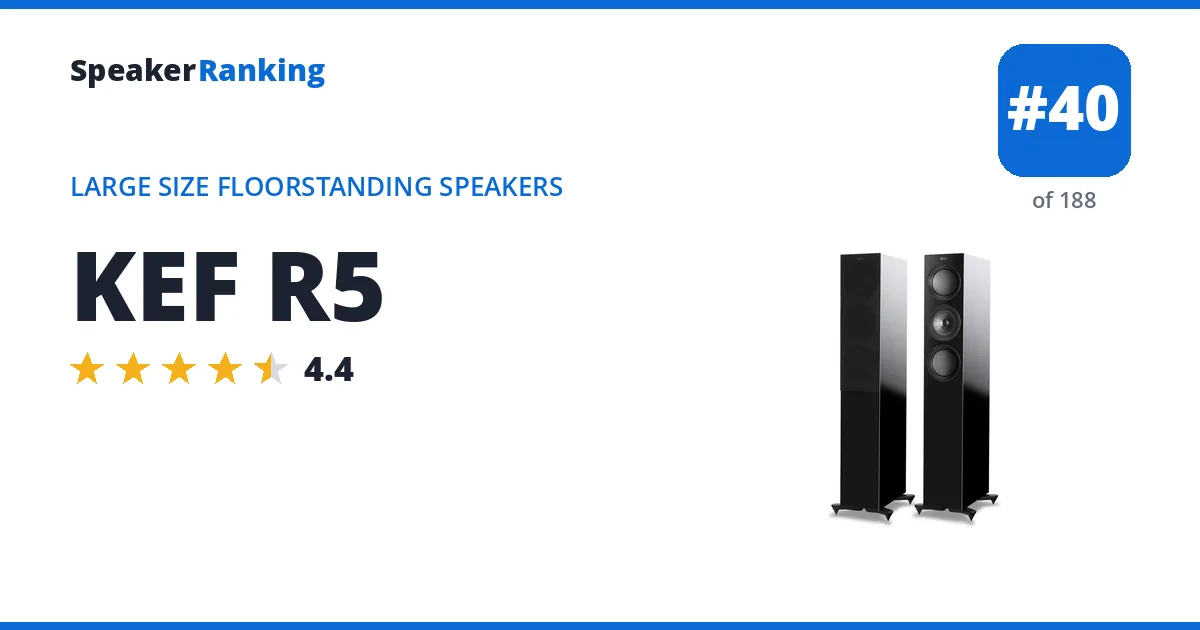
Same family: the KEF R3 (bookshelf, rated 4.5/5), the KEF R7 (larger floorstanding, ranked lower, estimated 4.2/5), the KEF R11 (larger floorstanding, ranked lower, estimated 4.3/5) and the KEF R2c (center, rated 4/5).
Pros: Slim three-way tower with the acoustic advantages of KEF’s coincident Uni-Q midrange/tweeter: horizontal and vertical off-axis responses track the direct sound smoothly, producing stable imaging and a well-behaved directivity index. Erin measured deep low-frequency reach for the cabinet width (77Hz F3 but 33Hz F10) and less than 1% harmonic distortion at 86dB. At 96dB it remains clean when high-passed, and its mild response deviations are suitable for equalization because the radiation pattern stays orderly. Measured bass extension of 77Hz (-3dB), with a measured sensitivity of 86dB.
Cons: The unusual gap between 77Hz F3 and 33Hz F10 indicates a gradual bass contour rather than flat deep-bass output; a subwoofer and roughly 80Hz high-pass are recommended for high-level playback. Erin measured a minimum near 3.5 ohms around 150Hz, although most of the curve remains above 4 ohms, so amplifier quality still matters. Sensitivity is approximately 86dB/2.83V/1m. At 102dB, compression reaches roughly 1dB around 150Hz, showing the limits of the twin 5.25-inch woofers. This original model lacks the Meta version’s MAT rear-wave absorption. Discontinued.
Full KEF R5 review and specifications →
| Bass Extension (-10dB) | 33Hz (measured, Erin’s Audio Corner) |
|---|---|
| Bass Extension (-3dB) | 77Hz (measured, Erin’s Audio Corner) |
| DIY Kit | No |
| Dimensions | 40.4”H x 6.9”W x 13.5”D |
| Drivers | 1” aluminum tweeter coaxial with 5” midrange; dual 5.25” woofers |
| Impedance | Approximately 3.5 ohms minimum near 150Hz (measured, Erin’s Audio Corner) |
| Sensitivity | Approximately 86dB/2.83V/1m (measured, Erin’s Audio Corner) |
| Spinorama Preference Score | 5.78 |
| Spinorama Preference Score with Perfect Sub | 7.40 |
| Weight | 59.5 lbs (27 kg) each |
| Woofer Cabinet | ported, rear |
- Links
- Reviews, Comparisons and Sound Samples
- Head-to-Head Comparisons