Short answer: the Kali Audio IN-8 V2 for near-wall placement, the Dutch & Dutch 8C for integrated cardioid DSP. The IN-8 V2’s three-way coaxial driver sits in a front-ported cabinet, so it can go near a wall without port noise, but it turns notably forward and brash in the 4-5kHz range on-axis. The 8C pairs a 1-inch dome tweeter with an 8-inch midrange and dual 8-inch rear subwoofers. They are $12501 apart.
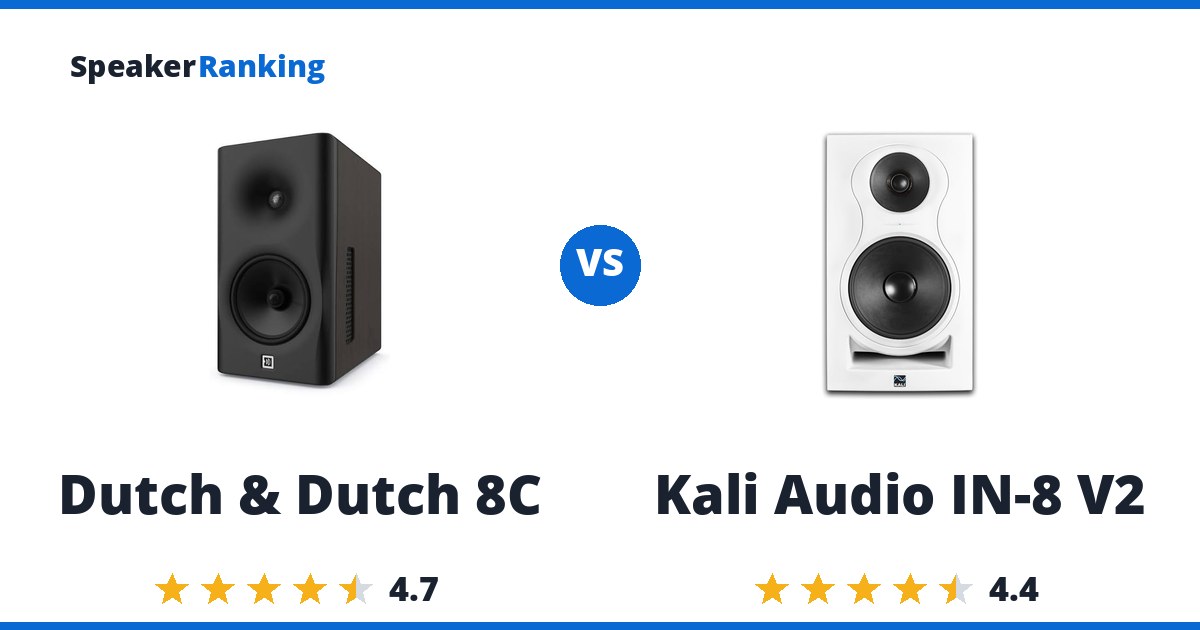
What the Dutch & Dutch 8C gets right: All-in-one powered design with 1-inch dome tweeter, 8-inch midrange, and dual 8-inch rear subwoofers. The catch: Premium pricing reflects integrated amplification and DSP cardioid processing.
On the Kali Audio IN-8 V2 side: Three-way coaxial (coincident) driver in a front-ported cabinet, allowing near-wall placement without port noise issues. The tradeoff: Notable forwardness/brashness in the 4-5kHz range when listened to on-axis.
Buy the Dutch & Dutch 8C when sound quality outweighs the price for you, and the Kali Audio IN-8 V2 when the price outweighs sound quality instead.
Still deciding? The full Powered Home rankings cover every ranked option.
Specifications Side By Side
| Dutch & Dutch 8C | Kali Audio IN-8 V2 | |
|---|---|---|
| Price | $13000 per pair | $998 per pair |
| Ranked | #9 of 67 in Large Size Powered Bookshelf Speakers | #26 of 67 in Large Size Powered Bookshelf Speakers |
| Bass Extension (-10dB) | <20Hz (measured, Erin's Audio Corner) | 36Hz (measured, Erin's Audio Corner) |
| Bass Extension (-3dB) | 23Hz (measured, Erin's Audio Corner) | 44Hz (measured, Erin's Audio Corner) |
| Dimensions | 19"H x 10.5"W x 15"D (482.6 x 266.7 x 381 mm) | 17.8"H x 10"W x 11.3"D (452.1 x 254 x 287 mm) |
| Inputs | XLR | XLR, RCA |
| Drivers | 2x 8" Aluminium Cone woofers, 8" Aluminium Cone midrange, 1" Aluminium/Magnesium dome tweeter | 8" (203mm) woofer |
| Weight | 57.3 lbs (26 kg) each | 22.9 lbs (10.4 kg) each |
| App | Yes (Ascend) | No |
| Bluetooth | No | No |
| DSP | Yes | No |
| EQ | Yes (24-band parametric) | Yes (Room adjustment) |
| Frequency Response | 20Hz - 20kHz (Manufacturer specified) | 45Hz - 21kHz (±3dB) (Manufacturer specified) |
| Sensitivity | ~106dB (measured at 0.30V/1m, Erin's Audio Corner) | 89dB (measured at 0.3V/1m, Erin's Audio Corner) |
| Streaming Services | Yes (network streaming) | - |
| Wi-Fi | Yes (Ethernet) | - |
| Amplifier Power | 1000W (250W tweeter + 250W mid + 500W dual woofers) | 140w Per Speaker |
| Maximum SPL | 106dB @ 1m continuous (manufacturer specified) | - |
| XLR Input | Yes | Yes |
| RCA Input | No | Yes |
| TRS Input | No | No |
| Optical Input | No | No |
| Coaxial Input | No | No |
| USB Input | No | No |
| HDMI Input | No | No |
| AES Input | No | No |
| Aux Input | No | No |
| Spinorama Preference Score | - | 3.53 |
| Spinorama Preference Score with Perfect Sub | - | 5.40 |
Related Speaker Comparisons
How Dutch & Dutch 8C compares with other leading options:
- Kii THREE vs Dutch & Dutch 8C
- Dutch & Dutch 8C vs Neumann KH420
- Dutch & Dutch 8C vs Genelec 8361A
- Aalto Speakers Aalto 3 Active Pro vs Dutch & Dutch 8C
- Yamaha HS8 vs Dutch & Dutch 8C
Prices on this page were last checked September 23, 2026 at 11:24 PM UTC. Product prices and availability are accurate as of that date/time and are subject to change; the price and availability shown on Amazon at the time of purchase will apply to the purchase of this product.
As an eBay Partner, we may be compensated if you make a purchase.
The Two Speakers In Full
 Dutch & Dutch 8C: $13000 per pair Tidepoolaudio eBay
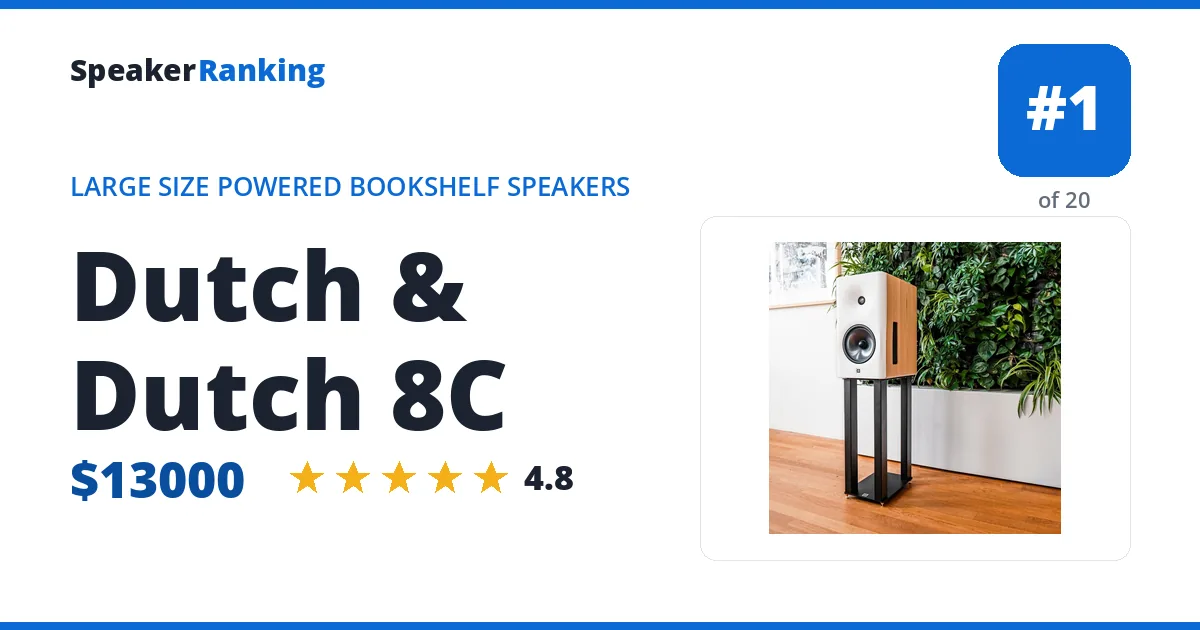
Pros: Very deep measured bass reaches 23.4Hz at -3dB, while the 1.8dB response span from 300Hz to 5kHz supports even mids. The 6.51 standalone score reflects that full-range strength. Cardioid midrange radiation and boundary-aware bass adjustment help integrate the system with nearby walls. Measured bass extension of 23Hz (-3dB), with a measured sensitivity of 106dB.
Cons: Cardioid operation reduces some reflections; it does not make the speaker independent of the room. Rear-woofer placement and setup remain important. Its 7.16 ideal-subwoofer score trails the strongest tonal performers here, although its deep native bass is a meaningful advantage for listening without a sub.
Full Dutch & Dutch 8C review and specifications →
| AES Input | No |
|---|---|
| Amplifier Power | 1000W (250W tweeter + 250W mid + 500W dual woofers) |
| App | Yes (Ascend) |
| Aux Input | No |
| Bass Extension (-10dB) | <20Hz (measured, Erin's Audio Corner) |
| Bass Extension (-3dB) | 23Hz (measured, Erin's Audio Corner) |
| Bluetooth | No |
| Coaxial Input | No |
| DSP | Yes |
| Dimensions | 19"H x 10.5"W x 15"D (482.6 x 266.7 x 381 mm) |
| Drivers | 2x 8" Aluminium Cone woofers, 8" Aluminium Cone midrange, 1" Aluminium/Magnesium dome tweeter |
| EQ | Yes (24-band parametric) |
| Frequency Response | 20Hz - 20kHz (Manufacturer specified) |
| HDMI Input | No |
| Inputs | XLR |
| Maximum SPL | 106dB @ 1m continuous (manufacturer specified) |
| Optical Input | No |
| RCA Input | No |
| Sensitivity | ~106dB (measured at 0.30V/1m, Erin's Audio Corner) |
| Streaming Services | Yes (network streaming) |
| TRS Input | No |
| USB Input | No |
| Weight | 57.3 lbs (26 kg) each |
| Wi-Fi | Yes (Ethernet) |
| XLR Input | Yes |
- Links
- Reviews, Comparisons and Sound Samples
- Head-to-Head Comparisons
- Dutch & Dutch 8C vs Aalto Speakers Aalto 3 Active Pro
- Dutch & Dutch 8C vs Genelec 8361A
- Dutch & Dutch 8C vs Neumann KH420
- Dutch & Dutch 8C vs Kii THREE
- Dutch & Dutch 8C vs Yamaha HS8
- Dutch & Dutch 8C vs Kali Audio LP-6 V2
- Dutch & Dutch 8C vs JBL M2 Master Reference Monitor
- Dutch & Dutch 8C vs JBL 4329P
- See all 12 comparisons
 Kali Audio IN-8 V2: $998 per pair Amazon eBay
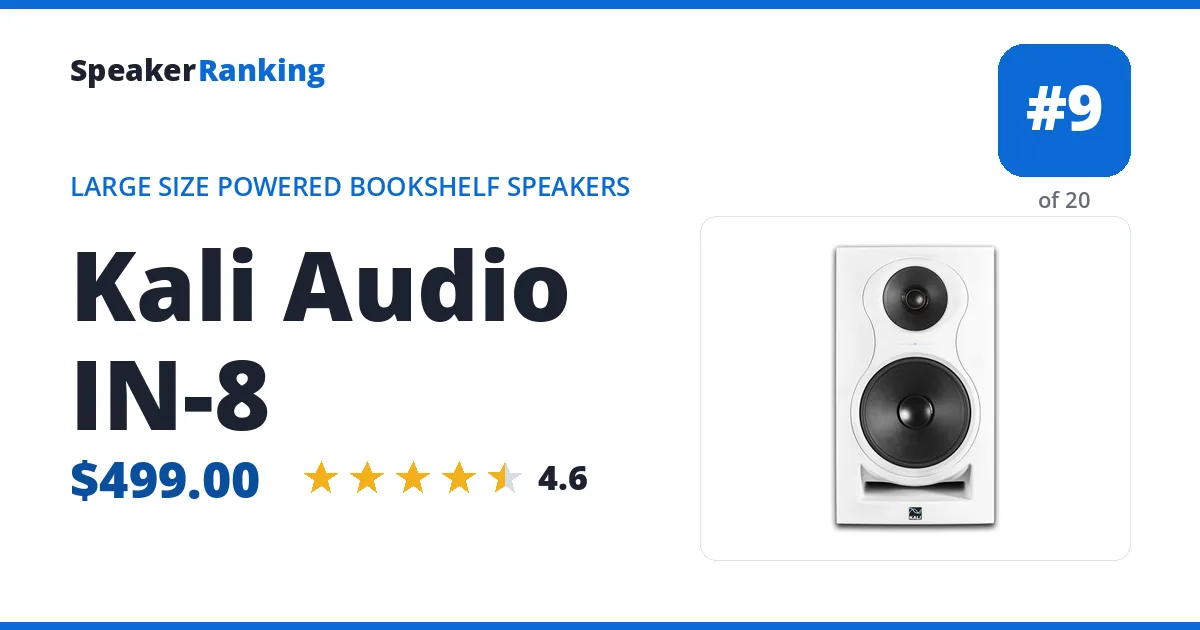
Pros: The IN-8 V2’s coaxial midrange/tweeter supports coherent imaging, and low distortion at ordinary levels complements its 6.54 ideal-subwoofer score. Measured -3dB extension of 45.4Hz provides useful bass; boundary settings assist placement. Measured bass extension of 44Hz (-3dB), with a measured sensitivity of 89dB.
Cons: The measured 3.0dB response span from 300Hz to 5kHz includes unevenness that can make some vocals sound forward. Bass and limiter behavior constrain high-level playback. These measurements apply to the V2, not the first-generation IN-8.
Full Kali Audio IN-8 V2 review and specifications →
| AES Input | No |
|---|---|
| Amplifier Power | 140w Per Speaker |
| App | No |
| Aux Input | No |
| Bass Extension (-10dB) | 36Hz (measured, Erin's Audio Corner) |
| Bass Extension (-3dB) | 44Hz (measured, Erin's Audio Corner) |
| Bluetooth | No |
| Coaxial Input | No |
| DSP | No |
| Dimensions | 17.8"H x 10"W x 11.3"D (452.1 x 254 x 287 mm) |
| Drivers | 8" (203mm) woofer |
| EQ | Yes (Room adjustment) |
| Frequency Response | 45Hz - 21kHz (±3dB) (Manufacturer specified) |
| HDMI Input | No |
| Inputs | XLR, RCA |
| Optical Input | No |
| RCA Input | Yes |
| Sensitivity | 89dB (measured at 0.3V/1m, Erin's Audio Corner) |
| Spinorama Preference Score | 3.53 |
| Spinorama Preference Score with Perfect Sub | 5.40 |
| TRS Input | No |
| USB Input | No |
| Weight | 22.9 lbs (10.4 kg) each |
| XLR Input | Yes |
- Links
- Reviews, Comparisons and Sound Samples
- Head-to-Head Comparisons
- Kali Audio IN-8 V2 vs Genelec 8050B
- Kali Audio IN-8 V2 vs Kali Audio LP-6 V2
- Kali Audio IN-8 V2 vs Yamaha HS8
- Kali Audio IN-8 V2 vs JBL 4305P
- Kali Audio IN-8 V2 vs Focal Solo6 ST6
- Kali Audio IN-8 V2 vs JBL 308P MKII
- Kali Audio IN-8 V2 vs Kali Audio LP-6
- Kali Audio IN-8 V2 vs Genelec 8040B
- See all 37 comparisons