Short answer: the Definitive Technology Demand D11 for tonal balance, the JBL Studio 630 for imaging. The D11’s spinorama is mostly flat and well controlled apart from a narrow 600Hz jaggy on and off axis. The Studio 630 has excellent directivity linearity that keeps harmonics of the same instrument collocated for precise, stable imaging, but a noticeable mid-range dip leaves it audibly missing something by the second or third track.
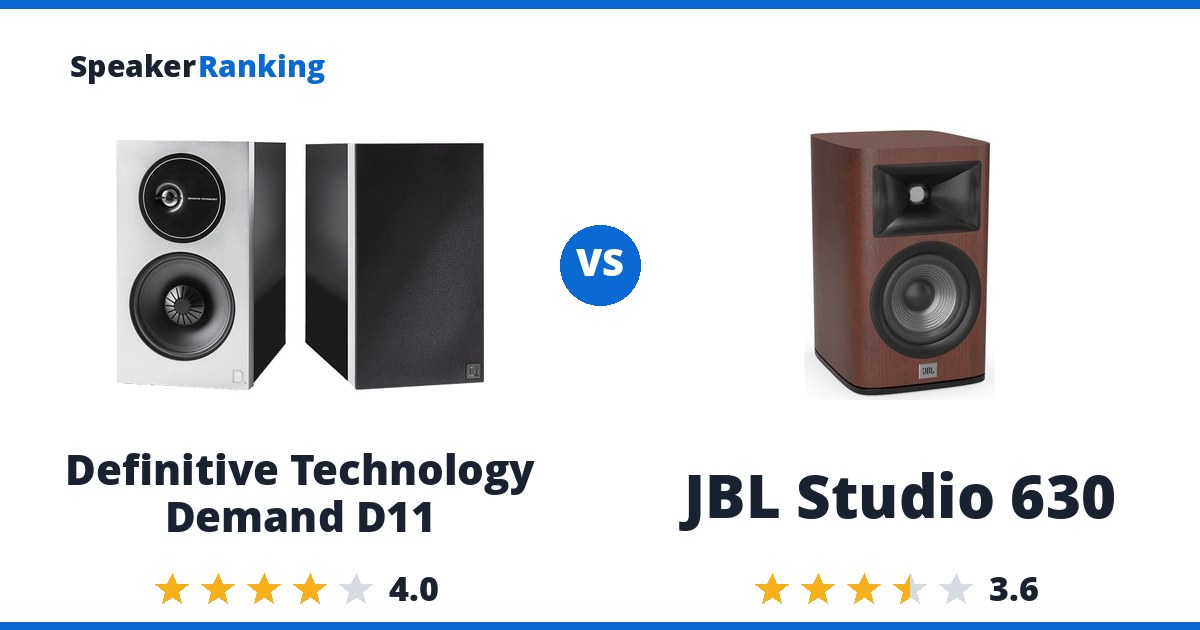
Buy the Definitive Technology Demand D11 only if you find one used in good condition; both are discontinued, and it is the better rated of the two. For a new speaker, start with the AsciLab C6B instead.
Want more options? Browse the full Passive Home rankings.
Specifications Side By Side
| Definitive Technology Demand D11 | JBL Studio 630 | |
|---|---|---|
| Price | $999 per pair Discontinued | $699 per pair Discontinued |
| Ranked | #59 of 134 in Large Size Bookshelf Speakers | #79 of 134 in Large Size Bookshelf Speakers |
| Bass Extension (-3dB) | 60.1Hz (measured, Audio Science Review) | 54.2Hz (measured, Erin’s Audio Corner) |
| Bass Extension (-10dB) | 46.3Hz (derived, log-interpolated between spinorama.org -9dB/-12dB points) | 37.0Hz (measured, Erin’s Audio Corner) |
| Drivers | 6.5” BDSS polypropylene woofer, 1” aluminum dome tweeter (offset), 6x10” oval passive radiator | 6.5” PolyPlas cone woofer, 1” compression driver (2414H-1) with waveguide |
| Dimensions | 13H x 7.25W x 12.5D in | 14-13/16”H x 9”W x 11-5/16”D |
| Weight | 17 lbs (7.7 kg) each | 19.8 lbs (9 kg) each |
| Frequency Response | 48Hz - 24kHz (61Hz - 22kHz -3dB) (Manufacturer specified) | 45Hz - 40,000Hz (manufacturer specified) |
| Sensitivity | 87dB (2.83V/1m, measured, Audio Science Review) | 83.2dB (measured, Erin’s Audio Corner; 85dB manufacturer specified) |
| Impedance | 8 ohms nominal | 6 ohms nominal, 4.7 ohms minimum (measured, Erin’s Audio Corner) |
| Power Handling | 20-200W recommended | up to 150W |
| Woofer Cabinet | passive radiator | - |
| Spinorama Preference Score | 4.12 (spinorama.org) | 3.67 |
| Spinorama Preference Score with Perfect Sub | 6.48 (spinorama.org) | 5.68 |
| DIY Kit | No | No |
Related Speaker Comparisons
More worthwhile head-to-heads for Definitive Technology Demand D11:
- ELAC Debut 3.0 DB63 vs Definitive Technology Demand D11
- JBL HDI-1600 vs Definitive Technology Demand D11
- Revel Concerta2 M16 vs Definitive Technology Demand D11
- ELAC Uni-Fi Reference UBR62 vs Definitive Technology Demand D11
- ELAC DBR62 vs Definitive Technology Demand D11
Prices on this page were last checked October 3, 2026 at 10:26 PM UTC. Product prices and availability are accurate as of that date/time and are subject to change; the price and availability shown on Amazon at the time of purchase will apply to the purchase of this product.
As an eBay Partner, we may be compensated if you make a purchase.
The Two Speakers In Full
 Definitive Technology Demand D11: $999 per pair Discontinued Amazon eBay
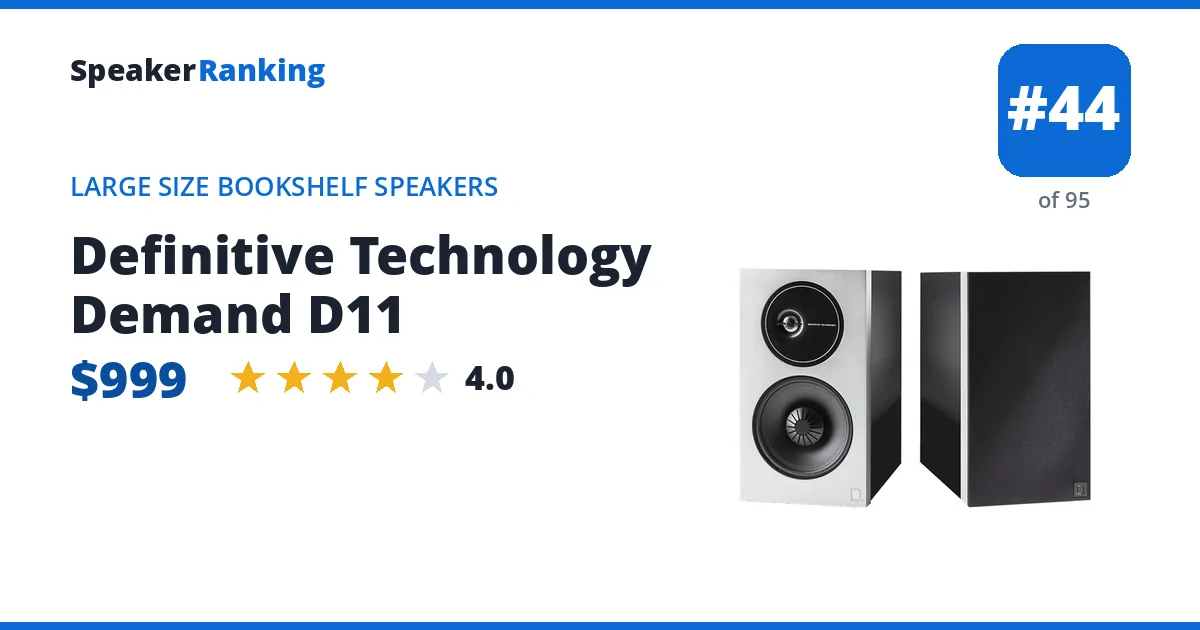
Pros: CEA2034 spinorama shows a mostly flat, well-controlled response: close to class-leading if not for one narrow resonance. Distortion is well controlled and the deep cabinet lets it play loud without bottoming out except on the deepest bass content. Cabinet construction and finish are a clear step above budget speakers. Measured bass extension of 60.1Hz (-3dB), with a measured sensitivity of 87dB.
Cons: A narrow but real ~600Hz jaggy shows up consistently in on-axis and off-axis measurements. Horizontal directivity is uneven because of the offset tweeter position, giving the left and right channels slightly different off-axis energy. There’s a low-frequency rattle/noise at very deep bass levels the reviewer called “horrendous.” Discontinued; the Demand series has moved on to newer models.
Full Definitive Technology Demand D11 review and specifications →
| Bass Extension (-10dB) | 46.3Hz (derived, log-interpolated between spinorama.org -9dB/-12dB points) |
|---|---|
| Bass Extension (-3dB) | 60.1Hz (measured, Audio Science Review) |
| DIY Kit | No |
| Dimensions | 13H x 7.25W x 12.5D in |
| Drivers | 6.5” BDSS polypropylene woofer, 1” aluminum dome tweeter (offset), 6x10” oval passive radiator |
| Frequency Response | 48Hz - 24kHz (61Hz - 22kHz -3dB) (Manufacturer specified) |
| Impedance | 8 ohms nominal |
| Power Handling | 20-200W recommended |
| Sensitivity | 87dB (2.83V/1m, measured, Audio Science Review) |
| Spinorama Preference Score | 4.12 (spinorama.org) |
| Spinorama Preference Score with Perfect Sub | 6.48 (spinorama.org) |
| Weight | 17 lbs (7.7 kg) each |
| Woofer Cabinet | passive radiator |
- Links
- Reviews, Comparisons and Sound Samples
- Head-to-Head Comparisons
- Definitive Technology Demand D11 vs Yamaha NS-800A
- Definitive Technology Demand D11 vs Technics SB-C700
- Definitive Technology Demand D11 vs ELAC DBR62
- Definitive Technology Demand D11 vs Dynaudio Contour 20i
- Definitive Technology Demand D11 vs ELAC Uni-Fi Reference UBR62
- Definitive Technology Demand D11 vs SVS Ultra Bookshelf
- Definitive Technology Demand D11 vs Revel Concerta2 M16
- Definitive Technology Demand D11 vs Infinity Reference R162
- See all 12 comparisons
 JBL Studio 630: $699 per pair Discontinued eBay
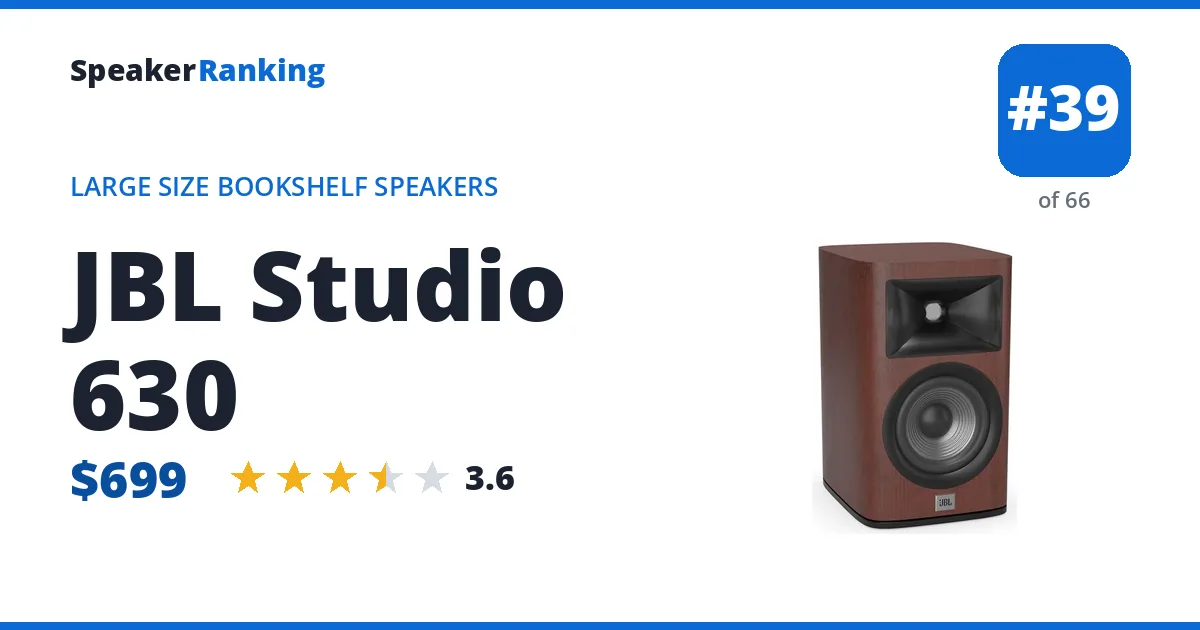
Pros: Excellent directivity linearity: harmonics of the same instrument stay collocated in the soundstage instead of drifting between positions, giving precise, stable imaging that holds up well into higher frequencies where many speakers start to beam and narrow. Good compression behavior: mid-bass stays taut and controlled from low to high volume without the sound falling apart or distorting as you turn it up. A pleasant, controlled mid-bass bump in the 60-100 Hz range adds punch to kick drums without bleeding into an uncontrolled boom on bass guitar. Horizontal radiation holds steady off-axis (about ±60°), so toe-in isn’t fussy. Compared directly to its predecessor, the JBL Studio 530, the reviewer would pick the 630 (smoother trend line through the upper mids and treble, and likely more dynamic headroom) as long as you’re willing to EQ. Measured bass extension of 54.2Hz (-3dB), with a measured sensitivity of 83.2dB.
Cons: Noticeable mid-range dip/scoop relative to the higher frequencies: not dramatic, but audibly “missing” something by the second or third track. Some tracks read as forward or aggressive around 2 kHz, like the upper frequencies are jumping out at you rather than sitting in stage depth. Needs EQ to bring the mid-range back up to be fully recommendable; without EQ available, the reviewer says he’d look at a different speaker entirely. Measured sensitivity (about 83.2dB) runs noticeably below the 85dB manufacturer spec, likely a byproduct of the mid-range dip skewing the average downward. Discontinued and no longer sold new.
Full JBL Studio 630 review and specifications →
| Bass Extension (-10dB) | 37.0Hz (measured, Erin’s Audio Corner) |
|---|---|
| Bass Extension (-3dB) | 54.2Hz (measured, Erin’s Audio Corner) |
| DIY Kit | No |
| Dimensions | 14-13/16”H x 9”W x 11-5/16”D |
| Drivers | 6.5” PolyPlas cone woofer, 1” compression driver (2414H-1) with waveguide |
| Frequency Response | 45Hz - 40,000Hz (manufacturer specified) |
| Impedance | 6 ohms nominal, 4.7 ohms minimum (measured, Erin’s Audio Corner) |
| Power Handling | up to 150W |
| Sensitivity | 83.2dB (measured, Erin’s Audio Corner; 85dB manufacturer specified) |
| Spinorama Preference Score | 3.67 |
| Spinorama Preference Score with Perfect Sub | 5.68 |
| Weight | 19.8 lbs (9 kg) each |
- Links
- Reviews, Comparisons and Sound Samples
- Head-to-Head Comparisons
- JBL Studio 630 vs Behringer B2030P
- JBL Studio 630 vs Dynaudio Emit 20
- JBL Studio 630 vs Klipsch RP-600M II
- JBL Studio 630 vs Infinity IL10
- JBL Studio 630 vs Dynaudio Special Forty
- JBL Studio 630 vs ELAC Debut 2.0 B6.2
- JBL Studio 630 vs SVS Prime Bookshelf
- JBL Studio 630 vs Infinity Reference R162
- See all 35 comparisons