Short answer: the Dynaudio Emit 20, if you are buying new. The Definitive Technology Demand D11 ranks higher than it (#59 vs #77 of 134 bookshelf speakers, 4.0/5 vs 3.6/5) but is discontinued, so only consider it used; the Dynaudio Emit 20 is still sold new at $1,049.
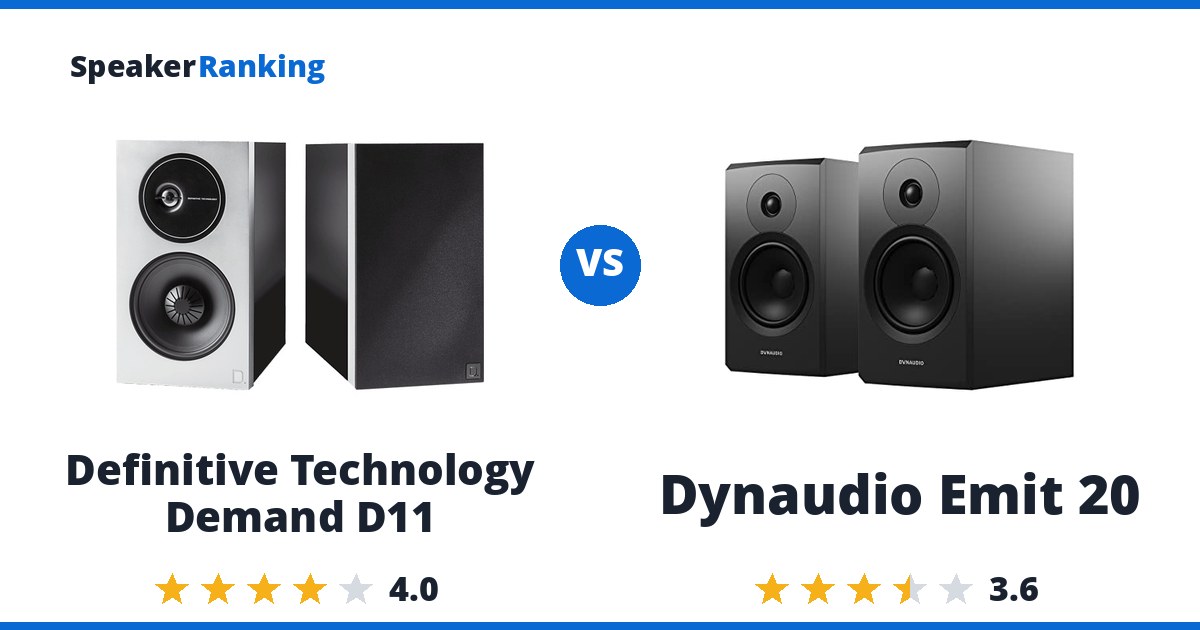
Buy the Dynaudio Emit 20 if you want one new; the Definitive Technology Demand D11 is discontinued, so only look for it used.
Still deciding? The full Passive Home rankings cover every ranked option.
Specifications Side By Side
| Definitive Technology Demand D11 | Dynaudio Emit 20 | |
|---|---|---|
| Price | $999 per pair Discontinued | $1,049.00 per pair |
| Ranked | #59 of 134 in Large Size Bookshelf Speakers | #77 of 134 in Large Size Bookshelf Speakers |
| Bass Extension (-3dB) | 60.1Hz (measured, Audio Science Review) | 54Hz (measured, Erin’s Audio Corner) |
| Bass Extension (-10dB) | 46.3Hz (derived, log-interpolated between spinorama.org -9dB/-12dB points) | 33Hz (measured, Erin’s Audio Corner) |
| Drivers | 6.5” BDSS polypropylene woofer, 1” aluminum dome tweeter (offset), 6x10” oval passive radiator | 7.1” Magnesium Silicate Polymer woofer, 1.1” Cerotar soft dome with Hexis tweeter |
| Dimensions | 13H x 7.25W x 12.5D in | 14.6”H x 8.1”W x 12.3”D (370.0 x 205.0 x 312.0 mm) |
| Weight | 17 lbs (7.7 kg) each | 12.8 lbs (5.8 kg) |
| Frequency Response | 48Hz - 24kHz (61Hz - 22kHz -3dB) (Manufacturer specified) | - |
| Sensitivity | 87dB (2.83V/1m, measured, Audio Science Review) | 83.5dB (measured, Erin’s Audio Corner; 86dB manufacturer specified) |
| Impedance | 8 ohms nominal | 6 ohms nominal (5.5 ohms minimum above 80Hz, measured, Erin’s Audio Corner) |
| Power Handling | 20-200W recommended | - |
| Woofer Cabinet | passive radiator | ported, rear |
| Spinorama Preference Score | 4.12 (spinorama.org) | 4.22 |
| Spinorama Preference Score with Perfect Sub | 6.48 (spinorama.org) | 5.92 |
| DIY Kit | No | No |
Related Speaker Comparisons
More top alternatives to Definitive Technology Demand D11:
- ELAC Debut 3.0 DB63 vs Definitive Technology Demand D11
- JBL HDI-1600 vs Definitive Technology Demand D11
- Revel Concerta2 M16 vs Definitive Technology Demand D11
- ELAC Uni-Fi Reference UBR62 vs Definitive Technology Demand D11
- ELAC DBR62 vs Definitive Technology Demand D11
Prices on this page were last checked October 3, 2026 at 10:26 PM UTC. Product prices and availability are accurate as of that date/time and are subject to change; the price and availability shown on Amazon at the time of purchase will apply to the purchase of this product.
As an eBay Partner, we may be compensated if you make a purchase.
The Two Speakers In Full
 Definitive Technology Demand D11: $999 per pair Discontinued Amazon eBay
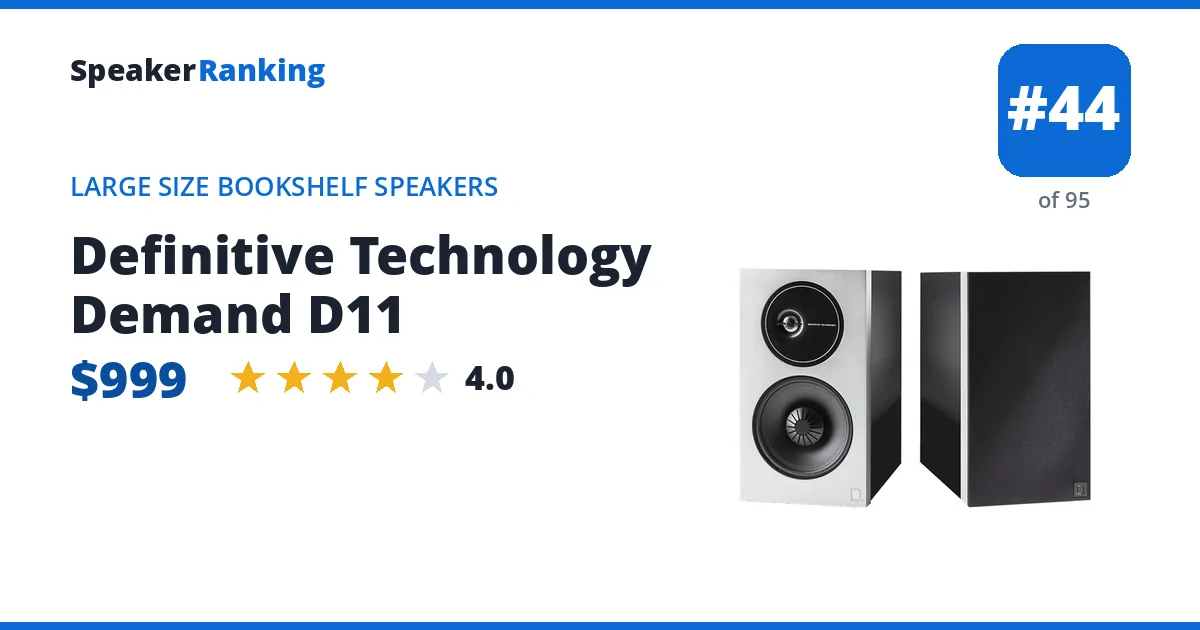
Pros: CEA2034 spinorama shows a mostly flat, well-controlled response: close to class-leading if not for one narrow resonance. Distortion is well controlled and the deep cabinet lets it play loud without bottoming out except on the deepest bass content. Cabinet construction and finish are a clear step above budget speakers. Measured bass extension of 60.1Hz (-3dB), with a measured sensitivity of 87dB.
Cons: A narrow but real ~600Hz jaggy shows up consistently in on-axis and off-axis measurements. Horizontal directivity is uneven because of the offset tweeter position, giving the left and right channels slightly different off-axis energy. There’s a low-frequency rattle/noise at very deep bass levels the reviewer called “horrendous.” Discontinued; the Demand series has moved on to newer models.
Full Definitive Technology Demand D11 review and specifications →
| Bass Extension (-10dB) | 46.3Hz (derived, log-interpolated between spinorama.org -9dB/-12dB points) |
|---|---|
| Bass Extension (-3dB) | 60.1Hz (measured, Audio Science Review) |
| DIY Kit | No |
| Dimensions | 13H x 7.25W x 12.5D in |
| Drivers | 6.5” BDSS polypropylene woofer, 1” aluminum dome tweeter (offset), 6x10” oval passive radiator |
| Frequency Response | 48Hz - 24kHz (61Hz - 22kHz -3dB) (Manufacturer specified) |
| Impedance | 8 ohms nominal |
| Power Handling | 20-200W recommended |
| Sensitivity | 87dB (2.83V/1m, measured, Audio Science Review) |
| Spinorama Preference Score | 4.12 (spinorama.org) |
| Spinorama Preference Score with Perfect Sub | 6.48 (spinorama.org) |
| Weight | 17 lbs (7.7 kg) each |
| Woofer Cabinet | passive radiator |
- Links
- Reviews, Comparisons and Sound Samples
- Head-to-Head Comparisons
- Definitive Technology Demand D11 vs Yamaha NS-800A
- Definitive Technology Demand D11 vs Technics SB-C700
- Definitive Technology Demand D11 vs ELAC DBR62
- Definitive Technology Demand D11 vs Dynaudio Contour 20i
- Definitive Technology Demand D11 vs ELAC Uni-Fi Reference UBR62
- Definitive Technology Demand D11 vs SVS Ultra Bookshelf
- Definitive Technology Demand D11 vs Revel Concerta2 M16
- Definitive Technology Demand D11 vs Infinity Reference R162
- See all 12 comparisons
 Dynaudio Emit 20: $1,049.00 per pair Amazon eBay
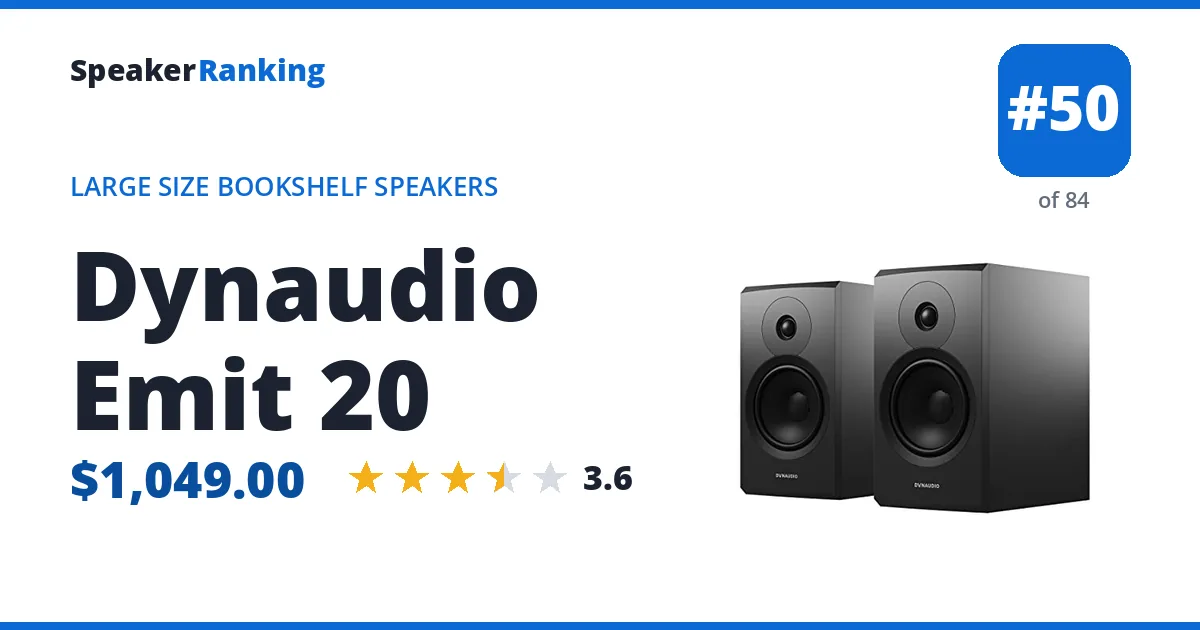
Pros: Two-way design with a 28mm Esotar soft dome tweeter (Hexis-damped) and an 18cm mid-woofer, using a first-order crossover on the tweeter and second-order on the woofer. Exceptional bass extension for a bookshelf speaker: reaches a clean, authoritative 40Hz in-room, rare enough that the reviewer says most listeners could skip a subwoofer for typical music. Very low distortion across the board, staying below 1% THD down to 40Hz at 86dB and below 3% even at 96dB: unusually clean bass performance where most two-way bookshelf speakers start rising in distortion around 80Hz. Wide, remarkably consistent horizontal directivity (about ±50-60°) that holds steady up to roughly 13kHz: rare for a speaker in this format, thanks to a beveled tweeter edge that acts as a mild waveguide. Excellent compression and dynamic-range linearity at the frequency extremes, actually showing slight bass enhancement rather than the sharp low-end compression common in similarly-sized bookshelf speakers. Measured bass extension of 54Hz (-3dB), with a measured sensitivity of 83.5dB.
Cons: A resonance around 600-800Hz gives snares and similar percussion a muffled, flat quality lacking impact: confirmed as originating in the woofer itself (isolated via measurements of the raw driver out of the cabinet), and attempts at constrained-layer damping didn’t resolve it. A peak around 4kHz adds a sharp, edgy quality to some male vocals. A roughly 5dB boost above 10kHz gives cymbals and hi-hats excess shimmer that can sound unnatural, especially pointed directly on-axis. Vertical dispersion shows two separate crossover-related notches (above and below the tweeter reference line around 5kHz) rather than the usual single one, a direct consequence of the shallow crossover slopes used on both drivers. Multitone distortion is elevated in the midrange, possibly due to the woofer’s magnet structure lacking a shorting ring. Best aimed slightly off-axis (about 10-15° of toe-out) to tame the excess high-frequency shimmer, rather than pointed straight at the listener.
Full Dynaudio Emit 20 review and specifications →
| Bass Extension (-10dB) | 33Hz (measured, Erin’s Audio Corner) |
|---|---|
| Bass Extension (-3dB) | 54Hz (measured, Erin’s Audio Corner) |
| DIY Kit | No |
| Dimensions | 14.6”H x 8.1”W x 12.3”D (370.0 x 205.0 x 312.0 mm) |
| Drivers | 7.1” Magnesium Silicate Polymer woofer, 1.1” Cerotar soft dome with Hexis tweeter |
| Impedance | 6 ohms nominal (5.5 ohms minimum above 80Hz, measured, Erin’s Audio Corner) |
| Sensitivity | 83.5dB (measured, Erin’s Audio Corner; 86dB manufacturer specified) |
| Spinorama Preference Score | 4.22 |
| Spinorama Preference Score with Perfect Sub | 5.92 |
| Weight | 12.8 lbs (5.8 kg) |
| Woofer Cabinet | ported, rear |
- Links
- Reviews, Comparisons and Sound Samples
- Head-to-Head Comparisons
- Dynaudio Emit 20 vs Philharmonic BMR Monitor
- Dynaudio Emit 20 vs Klipsch RP-600M II
- Dynaudio Emit 20 vs JBL Studio 630
- Dynaudio Emit 20 vs Behringer B2030P
- Dynaudio Emit 20 vs Mission LX-3 MKII
- Dynaudio Emit 20 vs Polk Signature Elite ES20
- Dynaudio Emit 20 vs Ascend CBM-170 SE2
- Dynaudio Emit 20 vs GR-Research X-LS Encore
- See all 67 comparisons