Short answer: the Bowers & Wilkins Formation Flex. It ranks #11 of 24 powered bookshelf speakers by sound quality (rated 3.5/5); the Audioengine A2+ ranks #12 (rated 3.4/5).
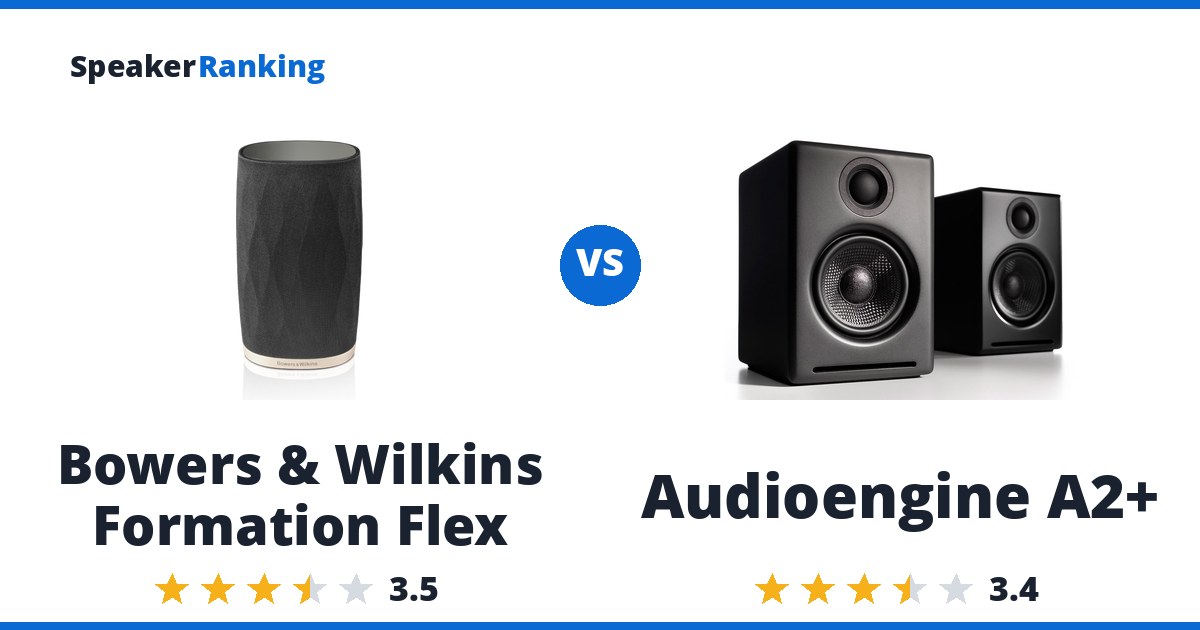
Why pick the Bowers & Wilkins Formation Flex: ASR’s Klippel data gives a 6.43 predicted preference score with an ideal subwoofer and broad horizontal coverage. The tradeoff: Standalone preference is only 3.69.
What the Audioengine A2+ does well: Erin’s Klippel measurements give a 5.39 predicted preference score with an ideal subwoofer. The tradeoff: The 2.07 standalone score and roughly 106Hz measured -3dB point reveal how much bass is missing without reinforcement or a subwoofer.
Buy the Bowers & Wilkins Formation Flex. It is rated higher for sound quality than the Audioengine A2+.
Looking for alternatives? See the complete Powered Home rankings.
Specifications Side By Side
| Bowers & Wilkins Formation Flex | Audioengine A2+ | |
|---|---|---|
| Price | £898 per pair | $279.00 per pair |
| Ranked | #11 of 24 in Small Size Powered Bookshelf Speakers | #12 of 24 in Small Size Powered Bookshelf Speakers |
| Enclosure | 2-way active wireless | - |
| Drivers | 1" decoupled double-dome tweeter, 4" woven-glass woofer | 0.75" silk dome tweeter, 2.75" fiber woofer |
| Dimensions | 8.5H x 5.1W x 5.1D in | 6" x 4" x 5.2" (152 x 102 x 133 mm) |
| Weight | 5.1 lbs (2.3 kg) each | 3.5 lbs (1.6 kg) left / 3.1 lbs (1.4 kg) right |
| Amplifier Power | 100W each (2 x 50W) | 15W RMS / 30W peak per channel |
| Wireless | AirPlay 2, Spotify Connect, Bluetooth, Formation mesh | - |
| Country | United Kingdom (design) | - |
| Spinorama Preference Score | 3.69 | 1.56 |
| Spinorama Preference Score with Perfect Sub | 6.43 | 4.81 |
| Inputs | AirPlay 2, Spotify Connect, Roon Ready, Bluetooth, Wi-Fi | RCA, 3.5mm, USB, Bluetooth 5.0 |
| XLR Input | No | No |
| RCA Input | No | Yes |
| TRS Input | No | No |
| Optical Input | No | No |
| Coaxial Input | No | No |
| USB Input | No | Yes |
| HDMI Input | No | No |
| AES Input | No | No |
| Aux Input | No | Yes |
| Bluetooth | Yes, 4.1 | Yes |
| Frequency Response | 50Hz - 28kHz (Manufacturer specified) | 65Hz - 22kHz (+-2dB, Manufacturer specified) |
| Bass Extension (-3dB) | - | 105.5Hz (measured, Erin's Audio Corner) |
| Bass Extension (-10dB) | - | 58.9Hz (measured, Erin's Audio Corner) |
| Bluetooth Version | - | 5.0 |
| EQ | - | No (fixed volume knob only) |
| App | - | No |
| Subwoofer Output | - | Yes |
| Outputs | - | RCA variable output (subwoofer) |
Related Speaker Comparisons
How Bowers & Wilkins Formation Flex compares with other leading options:
- Cambridge Audio L/R S vs Bowers & Wilkins Formation Flex
- HiVi Swan X3 vs Bowers & Wilkins Formation Flex
- Sovox MiniMax3 vs Bowers & Wilkins Formation Flex
- Bowers & Wilkins Formation Flex vs Fostex PM0.3
- Bowers & Wilkins Formation Flex vs Monacor SOUND-4BT
Prices on this page were last checked September 23, 2026 at 11:24 PM UTC. Product prices and availability are accurate as of that date/time and are subject to change; the price and availability shown on Amazon at the time of purchase will apply to the purchase of this product.
As an eBay Partner, we may be compensated if you make a purchase.
The Two Speakers In Full
 Bowers & Wilkins Formation Flex: £898 per pair Bowers & Wilkins eBay
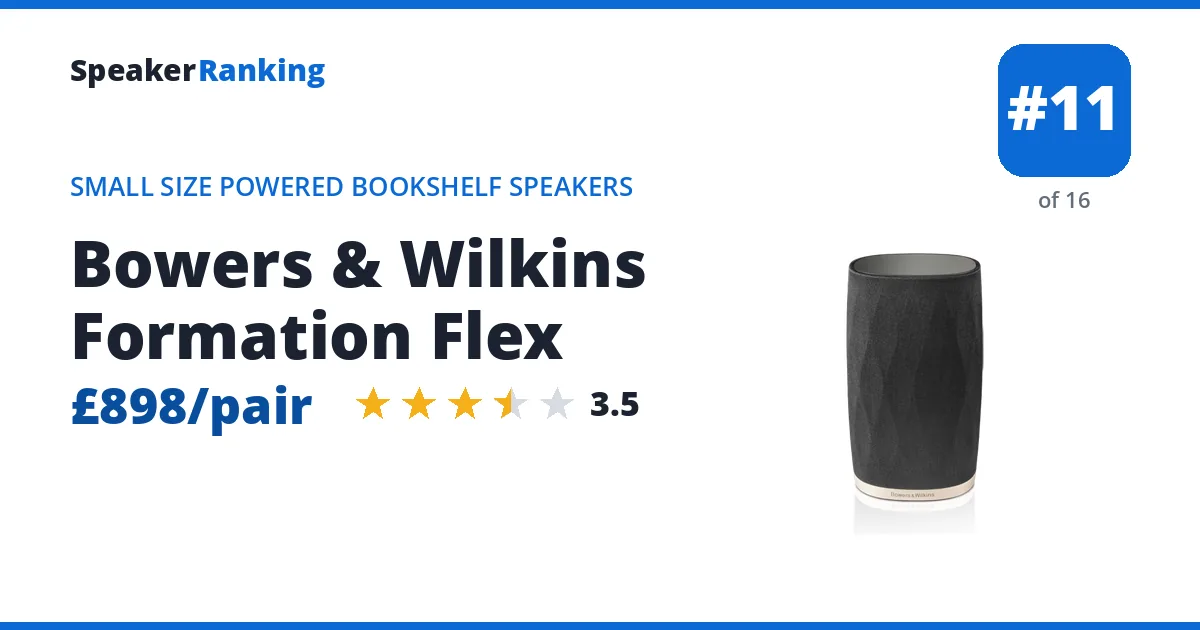
Pros: ASR’s Klippel data gives a 6.43 predicted preference score with an ideal subwoofer and broad horizontal coverage. Its wireless stereo-pair capability and network streaming can suit a minimalist system without conventional source cables. The measured tonal result is more credible than judging sound quality from the compact wireless format alone.
Cons: Standalone preference is only 3.69. The response rises toward the treble, and the -3dB point is about 95Hz, so lower bass is substantially reduced even though the preference model’s separate LFX metric is 62Hz. Those two bass metrics are not interchangeable. A stereo pair is costly, and the lack of conventional analog input limits system flexibility.
Full Bowers & Wilkins Formation Flex review and specifications →
| AES Input | No |
|---|---|
| Amplifier Power | 100W each (2 x 50W) |
| Aux Input | No |
| Bluetooth | Yes, 4.1 |
| Coaxial Input | No |
| Country | United Kingdom (design) |
| Dimensions | 8.5H x 5.1W x 5.1D in |
| Drivers | 1" decoupled double-dome tweeter, 4" woven-glass woofer |
| Enclosure | 2-way active wireless |
| Frequency Response | 50Hz - 28kHz (Manufacturer specified) |
| HDMI Input | No |
| Inputs | AirPlay 2, Spotify Connect, Roon Ready, Bluetooth, Wi-Fi |
| Optical Input | No |
| RCA Input | No |
| Spinorama Preference Score | 3.69 |
| Spinorama Preference Score with Perfect Sub | 6.43 |
| TRS Input | No |
| USB Input | No |
| Weight | 5.1 lbs (2.3 kg) each |
| Wireless | AirPlay 2, Spotify Connect, Bluetooth, Formation mesh |
| XLR Input | No |
- Links
- Reviews, Comparisons and Sound Samples
- Head-to-Head Comparisons
- Bowers & Wilkins Formation Flex vs Fostex PM0.3
- Bowers & Wilkins Formation Flex vs Sovox MiniMax3
- Bowers & Wilkins Formation Flex vs Monacor SOUND-4BT
- Bowers & Wilkins Formation Flex vs Kanto YU4
- Bowers & Wilkins Formation Flex vs HiVi Swan X3
- Bowers & Wilkins Formation Flex vs Klipsch ProMedia Lumina
- Bowers & Wilkins Formation Flex vs Monoprice Monolith MM-3
- Bowers & Wilkins Formation Flex vs Audioengine HD3
- See all 9 comparisons
 Audioengine A2+: $279.00 per pair Amazon Audioengine eBay
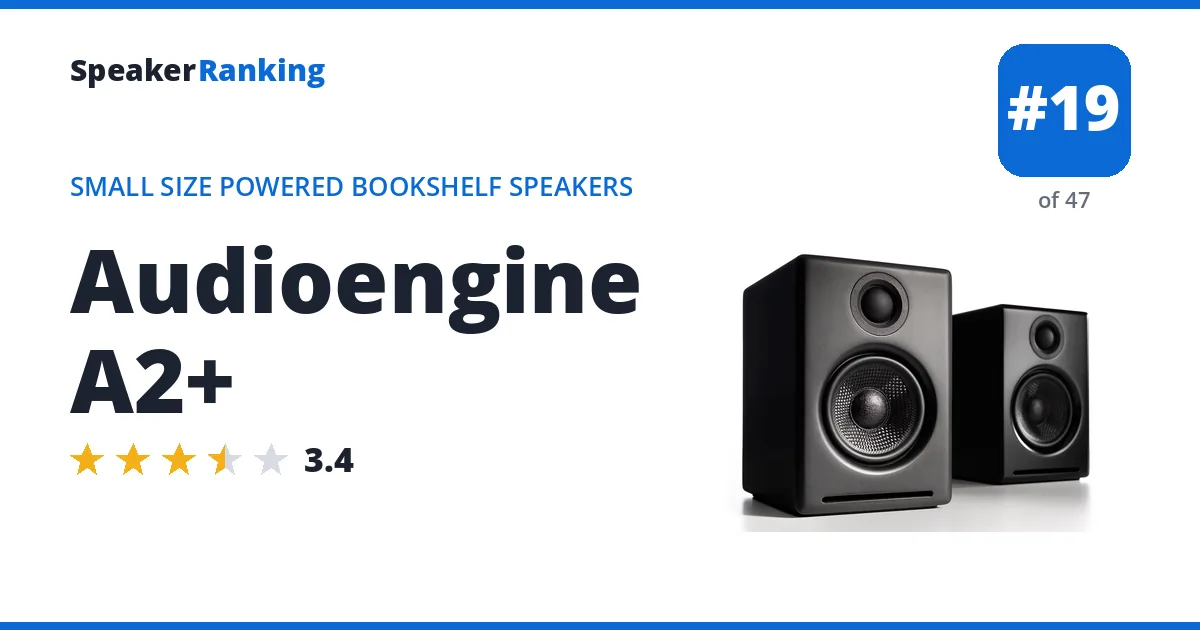
Pros: Erin’s Klippel measurements give a 5.39 predicted preference score with an ideal subwoofer. The tiny footprint, multiple inputs and variable RCA output are useful for desktop listening. The existing review found desk placement more forgiving than free-space placement, with no major port-chuffing problem in its tests. Measured bass extension of 105.5Hz (-3dB).
Cons: The 2.07 standalone score and roughly 106Hz measured -3dB point reveal how much bass is missing without reinforcement or a subwoofer. Midrange and crossover-region dips remain; desk gain is placement-dependent and cannot be assumed to correct them. Compression becomes substantial above roughly 87dB at 1m in the review, so this is a quiet nearfield option rather than a high-output monitor.
Full Audioengine A2+ review and specifications →
| AES Input | No |
|---|---|
| Amplifier Power | 15W RMS / 30W peak per channel |
| App | No |
| Aux Input | Yes |
| Bass Extension (-10dB) | 58.9Hz (measured, Erin's Audio Corner) |
| Bass Extension (-3dB) | 105.5Hz (measured, Erin's Audio Corner) |
| Bluetooth | Yes |
| Bluetooth Version | 5.0 |
| Coaxial Input | No |
| Dimensions | 6" x 4" x 5.2" (152 x 102 x 133 mm) |
| Drivers | 0.75" silk dome tweeter, 2.75" fiber woofer |
| EQ | No (fixed volume knob only) |
| Frequency Response | 65Hz - 22kHz (+-2dB, Manufacturer specified) |
| HDMI Input | No |
| Inputs | RCA, 3.5mm, USB, Bluetooth 5.0 |
| Optical Input | No |
| Outputs | RCA variable output (subwoofer) |
| RCA Input | Yes |
| Spinorama Preference Score | 1.56 |
| Spinorama Preference Score with Perfect Sub | 4.81 |
| Subwoofer Output | Yes |
| TRS Input | No |
| USB Input | Yes |
| Weight | 3.5 lbs (1.6 kg) left / 3.1 lbs (1.4 kg) right |
| XLR Input | No |
- Links
- Reviews, Comparisons and Sound Samples
- Head-to-Head Comparisons
- Audioengine A2+ vs Monacor SOUND-4BT
- Audioengine A2+ vs Kanto YU4
- Audioengine A2+ vs Klipsch ProMedia Lumina
- Audioengine A2+ vs Sovox MiniMax3
- Audioengine A2+ vs Edifier MR3
- Audioengine A2+ vs Monoprice Monolith MM-3
- Audioengine A2+ vs HiVi Swan X3
- Audioengine A2+ vs Mackie CR3-X
- See all 16 comparisons