Short answer: the Axiom ED120A. It ranks #18 of 50 12-inch pa speakers by sound quality, rated 4.0/5, at $1,790; the Seeburg X6 ranks #22, rated 3.9/5, and costs $1,975, so there is not much of a tradeoff to weigh.
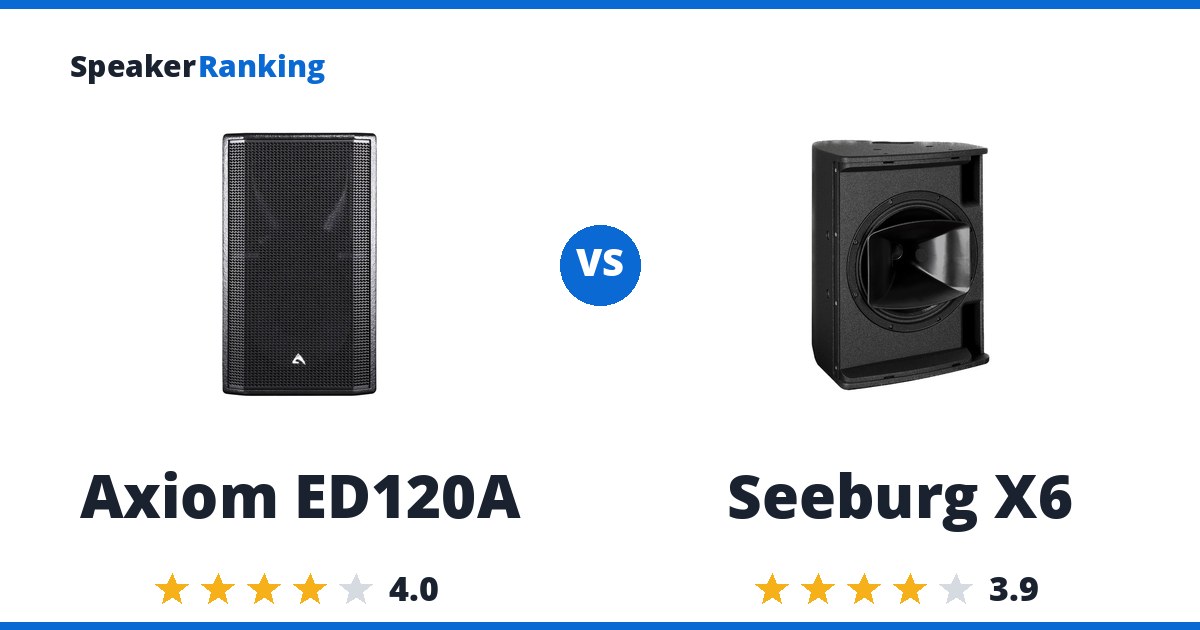
What the Axiom ED120A does well: High-quality vendor Spinorama data gives it a 5.73 ideal-subwoofer preference score and 52Hz bass extension, a solid tonal showing for a professional cabinet. The catch: The 132dB claimed peak is competitive rather than class-leading, and the asymmetric 60°-to-100° pattern needs more deliberate aiming than a conventional symmetric horn.
Why pick the Seeburg X6: Manufacturer measurements give preference scores of 3.07 standalone and 6.04 with an ideal subwoofer, on par with the JBL PRX912. Watch for: Bass reaches 80Hz at -3dB and about 66Hz at -10dB, so a subwoofer is still needed for full-range music.
Buy the Axiom ED120A. It is rated higher for sound quality than the Seeburg X6 and costs less, so it is the default pick unless a specific strength of the other one matters more to you.
Looking for alternatives? See the complete PA & Live Sound rankings.
Specifications Side By Side
| Axiom ED120A | Seeburg X6 | |
|---|---|---|
| Price | $1,790.00 | $1,975 |
| Ranked | #18 of 50 in 12-Inch PA Speakers | #22 of 50 in 12-Inch PA Speakers |
| Configuration | Active 2-way bass-reflex PA speaker | Passive 2-way coaxial PA speaker |
| Drivers | 12” woofer, 1.4” compression driver | 12” neodymium woofer (3.5” voice coil), coaxial 1.4” neodymium compression driver (3” voice coil) |
| Frequency Response | 65Hz - 17kHz (-6dB, manufacturer specified) | 55Hz - 18kHz (-6dB, manufacturer specified) |
| Dimensions | 24”H x 14.2”W x 12.2”D (610 x 360 x 310 mm) | 19.7”H x 14.2”W x 13”D (500 x 360 x 330 mm) |
| Amplifier Power | 1,200W continuous (900W LF + 300W HF Class D, manufacturer specified) | Passive speaker; requires external amplification (self-powered X6 dp version available) |
| Cabinet Material | 15mm reinforced phenolic birch plywood | - |
| Rigging | M10 and M6 fly points; pole-mount socket | 9x M10 points, 35mm pole mount |
| Network Control | PRONET control over EtherCON/CANBUS | - |
| Bass Extension (-3dB) | 60Hz (measured, vendor Spinorama data) | 80Hz (measured, vendor Spinorama data) |
| Coverage | 60°-100° asymmetric x 60° | 80° x 60° (rotatable) |
| Maximum SPL | 132dB peak (manufacturer specified) | 131dB peak (manufacturer specified) |
| Inputs | XLR input and link; EtherCON control network | - |
| DSP | Yes, CORE processing with PRONET control | No (passive) |
| Bluetooth | No | No |
| Weight | 41.9 lbs (19 kg) | 40.8 lbs (18.5 kg) |
| Spinorama Preference Score | 3.30 | 3.07 |
| Spinorama Preference Score with Perfect Sub | 5.73 | 6.04 |
| XLR Input | Yes | No |
| RCA Input | No | No |
| TRS Input | No | No |
| Optical Input | No | No |
| Coaxial Input | No | No |
| USB Input | No | No |
| HDMI Input | No | No |
| AES Input | No | No |
| Aux Input | No | No |
| Microphone Input | No | No |
| Guitar Input | No | No |
| Power Handling | - | 500W AES / 1,500W peak |
| Sensitivity | - | 99dB (1W/1m) |
| Impedance | - | 8 ohms |
| Bass Extension (-10dB) | - | about 66.3Hz (measured, vendor Spinorama data) |
Related Speaker Comparisons
More top alternatives to Axiom ED120A:
- QSC K12.2 vs Axiom ED120A
- KV2 Audio EX12 vs Axiom ED120A
- JBL PRX912 vs Axiom ED120A
- RCF KX 32-A vs Axiom ED120A
- RCF ART 932-A vs Axiom ED120A
Prices on this page were last checked September 26, 2026 at 11:14 PM UTC. Product prices and availability are accurate as of that date/time and are subject to change; the price and availability shown on Amazon at the time of purchase will apply to the purchase of this product.
As an eBay Partner, we may be compensated if you make a purchase.
The Two Speakers In Full
 Axiom ED120A: $1,790.00 eBay
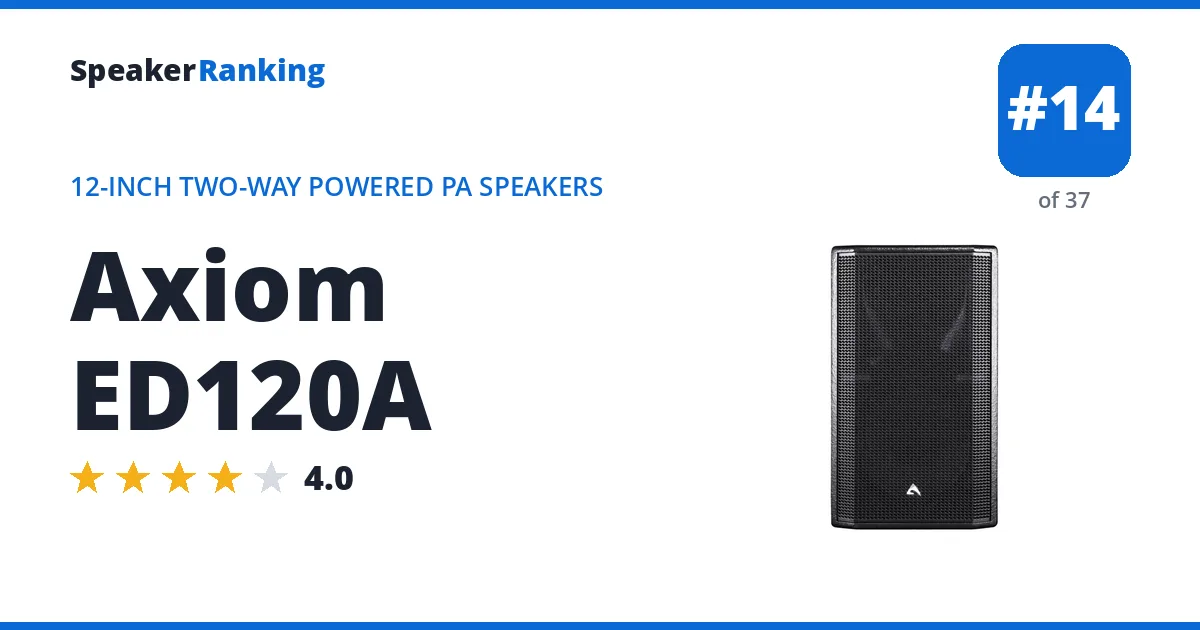
Pros: High-quality vendor Spinorama data gives it a 5.73 ideal-subwoofer preference score and 52Hz bass extension, a solid tonal showing for a professional cabinet. CORE DSP, PRONET remote control and an asymmetric rotatable horn add useful installation flexibility. Measured bass extension of 60Hz (-3dB).
Cons: The 132dB claimed peak is competitive rather than class-leading, and the asymmetric 60°-to-100° pattern needs more deliberate aiming than a conventional symmetric horn. Availability and service coverage are less broad than the mainstream QSC, JBL, Yamaha and RCF choices.
Full Axiom ED120A review and specifications →
| AES Input | No |
|---|---|
| Amplifier Power | 1,200W continuous (900W LF + 300W HF Class D, manufacturer specified) |
| Aux Input | No |
| Bass Extension (-3dB) | 60Hz (measured, vendor Spinorama data) |
| Bluetooth | No |
| Cabinet Material | 15mm reinforced phenolic birch plywood |
| Coaxial Input | No |
| Configuration | Active 2-way bass-reflex PA speaker |
| Coverage | 60°-100° asymmetric x 60° |
| DSP | Yes, CORE processing with PRONET control |
| Dimensions | 24”H x 14.2”W x 12.2”D (610 x 360 x 310 mm) |
| Drivers | 12” woofer, 1.4” compression driver |
| Frequency Response | 65Hz - 17kHz (-6dB, manufacturer specified) |
| Guitar Input | No |
| HDMI Input | No |
| Inputs | XLR input and link; EtherCON control network |
| Maximum SPL | 132dB peak (manufacturer specified) |
| Microphone Input | No |
| Network Control | PRONET control over EtherCON/CANBUS |
| Optical Input | No |
| RCA Input | No |
| Rigging | M10 and M6 fly points; pole-mount socket |
| Spinorama Preference Score | 3.30 |
| Spinorama Preference Score with Perfect Sub | 5.73 |
| TRS Input | No |
| USB Input | No |
| Weight | 41.9 lbs (19 kg) |
| XLR Input | Yes |
- Links
- Reviews, Comparisons and Sound Samples
- Head-to-Head Comparisons
 Seeburg X6: $1,975 Passive Thomann eBay
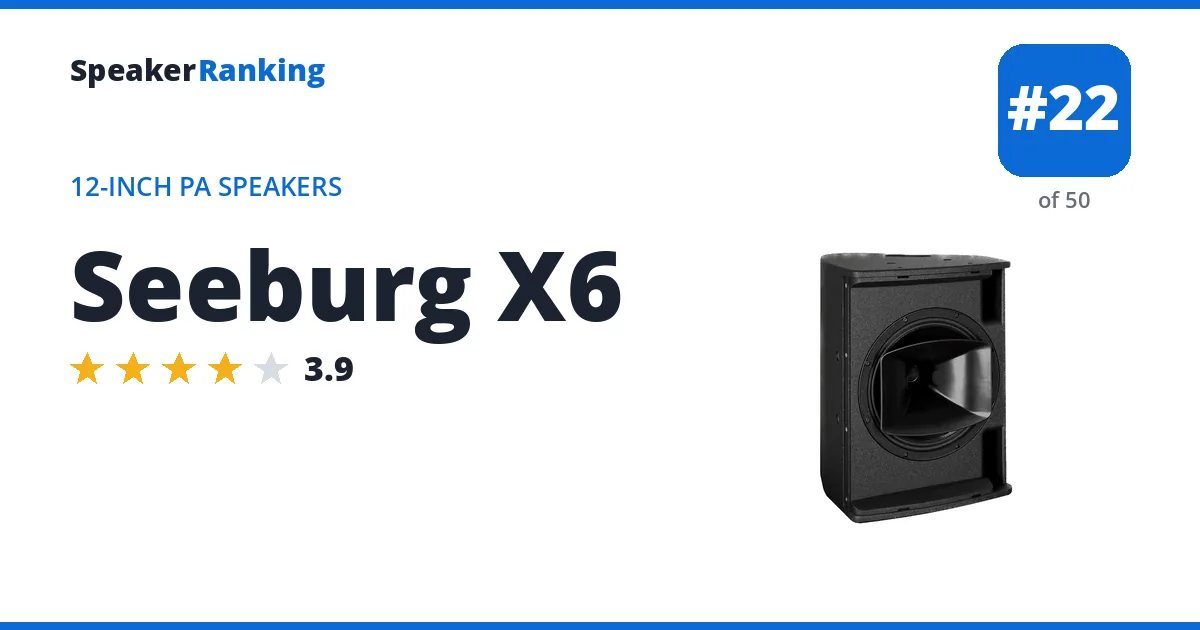
Pros: Manufacturer measurements give preference scores of 3.07 standalone and 6.04 with an ideal subwoofer, on par with the JBL PRX912. The coaxial 12-inch woofer and 1.4-inch compression driver give a 2.2dB reference band and consistent sound across the 80° x 60° pattern. With 99dB sensitivity and a 131dB peak rating from an 18.5kg cabinet, it suits bands and venues that need output without bulk. Measured bass extension of 80Hz (-3dB).
Cons: Bass reaches 80Hz at -3dB and about 66Hz at -10dB, so a subwoofer is still needed for full-range music. It is passive, so you need an amplifier and a processor with Seeburg presets, or the self-powered X6 dp version. A 4.34 directivity-index deviation means off-axis balance shifts more than the flattest designs here.
Full Seeburg X6 review and specifications →
| AES Input | No |
|---|---|
| Amplifier Power | Passive speaker; requires external amplification (self-powered X6 dp version available) |
| Aux Input | No |
| Bass Extension (-10dB) | about 66.3Hz (measured, vendor Spinorama data) |
| Bass Extension (-3dB) | 80Hz (measured, vendor Spinorama data) |
| Bluetooth | No |
| Coaxial Input | No |
| Configuration | Passive 2-way coaxial PA speaker |
| Coverage | 80° x 60° (rotatable) |
| DSP | No (passive) |
| Dimensions | 19.7”H x 14.2”W x 13”D (500 x 360 x 330 mm) |
| Drivers | 12” neodymium woofer (3.5” voice coil), coaxial 1.4” neodymium compression driver (3” voice coil) |
| Frequency Response | 55Hz - 18kHz (-6dB, manufacturer specified) |
| Guitar Input | No |
| HDMI Input | No |
| Impedance | 8 ohms |
| Maximum SPL | 131dB peak (manufacturer specified) |
| Microphone Input | No |
| Optical Input | No |
| Power Handling | 500W AES / 1,500W peak |
| RCA Input | No |
| Rigging | 9x M10 points, 35mm pole mount |
| Sensitivity | 99dB (1W/1m) |
| Spinorama Preference Score | 3.07 |
| Spinorama Preference Score with Perfect Sub | 6.04 |
| TRS Input | No |
| USB Input | No |
| Weight | 40.8 lbs (18.5 kg) |
| XLR Input | No |
- Links
- Reviews, Comparisons and Sound Samples
- Head-to-Head Comparisons