Short answer: both are discontinued, and they are rated the same for sound quality, though neither ranks well in its class. (#131 and #130 of 134 bookshelf speakers). Either one is only an option used, so choose on condition and price. Both are rated below 3.0/5 among the 134 bookshelf speakers; for better sound, the ELAC Debut 3.0 DB63 ranks #42 at $499.
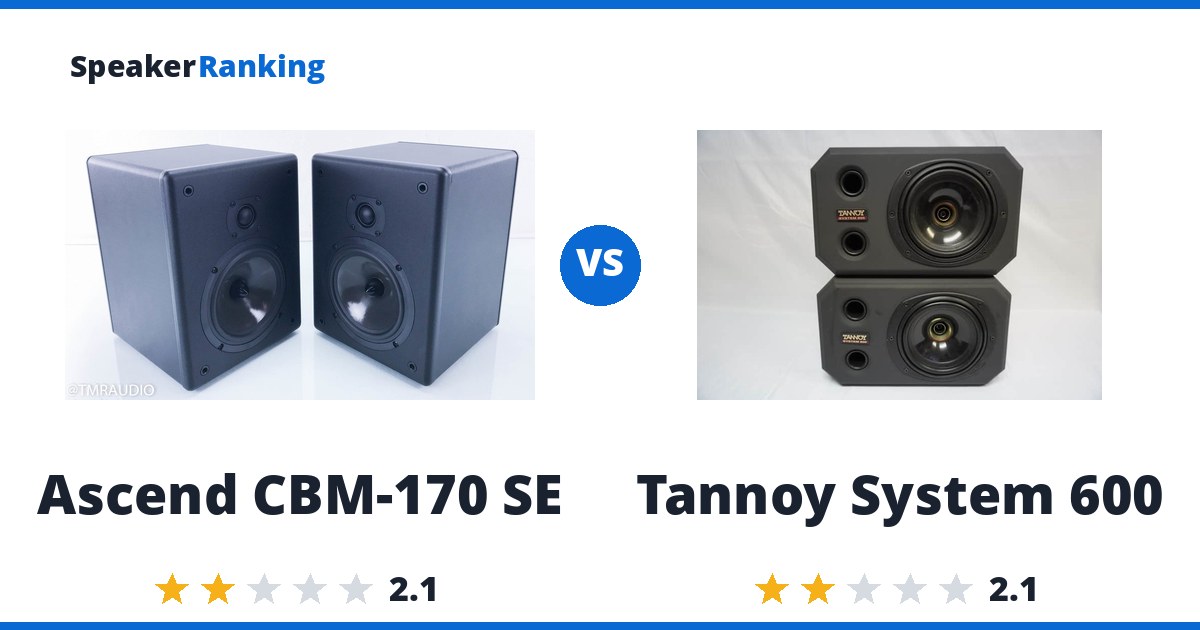
The CBM-170 SE becomes progressively bright above 1kHz, so it is a poor match for listeners already sensitive to elevated presence and treble. Careful toe-out or modest EQ can help, but the voicing is not naturally relaxed.
Tannoy’s concentric layout gives the System 600 consistent directional behavior and well-controlled impedance. The larger issue is a pronounced crossover suckout with preceding peaks, producing a poor predicted in-room response that is more fundamental than a simple placement adjustment.
Buy the Ascend CBM-170 SE if you want lower distortion and can tolerate or correct a brighter balance.
Buy the Tannoy System 600 only if its concentric-driver presentation and controlled impedance are more important than response accuracy.
Still deciding? The full Passive Home rankings cover every ranked option.
Specifications Side By Side
| Ascend CBM-170 SE | Tannoy System 600 | |
|---|---|---|
| Price | $384 per pair superseded by CBM-170SE2, Discontinued | $400 per pair Discontinued |
| Ranked | #131 of 134 in Large Size Bookshelf Speakers | #130 of 134 in Large Size Bookshelf Speakers |
| Drivers | 6.5” proprietary composite polygel cone woofer, 27mm custom SEAS soft dome tweeter | 6.5” Tannoy Dual Concentric driver (type 1678) |
| Dimensions | 12H x 9W x 10D in | 8.7”H x 14.2”W x 11.4”D (220 x 360 x 290 mm) |
| Weight | 14 lbs (6.35 kg) each | 20.9 lbs (9.5 kg) pair (cabinet) |
| Sensitivity | 91dB (2.83V/1m, manufacturer specified, in-room) | approx. 84dB (2.83V/1m, measured, Audio Science Review - low confidence, no flat reference plateau) |
| Bass Extension (-3dB) | approx. 80Hz (measured, Audio Science Review) | approx. 73Hz - low confidence, response never reaches a flat reference level (measured, Audio Science Review) |
| Bass Extension (-10dB) | approx. 50Hz (measured, Audio Science Review) | approx. 48Hz - low confidence, response never reaches a flat reference level (measured, Audio Science Review) |
| Impedance | 8 ohms | 8 ohms nominal |
| Spinorama Preference Score | 4.27 | 1.04 |
| Spinorama Preference Score with Perfect Sub | 7.06 | 4.03 |
| DIY Kit | No | No |
| Frequency Response | - | 52Hz - 20kHz +/-3dB (Manufacturer specified) |
| Power Handling | - | 50-150W recommended |
| Woofer Cabinet | - | ported, flared tubes |
Related Speaker Comparisons
More top alternatives to Tannoy System 600:
- ELAC Debut 3.0 DB63 vs Tannoy System 600
- Tannoy System 600 vs Dayton Audio MK602X
- ELAC Debut 3.0 DB63 vs Ascend CBM-170 SE
- Klipsch RP-600M vs Yamaha NS-10
- Triangle Borea BR03 vs Yamaha NS-10
Prices on this page were last checked October 3, 2026 at 10:26 PM UTC. Product prices and availability are accurate as of that date/time and are subject to change; the price and availability shown on Amazon at the time of purchase will apply to the purchase of this product.
As an eBay Partner, we may be compensated if you make a purchase.
The Two Speakers In Full
 Ascend CBM-170 SE: $384 per pair superseded by CBM-170SE2 Discontinued eBay
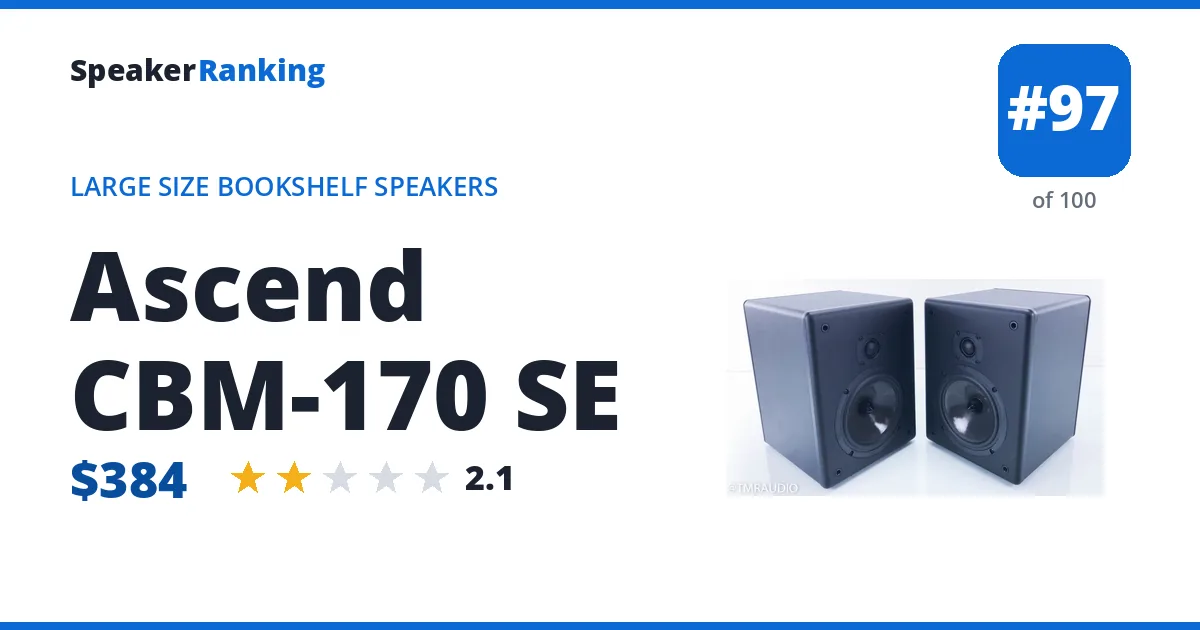
Newer model: the Ascend CBM-170 SE2, ranked higher, rated 3.8/5.
Pros: US-manufactured 2-way with a custom SEAS silk dome tweeter and low harmonic distortion. Solid cabinet construction for the price class. Measured bass extension of 80Hz (-3dB).
Cons: On-axis response starts peaking above 1kHz and keeps rising, which Amir predicted would create a bright, potentially fatiguing tonal balance: a character he says “can become grating” over time. The small tweeter paired with a larger woofer lacking a waveguide causes significant off-axis coloration, contradicting the manufacturer’s accuracy claims. Impedance dips below 4 ohms in the bass, and cabinet flex was noted, comparable to cheaper competitors. Amir suggests “looking elsewhere for a better design.”. Discontinued.
Full Ascend CBM-170 SE review and specifications →
| Bass Extension (-10dB) | approx. 50Hz (measured, Audio Science Review) |
|---|---|
| Bass Extension (-3dB) | approx. 80Hz (measured, Audio Science Review) |
| DIY Kit | No |
| Dimensions | 12H x 9W x 10D in |
| Drivers | 6.5” proprietary composite polygel cone woofer, 27mm custom SEAS soft dome tweeter |
| Impedance | 8 ohms |
| Sensitivity | 91dB (2.83V/1m, manufacturer specified, in-room) |
| Spinorama Preference Score | 4.27 |
| Spinorama Preference Score with Perfect Sub | 7.06 |
| Weight | 14 lbs (6.35 kg) each |
- Reviews, Comparisons and Sound Samples
- Head-to-Head Comparisons
 Tannoy System 600: $400 per pair Discontinued eBay
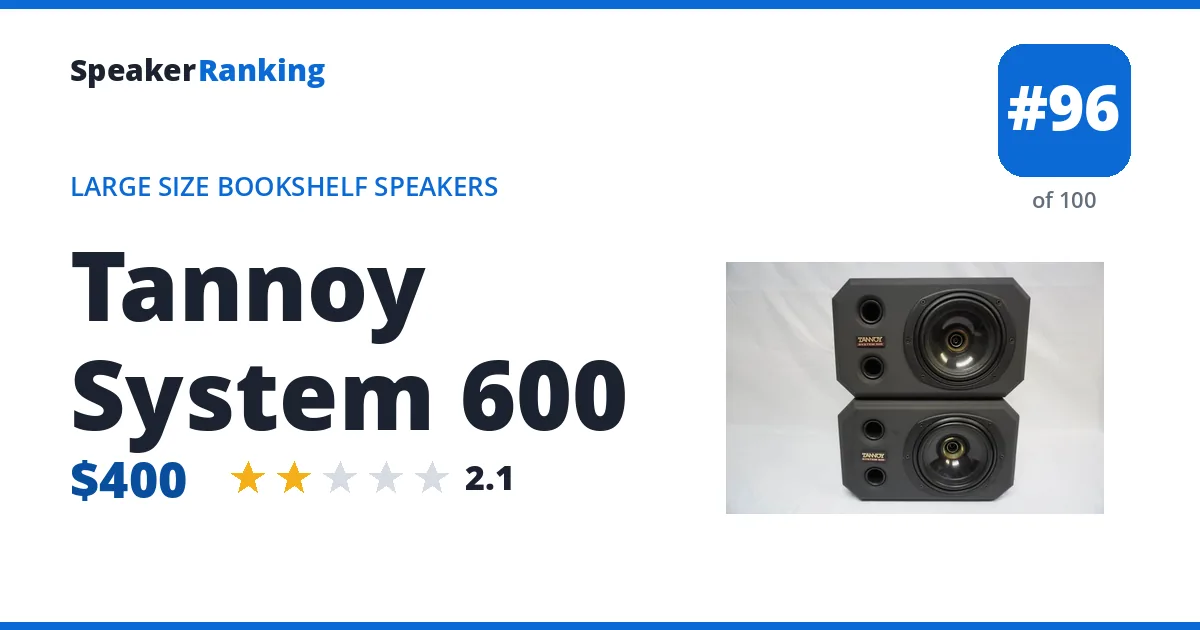
Pros: Impedance is well controlled, and the concentric dual-driver layout gives it consistent horizontal and vertical response relative to typical non-coaxial 2-ways of its era. Measured bass extension of 73Hz (-3dB), with a measured sensitivity of 84dB.
Cons: CEA2034 spinorama shows a large suck-out right at the crossover frequency where the two drivers fail to overlap properly, plus general peaking beforehand: the reviewer noted “no measurement seems to have been used to optimize this design.” Predicted in-room response is correspondingly poor. Amir ran out of time to perform a dedicated subjective listening test on this unit, but concluded from the data alone that it is “highly colored and really not something you want to put in your system.” Long discontinued; used-market only.
Full Tannoy System 600 review and specifications →
| Bass Extension (-10dB) | approx. 48Hz - low confidence, response never reaches a flat reference level (measured, Audio Science Review) |
|---|---|
| Bass Extension (-3dB) | approx. 73Hz - low confidence, response never reaches a flat reference level (measured, Audio Science Review) |
| DIY Kit | No |
| Dimensions | 8.7”H x 14.2”W x 11.4”D (220 x 360 x 290 mm) |
| Drivers | 6.5” Tannoy Dual Concentric driver (type 1678) |
| Frequency Response | 52Hz - 20kHz +/-3dB (Manufacturer specified) |
| Impedance | 8 ohms nominal |
| Power Handling | 50-150W recommended |
| Sensitivity | approx. 84dB (2.83V/1m, measured, Audio Science Review - low confidence, no flat reference plateau) |
| Spinorama Preference Score | 1.04 |
| Spinorama Preference Score with Perfect Sub | 4.03 |
| Weight | 20.9 lbs (9.5 kg) pair (cabinet) |
| Woofer Cabinet | ported, flared tubes |
- Reviews, Comparisons and Sound Samples
- Head-to-Head Comparisons