Short answer: the Ascend Acoustics Sierra Titan Tower. It ranks #25 of 73 floorstanding speakers by sound quality, rated 4.4/5, at $2,998; the JBL HDI-3600 ranks #31, rated 4.3/5, and costs $3,800, so there is not much of a tradeoff to weigh.
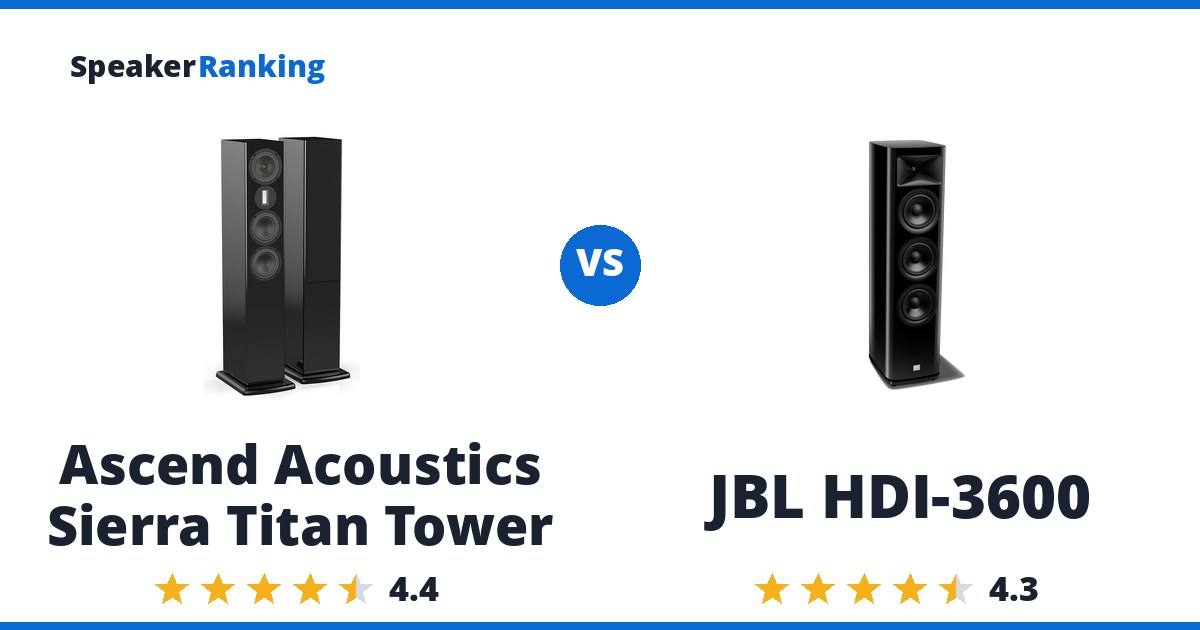
The case for the Ascend Acoustics Sierra Titan Tower: A SEAS Titan dome tweeter and dual 5.25 inch long throw woofers in a bamboo V-LAM tower reach a measured 58.6Hz extension point at a more accessible price than Ascend’s ribbon tweeter ELX line. The catch: Its listening window response is the least smooth of Ascend’s measured towers, trailing the pricier ELX Ribbon Tower.
Why pick the JBL HDI-3600: CEA2034 spinorama shows a fairly even on-axis response and flat overall frequency response, with high 90dB sensitivity and very low distortion through the midrange. Watch for: A wide shelving-down above 2kHz affects the in-room response, and vertical dispersion is a bigger issue than horizontal: the reviewer noted the dip is wider here than on the smaller HDI-1600, making it more audible.
Buy the Ascend Acoustics Sierra Titan Tower. It is rated higher for sound quality than the JBL HDI-3600 and costs less, so only choose the other one for a particular feature it does better.
Looking for alternatives? See the complete Passive Home rankings.
Specifications Side By Side
| Ascend Acoustics Sierra Titan Tower | JBL HDI-3600 | |
|---|---|---|
| Price | $2,998 per pair | $3800 per pair |
| Ranked | #25 of 73 in Large Size Floorstanding Speakers | #31 of 73 in Large Size Floorstanding Speakers |
| Enclosure | ported | - |
| Drivers | SEAS Titan dome tweeter, 1x 5.25” midrange (sealed sub-chamber), 2x 5.25” mineral filled polypropylene woofers | 2410H-2 1” compression driver, 3x 6.5” Advanced Aluminum Matrix woofers |
| Dimensions | 43”H x 7.5”W x 10.5”D (1092 x 190 x 267 mm) | 40.5”H x 10.2”W x 13.5”D (1029 x 260 x 343 mm) |
| Weight | 45 lbs (20.4 kg) each | 61.7 lbs (28 kg) each |
| Sensitivity | 88dB @ 2.83V/1m in-room (manufacturer) | 89.5dB (2.83V/1m, measured, Audio Science Review) |
| Impedance | 8 ohms nominal | 4 ohms nominal |
| Power Handling | 300W continuous, 500W peak | - |
| Frequency Response | 32-27,000Hz typical in-room (manufacturer) | 38Hz - 30kHz (+/-3dB) (Manufacturer specified) |
| Bass Extension (-3dB) | 58.6Hz (measured, spinorama.org vendor data) | 78Hz - the on-axis curve also shows an unusual step/dip around 40-55Hz that may be a near-field-scan artifact for this tower (measured, Audio Science Review) |
| Bass Extension (-10dB) | 34.6Hz (measured, spinorama.org vendor data) | 62Hz - the on-axis curve also shows an unusual step/dip around 40-55Hz that may be a near-field-scan artifact for this tower (measured, Audio Science Review) |
| Warranty | 7 years parts and labor | - |
| Country | United States | - |
| Spinorama Preference Score | 6.05 | 4.64 (spinorama.org) |
| Spinorama Preference Score with Perfect Sub | 8.00 | 6.95 (spinorama.org) |
| DIY Kit | No | No |
| Woofer Cabinet | - | ported, dual rear-firing |
Related Speaker Comparisons
More worthwhile head-to-heads for Ascend Acoustics Sierra Titan Tower:
- Ascend Acoustics Sierra Titan Tower vs KEF R11 Meta
- Ascend Acoustics Sierra Titan Tower vs JBL Studio 698
- Ascend Acoustics Sierra Titan Tower vs Polk Audio Reserve R700
- Ascend Acoustics Sierra Titan Tower vs Q Acoustics 5040
- KEF R5 vs JBL HDI-3600
Prices on this page were last checked September 29, 2026 at 3:43 PM UTC. Product prices and availability are accurate as of that date/time and are subject to change; the price and availability shown on Amazon at the time of purchase will apply to the purchase of this product.
As an eBay Partner, we may be compensated if you make a purchase.
The Two Speakers In Full
 Ascend Acoustics Sierra Titan Tower: $2,998 per pair Ascend Acoustics eBay
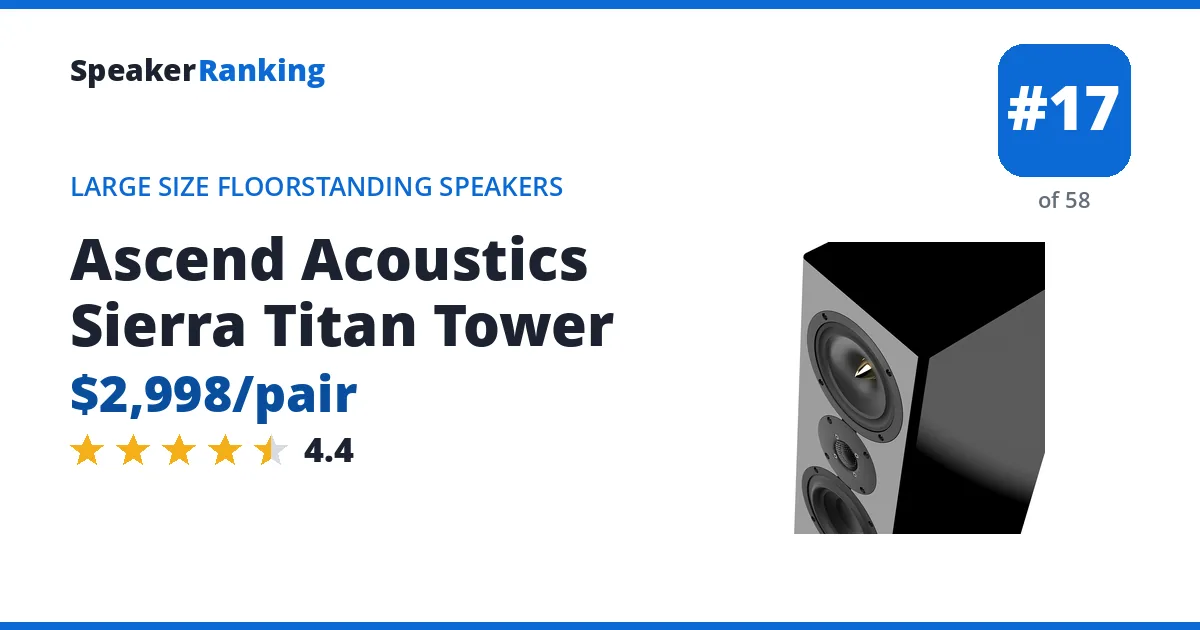
Pros: A SEAS Titan dome tweeter and dual 5.25 inch long throw woofers in a bamboo V-LAM tower reach a measured 58.6Hz extension point at a more accessible price than Ascend’s ribbon tweeter ELX line. The bass alignment Q of 0.72 keeps the low end reasonably well controlled. Backed by the same 7 year parts and labor warranty and hand matched +/-1.5dB pairs, each shipped with its own production line frequency response printout. Measured bass extension of 58.6Hz (-3dB).
Cons: Its listening window response is the least smooth of Ascend’s measured towers, trailing the pricier ELX Ribbon Tower. Sound power response falls off more steeply above the crossover than the ribbon version, so off axis and in room treble energy rolls off faster. Ascend sells direct only, with no dealer network or third party retailers for an in person audition.
Full Ascend Acoustics Sierra Titan Tower review and specifications →
| Bass Extension (-10dB) | 34.6Hz (measured, spinorama.org vendor data) |
|---|---|
| Bass Extension (-3dB) | 58.6Hz (measured, spinorama.org vendor data) |
| Country | United States |
| DIY Kit | No |
| Dimensions | 43”H x 7.5”W x 10.5”D (1092 x 190 x 267 mm) |
| Drivers | SEAS Titan dome tweeter, 1x 5.25” midrange (sealed sub-chamber), 2x 5.25” mineral filled polypropylene woofers |
| Enclosure | ported |
| Frequency Response | 32-27,000Hz typical in-room (manufacturer) |
| Impedance | 8 ohms nominal |
| Power Handling | 300W continuous, 500W peak |
| Sensitivity | 88dB @ 2.83V/1m in-room (manufacturer) |
| Spinorama Preference Score | 6.05 |
| Spinorama Preference Score with Perfect Sub | 8.00 |
| Warranty | 7 years parts and labor |
| Weight | 45 lbs (20.4 kg) each |
- Links
- Reviews, Comparisons and Sound Samples
- Head-to-Head Comparisons
 JBL HDI-3600: $3800 per pair Audio Advice eBay
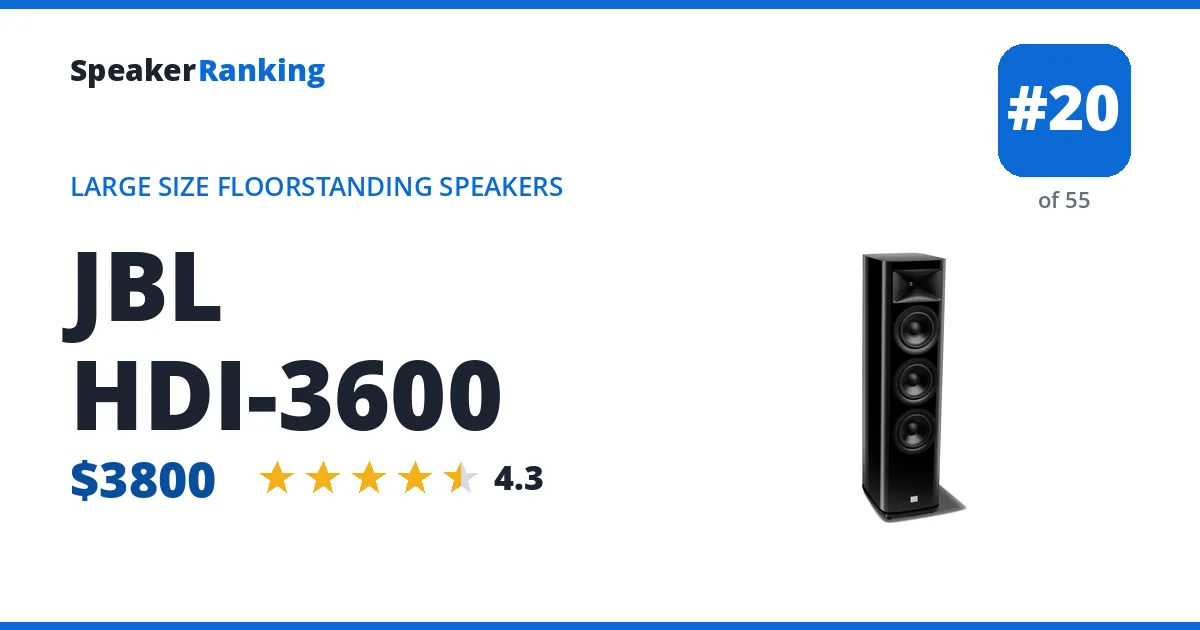
Pros: CEA2034 spinorama shows a fairly even on-axis response and flat overall frequency response, with high 90dB sensitivity and very low distortion through the midrange. Triple 6.5” Advanced Aluminum Matrix woofers and a 1” compression driver in JBL’s HDI waveguide. Measured bass extension of 78Hz (-3dB), with a measured sensitivity of 89.5dB.
Cons: A wide shelving-down above 2kHz affects the in-room response, and vertical dispersion is a bigger issue than horizontal: the reviewer noted the dip is wider here than on the smaller HDI-1600, making it more audible. Narrow vertical sweet spot means careful listener-height positioning matters more than usual.
Full JBL HDI-3600 review and specifications →
| Bass Extension (-10dB) | 62Hz - the on-axis curve also shows an unusual step/dip around 40-55Hz that may be a near-field-scan artifact for this tower (measured, Audio Science Review) |
|---|---|
| Bass Extension (-3dB) | 78Hz - the on-axis curve also shows an unusual step/dip around 40-55Hz that may be a near-field-scan artifact for this tower (measured, Audio Science Review) |
| DIY Kit | No |
| Dimensions | 40.5”H x 10.2”W x 13.5”D (1029 x 260 x 343 mm) |
| Drivers | 2410H-2 1” compression driver, 3x 6.5” Advanced Aluminum Matrix woofers |
| Frequency Response | 38Hz - 30kHz (+/-3dB) (Manufacturer specified) |
| Impedance | 4 ohms nominal |
| Sensitivity | 89.5dB (2.83V/1m, measured, Audio Science Review) |
| Spinorama Preference Score | 4.64 (spinorama.org) |
| Spinorama Preference Score with Perfect Sub | 6.95 (spinorama.org) |
| Weight | 61.7 lbs (28 kg) each |
| Woofer Cabinet | ported, dual rear-firing |
- Links
- Reviews, Comparisons and Sound Samples
- Head-to-Head Comparisons