Short answer: the Ascend Acoustics HTM-200SE2 for better sound quality, the Sony SS-CS5 M2 for the lower price. The Ascend Acoustics HTM-200SE2 ranks #7 of 87 bookshelf speakers at $368. The Sony SS-CS5 M2 ranks #48 at $277.99, $90.01 cheaper.
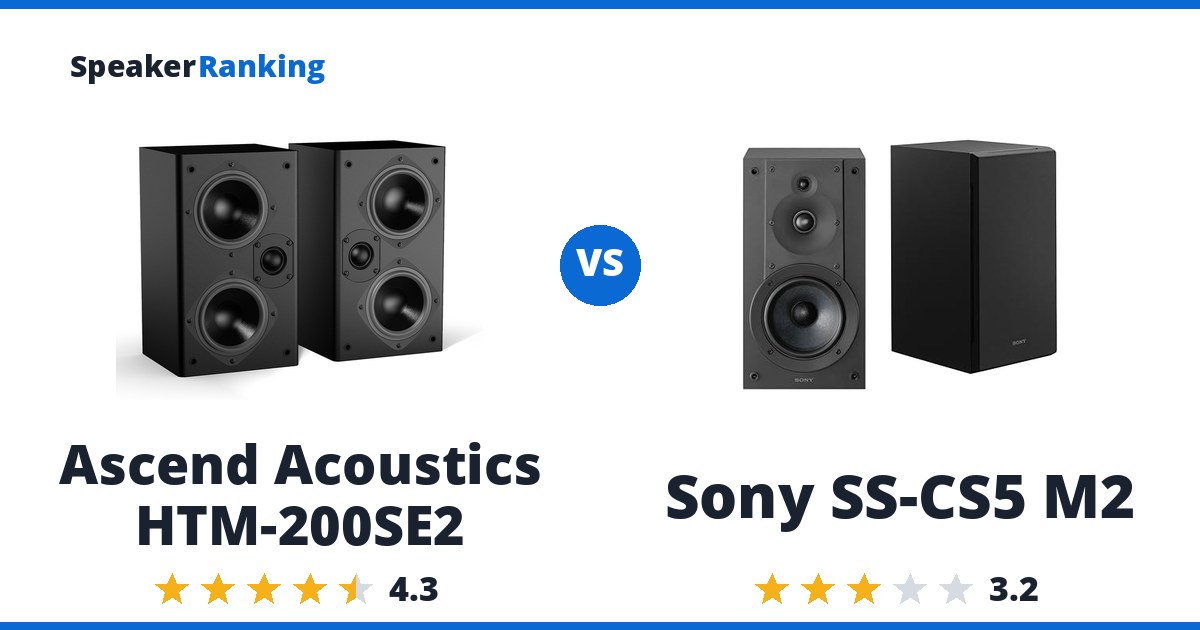
What the Ascend Acoustics HTM-200SE2 offers: High-quality manufacturer NFS data shows 0.385dB on-axis average absolute deviation, 0.428 listening-window smoothness, and unusually even 80-degree dispersion in both planes. The compact sealed cabinet is easy to place, while the preference score reaches 7.11 with a subwoofer. Watch for: Limited bass is the main tradeoff, measuring 87.9Hz at -3dB, 71.8Hz at -6dB, and 51.3Hz at -12dB; its preference score falls to 4.20 without a subwoofer. The 3.62 sound-power directivity-index standard deviation is respectable rather than exceptional, and the small woofers limit deep-bass output.
What the Sony SS-CS5 M2 offers: Added internal bracing (corners, sides, front baffle) plus an updated crossover meaningfully reduce the resonance issues that plagued the original SS-CS5, giving a smoother, more neutral character overall. A modest mid-range dip (about 1-2dB) is present but tolerable, and the reviewer would rather have this dip than a peak in that region. Slightly deeper bass than the previous version, measuring about 2dB more output around 60Hz. Distortion drops noticeably when crossed to a subwoofer around 80-120Hz, meaningfully improving midrange clarity and detail versus running full-range. Easy to drive on a standard AVR - no need for a dedicated high-power amplifier. More modern, understated waveguide look compared to the previous version’s glossy trim. Watch for: Mild sibilance in the 3-5kHz range stands out on S and T sounds in vocals. Some forwardness in the midrange noticeable on certain vocal recordings. Soundstage and sense of envelopment are comparatively flat and two-dimensional, especially next to reference-quality speakers with strong 3D imaging. Marketed as a “three-way” design mainly due to an added super-tweeter that the reviewer considers largely superfluous - it engages only at very high frequencies and adds complexity without a clearly audible benefit, when that cost might have been better spent on the main crossover. Output-limited: realistic ceiling is around the mid-90s dB SPL at a few meters, with comfortable listening closer to 75-85dB at 3-4 meters before distortion and compression become audible. Bass noticeably compresses/shelves below about 120Hz as volume increases, softening kick-drum impact at higher output. Smaller drivers and a lighter motor structure than rivals like the Polk XT20, which the reviewer generally prefers for its better directivity and higher SPL capability. Still needs a subwoofer for any real bass extension.
Buy the Ascend Acoustics HTM-200SE2 if sound quality matters more than the price. Buy the Sony SS-CS5 M2 if the price matters more than sound quality.
Looking for alternatives? See the complete Passive Home rankings.
Specifications Side By Side
| Ascend Acoustics HTM-200SE2 | Sony SS-CS5 M2 | |
|---|---|---|
| Price | $368 per pair | $277.99 per pair |
| Ranked | #7 of 87 in Medium Size Bookshelf Speakers | #48 of 87 in Medium Size Bookshelf Speakers |
| Bass Extension (-3dB) | 87.9Hz (measured, spinorama.org) | 80Hz (measured, Erin's Audio Corner) |
| Bass Extension (-10dB) | approximately 56Hz (measured, spinorama.org) | 54Hz (measured, Erin's Audio Corner) |
| Enclosure | Sealed | - |
| Drivers | Two 4-inch woofers; soft-dome tweeter | 5.12" woofer, 0.98 in tweeter; 0.75-inch supertweeter; 0.75-inch supertweeter; 0.75-inch supertweeter; 0.75-inch supertweeter |
| Impedance | 8 ohms nominal | 6 ohms |
| Spinorama Preference Score | 4.20 | - |
| Spinorama Preference Score with Perfect Sub | 7.11 | - |
| Dimensions | - | 13.2"H x 7"W x 8.7"D (335 x 178 x 220 mm) |
| Sensitivity | - | 82.5dB |
| Weight | - | 9.5 lbs (4.3 kg) each |
| Woofer Cabinet | - | ported, rear |
Related Speaker Comparisons
How Ascend Acoustics HTM-200SE2 compares with other leading options:
- Ascend Acoustics HTM-200SE2 vs Audio First Fidelia
- Ascend Acoustics HTM-200SE2 vs Philharmonic Ceramic Mini
- Ascend Sierra 1 v2 vs Ascend Acoustics HTM-200SE2
- KEF LS50 Meta vs Ascend Acoustics HTM-200SE2
- Ascend Acoustics HTM-200SE2 vs XMechanik Mechano23 DIY
Prices on this page were last checked September 16, 2026 at 12:41 AM UTC. Product prices and availability are accurate as of that date/time and are subject to change; the price and availability shown on Amazon at the time of purchase will apply to the purchase of this product.
As an eBay Partner, we may be compensated if you make a purchase.
The Two Speakers In Full
 Ascend Acoustics HTM-200SE2: $368 per pair Ascend Acoustics eBay
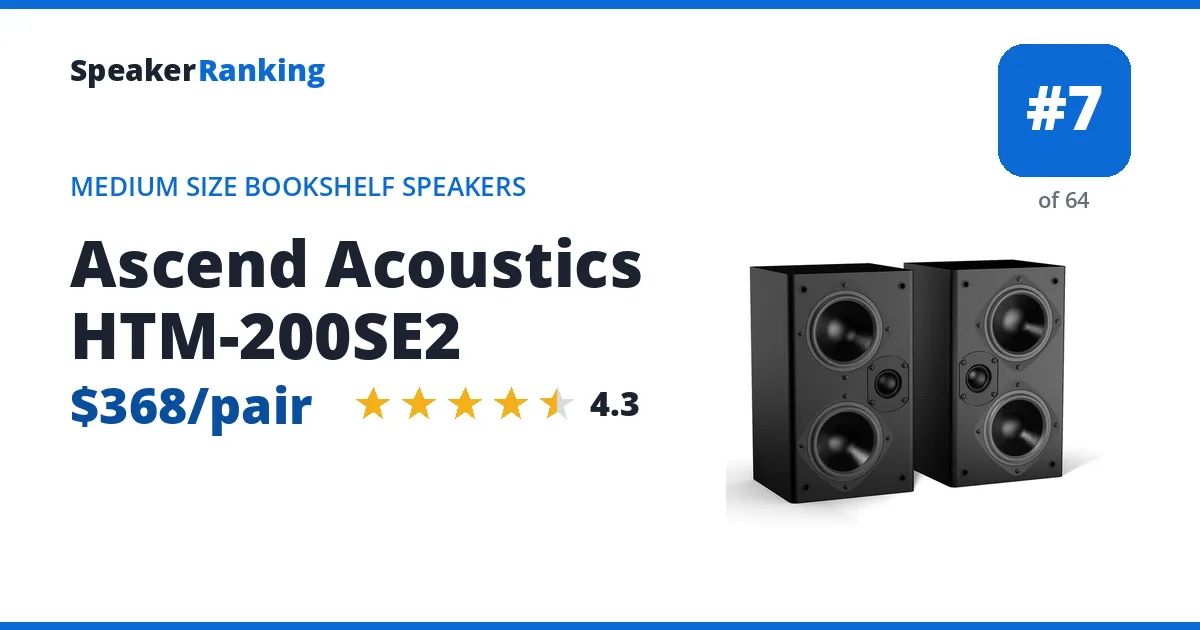
Pros: High-quality manufacturer NFS data shows 0.385dB on-axis average absolute deviation, 0.428 listening-window smoothness, and unusually even 80-degree dispersion in both planes. The compact sealed cabinet is easy to place, while the preference score reaches 7.11 with a subwoofer. Measured bass extension of 87.9Hz (-3dB).
Cons: Limited bass is the main tradeoff, measuring 87.9Hz at -3dB, 71.8Hz at -6dB, and 51.3Hz at -12dB; its preference score falls to 4.20 without a subwoofer. The 3.62 sound-power directivity-index standard deviation is respectable rather than exceptional, and the small woofers limit deep-bass output.
Full Ascend Acoustics HTM-200SE2 review and specifications →
| Bass Extension (-10dB) | approximately 56Hz (measured, spinorama.org) |
|---|---|
| Bass Extension (-3dB) | 87.9Hz (measured, spinorama.org) |
| Drivers | Two 4-inch woofers; soft-dome tweeter |
| Enclosure | Sealed |
| Impedance | 8 ohms nominal |
| Spinorama Preference Score | 4.20 |
| Spinorama Preference Score with Perfect Sub | 7.11 |
- Links
- Reviews, Comparisons and Sound Samples
- Head-to-Head Comparisons
- Ascend Acoustics HTM-200SE2 vs XMechanik Mechano23 DIY
- Ascend Acoustics HTM-200SE2 vs Arendal 1961 Monitor
- Ascend Acoustics HTM-200SE2 vs KEF LS50 Meta
- Ascend Acoustics HTM-200SE2 vs Ascend Acoustics Luna V2 Mini-Monitor Titan
- Ascend Acoustics HTM-200SE2 vs Ascend Sierra 1 v2
- Ascend Acoustics HTM-200SE2 vs Aalto Speakers Aalto 1 EVO
- Ascend Acoustics HTM-200SE2 vs Philharmonic Ceramic Mini
- Ascend Acoustics HTM-200SE2 vs Audio First Fidelia
- See all 20 comparisons
 Sony SS-CS5 M2: $277.99 per pair Amazon eBay
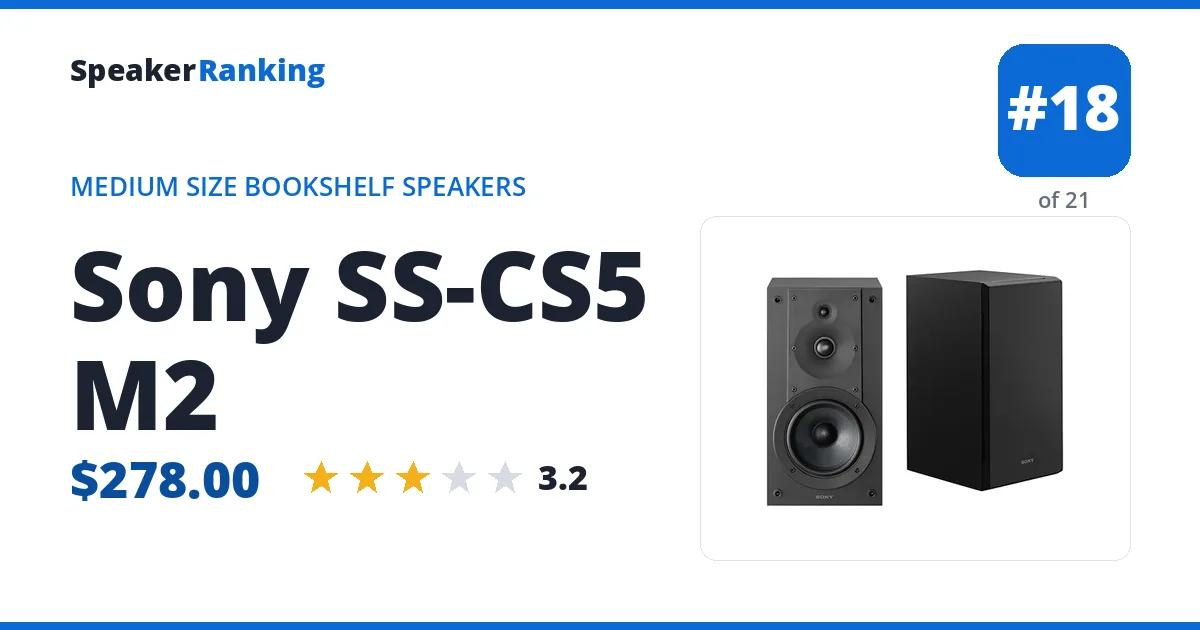
Pros: Added internal bracing (corners, sides, front baffle) plus an updated crossover meaningfully reduce the resonance issues that plagued the original SS-CS5, giving a smoother, more neutral character overall. A modest mid-range dip (about 1-2dB) is present but tolerable, and the reviewer would rather have this dip than a peak in that region. Slightly deeper bass than the previous version, measuring about 2dB more output around 60Hz. Distortion drops noticeably when crossed to a subwoofer around 80-120Hz, meaningfully improving midrange clarity and detail versus running full-range. Easy to drive on a standard AVR - no need for a dedicated high-power amplifier. More modern, understated waveguide look compared to the previous version’s glossy trim. Measured bass extension of 80Hz (-3dB).
Cons: Mild sibilance in the 3-5kHz range stands out on S and T sounds in vocals. Some forwardness in the midrange noticeable on certain vocal recordings. Soundstage and sense of envelopment are comparatively flat and two-dimensional, especially next to reference-quality speakers with strong 3D imaging. Marketed as a “three-way” design mainly due to an added super-tweeter that the reviewer considers largely superfluous - it engages only at very high frequencies and adds complexity without a clearly audible benefit, when that cost might have been better spent on the main crossover. Output-limited: realistic ceiling is around the mid-90s dB SPL at a few meters, with comfortable listening closer to 75-85dB at 3-4 meters before distortion and compression become audible. Bass noticeably compresses/shelves below about 120Hz as volume increases, softening kick-drum impact at higher output. Smaller drivers and a lighter motor structure than rivals like the Polk XT20, which the reviewer generally prefers for its better directivity and higher SPL capability. Still needs a subwoofer for any real bass extension.
Full Sony SS-CS5 M2 review and specifications →
| Bass Extension (-10dB) | 54Hz (measured, Erin's Audio Corner) |
|---|---|
| Bass Extension (-3dB) | 80Hz (measured, Erin's Audio Corner) |
| Dimensions | 13.2"H x 7"W x 8.7"D (335 x 178 x 220 mm) |
| Drivers | 5.12" woofer, 0.98 in tweeter; 0.75-inch supertweeter; 0.75-inch supertweeter; 0.75-inch supertweeter; 0.75-inch supertweeter |
| Impedance | 6 ohms |
| Sensitivity | 82.5dB |
| Weight | 9.5 lbs (4.3 kg) each |
| Woofer Cabinet | ported, rear |
- Links
- Reviews, Comparisons and Sound Samples
- Head-to-Head Comparisons