Short answer: the Ascend Acoustics ELX Ribbon Tower. It ranks #12 of 228 floorstanding speakers by sound quality, rated 4.6/5, at $5,698; the Revel F228Be ranks #29, rated 4.5/5, and costs $11,000, so there is little reason to consider the other one.
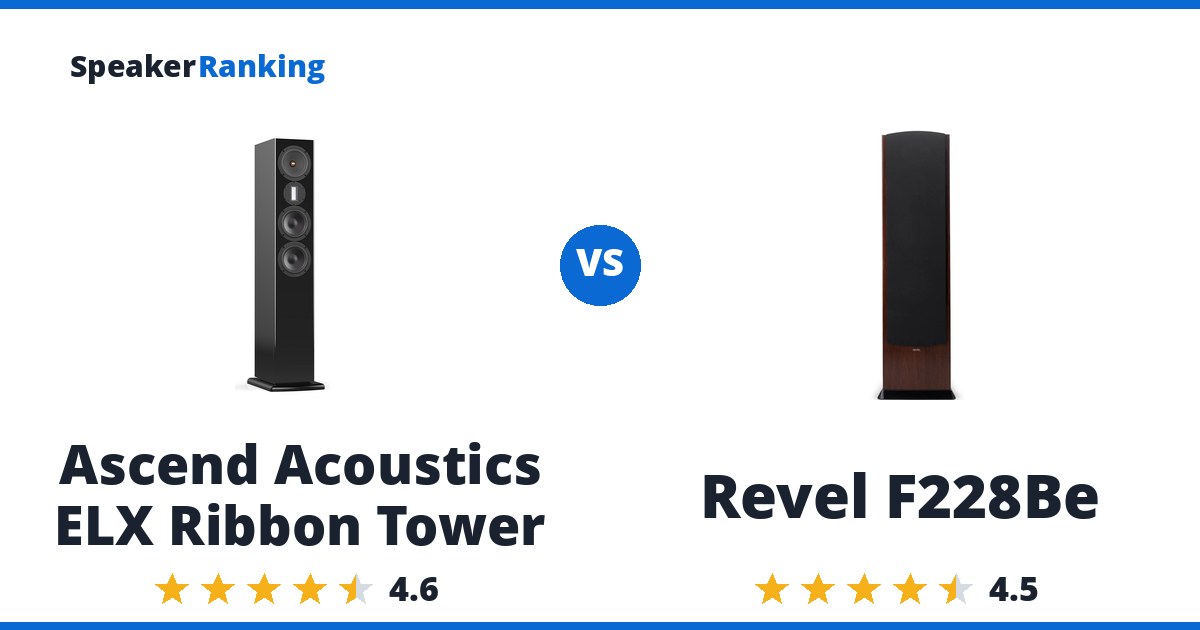
The Ascend Acoustics ELX Ribbon Tower is the more accurate, deeper-bass pick. A RAAL 70-20xram ribbon tweeter and dual SEAS Excel aluminum woofers in a 3-way, 4-driver bamboo tower measure a genuine 38.7Hz extension point with a nearly flat on axis slope of 0.05dB per octave, one of the flattest measured towers we list. Its measured preference score, a predictor of how neutral it sounds, is 6.97 against 6.01 for the Revel F228Be. Its bass reaches about 38.7Hz before falling 3dB, against 61Hz for the Revel F228Be. Watch for: Listening window smoothness measures a moderate 0.40 and on axis deviation runs 0.286dB average, both trailing the tighter figures posted by some of the passive AsciLab and Ascend bookshelf models in this same batch.
The case for the Revel F228Be: CEA2034 spinorama shows an essentially flat on-axis response with very nice directivity. The tradeoff: Minimum impedance dips to 3.4 ohms with a secondary rise around 2kHz, calling for an amplifier comfortable with a demanding load.
Buy the Ascend Acoustics ELX Ribbon Tower. It is rated higher for sound quality than the Revel F228Be and costs less, which makes it the one to get unless you need something the other one does better.
Still deciding? The full Passive Home rankings cover every ranked option.
Specifications Side By Side
| Ascend Acoustics ELX Ribbon Tower | Revel F228Be | |
|---|---|---|
| Price | $5,698 per pair | $11,000 per pair |
| Ranked | #12 of 228 in Large Size Floorstanding Speakers | #29 of 228 in Large Size Floorstanding Speakers |
| Enclosure | ported | - |
| Drivers | RAAL 70-20xram ribbon tweeter, 6” SEAS Excel Curv midrange (sealed sub-chamber), 2x 6” SEAS Excel aluminum woofers | Dual 8” (200mm) Deep Ceramic Composite aluminum cones, with cast frames woofers, 5-1/4” (130mm) Deep Ceramic Composite aluminum cone, with cast frame midrange, 1” (25mm) Beryllium dome, with acoustic lens waveguide tweeter |
| Dimensions | 43”H x 7.5”W x 10.5”D (1092 x 190 x 267 mm) | 50.9”H x 13.5”W x 17.6”D (1292.9 x 342.9 x 447 mm) |
| Weight | 56 lbs (25.4 kg) each | 112.4 lbs (51 kg) each |
| Sensitivity | 87.5dB @ 2.83V/1m anechoic (manufacturer) | 89.3dB (300Hz-3kHz @ 2.83V/1m, measured by Audio Science Review; 90dB manufacturer specified) |
| Impedance | 8 ohms nominal | 8 ohms |
| Power Handling | 400W continuous, 600W peak | - |
| Frequency Response | 36-27,000Hz +/-3dB anechoic (manufacturer) | - |
| Bass Extension (-3dB) | 38.7Hz (measured, spinorama.org vendor data) | 61Hz (measured, Audio Science Review) |
| Bass Extension (-10dB) | 28.5Hz (measured, spinorama.org vendor data) | 25Hz (measured, Audio Science Review) |
| Warranty | 7 years parts and labor | - |
| Country | United States | - |
| Spinorama Preference Score | 6.97 | 6.01 |
| Spinorama Preference Score with Perfect Sub | 8.42 | 7.51 |
| DIY Kit | No | No |
| Woofer Cabinet | - | ported, front |
Frequency Response Compared
Both speakers’ spinorama measurements, overlaid. A flatter line is more neutral: peaks sound forward or harsh, dips sound recessed. Each curve is shifted so its average from 300 Hz to 3 kHz sits at 0 dB, so loudness differences between the two are removed and only the shape is compared. The two were measured by different sources, so small differences, especially in the bass, can come from the measurement setup rather than the speakers.
Measurement data: Ascend Acoustics ELX Ribbon Tower (measured by the manufacturer) and Revel F228Be (measured by Audio Science Review), via spinorama.org.
Related Speaker Comparisons
How Ascend Acoustics ELX Ribbon Tower compares with other leading options:
- Ascend Acoustics ELX Ribbon Tower vs KEF Blade Two Meta
- MoFi SourcePoint V10 Master Edition vs Ascend Acoustics ELX Ribbon Tower
- MoFi SourcePoint 888 vs Ascend Acoustics ELX Ribbon Tower
- Ascend Acoustics ELX Ribbon Tower vs Revel F328Be
- Radiant Acoustics Clarity 66 vs Ascend Acoustics ELX Ribbon Tower
Prices on this page were last checked October 15, 2026 at 5:41 PM UTC. Product prices and availability are accurate as of that date/time and are subject to change; the price and availability shown on Amazon at the time of purchase will apply to the purchase of this product.
As an eBay Partner, we may be compensated if you make a purchase.
The Two Speakers In Full
 Ascend Acoustics ELX Ribbon Tower: $5,698 per pair Ascend Acoustics $5,698 eBay
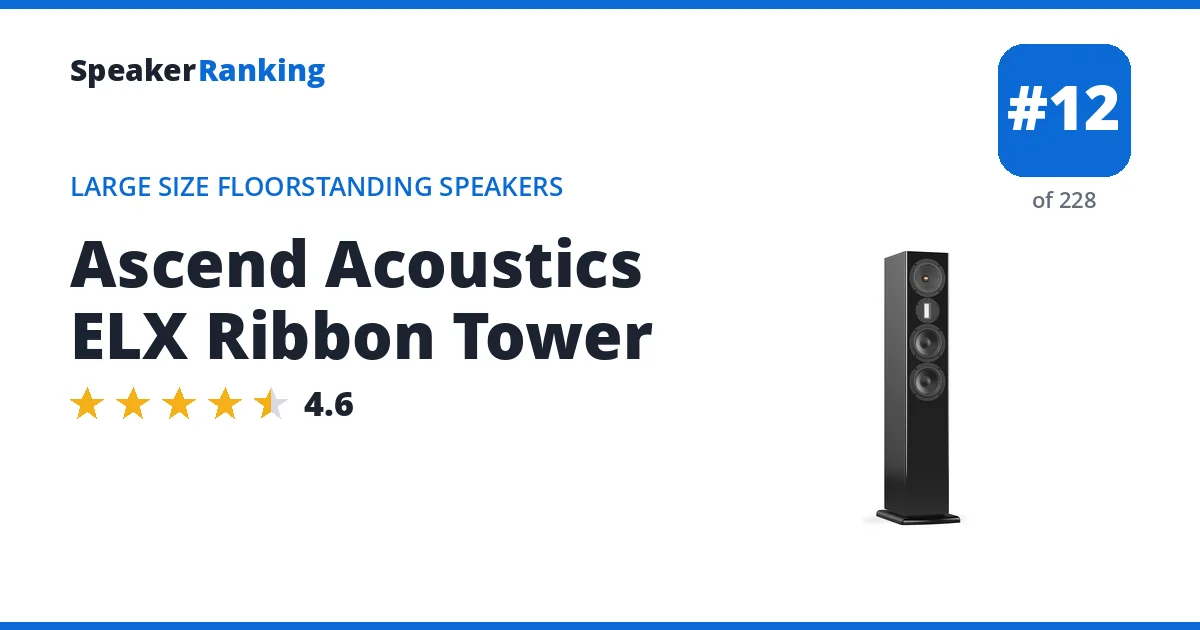
Same family: the Ascend Acoustics ELX Ribbon Horizon (center, rated 4.6/5).
Pros: A RAAL 70-20xram ribbon tweeter and dual SEAS Excel aluminum woofers in a 3-way, 4-driver bamboo tower measure a genuine 38.7Hz extension point with a nearly flat on axis slope of 0.05dB per octave, one of the flattest measured towers we list. The bass alignment Q of 0.62 keeps the low end well damped rather than peaky. Backed by a 7 year parts and labor warranty and hand assembled in Orange County, California, with each pair matched within +/-1.5dB. Measured bass extension of 38.7Hz (-3dB).
Cons: Listening window smoothness measures a moderate 0.40 and on axis deviation runs 0.286dB average, both trailing the tighter figures posted by some of the passive AsciLab and Ascend bookshelf models in this same batch. At $5698/pair it is Ascend’s most expensive tower, well above the Titan dome tweeter version of the same cabinet. The manufacturer’s own claimed sensitivity (87.5dB) runs nearly 1.5dB higher than the independently measured average (86.1dB), worth accounting for when matching an amplifier.
Full Ascend Acoustics ELX Ribbon Tower review and specifications →
| Bass Extension (-10dB) | 28.5Hz (measured, spinorama.org vendor data) |
|---|---|
| Bass Extension (-3dB) | 38.7Hz (measured, spinorama.org vendor data) |
| Country | United States |
| DIY Kit | No |
| Dimensions | 43”H x 7.5”W x 10.5”D (1092 x 190 x 267 mm) |
| Drivers | RAAL 70-20xram ribbon tweeter, 6” SEAS Excel Curv midrange (sealed sub-chamber), 2x 6” SEAS Excel aluminum woofers |
| Enclosure | ported |
| Frequency Response | 36-27,000Hz +/-3dB anechoic (manufacturer) |
| Impedance | 8 ohms nominal |
| Power Handling | 400W continuous, 600W peak |
| Sensitivity | 87.5dB @ 2.83V/1m anechoic (manufacturer) |
| Spinorama Preference Score | 6.97 |
| Spinorama Preference Score with Perfect Sub | 8.42 |
| Warranty | 7 years parts and labor |
| Weight | 56 lbs (25.4 kg) each |
- Links
- Reviews, Comparisons and Sound Samples
- Head-to-Head Comparisons
- Ascend Acoustics ELX Ribbon Tower vs Radiant Acoustics Clarity 66
- Ascend Acoustics ELX Ribbon Tower vs Revel F328Be
- Ascend Acoustics ELX Ribbon Tower vs Revel F226Be
- Ascend Acoustics ELX Ribbon Tower vs MoFi SourcePoint 888
- Ascend Acoustics ELX Ribbon Tower vs JBL 4367
- Ascend Acoustics ELX Ribbon Tower vs MoFi SourcePoint V10 Master Edition
- Ascend Acoustics ELX Ribbon Tower vs KEF Blade Two Meta
- Ascend Acoustics ELX Ribbon Tower vs JBL HDI-3800
- See all 24 comparisons
 Revel F228Be: $11,000 per pair Crutchfield $5,500.00 eBay
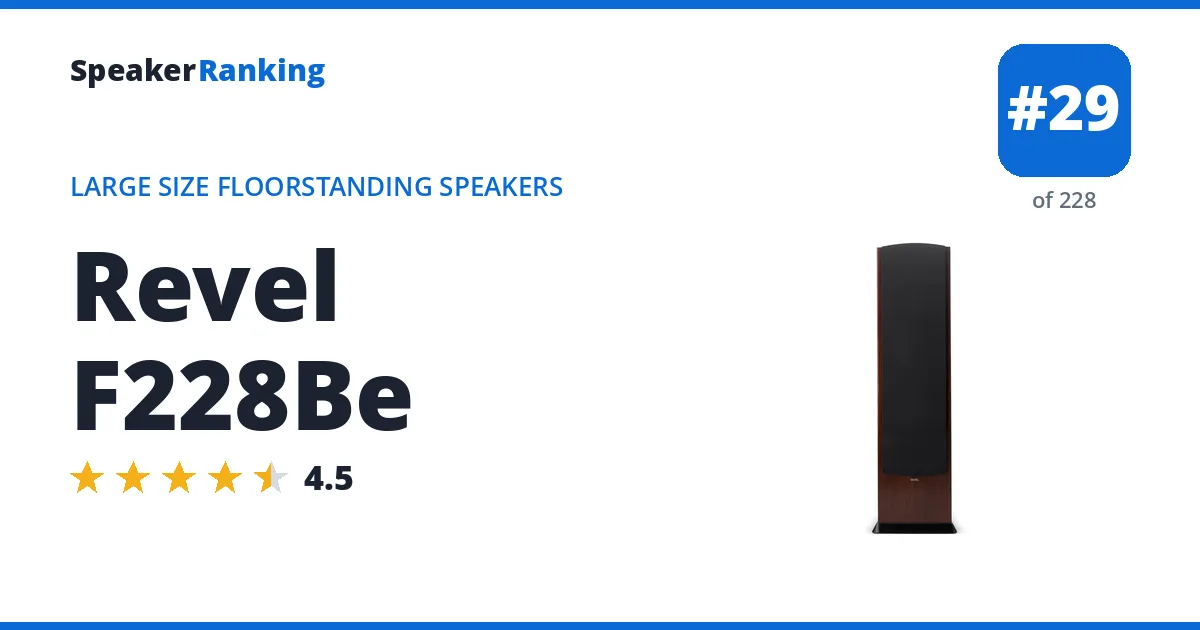
Older model: the Revel F208 (ranked higher, rated 4.5/5). See every Revel Performa generation.
Same family: the Revel M126Be (bookshelf, rated 4.3/5), the Revel F226Be (smaller floorstanding, ranked higher, rated 4.6/5), the Revel F328Be (larger floorstanding, ranked higher, rated 4.7/5) and the Revel C426Be (center, rated 4/5).
Pros: CEA2034 spinorama shows an essentially flat on-axis response with very nice directivity. Predicted in-room response is nearly perfect, with a smooth slope down from bass to treble. Horizontal beamwidth of about ±70 degrees is wide and holds up well until narrowing above 8kHz. Vertical directivity offers more degrees of listening-height freedom than a typical bookshelf design, a benefit of this tower’s driver layout. Distortion is extremely low across the full audio range at 86dB SPL/1m and stays comfortable even at 96dB SPL/1m. Near-field measurements of the individual drivers show nice, well-integrated crossover behavior with only low-level resonances. Measured bass extension of 61Hz (-3dB), with a measured sensitivity of 89.3dB.
Cons: Minimum impedance dips to 3.4 ohms with a secondary rise around 2kHz, calling for an amplifier comfortable with a demanding load. Very expensive and very heavy (51 kg each).
Full Revel F228Be review and specifications →
| Released | 2018 (8 years ago) |
|---|---|
| Bass Extension (-10dB) | 25Hz (measured, Audio Science Review) |
| Bass Extension (-3dB) | 61Hz (measured, Audio Science Review) |
| DIY Kit | No |
| Dimensions | 50.9”H x 13.5”W x 17.6”D (1292.9 x 342.9 x 447 mm) |
| Drivers | Dual 8” (200mm) Deep Ceramic Composite aluminum cones, with cast frames woofers, 5-1/4” (130mm) Deep Ceramic Composite aluminum cone, with cast frame midrange, 1” (25mm) Beryllium dome, with acoustic lens waveguide tweeter |
| Impedance | 8 ohms |
| Sensitivity | 89.3dB (300Hz-3kHz @ 2.83V/1m, measured by Audio Science Review; 90dB manufacturer specified) |
| Spinorama Preference Score | 6.01 |
| Spinorama Preference Score with Perfect Sub | 7.51 |
| Weight | 112.4 lbs (51 kg) each |
| Woofer Cabinet | ported, front |
- Links
- Reviews, Comparisons and Sound Samples
- Head-to-Head Comparisons