Short answer: the Ascend Acoustics ELX Ribbon Tower if sound quality matters most, the ELAC Debut 3.0 DF63 if price matters most. The Ascend Acoustics ELX Ribbon Tower ranks #6 of 71 floorstanding speakers at $5698. The ELAC Debut 3.0 DF63 ranks #35 at $649, $5049 cheaper.
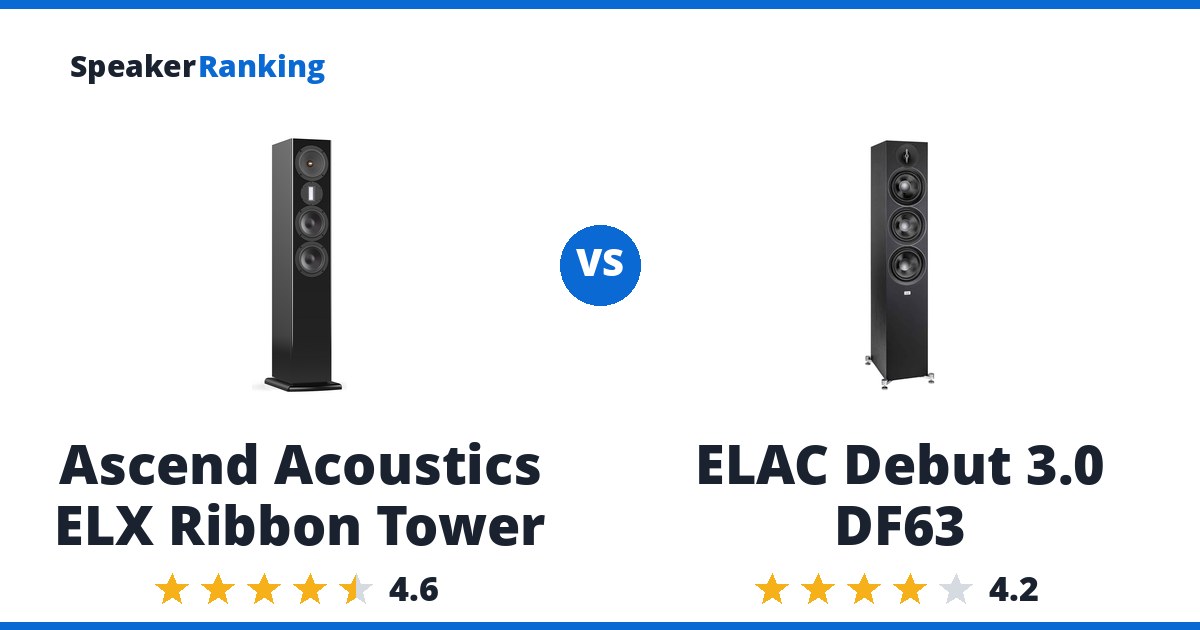
What the Ascend Acoustics ELX Ribbon Tower offers: A RAAL 70-20xram ribbon tweeter and dual SEAS Excel aluminum woofers in a 3-way, 4-driver bamboo tower measure a genuine 38.7Hz extension point with a nearly flat on axis slope of 0.05dB per octave, among the best measured towers in this batch. The bass alignment Q of 0.62 keeps the low end well damped rather than peaky. Backed by a 7 year parts and labor warranty and hand assembled in Orange County, California, with each pair matched within +/-1.5dB. Watch for: Listening window smoothness measures a moderate 0.40 and on axis deviation runs 0.286dB average, both trailing the tighter figures posted by some of the passive AsciLab and Ascend bookshelf models in this same batch. At $5,698/pair it is Ascend’s most expensive tower, well above the Titan dome tweeter version of the same cabinet. The manufacturer’s own claimed sensitivity (87.5dB) runs nearly 1.5dB higher than the independently measured average (86.1dB), worth accounting for when matching an amplifier.
What the ELAC Debut 3.0 DF63 offers: Three-driver floorstanding layout: two 6” dedicated midbase drivers plus a separate 6” mid-range driver (confirmed by measuring different driver impedance/inductance) and a 1” dome tweeter, each woofer given its own stuffed chamber inside the cabinet. The dedicated midrange driver keeps distortion low even at higher output, avoiding the intermodulation grain typical of two-way bookshelf designs. The waveguide keeps high-frequency directivity well controlled, and overall horizontal directivity is good up to about 2kHz. Harmonic distortion looks good at both 86dB and 96dB, and multitone distortion stays below the reviewer’s 3% threshold. A shallow bass rolloff (F3 71Hz, F10 29Hz) lets it extend fairly low without a hard cutoff. Preferred by the reviewer over the similarly-priced Polk R500 (too much high-frequency narrowing, less neutral) and considered ahead of the Polk R700 as well. Watch for: A genuine measured resonance around 200-300Hz (visible in frequency response, impedance, and group delay) causes an audible “droning” coloration on female vocals. A mild peak around 10kHz makes shakers and similar high-frequency percussion jump too far forward in the mix; needed about 2dB of EQ to tame in testing. A dip in the 1-3kHz range gives the speaker a warm, slightly veiled character - the reviewer suspects the tweeter crossover point (around 2-3kHz) is set a bit high and could be lowered to fill this in. Directivity shows a noticeable handoff mismatch around 2.5kHz where the midrange driver hands off to the tweeter, though it’s minor at the -6dB point. Vertical directivity is narrower than horizontal, so listeners need to stay close to the tweeter axis. Low EPDR (about 1.5 ohms minimum) means a Class AB amplifier should be well-ventilated. Best positioned pointed directly at the listener and closer to the front wall - toeing it out into the room causes too much high-frequency rolloff.
Buy the Ascend Acoustics ELX Ribbon Tower when sound quality outweighs the price for you, and the ELAC Debut 3.0 DF63 when the price outweighs sound quality instead.
Still deciding? The full Passive Home rankings cover every ranked option.
Specifications Side By Side
| Ascend Acoustics ELX Ribbon Tower | ELAC Debut 3.0 DF63 | |
|---|---|---|
| Price | $5,698 per pair | $649.00 per pair |
| Ranked | #6 of 71 in Large Size Floorstanding Speakers | #35 of 71 in Large Size Floorstanding Speakers |
| Enclosure | ported | - |
| Drivers | RAAL 70-20xram ribbon tweeter, 6" SEAS Excel Curv midrange (sealed sub-chamber), 2x 6" SEAS Excel aluminum woofers | Two 6.5" Aramid Fiber woofer, 6.5" Aramid Fiber midrange, 1" Aluminum Dome tweeter |
| Dimensions | 43"H x 7.5"W x 10.5"D (1092 x 190 x 267 mm) | 43.1"H x 7.7"W x 10.6"D (1094.7 x 195.6 x 269.2 mm) |
| Weight | 56 lbs (25.4 kg) each | 58.2 lbs (26.4 kg) each |
| Sensitivity | 87.5dB @ 2.83V/1m anechoic (manufacturer) | 86.6dB (measured, Erin's Audio Corner) |
| Impedance | 8 ohms nominal | 6 ohms nominal (3.4 ohms minimum, measured, Erin's Audio Corner) |
| Power Handling | 400W continuous, 600W peak | - |
| Frequency Response | 36-27,000Hz +/-3dB anechoic (manufacturer) | - |
| Bass Extension (-3dB) | 38.7Hz (measured, spinorama.org vendor data) | 71Hz (measured, Erin's Audio Corner) |
| Bass Extension (-10dB) | 28.5Hz (measured, spinorama.org vendor data) | 29Hz (measured, Erin's Audio Corner) |
| Warranty | 7 years parts and labor | - |
| Country | United States | - |
| Spinorama Preference Score | 6.36 | 4.93 |
| Spinorama Preference Score with Perfect Sub | 7.81 | 6.42 |
| Woofer Cabinet | - | ported, rear |
Related Speaker Comparisons
How Ascend Acoustics ELX Ribbon Tower compares with other leading options:
- Ascend Acoustics ELX Ribbon Tower vs KEF Blade Two Meta
- MoFi SourcePoint V10 Master Edition vs Ascend Acoustics ELX Ribbon Tower
- MoFi SourcePoint 888 vs Ascend Acoustics ELX Ribbon Tower
- Radiant Acoustics Clarity 66 vs Ascend Acoustics ELX Ribbon Tower
- Ascend Acoustics ELX Ribbon Tower vs JBL HDI-3800
Prices on this page were last checked September 16, 2026 at 12:41 AM UTC. Product prices and availability are accurate as of that date/time and are subject to change; the price and availability shown on Amazon at the time of purchase will apply to the purchase of this product.
As an eBay Partner, we may be compensated if you make a purchase.
The Two Speakers In Full
 Ascend Acoustics ELX Ribbon Tower: $5,698 per pair Ascend Acoustics eBay
Pros: A RAAL 70-20xram ribbon tweeter and dual SEAS Excel aluminum woofers in a 3-way, 4-driver bamboo tower measure a genuine 38.7Hz extension point with a nearly flat on axis slope of 0.05dB per octave, among the best measured towers in this batch. The bass alignment Q of 0.62 keeps the low end well damped rather than peaky. Backed by a 7 year parts and labor warranty and hand assembled in Orange County, California, with each pair matched within +/-1.5dB. Measured bass extension of 38.7Hz (-3dB).
Cons: Listening window smoothness measures a moderate 0.40 and on axis deviation runs 0.286dB average, both trailing the tighter figures posted by some of the passive AsciLab and Ascend bookshelf models in this same batch. At $5,698/pair it is Ascend’s most expensive tower, well above the Titan dome tweeter version of the same cabinet. The manufacturer’s own claimed sensitivity (87.5dB) runs nearly 1.5dB higher than the independently measured average (86.1dB), worth accounting for when matching an amplifier.
Full Ascend Acoustics ELX Ribbon Tower review and specifications →
| Bass Extension (-10dB) | 28.5Hz (measured, spinorama.org vendor data) |
|---|---|
| Bass Extension (-3dB) | 38.7Hz (measured, spinorama.org vendor data) |
| Country | United States |
| Dimensions | 43"H x 7.5"W x 10.5"D (1092 x 190 x 267 mm) |
| Drivers | RAAL 70-20xram ribbon tweeter, 6" SEAS Excel Curv midrange (sealed sub-chamber), 2x 6" SEAS Excel aluminum woofers |
| Enclosure | ported |
| Frequency Response | 36-27,000Hz +/-3dB anechoic (manufacturer) |
| Impedance | 8 ohms nominal |
| Power Handling | 400W continuous, 600W peak |
| Sensitivity | 87.5dB @ 2.83V/1m anechoic (manufacturer) |
| Spinorama Preference Score | 6.36 |
| Spinorama Preference Score with Perfect Sub | 7.81 |
| Warranty | 7 years parts and labor |
| Weight | 56 lbs (25.4 kg) each |
- Links
- Reviews, Comparisons and Sound Samples
- Head-to-Head Comparisons
- Ascend Acoustics ELX Ribbon Tower vs JBL HDI-3800
- Ascend Acoustics ELX Ribbon Tower vs Radiant Acoustics Clarity 66
- Ascend Acoustics ELX Ribbon Tower vs MoFi SourcePoint 888
- Ascend Acoustics ELX Ribbon Tower vs Revel F328Be
- Ascend Acoustics ELX Ribbon Tower vs MoFi SourcePoint V10 Master Edition
- Ascend Acoustics ELX Ribbon Tower vs KEF Blade Two Meta
- Ascend Acoustics ELX Ribbon Tower vs Revel F226Be
- Ascend Acoustics ELX Ribbon Tower vs JBL 4367
- See all 24 comparisons
 ELAC Debut 3.0 DF63: $649.00 per pair Amazon eBay
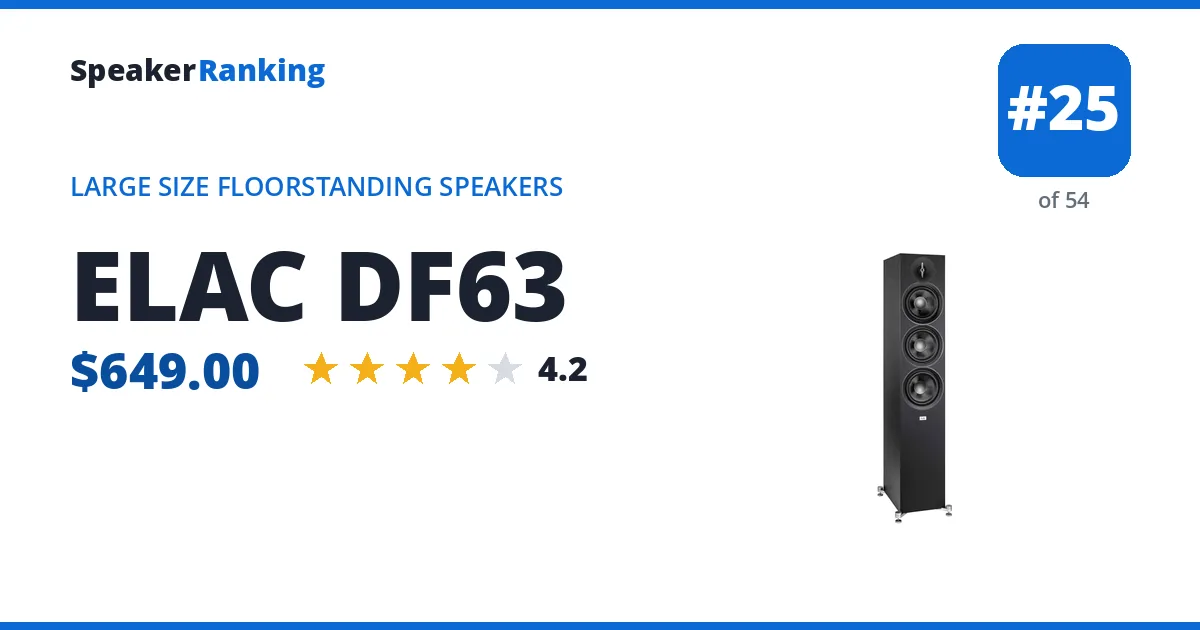
Pros: Three-driver floorstanding layout: two 6” dedicated midbase drivers plus a separate 6” mid-range driver (confirmed by measuring different driver impedance/inductance) and a 1” dome tweeter, each woofer given its own stuffed chamber inside the cabinet. The dedicated midrange driver keeps distortion low even at higher output, avoiding the intermodulation grain typical of two-way bookshelf designs. The waveguide keeps high-frequency directivity well controlled, and overall horizontal directivity is good up to about 2kHz. Harmonic distortion looks good at both 86dB and 96dB, and multitone distortion stays below the reviewer’s 3% threshold. A shallow bass rolloff (F3 71Hz, F10 29Hz) lets it extend fairly low without a hard cutoff. Preferred by the reviewer over the similarly-priced Polk R500 (too much high-frequency narrowing, less neutral) and considered ahead of the Polk R700 as well. Measured bass extension of 71Hz (-3dB), with a measured sensitivity of 86.6dB.
Cons: A genuine measured resonance around 200-300Hz (visible in frequency response, impedance, and group delay) causes an audible “droning” coloration on female vocals. A mild peak around 10kHz makes shakers and similar high-frequency percussion jump too far forward in the mix; needed about 2dB of EQ to tame in testing. A dip in the 1-3kHz range gives the speaker a warm, slightly veiled character - the reviewer suspects the tweeter crossover point (around 2-3kHz) is set a bit high and could be lowered to fill this in. Directivity shows a noticeable handoff mismatch around 2.5kHz where the midrange driver hands off to the tweeter, though it’s minor at the -6dB point. Vertical directivity is narrower than horizontal, so listeners need to stay close to the tweeter axis. Low EPDR (about 1.5 ohms minimum) means a Class AB amplifier should be well-ventilated. Best positioned pointed directly at the listener and closer to the front wall - toeing it out into the room causes too much high-frequency rolloff.
Full ELAC Debut 3.0 DF63 review and specifications →
| Bass Extension (-10dB) | 29Hz (measured, Erin's Audio Corner) |
|---|---|
| Bass Extension (-3dB) | 71Hz (measured, Erin's Audio Corner) |
| Dimensions | 43.1"H x 7.7"W x 10.6"D (1094.7 x 195.6 x 269.2 mm) |
| Drivers | Two 6.5" Aramid Fiber woofer, 6.5" Aramid Fiber midrange, 1" Aluminum Dome tweeter |
| Impedance | 6 ohms nominal (3.4 ohms minimum, measured, Erin's Audio Corner) |
| Sensitivity | 86.6dB (measured, Erin's Audio Corner) |
| Spinorama Preference Score | 4.93 |
| Spinorama Preference Score with Perfect Sub | 6.42 |
| Weight | 58.2 lbs (26.4 kg) each |
| Woofer Cabinet | ported, rear |
- Links
- Reviews, Comparisons and Sound Samples
- Head-to-Head Comparisons
- ELAC Debut 3.0 DF63 vs Polk Reserve R500
- ELAC Debut 3.0 DF63 vs PSB Imagine T65
- ELAC Debut 3.0 DF63 vs Linkwitz Lab LXmini
- ELAC Debut 3.0 DF63 vs Q Acoustics 5040
- ELAC Debut 3.0 DF63 vs Polk Audio Reserve R700
- ELAC Debut 3.0 DF63 vs Definitive Technology BP-9020
- ELAC Debut 3.0 DF63 vs Infinity Primus 360
- ELAC Debut 3.0 DF63 vs Emotiva Airmotiv T2+
- See all 41 comparisons