Short answer: the Arendal 1528 Monitor 8 if sound quality matters most, the Philharmonic BMR (v1) if price matters most. The Arendal 1528 Monitor 8 ranks #22 of 130 bookshelf speakers at $6000. The Philharmonic BMR (v1) ranks #36 at $2200, $3800 cheaper.
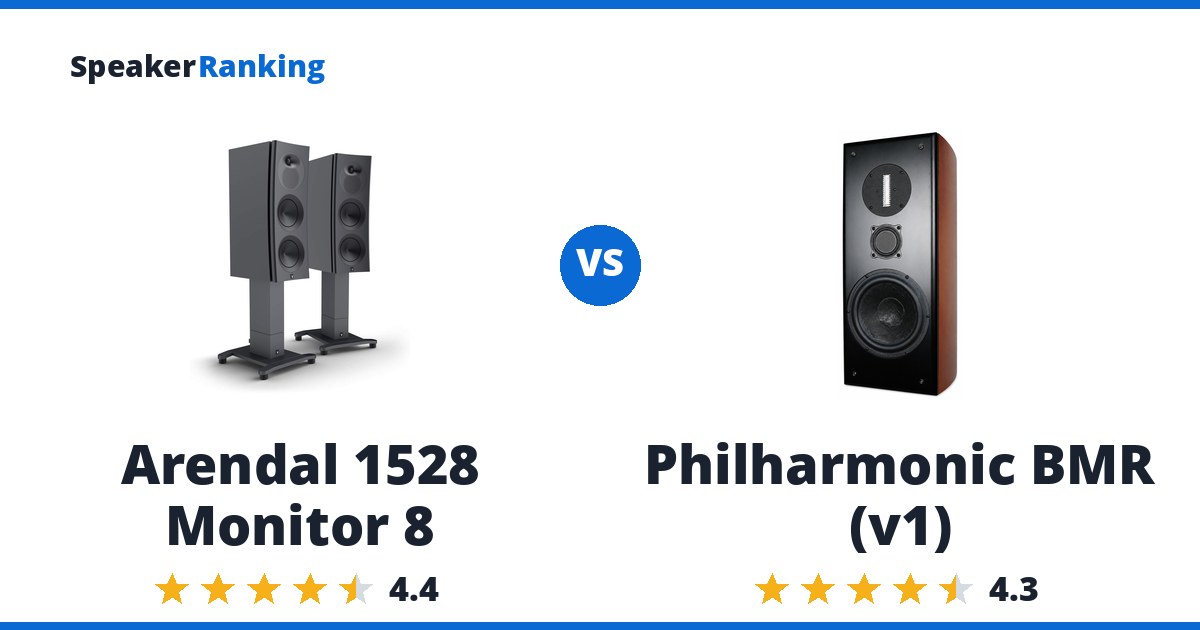
What the Arendal 1528 Monitor 8 offers: Three-way design featuring a 28mm tweeter, 5” mid-range, and dual 8” mid-bass drivers in a convertible sealed/ported HDF cabinet, with a supplied port bung for sealed operation near a wall. In ported configuration, reaches down to about 35Hz in most rooms (F3 41Hz, F10 26Hz) - deep enough that many listeners could skip a subwoofer unless they want output below 40Hz. Extremely low distortion and compression across the board (harmonic, multitone, and both long- and short-term compression testing) - among the best the reviewer has tested at this price, beating speakers costing twice as much. Wide, consistent horizontal soundstage of about ±60°. Smooth, non-fatiguing high frequency rather than the elevated “detail” boost common on speakers marketed for resolution. A slight forwardness around 1.5kHz adds a touch of attack without tipping into brightness. Watch for: A dip in the midbase around 100Hz noticeably reduces the “chestiness” of male vocals compared to the reviewer’s reference speaker. A diffraction-related flare in the upper-midrange/lower-treble (around 1.5-2kHz) gives a mild forwardness that benefits from sidewall absorption panels, though it’s not a major issue. Vertical sweet spot is fairly narrow at about ±20° - a bigger consideration for multi-row home theater seating than rivals like the MoFi SourcePoint 8, which manages about ±60°. The MoFi SourcePoint 8, a similarly-priced rival, also has more linear bass with no midbase dip, at the cost of a more elevated top end. Minor resonances appear around 400Hz and 800Hz in measurements, though the reviewer considers them inaudible or insignificant. Very heavy (about 104 lbs each) HDF cabinet requires dedicated, sturdy stands. Low EPDR (dips to about 1.9 ohms in two spots) means a Class AB amplifier needs to comfortably handle a 4-ohm load without overheating; a Class D amp is a safer choice for full-range use.
What the Philharmonic BMR (v1) offers: Large three-way combining a Scan-Speak 7-inch paper/carbon woofer, 2.5-inch Tectonic balanced-mode midrange and RAAL 64-10 ribbon. Erin measured approximately +/-1.5dB linearity from 80Hz upward, very broad +/-40-degree-or-better horizontal coverage and about 83dB/2.83V/1m sensitivity. The port is tuned in the mid/low-30Hz region without audible chuffing, the midrange provides unusually expansive staging, and distortion remained subjectively unobtrusive. Watch for: The measured 83dB sensitivity and roughly 4-ohm load demand meaningful external amplification. A 1-2dB shelf below about 300Hz reduces warmth unless corrected, while a response/impedance feature near 250-300Hz corresponded with Erin’s sense of resonance. The ribbon produces narrower vertical than horizontal radiation, and second-order high-frequency distortion plus dynamic enhancement near 3kHz appeared in testing. This was an earlier cabinet/version, not the current v2.
Buy the Arendal 1528 Monitor 8 if sound quality matters more than the price. Buy the Philharmonic BMR (v1) if the price matters more than sound quality.
Still deciding? The full Passive Home rankings cover every ranked option.
Specifications Side By Side
| Arendal 1528 Monitor 8 | Philharmonic BMR (v1) | |
|---|---|---|
| Price | $6000 per pair | $2,395 per pair |
| Ranked | #22 of 130 in Large Size Bookshelf Speakers | #36 of 130 in Large Size Bookshelf Speakers |
| Bass Extension (-10dB) | 26Hz (measured, Erin's Audio Corner) | 37.8Hz (measured, Erin's Audio Corner) |
| Bass Extension (-3dB) | 41Hz (measured, Erin's Audio Corner) | Approximately 62Hz relative to mean (measured, Erin's Audio Corner website) |
| Dimensions | 31.8"H x 11.4"W x 17.6"D (807.7 x 289.6 x 447 mm) | - |
| Impedance | 4 ohms nominal, 3.8 ohms minimum (measured, Erin's Audio Corner) | Approximately 4 ohms nominal (measured, Erin's Audio Corner) |
| Drivers | Dual 8" woofers, 5" midrange, 28mm tweeter | RAAL 64-10 ribbon; 2.5" BMR midrange; 7" Scan-Speak woofer |
| Sensitivity | 84.4dB (measured, Erin's Audio Corner) | Approximately 83dB/2.83V/1m (measured, Erin's Audio Corner) |
| Weight | 103.6 lbs (47 kg) each | - |
| Woofer Cabinet | ported | ported |
| Spinorama Preference Score | 4.70 | 5.24 |
| Spinorama Preference Score with Perfect Sub | 6.16 | 6.90 |
| Port Tuning | - | Mid/low-30Hz range (measured, Erin's Audio Corner) |
Related Speaker Comparisons
More worthwhile head-to-heads for Arendal 1528 Monitor 8:
- Arendal 1528 Monitor 8 vs Perlisten S4b
- KEF Reference 1 Meta vs Arendal 1528 Monitor 8
- Arendal 1528 Monitor 8 vs GR-Research NX-Studio
- AsciLab C6B vs Arendal 1528 Monitor 8
- Audio First Cadentia 3 vs Arendal 1528 Monitor 8
Prices on this page were last checked September 16, 2026 at 12:41 AM UTC. Product prices and availability are accurate as of that date/time and are subject to change; the price and availability shown on Amazon at the time of purchase will apply to the purchase of this product.
As an eBay Partner, we may be compensated if you make a purchase.
The Two Speakers In Full
 Arendal 1528 Monitor 8: $6000 per pair Arendalsound eBay
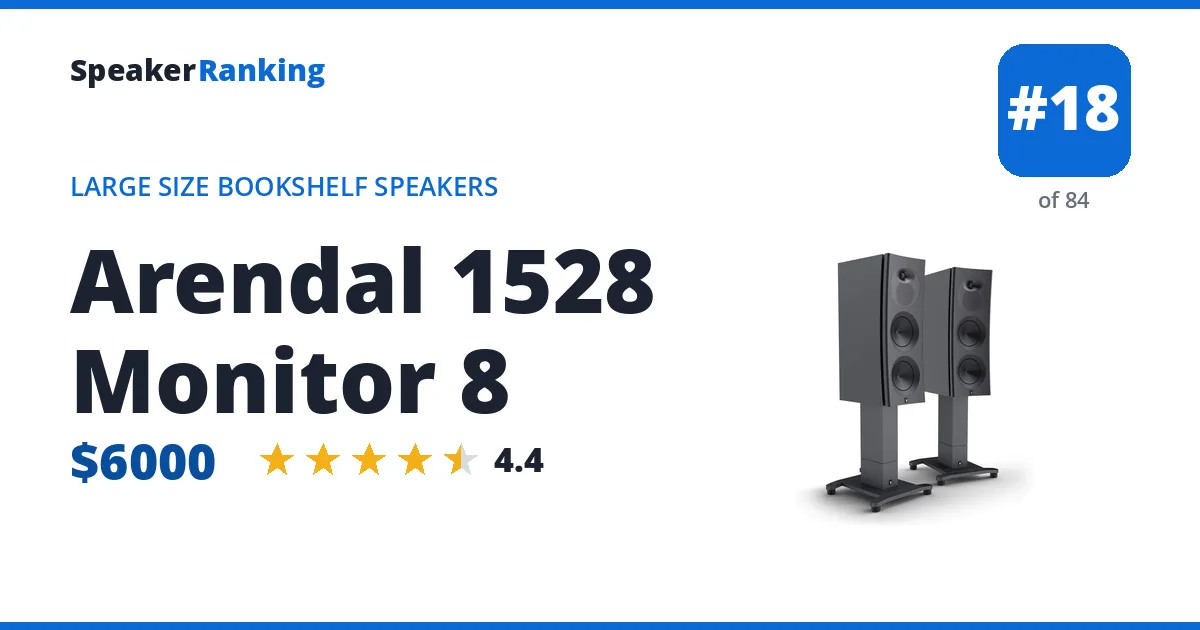
Pros: Three-way design featuring a 28mm tweeter, 5” mid-range, and dual 8” mid-bass drivers in a convertible sealed/ported HDF cabinet, with a supplied port bung for sealed operation near a wall. In ported configuration, reaches down to about 35Hz in most rooms (F3 41Hz, F10 26Hz) - deep enough that many listeners could skip a subwoofer unless they want output below 40Hz. Extremely low distortion and compression across the board (harmonic, multitone, and both long- and short-term compression testing) - among the best the reviewer has tested at this price, beating speakers costing twice as much. Wide, consistent horizontal soundstage of about ±60°. Smooth, non-fatiguing high frequency rather than the elevated “detail” boost common on speakers marketed for resolution. A slight forwardness around 1.5kHz adds a touch of attack without tipping into brightness. Measured bass extension of 41Hz (-3dB), with a measured sensitivity of 84.4dB.
Cons: A dip in the midbase around 100Hz noticeably reduces the “chestiness” of male vocals compared to the reviewer’s reference speaker. A diffraction-related flare in the upper-midrange/lower-treble (around 1.5-2kHz) gives a mild forwardness that benefits from sidewall absorption panels, though it’s not a major issue. Vertical sweet spot is fairly narrow at about ±20° - a bigger consideration for multi-row home theater seating than rivals like the MoFi SourcePoint 8, which manages about ±60°. The MoFi SourcePoint 8, a similarly-priced rival, also has more linear bass with no midbase dip, at the cost of a more elevated top end. Minor resonances appear around 400Hz and 800Hz in measurements, though the reviewer considers them inaudible or insignificant. Very heavy (about 104 lbs each) HDF cabinet requires dedicated, sturdy stands. Low EPDR (dips to about 1.9 ohms in two spots) means a Class AB amplifier needs to comfortably handle a 4-ohm load without overheating; a Class D amp is a safer choice for full-range use.
Full Arendal 1528 Monitor 8 review and specifications →
| Bass Extension (-10dB) | 26Hz (measured, Erin's Audio Corner) |
|---|---|
| Bass Extension (-3dB) | 41Hz (measured, Erin's Audio Corner) |
| Dimensions | 31.8"H x 11.4"W x 17.6"D (807.7 x 289.6 x 447 mm) |
| Drivers | Dual 8" woofers, 5" midrange, 28mm tweeter |
| Impedance | 4 ohms nominal, 3.8 ohms minimum (measured, Erin's Audio Corner) |
| Sensitivity | 84.4dB (measured, Erin's Audio Corner) |
| Spinorama Preference Score | 4.70 |
| Spinorama Preference Score with Perfect Sub | 6.16 |
| Weight | 103.6 lbs (47 kg) each |
| Woofer Cabinet | ported |
- Links
- Reviews, Comparisons and Sound Samples
- Head-to-Head Comparisons
- Arendal 1528 Monitor 8 vs Ascend Acoustics CMT-340 SE2
- Arendal 1528 Monitor 8 vs Wharfedale Super Linton
- Arendal 1528 Monitor 8 vs AsciLab F6Bs
- Arendal 1528 Monitor 8 vs MoFi SourcePoint 10
- Arendal 1528 Monitor 8 vs MoFi SourcePoint 8
- Arendal 1528 Monitor 8 vs Radiant Acoustics Clarity 6.2
- Arendal 1528 Monitor 8 vs Dynaudio Heritage Special
- Arendal 1528 Monitor 8 vs Buchardt Audio E50
- See all 44 comparisons
 Philharmonic BMR (v1): $2,395 per pair Philharmonic Audio eBay
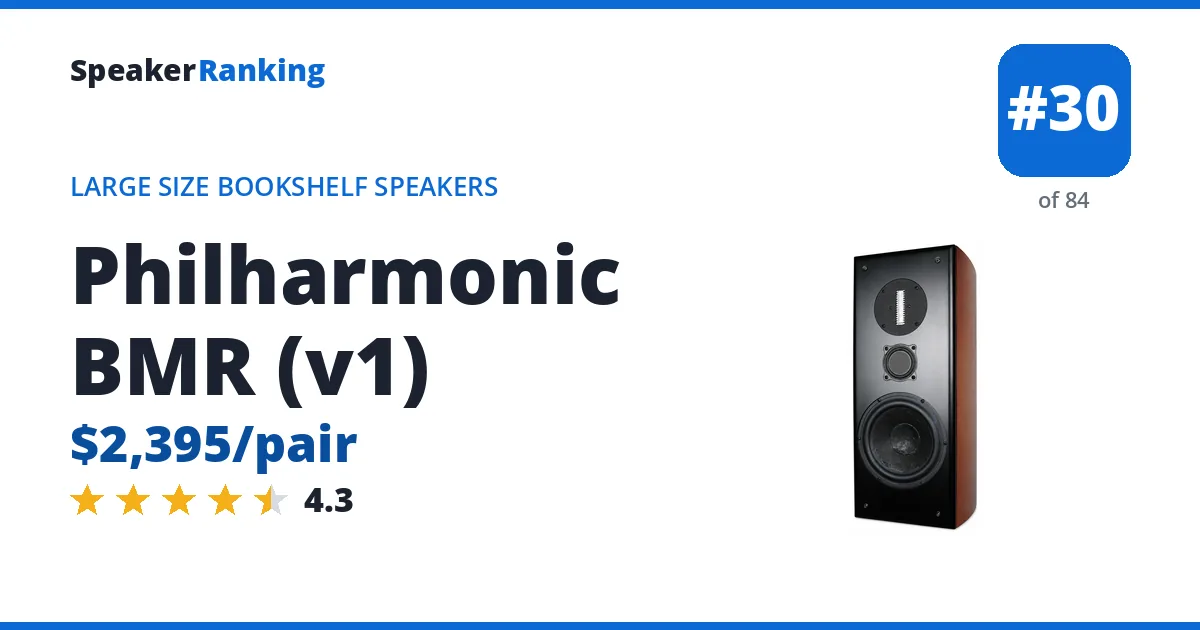
Pros: Large three-way combining a Scan-Speak 7-inch paper/carbon woofer, 2.5-inch Tectonic balanced-mode midrange and RAAL 64-10 ribbon. Erin measured approximately +/-1.5dB linearity from 80Hz upward, very broad +/-40-degree-or-better horizontal coverage and about 83dB/2.83V/1m sensitivity. The port is tuned in the mid/low-30Hz region without audible chuffing, the midrange provides unusually expansive staging, and distortion remained subjectively unobtrusive. Measured bass extension of 62Hz (-3dB), with a measured sensitivity of 83dB.
Cons: The measured 83dB sensitivity and roughly 4-ohm load demand meaningful external amplification. A 1-2dB shelf below about 300Hz reduces warmth unless corrected, while a response/impedance feature near 250-300Hz corresponded with Erin’s sense of resonance. The ribbon produces narrower vertical than horizontal radiation, and second-order high-frequency distortion plus dynamic enhancement near 3kHz appeared in testing. This was an earlier cabinet/version, not the current v2.
Full Philharmonic BMR (v1) review and specifications →
| Bass Extension (-10dB) | 37.8Hz (measured, Erin's Audio Corner) |
|---|---|
| Bass Extension (-3dB) | Approximately 62Hz relative to mean (measured, Erin's Audio Corner website) |
| Drivers | RAAL 64-10 ribbon; 2.5" BMR midrange; 7" Scan-Speak woofer |
| Impedance | Approximately 4 ohms nominal (measured, Erin's Audio Corner) |
| Port Tuning | Mid/low-30Hz range (measured, Erin's Audio Corner) |
| Sensitivity | Approximately 83dB/2.83V/1m (measured, Erin's Audio Corner) |
| Spinorama Preference Score | 5.24 |
| Spinorama Preference Score with Perfect Sub | 6.90 |
| Woofer Cabinet | ported |
- Links
- Reviews, Comparisons and Sound Samples
- Head-to-Head Comparisons
- Philharmonic BMR (v1) vs ELAC VELA BS 403
- Philharmonic BMR (v1) vs Selah Audio Integrity
- Philharmonic BMR (v1) vs Ascend Acoustics Sierra-2EX V2
- Philharmonic BMR (v1) vs Ascend Acoustics Sierra-LX
- Philharmonic BMR (v1) vs Wharfedale Linton 85
- Philharmonic BMR (v1) vs Emotiva Airmotiv XB2
- Philharmonic BMR (v1) vs ELAC Debut 3.0 DB63
- Philharmonic BMR (v1) vs Selah Audio Purezza
- See all 49 comparisons