Short answer: the D3v for near-field desktop use, the HS5 if you need more output headroom. The D3v ranks #3 out of 23 small powered bookshelf speakers, and the HS5 ranks #41 out of 65 medium powered bookshelf speakers, for $54.99 more.
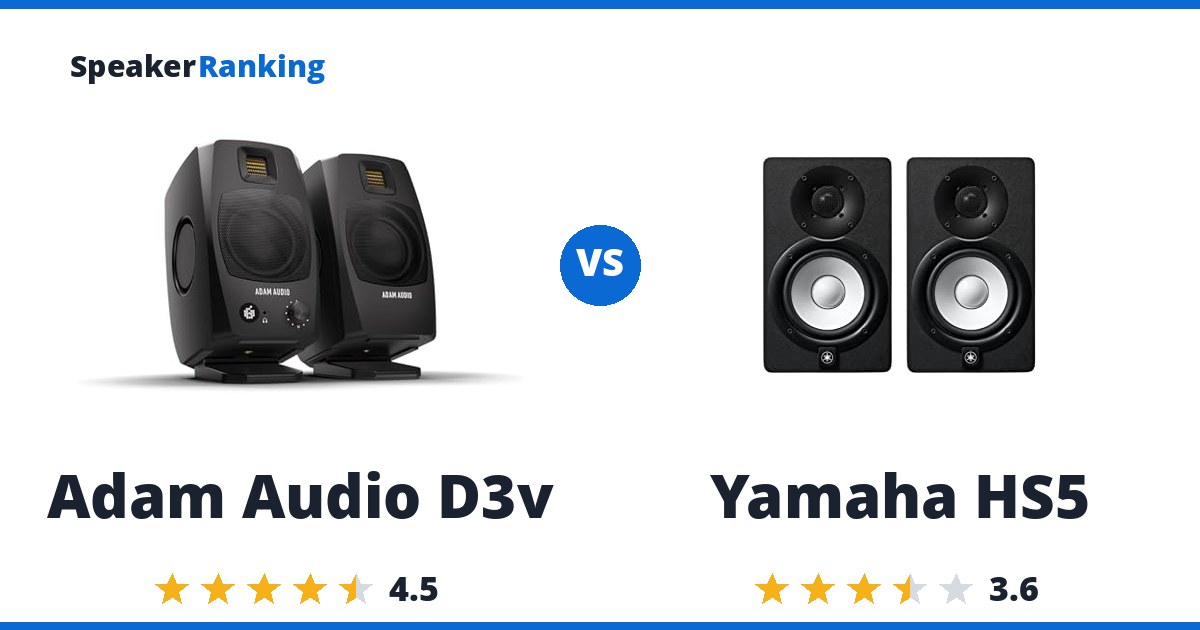
The D3v measures remarkably clean for its size. Erin’s Klippel data shows its midrange spans just 1.7dB from 300Hz to 5kHz, and its side-firing passive radiators push -3dB bass extension down to about 50Hz, deeper than the Genelec 8010A or Audio Smile Little British Monitor and even beating the physically larger HS5’s 88Hz. The HS5, despite Yamaha’s reputation for neutrality, measures with excess midrange energy and reduced lower-midrange weight that Audio Science Review’s testing found gives it a bass-light balance rather than the flat response its name implies, with a wider 4.3dB spread across the same 300Hz-5kHz band.
The tradeoff is output headroom. The D3v’s built-in limiter reduces both bass and midrange content as volume rises, and compression testing caps its usable maximum around 89-90dB at 1m, so its deep bass at moderate volume shouldn’t be mistaken for high-output capability. The HS5’s larger 5-inch woofer and cabinet give it more room to play loud without that same limiting behavior, which is part of why studios reach for it despite the tonal compromise.
What the D3v adds: USB-C input alongside balanced TRS, a smaller footprint at 3.7 lbs versus the HS5’s 12.1 lbs each, and room-adjustment filters tuned for desktop placement.
What the HS5 adds: balanced XLR input built for a studio rack or stand, and smoother early-reflection directivity that responds well to broad EQ correction.
Buy the D3v for near-field desktop monitoring where its tighter midrange and deeper bass extension matter more than raw volume.
Buy the HS5 if you need XLR connectivity, more output headroom, or you’re setting up speakers on stands rather than a desk.
Still deciding? The full Powered Home rankings cover every ranked option.
Specifications Side By Side
| Adam Audio D3v | Yamaha HS5 | |
|---|---|---|
| Price | $344.99 per pair | $399.98 per pair |
| Ranked | #3 of 23 in Small Size Powered Bookshelf Speakers | #41 of 65 in Medium Size Powered Bookshelf Speakers |
| Bass Extension (-10dB) | 45Hz (measured, Erin's Audio Corner) | 68Hz (measured, Audio Science Review) |
| Bass Extension (-3dB) | 50Hz (measured, Erin's Audio Corner) | 88Hz (measured, Audio Science Review) |
| App | No | No |
| Bluetooth | No | No |
| Dimensions | 6.7"H x 4.3"W x 5.9"D (170.2 x 109.2 x 149.9 mm) | 11.2"H x 6.7"W x 8.7"D (284.5 x 170.2 x 221 mm) |
| EQ | Yes (Room adjustment filters) | Yes (Room adjustment) |
| Frequency Response | 50Hz - 50kHz (Manufacturer specified) | 58Hz - 24kHz (-3dB) (Manufacturer specified) |
| Inputs | USB-C, balanced 1/4-inch TRS | XLR |
| Sensitivity | 86.5dB (measured at 0.3V/1m, Erin's Audio Corner) | - |
| Drivers | 3.5" woofer, U-ART accelerated ribbon tweeter | 5" (127mm) woofer |
| Weight | 3.7 lbs (1.7 kg) | 12.1 lbs (5.5 kg) each |
| Amplifier Power | 50W (30W woofer + 20W tweeter) | 45w Per Speaker |
| Maximum SPL | 102dB @ 1m (manufacturer specified) | - |
| Spinorama Preference Score | 4.47 | 2.91 |
| Spinorama Preference Score with Perfect Sub | 6.70 | 5.52 |
| XLR Input | No | Yes |
| RCA Input | No | No |
| TRS Input | Yes | No |
| Optical Input | No | No |
| Coaxial Input | No | No |
| USB Input | Yes | No |
| HDMI Input | No | No |
| AES Input | No | No |
| Aux Input | No | No |
Related Speaker Comparisons
More worthwhile head-to-heads for Adam Audio D3v:
- Audio Smile Little British Monitor vs Adam Audio D3v
- Adam Audio D3v vs Genelec 8010A
- Adam Audio D3v vs Cambridge Audio L/R S
- Adam Audio D3v vs IK Multimedia iLoud Micro Monitor
- Adam Audio D3v vs Edifier M60
Prices on this page were last checked September 23, 2026 at 11:24 PM UTC. Product prices and availability are accurate as of that date/time and are subject to change; the price and availability shown on Amazon at the time of purchase will apply to the purchase of this product.
As an eBay Partner, we may be compensated if you make a purchase.
The Two Speakers In Full
 Adam Audio D3v: $344.99 per pair Amazon eBay
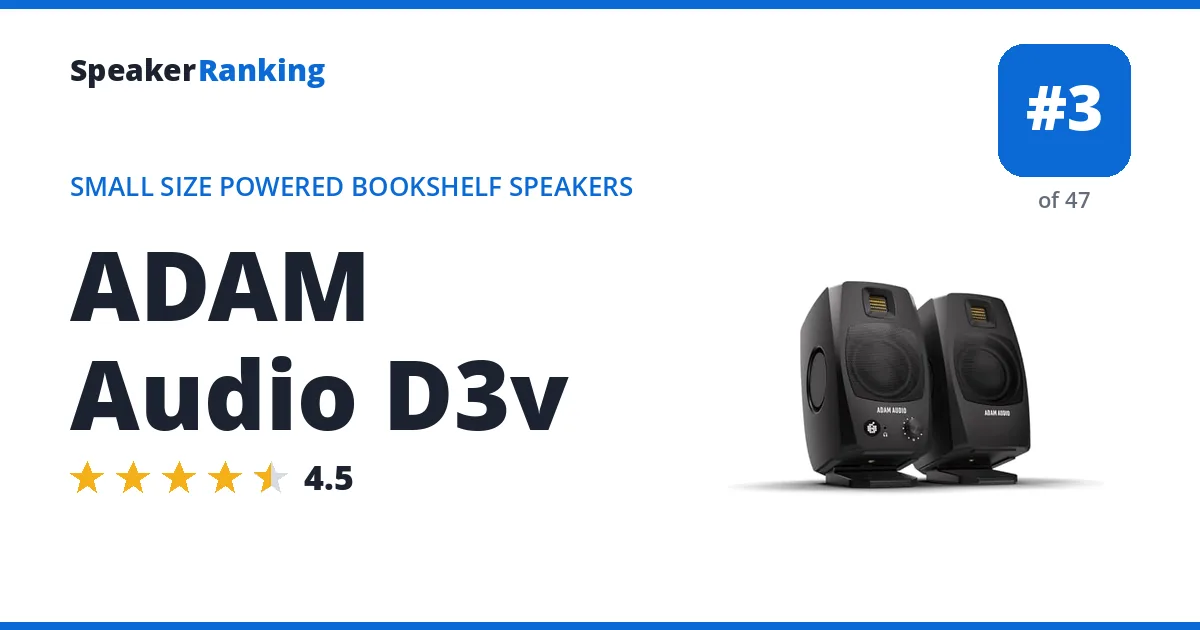
Pros: Excellent midrange linearity for a tiny desktop speaker: Erin’s Klippel data spans just 1.7dB from 300Hz to 5kHz. Side passive radiators help bass reach -3dB at about 51Hz, substantially deeper than the Genelec 8010A or Audio Smile LBM. Predicted preference scores of 4.47 standalone and 6.70 with an ideal subwoofer support it as a particularly useful compact system without a sub. USB-C, analog inputs and placement filters simplify desk setup. Measured bass extension of 50Hz (-3dB), with a measured sensitivity of 86.5dB.
Cons: A rising upper-frequency balance and vertical crossover interference keep it from being uniformly neutral at every angle; aim the tweeters toward ear height. The limiter reduces bass and midrange output as volume rises, with the existing review’s compression tests putting usable maximum output around 89-90dB at 1m. Deep bass at moderate volume should not be confused with high output capability.
Full Adam Audio D3v review and specifications →
| AES Input | No |
|---|---|
| Amplifier Power | 50W (30W woofer + 20W tweeter) |
| App | No |
| Aux Input | No |
| Bass Extension (-10dB) | 45Hz (measured, Erin's Audio Corner) |
| Bass Extension (-3dB) | 50Hz (measured, Erin's Audio Corner) |
| Bluetooth | No |
| Coaxial Input | No |
| Dimensions | 6.7"H x 4.3"W x 5.9"D (170.2 x 109.2 x 149.9 mm) |
| Drivers | 3.5" woofer, U-ART accelerated ribbon tweeter |
| EQ | Yes (Room adjustment filters) |
| Frequency Response | 50Hz - 50kHz (Manufacturer specified) |
| HDMI Input | No |
| Inputs | USB-C, balanced 1/4-inch TRS |
| Maximum SPL | 102dB @ 1m (manufacturer specified) |
| Optical Input | No |
| RCA Input | No |
| Sensitivity | 86.5dB (measured at 0.3V/1m, Erin's Audio Corner) |
| Spinorama Preference Score | 4.47 |
| Spinorama Preference Score with Perfect Sub | 6.70 |
| TRS Input | Yes |
| USB Input | Yes |
| Weight | 3.7 lbs (1.7 kg) |
| XLR Input | No |
- Links
- Reviews, Comparisons and Sound Samples
- Erin’s Audio Corner: ADAM Audio D3V: Mighty Small But Mighty Awesome Desktop Speaker More from Erin’s Audio Corner →
- Erin’s Audio Review Adam Audio D3v
- Erin’s Audio Corner Measurements (spinorama.org)
- Jasper Tech: Best Desktop Computer Speakers for Every Budget – 2026 More from Jasper Tech →
- Jasper Tech: Are the D3V The Best Studio Monitors For The Money?
- Erin’s Audio Corner: The Best Budget Desktop Speakers, Tested & Rated
- Head-to-Head Comparisons
- Adam Audio D3v vs Genelec 8010A
- Adam Audio D3v vs Cambridge Audio L/R S
- Adam Audio D3v vs IK Multimedia iLoud Micro Monitor
- Adam Audio D3v vs Audio Smile Little British Monitor
- Adam Audio D3v vs Edifier M60
- Adam Audio D3v vs HiVi Swan X3
- Adam Audio D3v vs Edifier MR3
- Adam Audio D3v vs Audioengine A2+
- See all 14 comparisons
 Yamaha HS5: $399.98 per pair Amazon eBay
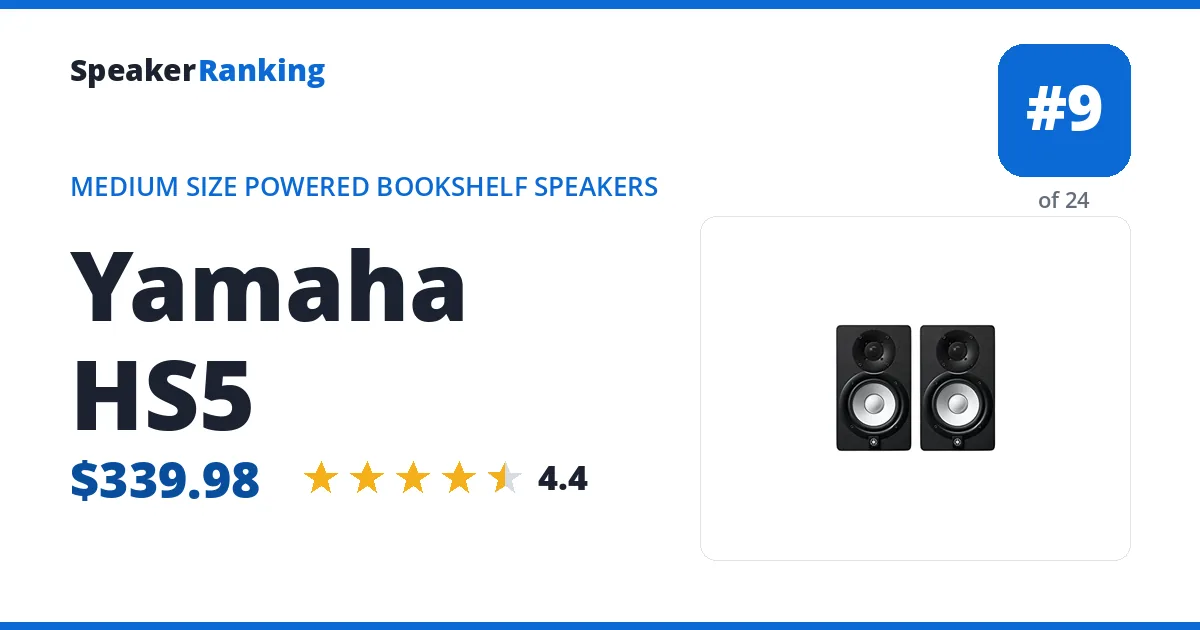
Pros: ASR found reasonably smooth early-reflection directivity, which makes broad EQ correction more promising than on speakers whose off-axis response changes abruptly. Balanced inputs and placement controls suit studio use. The measured preference scores are 2.91 standalone and 5.52 with an ideal subwoofer. Measured bass extension of 88Hz (-3dB).
Cons: The measurements do not support describing it as very neutral: excess midrange and reduced lower-midrange/upper-bass weight produce a bass-light balance. The 300Hz-5kHz span is 4.3dB. Its automated -3dB crossing is affected by response shape, so it should not be treated as a simple bass-cutoff specification. A subwoofer adds low bass but does not fix the elevated midrange.
Full Yamaha HS5 review and specifications →
| AES Input | No |
|---|---|
| Amplifier Power | 45w Per Speaker |
| App | No |
| Aux Input | No |
| Bass Extension (-10dB) | 68Hz (measured, Audio Science Review) |
| Bass Extension (-3dB) | 88Hz (measured, Audio Science Review) |
| Bluetooth | No |
| Coaxial Input | No |
| Dimensions | 11.2"H x 6.7"W x 8.7"D (284.5 x 170.2 x 221 mm) |
| Drivers | 5" (127mm) woofer |
| EQ | Yes (Room adjustment) |
| Frequency Response | 58Hz - 24kHz (-3dB) (Manufacturer specified) |
| HDMI Input | No |
| Inputs | XLR |
| Optical Input | No |
| RCA Input | No |
| Spinorama Preference Score | 2.91 |
| Spinorama Preference Score with Perfect Sub | 5.52 |
| TRS Input | No |
| USB Input | No |
| Weight | 12.1 lbs (5.5 kg) each |
| XLR Input | Yes |
- Links
- Reviews, Comparisons and Sound Samples
- Audio Science Review Measurements More from Audio Science Review →
- DSAUDIO.review: DSAUDIO.review KRK Classic 5 CL5G3 vs Yamaha HS5 sound.DEMO More from DSAUDIOreview →
- DSAUDIO.review: DSAUDIO.review Focal Alpha 50 EVO vs Yamaha HS5 sound.DEMO
- DSAUDIO.review: Genelec 8020D vs Yamaha HS5 Soun & Frequency Response Comparison
- DSAUDIO.review: JBL 305P MKII vs Yamaha HS5 6-Track Comparison
- DSAUDIO.review: Adam Audio T5V vs Yamaha HS5 5 Track Comparison
- DSAUDIO.review: Yamaha HS5 vs Presonus Eris E5 Sound Demo
- DSAUDIO.review: KRK Rokit 5 G4 RP5G4 vs Yamaha HS5 Sound & Frequency Response Comparison
- DSAUDIO.review: New PreSonus E5 XT and Yamaha HS5 could not sound any more different! SOUND AND RESPONSE COMPARISON
- DSAUDIO.review: Yamaha HS8 vs Yamaha HS5 Sound & Frequency Response Comparison
- DSAUDIO.review: Genelec 8010A (Genelec G One) vs Yamaha HS5 Sound Demo w/ Bass Test
- Audio Science Review Measurements (spinorama.org)
- Head-to-Head Comparisons