Short answer: Adam D3v is the more accurate near-field monitor choice; Audioengine A2+ is the more flexible desktop system. They place 3 of 48 and 19 of 48.
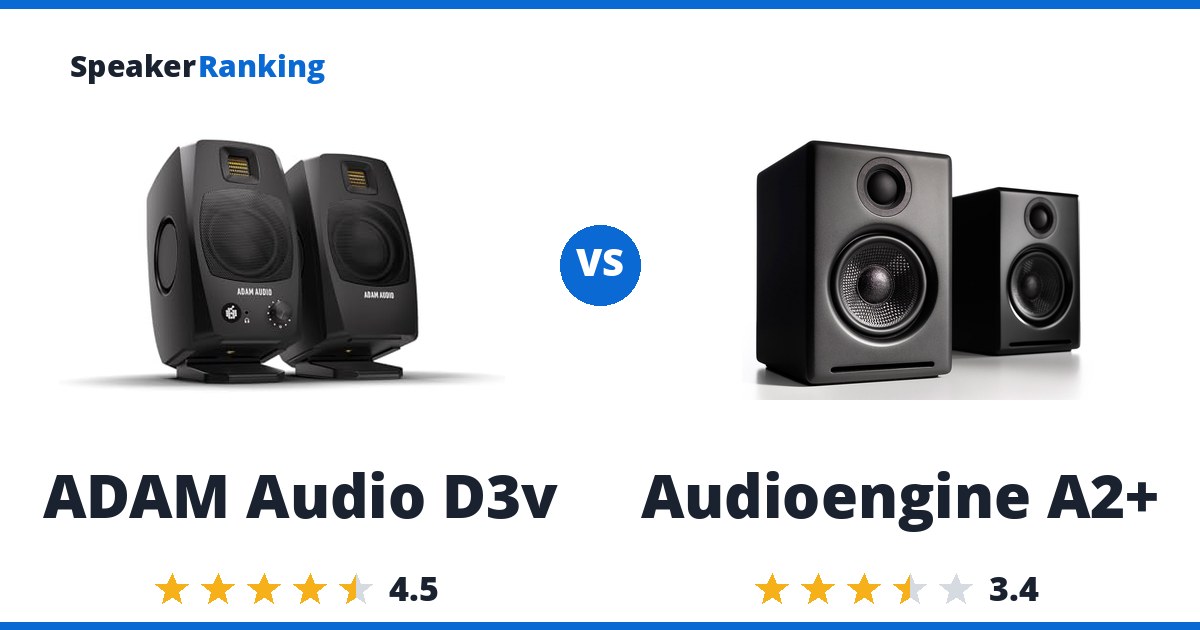
D3v uses side passive radiators to get more bass from a compact desktop monitor and is intended for roughly one-meter listening. Its limiter removes low-frequency and midrange content as output rises, so it is not for loud or far-field use.
A2+ has a genuinely small footprint, RCA, 3.5mm, USB, Bluetooth, a rear volume knob, and variable RCA output. Its measured response has a pronounced midrange dip and a persistent presence-region depression that desk placement does not cure.
Buy the ADAM Audio D3v if you want the more monitor-like speaker for close desktop listening.
Buy the Audioengine A2+ if input flexibility and a tiny desktop footprint are more important than tonal accuracy.
Still deciding? The full Powered Home rankings cover every ranked option.
Measured Differences
- Bass depth: the ADAM Audio D3v reaches 45 Hz (10 dB down) against 58.9 Hz for the Audioengine A2+, about half an octave deeper. You hear more of the lowest bass notes and kick drums.
- Tonal accuracy above the bass: with a subwoofer taking the low end, the ADAM Audio D3v scores 7.6 against 6.1 for the Audioengine A2+ on the Spinorama preference scale. Its frequency response and off-axis sound are smoother, so voices and instruments sound closer to the recording.
Prices on this page were last checked November 14, 2026 at 6:17 PM UTC. Product prices and availability are accurate as of that date/time and are subject to change; the price and availability shown on Amazon at the time of purchase will apply to the purchase of this product.
As an eBay Partner, we may be compensated if you make a purchase.
Specifications Side By Side
| ADAM Audio D3v | Audioengine A2+ | |
|---|---|---|
| Price | $349.99 per pair | $299.00 per pair |
| Ranked | #3 of 48 in Small Size Powered Bookshelf Speakers | #19 of 48 in Small Size Powered Bookshelf Speakers |
| Bass Extension (-10dB) | 45Hz (measured, Erin’s Audio Corner) | 58.9Hz (measured, Erin’s Audio Corner) |
| Bass Extension (-3dB) | 50Hz (measured, Erin’s Audio Corner) | 105.5Hz (measured, Erin’s Audio Corner) |
| App | No | No |
| Bluetooth | No | Yes |
| Dimensions | 200H (240H on included stand) x 115W x 150D mm | 6” x 4” x 5.2” (152 x 102 x 133 mm) |
| EQ | Yes (Room adjustment filters) | No (fixed volume knob only) |
| Frequency Response | 48Hz - 22.6kHz (-3dB) (Manufacturer specified) | 65Hz - 22kHz (+-2dB, Manufacturer specified) |
| Inputs | USB-C, balanced 1/4-inch TRS | RCA, 3.5mm, USB, Bluetooth 5.0 |
| Sensitivity | 86.5dB (measured at 0.3V/1m, Erin’s Audio Corner) | - |
| Drivers | 3.5” aluminium woofer, D-ART folded ribbon tweeter, 2 x 3.5” passive radiators (each) | 0.75” silk dome tweeter, 2.75” fiber woofer |
| Weight | 7.9 lbs (3.58 kg) (pair) | 3.5 lbs (1.6 kg) left / 3.1 lbs (1.4 kg) right |
| Amplifier Power | 100W RMS per speaker (70W woofer + 30W tweeter) (Manufacturer specified) | 15W RMS / 30W peak per channel |
| Maximum SPL | 98dB peak @ 1m (IEC-weighted noise, manufacturer specified) | - |
| Spinorama Preference Score | 5.37 | 2.78 |
| Spinorama Preference Score with Perfect Sub | 7.59 | 6.10 |
| XLR Input | No | No |
| RCA Input | No | Yes |
| TRS Input | Yes | No |
| Optical Input | No | No |
| Coaxial Input | No | No |
| USB Input | Yes | Yes |
| HDMI Input | No | No |
| AES Input | No | No |
| Aux Input | No | Yes |
| Outputs | 3.5mm headphone | RCA variable output (subwoofer) |
| Headphone Output | Yes | - |
| Bluetooth Version | - | 5.0 |
| Subwoofer Output | - | Yes |
Where the Ratings Come From
- ADAM Audio D3v: Spinorama.org measurements and reviews by Erin’s Audio Corner and Jasper Tech.
- Audioengine A2+: Spinorama.org measurements and reviews by Erin’s Audio Corner and DSAUDIO.review.
This comparison is generated from the ratings, specifications and measurements on each product’s own page, and it updates when that data changes. How we rank explains how each rating is decided.
Related Speaker Comparisons
How ADAM Audio D3v compares with other leading options: