The ZMF Auteur ranks #294 out of 485 total Over-Ear Headphones for sound quality. See all Headphones rankings for every top pick.
Brand: ZMF
Prices on this page were last checked October 19, 2026 at 10:32 PM UTC. Product prices and availability are accurate as of that date/time and are subject to change; the price and availability shown on Amazon at the time of purchase will apply to the purchase of this product.
As an eBay Partner, we may be compensated if you make a purchase.
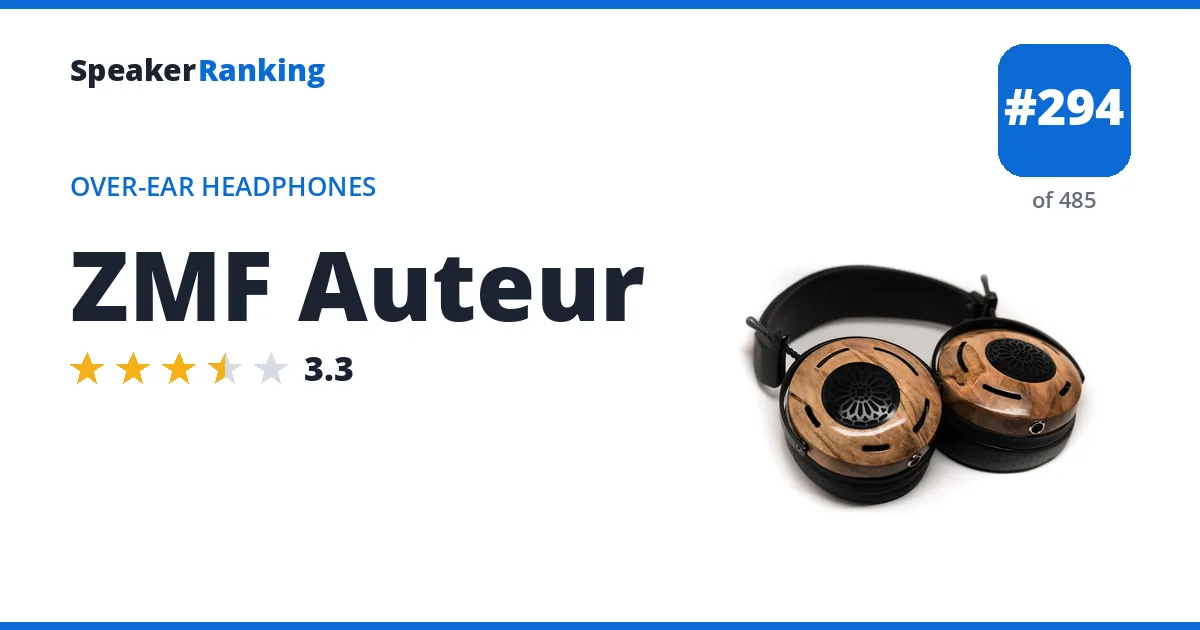
#294 ZMF Auteur: $1,599.00 Discontinued eBay
Newer model: the ZMF Auteur Classic, ranked lower, rated 2.9/5, released Jul 2022. See every ZMF Auteur generation.
Pros: An open-back wooden over-ear headphone with a 300 ohm biocellulose dynamic driver whose lower mids sit close to target, giving voices and instruments natural body. The open back gives a wide, airy presentation.
Cons: Sub bass falls 6 dB below target by 40 Hz, and treble has a 10 dB dip near 7.5 kHz and another near 10 kHz, so it lacks rumble and air. 300 ohm impedance with 97 dB/mW sensitivity needs a dedicated amplifier, and it is discontinued, replaced by the ZMF Auteur Classic. See headphone amps and DACs with enough power to drive it.
Is the ZMF Auteur right for you?
Buy it if
- your taste runs warm: it scores 82 for that sound.
- you are sensitive to bright or sharp treble (treble sits 2.8 dB below target).
- you are happy to use EQ: our preset lifts its Harman match by about 15 points.
Skip it if
- you will plug straight into a phone or laptop: at 300 ohms it needs a headphone amp.
- you want more bass (about 3 dB below target).
- you need isolation or will use it in public: open-back headphones leak sound both ways.
- you want to buy it new: it is discontinued.
| Released | 2018 (8 years ago) |
|---|---|
| Back | Open |
| Connection | Wired |
| Deviation From Target | 2.89 dB standard deviation |
| Driver Type | Dynamic |
| Drivers | 1 x custom bio-cellulose dynamic |
| Form Factor | Over-ear |
| Harman Preference Score | 66 (median of 4 squig.link measurements, calibrated to AutoEQ) |
| Impedance | 300 ohms |
| Sensitivity | 97 dB/mW |
| Sub-bass Extension | Falls 6 dB below target at 40 Hz (-7.4 dB at 30 Hz) |
| Tonal Tilt | -0.73 (negative is warmer, positive brighter) |
EQ Presets
Harman target
Set a preamp of -6.3 dB, then add these filters in any parametric equalizer (Wavelet, Equalizer APO, Peace, or a player with parametric EQ). Calculated by Speaker Ranking from the median of 4 squig.link measurements, in the filter layout AutoEQ uses. Predicted Harman match with this EQ: 81 out of 100, up from 66.
| Filter | Frequency | Gain | Q |
|---|---|---|---|
| Low shelf | 105 Hz | +4.4 dB | 0.70 |
| High shelf | 10,000 Hz | -2.4 dB | 0.70 |
| Peak | 24 Hz | +2.0 dB | 1.71 |
| Peak | 247 Hz | -2.7 dB | 0.40 |
| Peak | 1,685 Hz | +3.2 dB | 3.71 |
| Peak | 3,430 Hz | +3.0 dB | 1.14 |
| Peak | 5,498 Hz | -5.4 dB | 6.00 |
| Peak | 7,391 Hz | +2.0 dB | 2.53 |
Neutral target
Set a preamp of -3.7 dB, then add these filters in any parametric equalizer (Wavelet, Equalizer APO, Peace, or a player with parametric EQ). Calculated by Speaker Ranking from the median of 4 squig.link measurements, in the filter layout AutoEQ uses. Predicted Neutral match with this EQ: 82 out of 100, up from 52.
| Filter | Frequency | Gain | Q |
|---|---|---|---|
| Low shelf | 105 Hz | -1.1 dB | 0.70 |
| High shelf | 10,000 Hz | -2.4 dB | 0.70 |
| Peak | 23 Hz | +2.4 dB | 2.37 |
| Peak | 220 Hz | -2.8 dB | 0.40 |
| Peak | 1,685 Hz | +3.2 dB | 3.71 |
| Peak | 3,430 Hz | +3.0 dB | 1.14 |
| Peak | 5,498 Hz | -5.4 dB | 6.00 |
| Peak | 7,378 Hz | +2.0 dB | 2.59 |
Studio flat target
Set a preamp of -5.9 dB, then add these filters in any parametric equalizer (Wavelet, Equalizer APO, Peace, or a player with parametric EQ). Calculated by Speaker Ranking from the median of 4 squig.link measurements, in the filter layout AutoEQ uses. Predicted Studio flat match with this EQ: 74 out of 100, up from 18.
| Filter | Frequency | Gain | Q |
|---|---|---|---|
| Low shelf | 105 Hz | -3.0 dB | 0.70 |
| High shelf | 10,000 Hz | +2.0 dB | 0.70 |
| Peak | 224 Hz | -4.6 dB | 0.47 |
| Peak | 1,823 Hz | +4.3 dB | 2.57 |
| Peak | 3,219 Hz | +5.3 dB | 1.14 |
| Peak | 5,497 Hz | -6.8 dB | 6.00 |
Warm target
Set a preamp of -4.6 dB, then add these filters in any parametric equalizer (Wavelet, Equalizer APO, Peace, or a player with parametric EQ). Calculated by Speaker Ranking from the median of 4 squig.link measurements, in the filter layout AutoEQ uses. Predicted Warm match with this EQ: 91 out of 100, up from 82.
| Filter | Frequency | Gain | Q |
|---|---|---|---|
| Low shelf | 105 Hz | +4.6 dB | 0.70 |
| High shelf | 10,000 Hz | -5.6 dB | 0.70 |
| Peak | 227 Hz | -2.4 dB | 0.44 |
| Peak | 1,621 Hz | +2.8 dB | 3.80 |
| Peak | 4,318 Hz | +1.6 dB | 0.42 |
| Peak | 5,525 Hz | -6.0 dB | 6.00 |
| Peak | 7,468 Hz | +2.0 dB | 5.90 |
Bass target
Set a preamp of -5.9 dB, then add these filters in any parametric equalizer (Wavelet, Equalizer APO, Peace, or a player with parametric EQ). Calculated by Speaker Ranking from the median of 4 squig.link measurements, in the filter layout AutoEQ uses. Predicted Bass match with this EQ: 87 out of 100, up from 70.
| Filter | Frequency | Gain | Q |
|---|---|---|---|
| Low shelf | 105 Hz | +5.9 dB | 0.70 |
| High shelf | 10,000 Hz | -2.4 dB | 0.70 |
| Peak | 250 Hz | -2.5 dB | 0.59 |
| Peak | 812 Hz | -1.8 dB | 3.06 |
| Peak | 1,685 Hz | +3.2 dB | 3.71 |
| Peak | 3,430 Hz | +3.0 dB | 1.13 |
| Peak | 3,884 Hz | +2.4 dB | 6.00 |
| Peak | 5,498 Hz | -5.4 dB | 6.00 |
| Peak | 7,353 Hz | +2.0 dB | 2.72 |
Bright target
Set a preamp of -6.2 dB, then add these filters in any parametric equalizer (Wavelet, Equalizer APO, Peace, or a player with parametric EQ). Calculated by Speaker Ranking from the median of 4 squig.link measurements, in the filter layout AutoEQ uses. Predicted Bright match with this EQ: 66 out of 100, up from 30.
| Filter | Frequency | Gain | Q |
|---|---|---|---|
| Low shelf | 105 Hz | -1.1 dB | 0.70 |
| High shelf | 10,000 Hz | +0.5 dB | 0.70 |
| Peak | 23 Hz | +2.4 dB | 2.34 |
| Peak | 209 Hz | -2.8 dB | 0.40 |
| Peak | 835 Hz | -1.7 dB | 2.98 |
| Peak | 1,631 Hz | +3.0 dB | 3.71 |
| Peak | 3,497 Hz | +4.4 dB | 1.00 |
| Peak | 4,082 Hz | +2.3 dB | 6.00 |
| Peak | 5,515 Hz | -2.9 dB | 6.00 |
V-shaped target
Set a preamp of -6.3 dB, then add these filters in any parametric equalizer (Wavelet, Equalizer APO, Peace, or a player with parametric EQ). Calculated by Speaker Ranking from the median of 4 squig.link measurements, in the filter layout AutoEQ uses. Predicted V-shaped match with this EQ: 64 out of 100, up from 52.
| Filter | Frequency | Gain | Q |
|---|---|---|---|
| Low shelf | 105 Hz | +6.0 dB | 0.70 |
| High shelf | 10,000 Hz | +1.2 dB | 0.70 |
| Peak | 74 Hz | +1.3 dB | 3.12 |
| Peak | 238 Hz | -1.2 dB | 1.13 |
| Peak | 749 Hz | -2.6 dB | 1.63 |
| Peak | 1,647 Hz | +2.8 dB | 3.51 |
| Peak | 3,433 Hz | +4.8 dB | 0.92 |
| Peak | 4,197 Hz | +2.2 dB | 6.00 |
| Peak | 5,513 Hz | -2.5 dB | 6.00 |
- Reviews, Comparisons and Sound Samples
Frequency Response
How the ZMF Auteur measures across the audible range, against the Harman over-ear target that most listeners prefer in blind tests. Where the line sits above the target that range sounds louder (more bass, brighter treble), below it quieter. The curve is the median of 4 independent measurements, so one odd sample or rig cannot skew it, and both lines are shifted so their 500 Hz to 2 kHz average sits at 0 dB.
Measurement data: median of 4 measurements from the squig.link databases of capraaudio, daemonxar, kuulokenurkka and sai. Thanks to each of them for publishing their work.
Head-to-Head Comparisons
1 comparisonsNo comparisons match that search.