Short answer: the ADAM Audio T7V. Both are rated 3.9/5 for sound quality (#95 and #93 of 119 powered bookshelf speakers), and the ADAM Audio T7V costs $579.98 against $699.98 for the Yamaha HS7, so with nothing between them on sound quality, price settles it.
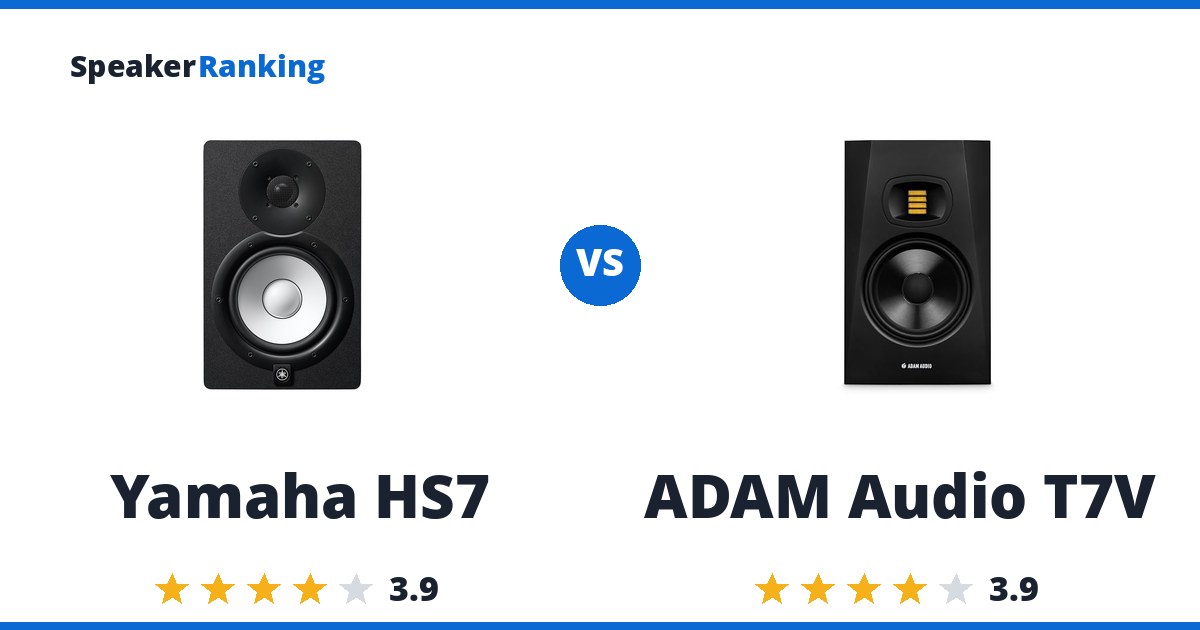
What the Yamaha HS7 does well: A simple, well known 6.5 inch studio monitor with balanced inputs and controls to adjust for wall placement and treble. Watch for: Its uneven bass response crosses -3dB around 87.9Hz in the normalized measurement, so quoting the 41Hz low-frequency score input as flat bass extension is misleading.
The case for the ADAM Audio T7V: An affordable 7 inch studio monitor with an even midrange, basic tone controls and analog inputs for a simple desk setup. The catch: Correct listening height is important for the two-way crossover.
Buy the ADAM Audio T7V. Both are rated the same for sound quality, and it costs $120 less than the Yamaha HS7.
Still deciding? The full Powered Home rankings cover every ranked option.
Prices on this page were last checked November 7, 2026 at 7:34 PM UTC. Product prices and availability are accurate as of that date/time and are subject to change; the price and availability shown on Amazon at the time of purchase will apply to the purchase of this product.
As an eBay Partner, we may be compensated if you make a purchase.
Specifications Side By Side
| Yamaha HS7 | ADAM Audio T7V | |
|---|---|---|
| Price | $699.98 per pair | $579.98 per pair |
| Ranked | #93 of 119 in Large Size Powered Bookshelf Speakers | #95 of 119 in Large Size Powered Bookshelf Speakers |
| Enclosure | 2-way active, rear-ported | - |
| Drivers | 1” dome tweeter, 6.5” cone woofer | 7” (178mm) woofer |
| Dimensions | 13.1H x 8.3W x 11.2D in | 13.7”H x 8.3”W x 11.5”D (348 x 210.8 x 292.1 mm) |
| Weight | 18.1 lbs (8.2 kg) each | 15.7 lbs (7.1 kg) |
| Amplifier Power | 95W each (60W LF, 35W HF) | 70w Per Speaker |
| Inputs | Balanced XLR and 1/4” TRS | XLR, RCA |
| Country | Japan (design) | - |
| Spinorama Preference Score | 4.54 | - |
| Spinorama Preference Score with Perfect Sub | 6.48 | - |
| XLR Input | Yes | Yes |
| RCA Input | No | Yes |
| TRS Input | Yes | No |
| Optical Input | No | No |
| Coaxial Input | No | No |
| USB Input | No | No |
| HDMI Input | No | No |
| AES Input | No | No |
| Aux Input | No | No |
| Bluetooth | No | No |
| Frequency Response | 43Hz - 30kHz (Manufacturer specified) | 39Hz - 25kHz (-6dB) (Manufacturer specified) |
| Bass Extension (-3dB) | - | approx. 65Hz, extrapolated from the reviewer’s directly-computed -6dB point of 45.4Hz (measured, Audio Science Review) |
| Bass Extension (-10dB) | - | approx. 45Hz, extrapolated from the reviewer’s directly-computed -6dB point of 45.4Hz (measured, Audio Science Review) |
| App | - | No |
| EQ | - | Yes (Room adjustment) |
| DSP | - | No |
Watch Them Compared
Videos and reviews that test both speakers side by side.
Related Speaker Comparisons
How Yamaha HS7 compares with other leading options: