Short answer: the Vandersteen Treo CT. It ranks #55 of 73 floorstanding speakers by sound quality, rated 3.8/5, at $11,090. The Børresen X3 ranks #67, rated 3.0/5, at $11,000, $90 cheaper, not enough of a saving to outweigh the sound-quality gap.
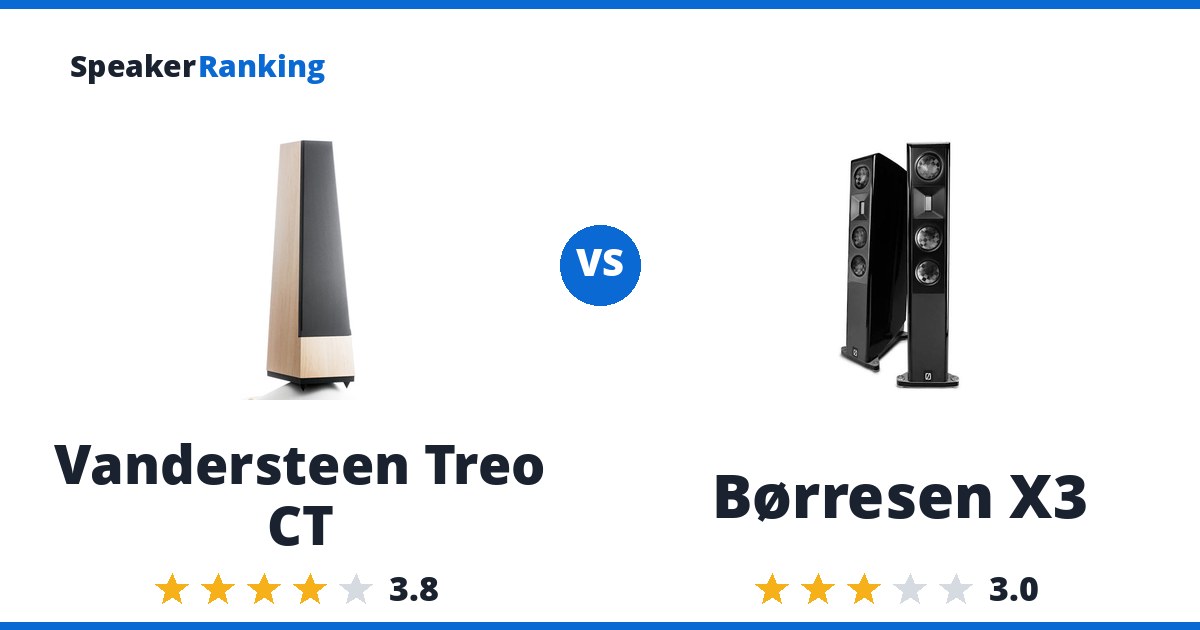
Why pick the Vandersteen Treo CT: A time-aligned four-driver floorstander with carbon tweeter, first-order crossovers and exceptional measured bass reach. Watch for: At $11090 per pair, 80 lb each and only 85dB sensitivity, it is costly and amplifier-demanding.
Why pick the Børresen X3: A 2.5-way tower built around a planar ribbon tweeter, a 4.5” mid-range driver, and dual 4.5” bass drivers, spec’d at 88dB/1W sensitivity into a 4-ohm nominal load (measured minimum impedance stays a friendly 6.1 ohms above 80Hz, so it doesn’t actually need much power despite the sub-90dB rating). The catch: A significant midrange suckout centered around 200-300Hz measures 8-11dB below the mean SPL, creating an audible hole in the mid-range that multiple independent listeners also flagged unprompted.
Buy the Vandersteen Treo CT. It is rated higher for sound quality, and saving $90 with the Børresen X3 does not make up for the sound-quality gap.
Still deciding? The full Passive Home rankings cover every ranked option.
Specifications Side By Side
| Vandersteen Treo CT | Børresen X3 | |
|---|---|---|
| Price | $11,090 per pair | $11,000.00 per pair |
| Ranked | #55 of 73 in Large Size Floorstanding Speakers | #67 of 73 in Large Size Floorstanding Speakers |
| Enclosure | 4-driver, floorstanding bass-reflex | - |
| Drivers | 1” carbon tweeter, 4.5” midrange, 6.5” woofer, 8” acoustic coupler | Planar ribbon tweeter, 4.5” mid-range driver, dual 4.5” bass drivers |
| Dimensions | 43H x 10W x 15D in | 50.8”H x 13.6”W x 23.9”D (1290.0 x 345.0 x 607.0 mm) |
| Weight | 80 lbs (36.3 kg) each | 121.3 lbs (55 kg) |
| Sensitivity | 85dB | 88dB |
| Impedance | 6 ohms nominal, 4 ohms minimum | 4 ohms |
| Country | United States | Denmark |
| Spinorama Preference Score | 4.95 | 2.38 |
| Spinorama Preference Score with Perfect Sub | 6.17 | 3.50 |
| Bass Extension (-3dB) | 43.9Hz (measured, Erin’s Audio Corner via spinorama.org) | 50Hz (measured, Erin’s Audio Corner) |
| Bass Extension (-10dB) | 22.4Hz (derived, log-interpolated between spinorama.org -9dB/-12dB points) | 25Hz (measured, Erin’s Audio Corner) |
| DIY Kit | No | No |
| Frequency Response | - | 35Hz - 50kHz (Manufacturer specified) |
| Recommended Power | - | 50W minimum |
Related Speaker Comparisons
How Vandersteen Treo CT compares with other leading options:
- Vandersteen Treo CT vs Polk T50
- Aperion Audio Novus N5T vs Vandersteen Treo CT
- Børresen X3 vs Bose 901 Series V
- Dali Rubikore 6 vs Børresen X3
- Atlantic Technology 8600eLR vs Børresen X3
Prices on this page were last checked September 29, 2026 at 3:43 PM UTC. Product prices and availability are accurate as of that date/time and are subject to change; the price and availability shown on Amazon at the time of purchase will apply to the purchase of this product.
As an eBay Partner, we may be compensated if you make a purchase.
The Two Speakers In Full
 Vandersteen Treo CT: $11,090 per pair Audio Connection eBay
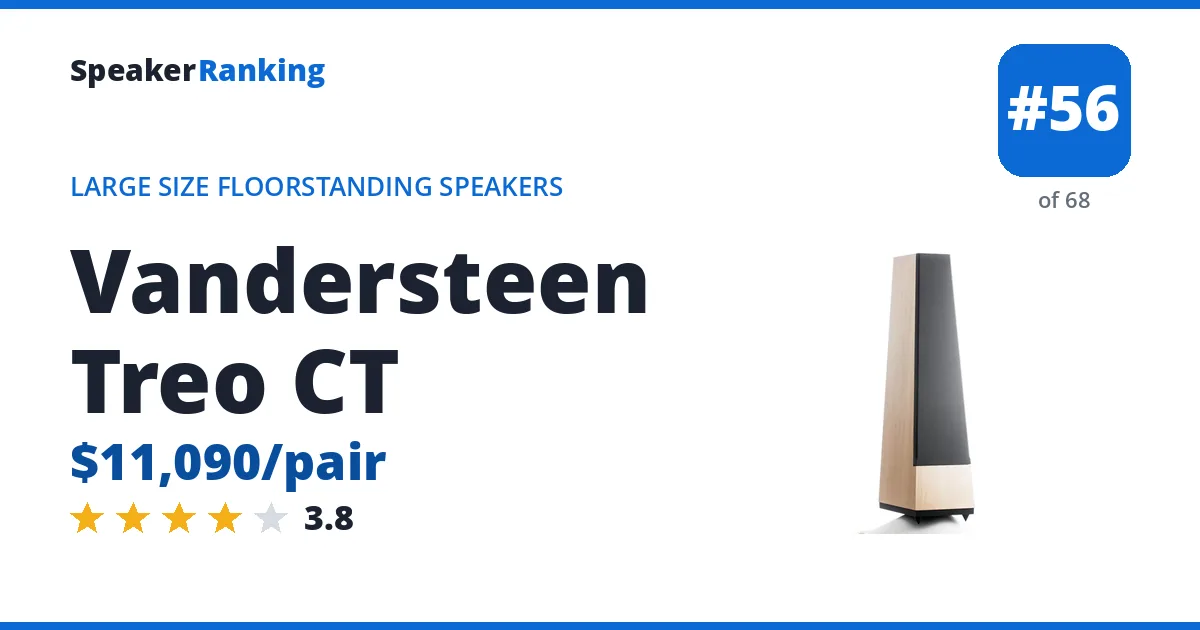
Pros: A time-aligned four-driver floorstander with carbon tweeter, first-order crossovers and exceptional measured bass reach. Erin’s data predicts 27Hz in-room extension, a 4.95 standalone preference score, smooth 0.106 sound power and a 6.17 score with a subwoofer. Measured bass extension of 43.9Hz (-3dB).
Cons: At $11090 per pair, 80 lb each and only 85dB sensitivity, it is costly and amplifier-demanding. The response rises about +0.62dB per octave, horizontal coverage narrows to roughly +/-40 degrees, and on-axis smoothness is only 0.170.
Full Vandersteen Treo CT review and specifications →
| Bass Extension (-10dB) | 22.4Hz (derived, log-interpolated between spinorama.org -9dB/-12dB points) |
|---|---|
| Bass Extension (-3dB) | 43.9Hz (measured, Erin’s Audio Corner via spinorama.org) |
| Country | United States |
| DIY Kit | No |
| Dimensions | 43H x 10W x 15D in |
| Drivers | 1” carbon tweeter, 4.5” midrange, 6.5” woofer, 8” acoustic coupler |
| Enclosure | 4-driver, floorstanding bass-reflex |
| Impedance | 6 ohms nominal, 4 ohms minimum |
| Sensitivity | 85dB |
| Spinorama Preference Score | 4.95 |
| Spinorama Preference Score with Perfect Sub | 6.17 |
| Weight | 80 lbs (36.3 kg) each |
- Links
- Reviews, Comparisons and Sound Samples
- Head-to-Head Comparisons
 Børresen X3: $11,000.00 per pair eBay
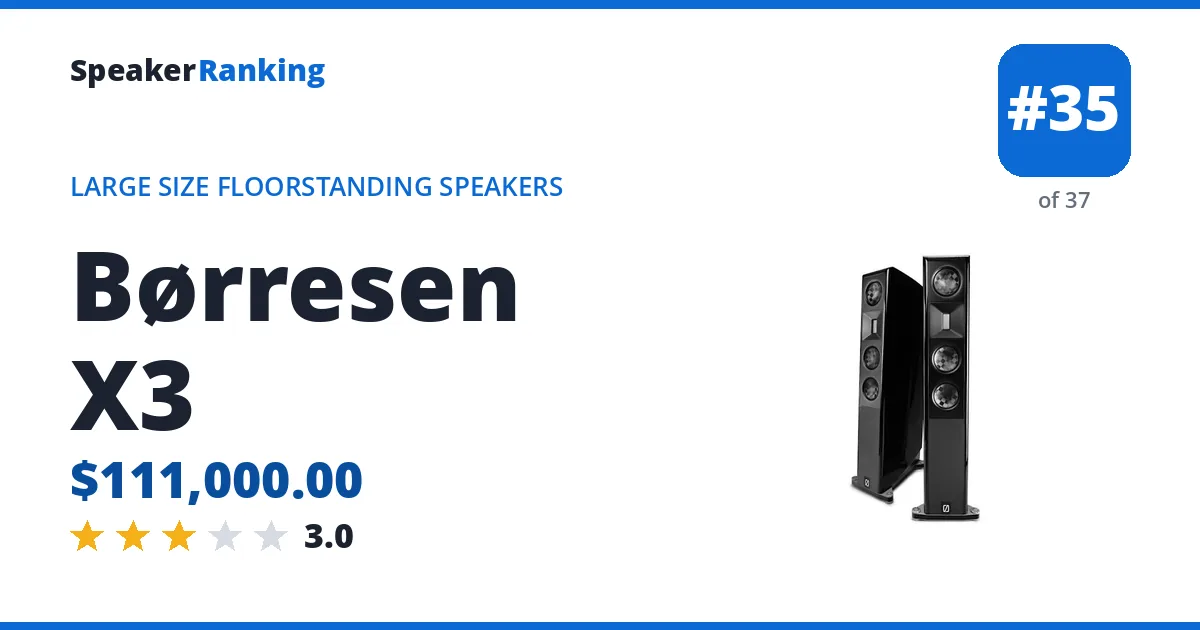
Pros: A 2.5-way tower built around a planar ribbon tweeter, a 4.5” mid-range driver, and dual 4.5” bass drivers, spec’d at 88dB/1W sensitivity into a 4-ohm nominal load (measured minimum impedance stays a friendly 6.1 ohms above 80Hz, so it doesn’t actually need much power despite the sub-90dB rating). Very wide, remarkably consistent horizontal directivity around ±70° gives an expansive, enveloping soundstage, helped by the reviewer’s pair measuring essentially identically to each other for tight image precision. A pronounced high-Q bass shelf centered around 80Hz (roughly 8dB above the mean level) delivers a punchy, attention-grabbing low-end thump at moderate volumes. Harmonic distortion is clean through the midrange at 86dB, and multitone distortion stays under about 3% even though the low end is handled by relatively small 4.5” drivers rather than something larger. Detailed, extended high frequencies when seated on the tweeter’s intended axis. Measured bass extension of 50Hz (-3dB).
Cons: A significant midrange suckout centered around 200-300Hz measures 8-11dB below the mean SPL, creating an audible hole in the mid-range that multiple independent listeners also flagged unprompted. The 80Hz bass shelf comes with the worst low-frequency ringing the reviewer says he has measured to date on a waterfall plot: it lingers well after the surrounding frequencies have decayed, giving kick drum and bass notes a boomy, one-note quality. Significant dynamic compression sets in as volume rises: bass output near 90Hz drops only about 1.5dB at 86dB SPL, but the loss grows substantially by 96dB and 102dB (around 26dB of total dynamic range), so the appealing bass punch measurably fades at higher listening levels. The upper-midrange and lower treble (2-4kHz) read soft and recessed unless the listener sits almost exactly on the tweeter’s reference axis, within about 15°: the manufacturer’s recommended setup (tweeter aimed above ear height, per their design intent) makes this worse rather than better for a seated listener at normal height. A crossover-related directivity kink between the tweeter and mid-range driver, visible in the vertical response, trades some pinpoint image precision for a more diffuse sense of envelopment compared to smaller two-way designs. Resonances appear in the impedance curve near 300Hz and 2kHz, coinciding with the measured midrange dip.
Full Børresen X3 review and specifications →
| Bass Extension (-10dB) | 25Hz (measured, Erin’s Audio Corner) |
|---|---|
| Bass Extension (-3dB) | 50Hz (measured, Erin’s Audio Corner) |
| Country | Denmark |
| DIY Kit | No |
| Dimensions | 50.8”H x 13.6”W x 23.9”D (1290.0 x 345.0 x 607.0 mm) |
| Drivers | Planar ribbon tweeter, 4.5” mid-range driver, dual 4.5” bass drivers |
| Frequency Response | 35Hz - 50kHz (Manufacturer specified) |
| Impedance | 4 ohms |
| Recommended Power | 50W minimum |
| Sensitivity | 88dB |
| Spinorama Preference Score | 2.38 |
| Spinorama Preference Score with Perfect Sub | 3.50 |
| Weight | 121.3 lbs (55 kg) |
- Links
- Reviews, Comparisons and Sound Samples
- Head-to-Head Comparisons