Short answer: the XTZ Spirit 4 for better sound quality, the Triangle Borea BR03 for the lower price. The XTZ Spirit 4 ranks #92 of 130 bookshelf speakers at $477. The Triangle Borea BR03 ranks #109 at $399, $78 cheaper.
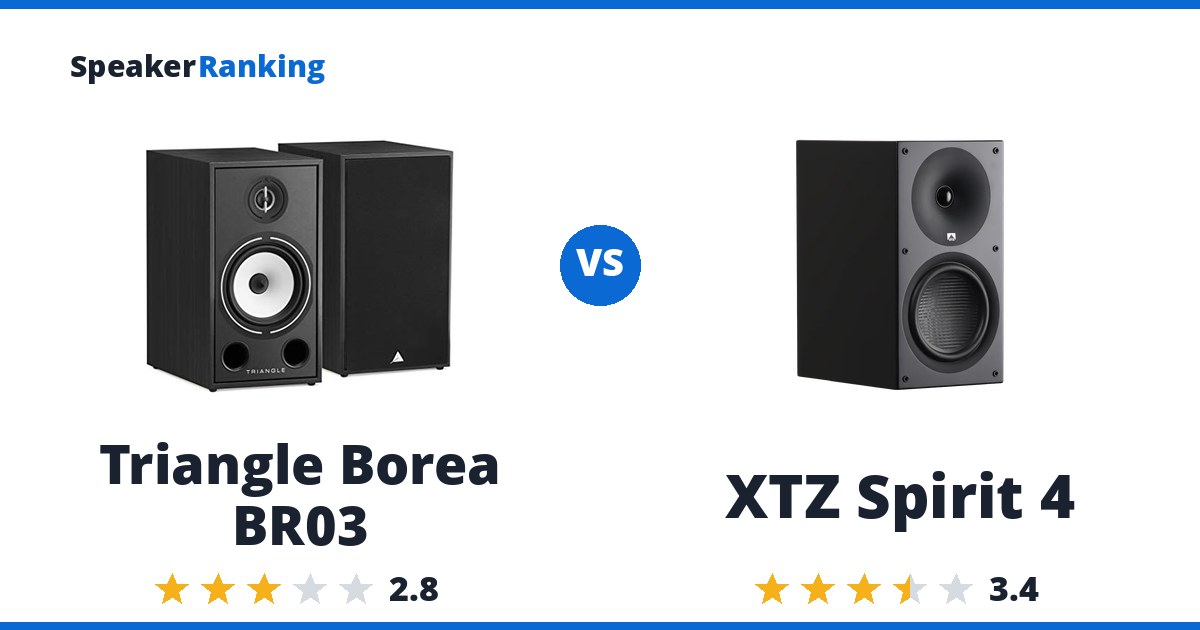
What the Triangle Borea BR03 offers: Bass output is genuinely decent for the price - measured extension reaches F3 57Hz/F10 42Hz, which the reviewer had no real complaints about. Dual front-firing ports and a well-stuffed, well-braced cabinet. Solid build quality overall. Watch for: A noticeable mid-range suckout, most pronounced in the upper mid-range/lower treble, that the reviewer attributes to cabinet resonances and driver breakup rather than a deliberate voicing choice - it makes vocals and instruments sound recessed and thin rather than warm. Sibilance in the 4-8kHz region shows up on every track the reviewer tried. Measured minimum impedance dips to about 4.2 ohms (with an even lower EPDR), despite the speaker and its own rear panel being labeled 8 ohms - worth knowing if you’re planning to drive these with a receiver/AVR that assumes an 8-ohm nominal load. The reviewer is upfront that this speaker has a devoted following among other reviewers, but says he specifically doesn’t hear what they hear and wants people who own it to trust their own ears rather than assume something’s wrong with their hearing if they don’t love it either.
What the XTZ Spirit 4 offers: Substantial 6.5-inch stand-mount with a waveguided dome tweeter, adjustable treble level and port tuning. Spinorama predicts 44Hz in-room extension, broad roughly +/-60-degree horizontal coverage and a 5.39 preference score with a subwoofer. Watch for: The third-party measurement is low confidence. On-axis smoothness is only 0.248, directivity-index consistency is middling at 3.21, and the mildly downward -0.29dB/octave tonal slope contributes to a modest 3.27 raw preference score.
Buy the Triangle Borea BR03 if the price is the priority over sound quality, or the XTZ Spirit 4 if sound quality is the priority over the price.
If sound quality matters at all to you, skip the Triangle Borea BR03. It ranks near the bottom of the 130 bookshelf speakers, so look higher up the list instead.
Looking for alternatives? See the complete Passive Home rankings.
Specifications Side By Side
| Triangle Borea BR03 | XTZ Spirit 4 | |
|---|---|---|
| Price | $399.00 per pair | $477 per pair |
| Ranked | #109 of 130 in Large Size Bookshelf Speakers | #92 of 130 in Large Size Bookshelf Speakers |
| Drivers | 6.5" natural cellulose midwoofer, 1" (25mm) EFS silk dome tweeter | 1" dome tweeter, 6.5" woofer |
| Crossover Frequency | 3600Hz | - |
| Dimensions | 14.96"H x 8.11"W x 12.36"D | 13.8H x 7.5W x 10.6D in |
| Weight | 13.2 lbs (6 kg) each | 17.9 lbs (8.1 kg) each |
| Impedance | 8 ohms nominal (manufacturer spec), 4.2 ohms minimum (measured, Erin's Audio Corner) | 4 ohms |
| Sensitivity | 87.5dB (measured at 2.83V/1m, Erin's Audio Corner) | 86dB |
| Bass Extension (-3dB) | 57Hz (measured, Erin's Audio Corner) | - |
| Bass Extension (-10dB) | 42Hz (measured, Erin's Audio Corner) | - |
| Recommended Power | 100W | - |
| Woofer Cabinet | ported, dual front ports | - |
| Spinorama Preference Score | 3.12 | 3.27 |
| Spinorama Preference Score with Perfect Sub | 5.47 | 5.39 |
| Enclosure | - | 2-way passive, rear-ported |
Related Speaker Comparisons
More top alternatives to XTZ Spirit 4:
- XTZ Spirit 4 vs Perlisten S4b
- XTZ Spirit 4 vs KEF Reference 1 Meta
- XTZ Spirit 4 vs GR-Research NX-Studio
- AsciLab C6B vs XTZ Spirit 4
- Audio First Cadentia 3 vs XTZ Spirit 4
Prices on this page were last checked September 16, 2026 at 12:41 AM UTC. Product prices and availability are accurate as of that date/time and are subject to change; the price and availability shown on Amazon at the time of purchase will apply to the purchase of this product.
As an eBay Partner, we may be compensated if you make a purchase.
The Two Speakers In Full
 Triangle Borea BR03: $399.00 per pair Amazon eBay
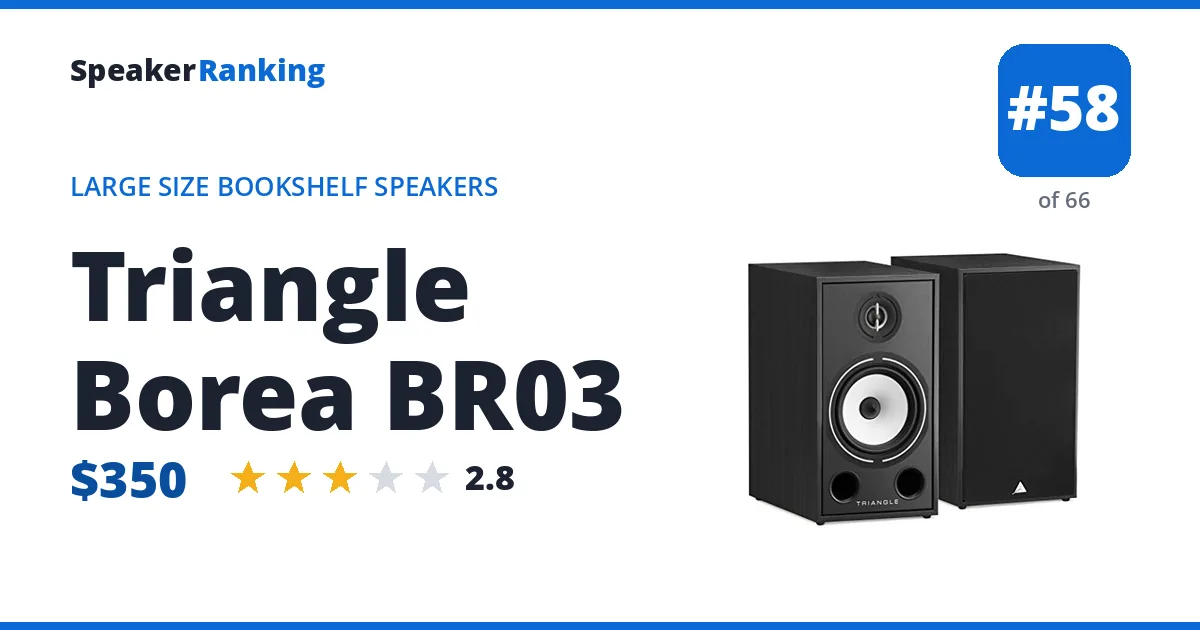
Pros: Bass output is genuinely decent for the price - measured extension reaches F3 57Hz/F10 42Hz, which the reviewer had no real complaints about. Dual front-firing ports and a well-stuffed, well-braced cabinet. Solid build quality overall. Measured bass extension of 57Hz (-3dB), with a measured sensitivity of 87.5dB.
Cons: A noticeable mid-range suckout, most pronounced in the upper mid-range/lower treble, that the reviewer attributes to cabinet resonances and driver breakup rather than a deliberate voicing choice - it makes vocals and instruments sound recessed and thin rather than warm. Sibilance in the 4-8kHz region shows up on every track the reviewer tried. Measured minimum impedance dips to about 4.2 ohms (with an even lower EPDR), despite the speaker and its own rear panel being labeled 8 ohms - worth knowing if you’re planning to drive these with a receiver/AVR that assumes an 8-ohm nominal load. The reviewer is upfront that this speaker has a devoted following among other reviewers, but says he specifically doesn’t hear what they hear and wants people who own it to trust their own ears rather than assume something’s wrong with their hearing if they don’t love it either.
Full Triangle Borea BR03 review and specifications →
| Bass Extension (-10dB) | 42Hz (measured, Erin's Audio Corner) |
|---|---|
| Bass Extension (-3dB) | 57Hz (measured, Erin's Audio Corner) |
| Crossover Frequency | 3600Hz |
| Dimensions | 14.96"H x 8.11"W x 12.36"D |
| Drivers | 6.5" natural cellulose midwoofer, 1" (25mm) EFS silk dome tweeter |
| Impedance | 8 ohms nominal (manufacturer spec), 4.2 ohms minimum (measured, Erin's Audio Corner) |
| Recommended Power | 100W |
| Sensitivity | 87.5dB (measured at 2.83V/1m, Erin's Audio Corner) |
| Spinorama Preference Score | 3.12 |
| Spinorama Preference Score with Perfect Sub | 5.47 |
| Weight | 13.2 lbs (6 kg) each |
| Woofer Cabinet | ported, dual front ports |
- Links
- Reviews, Comparisons and Sound Samples
- Head-to-Head Comparisons
- Triangle Borea BR03 vs B&W 805S
- Triangle Borea BR03 vs Wharfedale Diamond 9.1
- Triangle Borea BR03 vs Klipsch RP-600M
- Triangle Borea BR03 vs Sonus Faber Lumina II Amator
- Triangle Borea BR03 vs Aperion Audio Verus V8B
- Triangle Borea BR03 vs KEF Q350
- Triangle Borea BR03 vs Sonus Faber Sonetto II G2
- Triangle Borea BR03 vs Emotiva Airmotiv B2+
- See all 51 comparisons
 XTZ Spirit 4: $477 per pair XTZ eBay
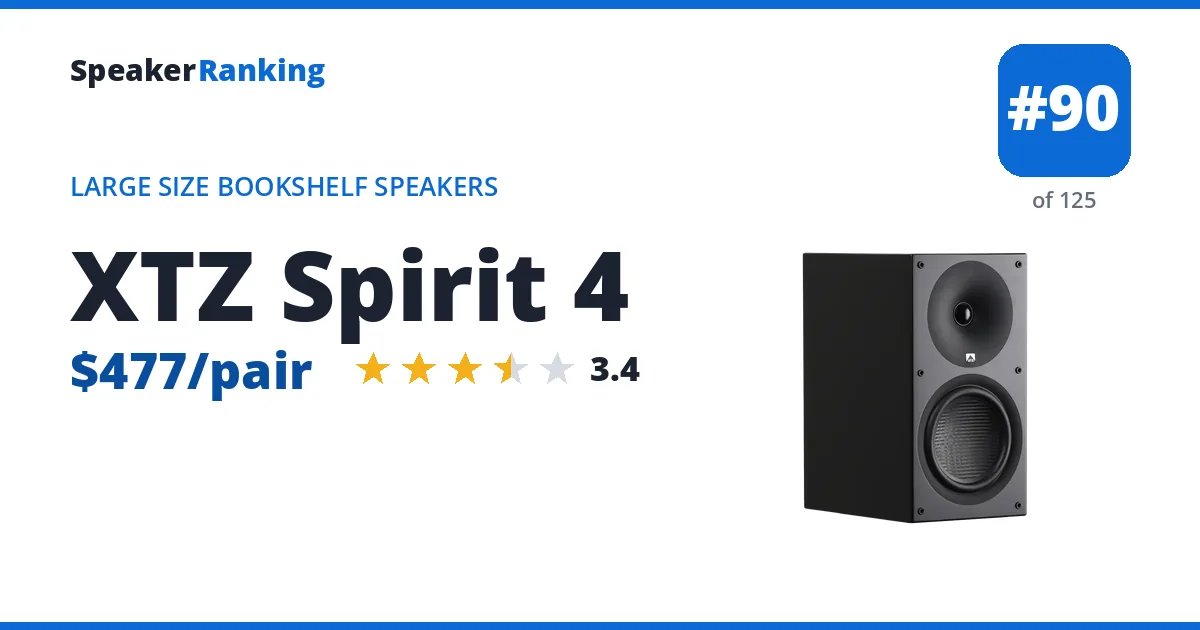
Pros: Substantial 6.5-inch stand-mount with a waveguided dome tweeter, adjustable treble level and port tuning. Spinorama predicts 44Hz in-room extension, broad roughly +/-60-degree horizontal coverage and a 5.39 preference score with a subwoofer.
Cons: The third-party measurement is low confidence. On-axis smoothness is only 0.248, directivity-index consistency is middling at 3.21, and the mildly downward -0.29dB/octave tonal slope contributes to a modest 3.27 raw preference score.
Full XTZ Spirit 4 review and specifications →
| Dimensions | 13.8H x 7.5W x 10.6D in |
|---|---|
| Drivers | 1" dome tweeter, 6.5" woofer |
| Enclosure | 2-way passive, rear-ported |
| Impedance | 4 ohms |
| Sensitivity | 86dB |
| Spinorama Preference Score | 3.27 |
| Spinorama Preference Score with Perfect Sub | 5.39 |
| Weight | 17.9 lbs (8.1 kg) each |
- Links
- Reviews, Comparisons and Sound Samples
- Head-to-Head Comparisons
- XTZ Spirit 4 vs Sonus Faber Lumina II
- XTZ Spirit 4 vs KEF Q3 Meta
- XTZ Spirit 4 vs SVS Prime Bookshelf
- XTZ Spirit 4 vs ELAC Debut 2.0 B6.2
- XTZ Spirit 4 vs Polk R200
- XTZ Spirit 4 vs Dynaudio Special Forty
- XTZ Spirit 4 vs GR-Research X-LS Encore
- XTZ Spirit 4 vs Sonus Faber Sonetto II G2
- See all 44 comparisons