Short answer: the Cambridge Audio L/R S. It ranks #4 of 24 powered bookshelf speakers by sound quality, rated 4.4/5, at $549; the Sovox MiniMax3 ranks #9, rated 3.7/5, and costs $650, so there is not much of a tradeoff to weigh.
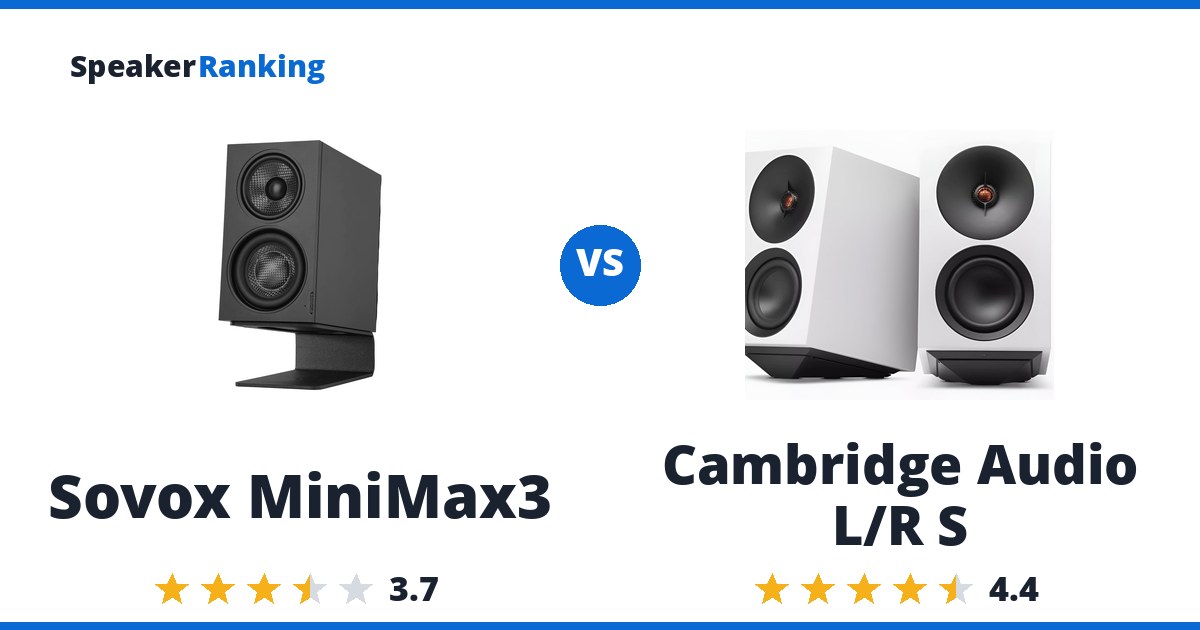
What the Sovox MiniMax3 does well: A coaxial midrange and tweeter give a wide, even sweet spot, and a listening-window smoothness of 0.78 lifts it to a 6.48 preference score with an ideal subwoofer, so tonal balance holds as you shift around a desk. The tradeoff: Output tops out around 86dB, with heavy compression and very high distortion as it gets there, so it only suits nearfield listening at modest volume.
What the Cambridge Audio L/R S does well: A 2-way active bookshelf pair built for near-field desktop use, with a 21mm aluminum tweeter and a 3-inch long-throw woofer on each speaker. The tradeoff: Maximum clean output is limited: Erin’s Audio Corner measured about 86dB before the onboard limiter engages around 96dB to protect the drivers, so this is a near-field or small-room speaker rather than one built to fill a living room.
Buy the Cambridge Audio L/R S. It is rated higher for sound quality than the Sovox MiniMax3 and costs less, which settles it without a real tradeoff to make.
Want more options? Browse the full Powered Home rankings.
Specifications Side By Side
| Sovox MiniMax3 | Cambridge Audio L/R S | |
|---|---|---|
| Price | $650 per pair | $549.00 per pair |
| Ranked | #9 of 24 in Small Size Powered Bookshelf Speakers | #4 of 24 in Small Size Powered Bookshelf Speakers |
| Bass Extension (-3dB) | 66Hz (measured, Erin's Audio Corner) | 57Hz (measured, Erin's Audio Corner) |
| Bass Extension (-10dB) | 55Hz (measured, Erin's Audio Corner) | 50Hz (measured, Erin's Audio Corner) |
| Dimensions | 7.7"H x 4.3"W x 7.9"D (195 x 110 x 200 mm) | 5.3" (134 mm) W x 226mm H x 180mm D (each) |
| Weight | 9 lbs (4.1 kg) each | 6.6 lbs (3.0kg) primary speaker, 5.7 lbs (2.6kg) secondary speaker |
| Drivers | 3 in. carbon fiber coaxial midrange with 1 in. silk dome tweeter, 3.5 in. carbon fiber woofer, 5 in. passive radiator | 21mm aluminum dome tweeter, 3" long-throw woofer |
| Inputs | XLR, RCA | RCA, optical digital, USB-C |
| Bluetooth | No | Yes |
| DSP | Yes | Yes, room size, wall distance, and reflective surface correction; desktop-placement and near-wall/free-space switches |
| EQ | Yes (Free, Desk, Wall and Desk & Wall presets; treble and bass trims) | - |
| Amplifier Power | 68.6W total (44.3W LF + 17.95W MF + 6.32W HF Class D) | 100W total (50W to woofer, 50W to tweeter, per speaker) |
| Maximum SPL | 97dB @ 1m short term (manufacturer specified) | - |
| Frequency Response | 49Hz - 20kHz (±3dB) (Manufacturer specified) | 55Hz - 24kHz (±3dB, manufacturer specified) |
| Spinorama Preference Score | 3.84 | - |
| Spinorama Preference Score with Perfect Sub | 6.48 | - |
| Subwoofer Output | No | Yes |
| XLR Input | Yes | No |
| RCA Input | Yes | Yes |
| TRS Input | No | No |
| Optical Input | No | Yes |
| Coaxial Input | No | No |
| USB Input | No | Yes |
| HDMI Input | No | No |
| AES Input | No | No |
| Aux Input | No | No |
| Bluetooth Codecs | - | SBC, AAC, aptX, aptX HD |
| App | - | Yes |
| Outputs | - | Subwoofer, wired speaker-to-speaker link |
Related Speaker Comparisons
How Cambridge Audio L/R S compares with other leading options:
- Cambridge Audio L/R S vs Audio Smile Little British Monitor
- Genelec 8010A vs Cambridge Audio L/R S
- Adam Audio D3v vs Cambridge Audio L/R S
- IK Multimedia iLoud Micro Monitor vs Cambridge Audio L/R S
- Edifier M60 vs Cambridge Audio L/R S
Prices on this page were last checked September 23, 2026 at 11:24 PM UTC. Product prices and availability are accurate as of that date/time and are subject to change; the price and availability shown on Amazon at the time of purchase will apply to the purchase of this product.
As an eBay Partner, we may be compensated if you make a purchase.
The Two Speakers In Full
 Sovox MiniMax3: $650 per pair Sovox eBay
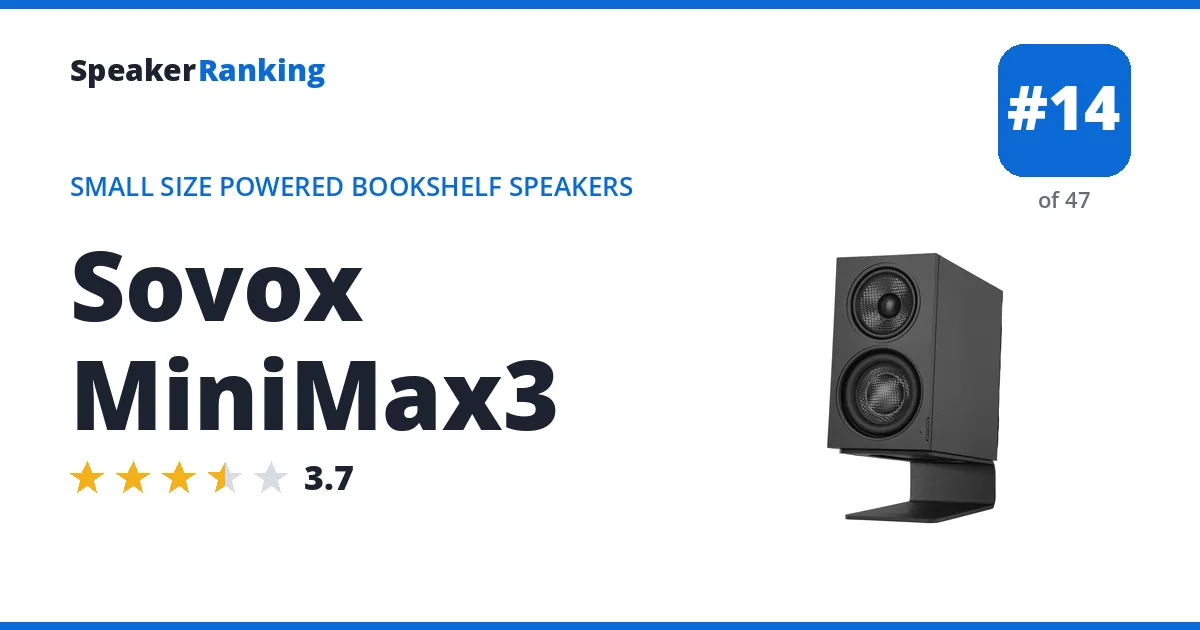
Pros: A coaxial midrange and tweeter give a wide, even sweet spot, and a listening-window smoothness of 0.78 lifts it to a 6.48 preference score with an ideal subwoofer, so tonal balance holds as you shift around a desk. The 3.5-inch woofer and 5-inch passive radiator reach 66Hz at -3dB and about 53Hz at -12dB, deeper than most speakers this small. The unibody aluminum enclosure is solid and only 195mm tall, and Free, Desk, Wall and Desk & Wall presets plus treble and bass trims adapt it to its placement. Measured bass extension of 66Hz (-3dB).
Cons: Output tops out around 86dB, with heavy compression and very high distortion as it gets there, so it only suits nearfield listening at modest volume. Treble rises on axis (+0.35dB per octave), which holds its standalone preference score to 3.84; toeing it about 10 degrees away from your ears smooths the top end. Bass falls away quickly below 60Hz and there is no subwoofer output, and inputs are limited to balanced XLR and RCA.
Full Sovox MiniMax3 review and specifications →
| AES Input | No |
|---|---|
| Amplifier Power | 68.6W total (44.3W LF + 17.95W MF + 6.32W HF Class D) |
| Aux Input | No |
| Bass Extension (-10dB) | 55Hz (measured, Erin's Audio Corner) |
| Bass Extension (-3dB) | 66Hz (measured, Erin's Audio Corner) |
| Bluetooth | No |
| Coaxial Input | No |
| DSP | Yes |
| Dimensions | 7.7"H x 4.3"W x 7.9"D (195 x 110 x 200 mm) |
| Drivers | 3 in. carbon fiber coaxial midrange with 1 in. silk dome tweeter, 3.5 in. carbon fiber woofer, 5 in. passive radiator |
| EQ | Yes (Free, Desk, Wall and Desk & Wall presets; treble and bass trims) |
| Frequency Response | 49Hz - 20kHz (±3dB) (Manufacturer specified) |
| HDMI Input | No |
| Inputs | XLR, RCA |
| Maximum SPL | 97dB @ 1m short term (manufacturer specified) |
| Optical Input | No |
| RCA Input | Yes |
| Spinorama Preference Score | 3.84 |
| Spinorama Preference Score with Perfect Sub | 6.48 |
| Subwoofer Output | No |
| TRS Input | No |
| USB Input | No |
| Weight | 9 lbs (4.1 kg) each |
| XLR Input | Yes |
- Links
- Reviews, Comparisons and Sound Samples
- Head-to-Head Comparisons
 Cambridge Audio L/R S: $549.00 per pair Amazon eBay
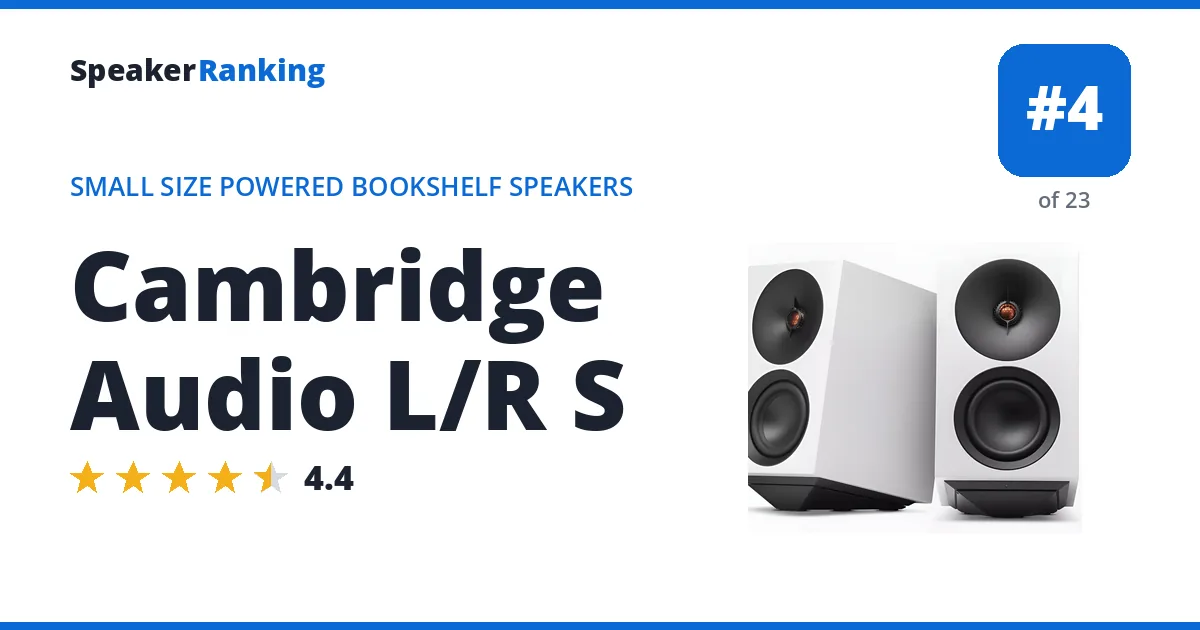
Pros: A 2-way active bookshelf pair built for near-field desktop use, with a 21mm aluminum tweeter and a 3-inch long-throw woofer on each speaker. Erin’s Audio Corner measured a very neutral on-axis response with good directivity control up through the 2-3kHz handoff to the tweeter, an F3 of about 57Hz and F10 of about 50Hz, and output held within roughly plus or minus 2.5dB from 80Hz to 20kHz. Horizontal dispersion of about plus or minus 60 degrees and a vertical window of about plus 30 to minus 20 degrees make it forgiving of off-center desktop seating. Two rear switches (a desktop-placement compensation switch and a near-wall/free-space switch) plus in-app DSP for room size, wall distance, and reflective surface type let you tune the in-room response rather than just hoping placement works out, and the reviewer noted an audible tightening of the bass moving between room-size settings. Rear connectivity includes RCA, optical digital, USB-C, and a dedicated subwoofer output. Measured bass extension of 57Hz (-3dB).
Cons: Maximum clean output is limited: Erin’s Audio Corner measured about 86dB before the onboard limiter engages around 96dB to protect the drivers, so this is a near-field or small-room speaker rather than one built to fill a living room. Each speaker’s Class D amplifier splits only 50W to the woofer and 50W to the tweeter, modest for the class. The DSP room-correction options are preset-based rather than a true microphone-measured calibration at the listening position, so results depend on picking settings that match your actual room.
Full Cambridge Audio L/R S review and specifications →
| AES Input | No |
|---|---|
| Amplifier Power | 100W total (50W to woofer, 50W to tweeter, per speaker) |
| App | Yes |
| Aux Input | No |
| Bass Extension (-10dB) | 50Hz (measured, Erin's Audio Corner) |
| Bass Extension (-3dB) | 57Hz (measured, Erin's Audio Corner) |
| Bluetooth | Yes |
| Bluetooth Codecs | SBC, AAC, aptX, aptX HD |
| Coaxial Input | No |
| DSP | Yes, room size, wall distance, and reflective surface correction; desktop-placement and near-wall/free-space switches |
| Dimensions | 5.3" (134 mm) W x 226mm H x 180mm D (each) |
| Drivers | 21mm aluminum dome tweeter, 3" long-throw woofer |
| Frequency Response | 55Hz - 24kHz (±3dB, manufacturer specified) |
| HDMI Input | No |
| Inputs | RCA, optical digital, USB-C |
| Optical Input | Yes |
| Outputs | Subwoofer, wired speaker-to-speaker link |
| RCA Input | Yes |
| Subwoofer Output | Yes |
| TRS Input | No |
| USB Input | Yes |
| Weight | 6.6 lbs (3.0kg) primary speaker, 5.7 lbs (2.6kg) secondary speaker |
| XLR Input | No |
- Links
- Reviews, Comparisons and Sound Samples
- Head-to-Head Comparisons
- Cambridge Audio L/R S vs Adam Audio D3v
- Cambridge Audio L/R S vs IK Multimedia iLoud Micro Monitor
- Cambridge Audio L/R S vs Edifier M60
- Cambridge Audio L/R S vs Genelec 8010A
- Cambridge Audio L/R S vs HiVi Swan X3
- Cambridge Audio L/R S vs Audio Smile Little British Monitor
- Cambridge Audio L/R S vs Edifier MR3
- Cambridge Audio L/R S vs Bowers & Wilkins Formation Flex
- See all 16 comparisons