Short answer: the Monitor Audio Silver 50 8G, if you are buying new. The Monitor Audio Silver 50 7G ranks higher than the Sony SS-CS5 M2 (#16 vs #87 of 160 bookshelf speakers) but is discontinued; its replacement, the Monitor Audio Silver 50 8G, is rated 4.2/5 at $1,250 and is still sold new.
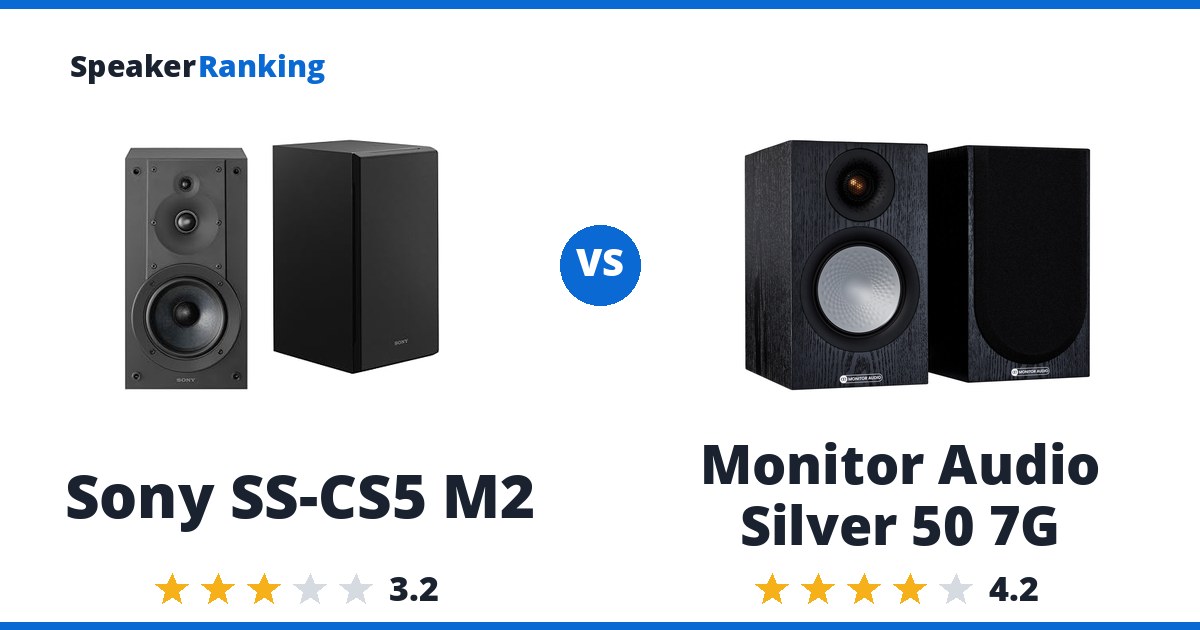
The case for the Sony SS-CS5 M2: Added internal bracing (corners, sides, front baffle) plus an updated crossover meaningfully reduce the resonance issues that plagued the original Sony SS-CS5, giving a smoother, more neutral character overall. The catch: Mild sibilance in the 3-5kHz range stands out on S and T sounds in vocals.
The Monitor Audio Silver 50 7G is the better-sounding choice. The 7th generation C-CAM Gold Dome tweeter with UD Waveguide II and RST II mid bass driver produce a listening window smoothness score of 0.50 at an accessible price, earning a Hi-Fi News Outstanding Product Award. The tradeoff: The on axis response trends noticeably upward toward the treble (rising about 0.5dB per octave, a steep tilt), which can read as bright on already bright recordings.
Buy the Monitor Audio Silver 50 8G, the replacement for the discontinued Monitor Audio Silver 50 7G; it is rated higher for sound quality than the Sony SS-CS5 M2.
Looking for alternatives? See the complete Passive Home rankings.
Specifications Side By Side
| Sony SS-CS5 M2 | Monitor Audio Silver 50 7G | |
|---|---|---|
| Price | $153.00 per pair | $799 per pair Discontinued |
| Ranked | #87 of 160 in Medium Size Bookshelf Speakers | #16 of 160 in Medium Size Bookshelf Speakers |
| Bass Extension (-10dB) | 54Hz (measured, Erin’s Audio Corner) | 50.7Hz (measured, Erin’s Audio Corner) |
| Bass Extension (-3dB) | 80Hz (measured, Erin’s Audio Corner) | 87.9Hz (measured, Erin’s Audio Corner) |
| Dimensions | 13.2”H x 7”W x 8.7”D (335 x 178 x 220 mm) | 11.1”H x 6.5”W x 10.7”D (282 x 165 x 272 mm) |
| Impedance | 6 ohms | 8 ohms nominal, 3.9 ohms minimum |
| Sensitivity | 82.5dB | 86dB @ 2.83V/1m |
| Drivers | 5.12” woofer, 0.98 in tweeter; 0.75-inch supertweeter; 0.75-inch supertweeter; 0.75-inch supertweeter; 0.75-inch supertweeter | 1” C-CAM Gold Dome tweeter, 5.25” C-CAM RST II mid bass driver |
| Weight | 9.5 lbs (4.3 kg) each | 12.3 lbs (5.6 kg) each |
| Woofer Cabinet | ported, rear | - |
| DIY Kit | No | No |
| Enclosure | - | ported |
| Crossover Frequency | - | 2.6kHz |
| Port Tuning | - | 58Hz |
| Power Handling | - | 100W RMS handling, 40-100W recommended amplifier power |
| Warranty | - | Lifetime, parts and labor |
| Country | - | China |
| Maximum SPL | - | 104dB (manufacturer specified) |
| Spinorama Preference Score | - | 5.40 |
| Spinorama Preference Score with Perfect Sub | - | 8.01 |
Related Speaker Comparisons
More worthwhile head-to-heads for Monitor Audio Silver 50 7G:
- Monitor Audio Silver 50 7G vs Audio First Fidelia
- Monitor Audio Silver 50 7G vs Philharmonic Ceramic Mini
- Ascend Sierra 1 v2 vs Monitor Audio Silver 50 7G
- KEF LS50 Meta vs Monitor Audio Silver 50 7G
- XMechanik Mechano23 DIY vs Monitor Audio Silver 50 7G
Prices on this page were last checked October 9, 2026 at 8:01 AM UTC. Product prices and availability are accurate as of that date/time and are subject to change; the price and availability shown on Amazon at the time of purchase will apply to the purchase of this product.
As an eBay Partner, we may be compensated if you make a purchase.
The Two Speakers In Full
 Sony SS-CS5 M2: $153.00 per pair Amazon eBay
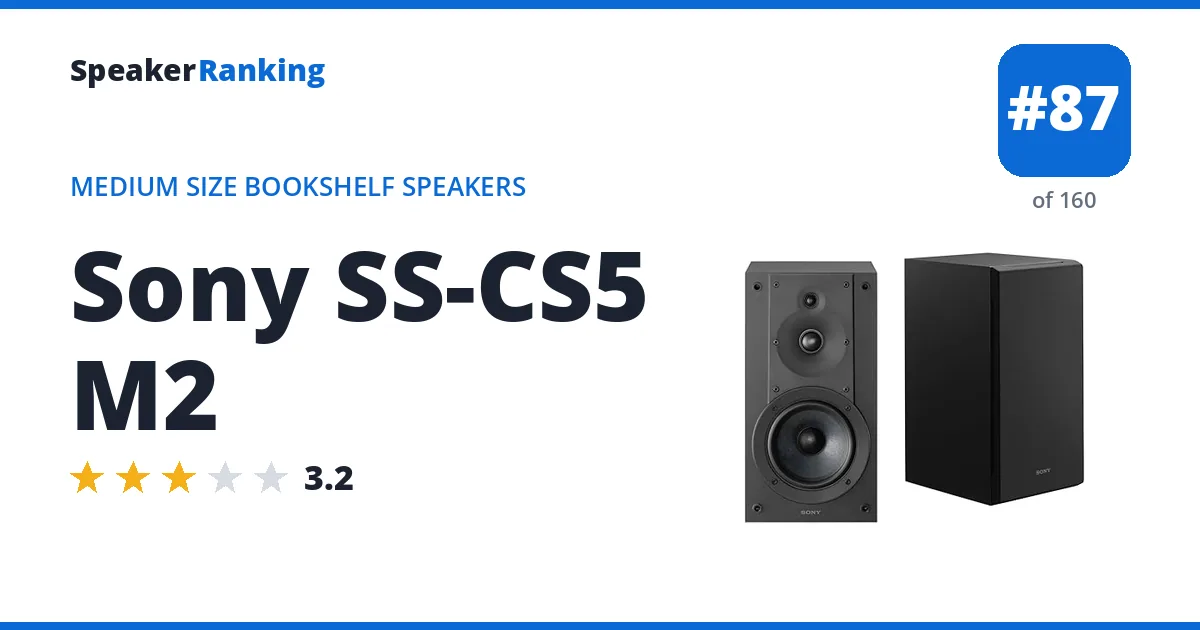
Older model: the Sony SS-CS5 (ranked higher, rated 3.5/5).
Same family: the Sony SS-CS3 M2 (floorstanding, estimated 3/5) and the Sony SS-CS8 M2 (center, estimated 2.8/5).
Pros: Added internal bracing (corners, sides, front baffle) plus an updated crossover meaningfully reduce the resonance issues that plagued the original Sony SS-CS5, giving a smoother, more neutral character overall. A modest mid-range dip (about 1-2dB) is present but tolerable, and the reviewer would rather have this dip than a peak in that region. Slightly deeper bass than the previous version, measuring about 2dB more output around 60Hz. Distortion drops noticeably when crossed to a subwoofer around 80-120Hz, meaningfully improving midrange clarity and detail versus running full-range. Easy to drive on a standard AVR: no need for a dedicated high-power amplifier. More modern, understated waveguide look compared to the previous version’s glossy trim. Measured bass extension of 80Hz (-3dB).
Cons: Mild sibilance in the 3-5kHz range stands out on S and T sounds in vocals. Some forwardness in the midrange noticeable on certain vocal recordings. Soundstage and sense of envelopment are comparatively flat and two-dimensional, especially next to reference-quality speakers with strong 3D imaging. Marketed as a “three-way” design mainly due to an added super-tweeter that the reviewer considers largely superfluous: it engages only at very high frequencies and adds complexity without a clearly audible benefit, when that cost might have been better spent on the main crossover. Output-limited: realistic ceiling is around the mid-90s dB SPL at a few meters, with comfortable listening closer to 75-85dB at 3-4 meters before distortion and compression become audible. Bass noticeably compresses/shelves below about 120Hz as volume increases, softening kick-drum impact at higher output. Smaller drivers and a lighter motor structure than rivals like the Polk Monitor XT20, which the reviewer generally prefers for its better directivity and higher SPL capability. Still needs a subwoofer for any real bass extension.
Full Sony SS-CS5 M2 review and specifications →
| Bass Extension (-10dB) | 54Hz (measured, Erin’s Audio Corner) |
|---|---|
| Bass Extension (-3dB) | 80Hz (measured, Erin’s Audio Corner) |
| DIY Kit | No |
| Dimensions | 13.2”H x 7”W x 8.7”D (335 x 178 x 220 mm) |
| Drivers | 5.12” woofer, 0.98 in tweeter; 0.75-inch supertweeter; 0.75-inch supertweeter; 0.75-inch supertweeter; 0.75-inch supertweeter |
| Impedance | 6 ohms |
| Sensitivity | 82.5dB |
| Weight | 9.5 lbs (4.3 kg) each |
| Woofer Cabinet | ported, rear |
- Links
- Reviews, Comparisons and Sound Samples
- Head-to-Head Comparisons
- Sony SS-CS5 M2 vs ELAC Debut 2.0 B5.2
- Sony SS-CS5 M2 vs Paradigm Monitor SE Atom
- Sony SS-CS5 M2 vs JBL Stage 250B
- Sony SS-CS5 M2 vs Monoprice Monolith THX Compact Satellite
- Sony SS-CS5 M2 vs JBL Studio 530
- Sony SS-CS5 M2 vs Totem Kin One
- Sony SS-CS5 M2 vs Dynaudio Emit M10
- Sony SS-CS5 M2 vs ELAC BS U5
- See all 45 comparisons
 Monitor Audio Silver 50 7G: $799 per pair Discontinued Crutchfield eBay
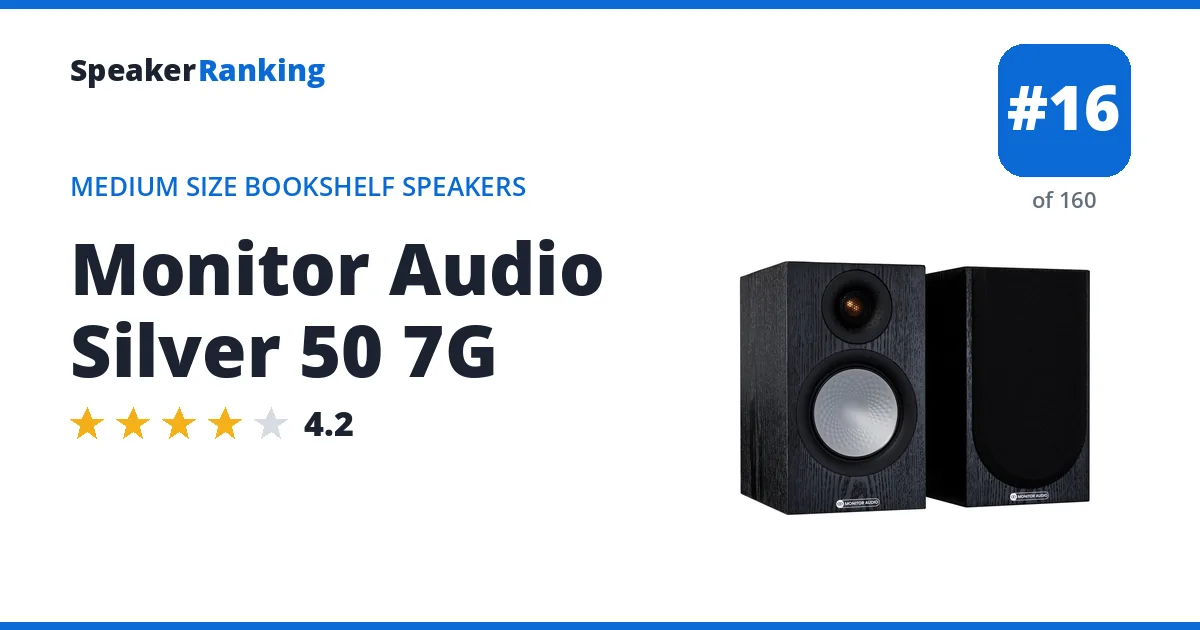
Newer model: the Monitor Audio Silver 50 8G, estimated 4.2/5.
Same family: the Monitor Audio Silver 100 7G (larger bookshelf, estimated 4.3/5), the Monitor Audio Silver 200 7G (smallest floorstanding, estimated 4.3/5), the Monitor Audio Silver 300 7G (floorstanding, estimated 4.4/5), the Monitor Audio Silver 500 7G (largest floorstanding, estimated 4.5/5) and the Monitor Audio Silver C250 7G (center, estimated 4.1/5).
Pros: The 7th generation C-CAM Gold Dome tweeter with UD Waveguide II and RST II mid bass driver produce a listening window smoothness score of 0.50 at an accessible price, earning a Hi-Fi News Outstanding Product Award. A HiVe II reflex port system is tuned to 58Hz for real bass weight from a compact 5.25 inch two way. Measured bass extension of 87.9Hz (-3dB).
Cons: The on axis response trends noticeably upward toward the treble (rising about 0.5dB per octave, a steep tilt), which can read as bright on already bright recordings. Off axis sound also tracks the on axis response less consistently than most speakers here. Bass extension is limited to a measured 87.9Hz at -3dB, so a subwoofer is recommended for full range use, and minimum impedance dips to 3.9 ohms at 250Hz. Discontinued.
Full Monitor Audio Silver 50 7G review and specifications →
| Bass Extension (-10dB) | 50.7Hz (measured, Erin’s Audio Corner) |
|---|---|
| Bass Extension (-3dB) | 87.9Hz (measured, Erin’s Audio Corner) |
| Country | China |
| Crossover Frequency | 2.6kHz |
| DIY Kit | No |
| Dimensions | 11.1”H x 6.5”W x 10.7”D (282 x 165 x 272 mm) |
| Drivers | 1” C-CAM Gold Dome tweeter, 5.25” C-CAM RST II mid bass driver |
| Enclosure | ported |
| Impedance | 8 ohms nominal, 3.9 ohms minimum |
| Maximum SPL | 104dB (manufacturer specified) |
| Port Tuning | 58Hz |
| Power Handling | 100W RMS handling, 40-100W recommended amplifier power |
| Sensitivity | 86dB @ 2.83V/1m |
| Spinorama Preference Score | 5.40 |
| Spinorama Preference Score with Perfect Sub | 8.01 |
| Warranty | Lifetime, parts and labor |
| Weight | 12.3 lbs (5.6 kg) each |
- Links
- Reviews, Comparisons and Sound Samples
- Head-to-Head Comparisons
- Monitor Audio Silver 50 7G vs Revel M105
- Monitor Audio Silver 50 7G vs Elac Carina BS243.4
- Monitor Audio Silver 50 7G vs Aalto Speakers Aalto 1 EVO
- Monitor Audio Silver 50 7G vs Ascend Acoustics Luna V2 Mini-Monitor Titan
- Monitor Audio Silver 50 7G vs Arendal 1961 Monitor
- Monitor Audio Silver 50 7G vs Ascend Acoustics HTM-200SE2
- Monitor Audio Silver 50 7G vs XMechanik Mechano23 DIY
- Monitor Audio Silver 50 7G vs Klipsch RP-500M II
- See all 27 comparisons