Short answer: the Revel C426Be. It ranks #24 of 98 center channel speakers by sound quality, rated 4.0/5, at $5,444.95. The Vandersteen VCC-5 ranks #68, rated 3.4/5, at $3,300, $2,144.95 cheaper, not enough of a saving to outweigh the sound-quality gap.
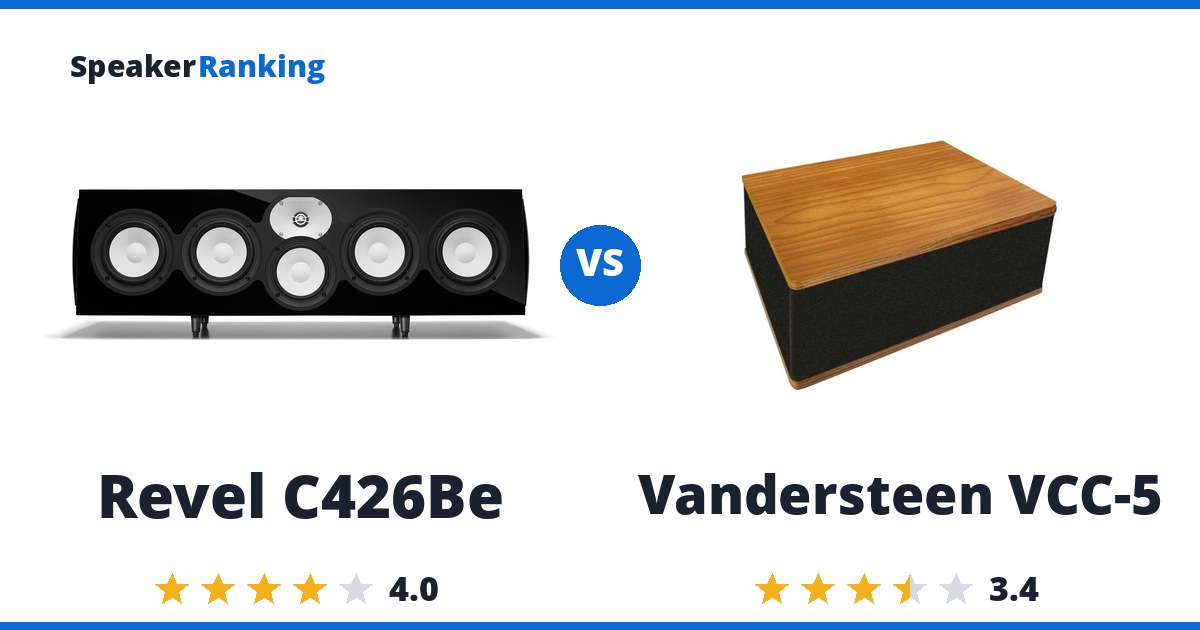
The Revel C426Be is the more accurate choice. A three-way center with a 1” beryllium tweeter in Revel’s acoustic lens waveguide, a 5.25” midrange and four 6.5” woofers. Its measured preference score, a predictor of how neutral it sounds, is 5.27 against 3.85 for the Vandersteen VCC-5. The catch: The listening window is less even than the best centers here, spanning 3.1dB from 300Hz to 5kHz, and the directivity index varies more across frequency (3.8dB deviation).
The Vandersteen VCC-5 is the deeper-bass choice. A triaxial design: a 1” alloy dome tweeter mounted coaxially in a 6.5” midrange, with two 6.5” woofers inside the cabinet and first-order crossovers. Its bass reaches about 52.7Hz before falling 3dB, against 66.7Hz for the Revel C426Be. The tradeoff: On-axis response is uneven (0.96dB average deviation) and the listening window spans 4.5dB from 300Hz to 5kHz.
Buy the Revel C426Be. It is rated higher for sound quality, and the $2,144.95 you would save on the Vandersteen VCC-5 does not close the gap.
Want more options? Browse the full Passive Home rankings.
Specifications Side By Side
| Revel C426Be | Vandersteen VCC-5 | |
|---|---|---|
| Price | $5,444.95 each | $3,300 each |
| Ranked | #24 of 98 in Center Channel Speakers | #68 of 98 in Center Channel Speakers |
| Drivers | 1” beryllium dome tweeter with acoustic lens, 5.25” DCC aluminum midrange, 4x 6.5” DCC aluminum woofers | 1” alloy dome tweeter coaxial with 6.5” mineral-filled polycone midrange, 2x 6.5” mineral-filled polycone woofers |
| Frequency Response | 38Hz-40kHz -6dB (manufacturer specified) | 50Hz-30kHz ±2dB (manufacturer specified) |
| Sensitivity | 90dB (2.83V/1m, manufacturer specified) | 85dB (2.83V/1m, manufacturer specified) |
| Impedance | 8 ohms nominal (manufacturer specified) | 6 ohms nominal, 4 ohms minimum (manufacturer specified) |
| Woofer Cabinet | ported (dual rear ports) | - |
| Dimensions | 10.6”H x 38.5”W x 14”D (268 x 977 x 356 mm) | 9.8”H x 24”W x 18”D (248 x 610 x 457 mm) |
| Weight | 71 lbs (32.2 kg) | 67.9 lbs (30.8 kg) |
| Bass Extension (-3dB) | 66.7Hz (measured, Erin’s Audio Corner) | 52.7Hz (measured, Audio Science Review) |
| Bass Extension (-10dB) | about 35.2Hz (measured, Erin’s Audio Corner) | about 41.0Hz (measured, Audio Science Review) |
| Spinorama Preference Score | 5.27 | 3.85 |
| Spinorama Preference Score with Perfect Sub | 6.96 | 6.05 |
| DIY Kit | No | No |
Related Speaker Comparisons
More top alternatives to Revel C426Be:
- KEF Reference 2 Meta vs Revel C426Be
- Revel C426Be vs Paradigm Founder 90C
- SVS Ultra Evolution Center vs KEF Q6 Meta
- KEF Q6 Meta vs SVS Prime Center
- Q Acoustics 5090 vs Q Acoustics 3090c
Prices on this page were last checked October 5, 2026 at 10:21 PM UTC. Product prices and availability are accurate as of that date/time and are subject to change; the price and availability shown on Amazon at the time of purchase will apply to the purchase of this product.
As an eBay Partner, we may be compensated if you make a purchase.
The Two Speakers In Full
 Revel C426Be: $5,444.95 each Audio Advice eBay
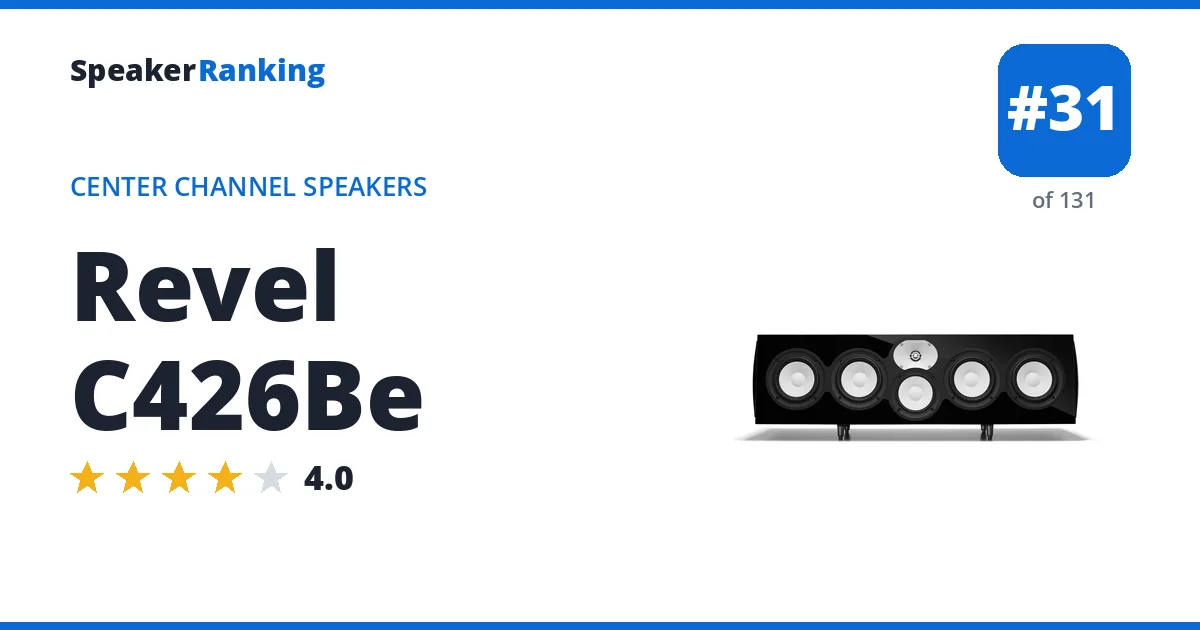
Pros: A three-way center with a 1” beryllium tweeter in Revel’s acoustic lens waveguide, a 5.25” midrange and four 6.5” woofers. Erin’s Audio Corner measured a preference score of 5.27 without a subwoofer, behind only the Perlisten and Ascend centers, helped by deep bass of 66.7Hz (-3dB) and about 35Hz (-10dB). Horizontal dispersion is wide (about ±60 degrees), so off-center seats hear the same dialogue balance, and 90dB sensitivity makes it easy to drive. Measured bass extension of 66.7Hz (-3dB).
Cons: The listening window is less even than the best centers here, spanning 3.1dB from 300Hz to 5kHz, and the directivity index varies more across frequency (3.8dB deviation). It is 977mm wide and 32.2kg, and at $5445 it is one of the more expensive centers here.
Full Revel C426Be review and specifications →
| Bass Extension (-10dB) | about 35.2Hz (measured, Erin’s Audio Corner) |
|---|---|
| Bass Extension (-3dB) | 66.7Hz (measured, Erin’s Audio Corner) |
| DIY Kit | No |
| Dimensions | 10.6”H x 38.5”W x 14”D (268 x 977 x 356 mm) |
| Drivers | 1” beryllium dome tweeter with acoustic lens, 5.25” DCC aluminum midrange, 4x 6.5” DCC aluminum woofers |
| Frequency Response | 38Hz-40kHz -6dB (manufacturer specified) |
| Impedance | 8 ohms nominal (manufacturer specified) |
| Sensitivity | 90dB (2.83V/1m, manufacturer specified) |
| Spinorama Preference Score | 5.27 |
| Spinorama Preference Score with Perfect Sub | 6.96 |
| Weight | 71 lbs (32.2 kg) |
| Woofer Cabinet | ported (dual rear ports) |
- Links
- Reviews, Comparisons and Sound Samples
- Head-to-Head Comparisons
 Vandersteen VCC-5: $3,300 each Audio Connection eBay
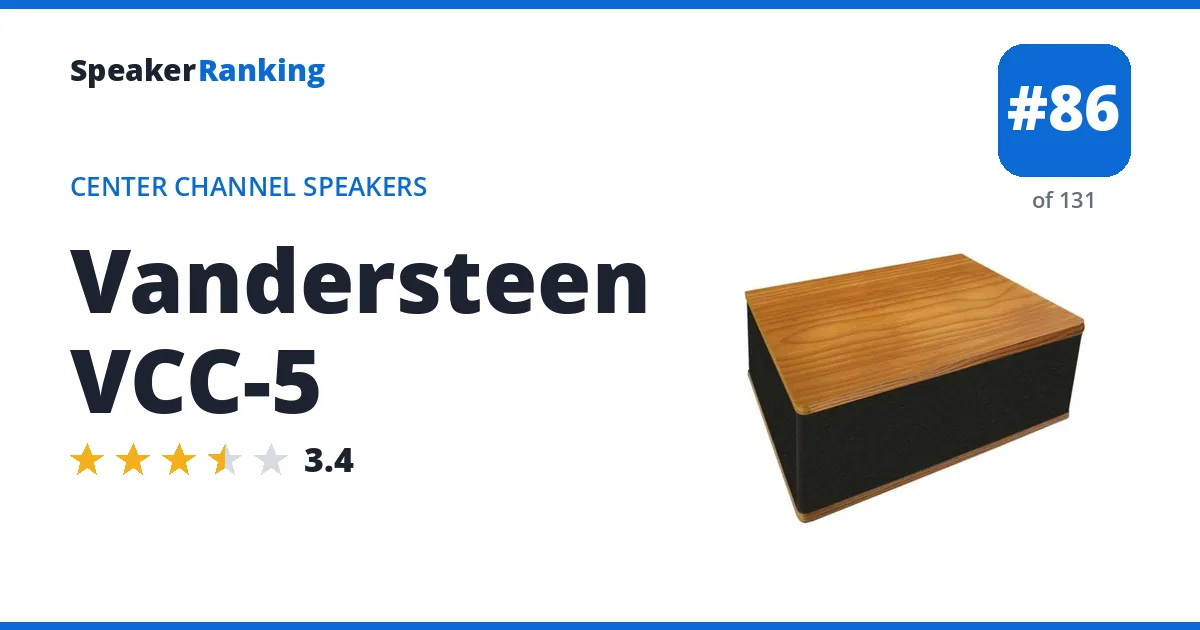
Pros: A triaxial design: a 1” alloy dome tweeter mounted coaxially in a 6.5” midrange, with two 6.5” woofers inside the cabinet and first-order crossovers. Audio Science Review measured deep bass for a center, 52.7Hz (-3dB) and about 41Hz (-10dB), and dispersion that stays even both horizontally and vertically (about ±40 degrees each), so it tolerates being placed above or below the screen. Measured bass extension of 52.7Hz (-3dB).
Cons: On-axis response is uneven (0.96dB average deviation) and the listening window spans 4.5dB from 300Hz to 5kHz. Sensitivity is a low 85dB and it weighs 68 lb. At $3300 it costs much more than centers that measure better.
Full Vandersteen VCC-5 review and specifications →
| Bass Extension (-10dB) | about 41.0Hz (measured, Audio Science Review) |
|---|---|
| Bass Extension (-3dB) | 52.7Hz (measured, Audio Science Review) |
| DIY Kit | No |
| Dimensions | 9.8”H x 24”W x 18”D (248 x 610 x 457 mm) |
| Drivers | 1” alloy dome tweeter coaxial with 6.5” mineral-filled polycone midrange, 2x 6.5” mineral-filled polycone woofers |
| Frequency Response | 50Hz-30kHz ±2dB (manufacturer specified) |
| Impedance | 6 ohms nominal, 4 ohms minimum (manufacturer specified) |
| Sensitivity | 85dB (2.83V/1m, manufacturer specified) |
| Spinorama Preference Score | 3.85 |
| Spinorama Preference Score with Perfect Sub | 6.05 |
| Weight | 67.9 lbs (30.8 kg) |
- Links
- Reviews, Comparisons and Sound Samples