Short answer: the Klipsch Heresy IV for efficiency, the Q Acoustics 5040 for bass. The Heresy IV measures 94.5dB/2.83V/1m sensitivity, well below Klipsch’s 99dB claim but still excellent, and Erin measured a 77Hz F3 with response rolling away near 100Hz in-room, so a subwoofer is required. The 5040’s C3 profile keeps the midrange smooth, but a mid-bass scoop around 200Hz leaves it roughly 6dB below the mean SPL.
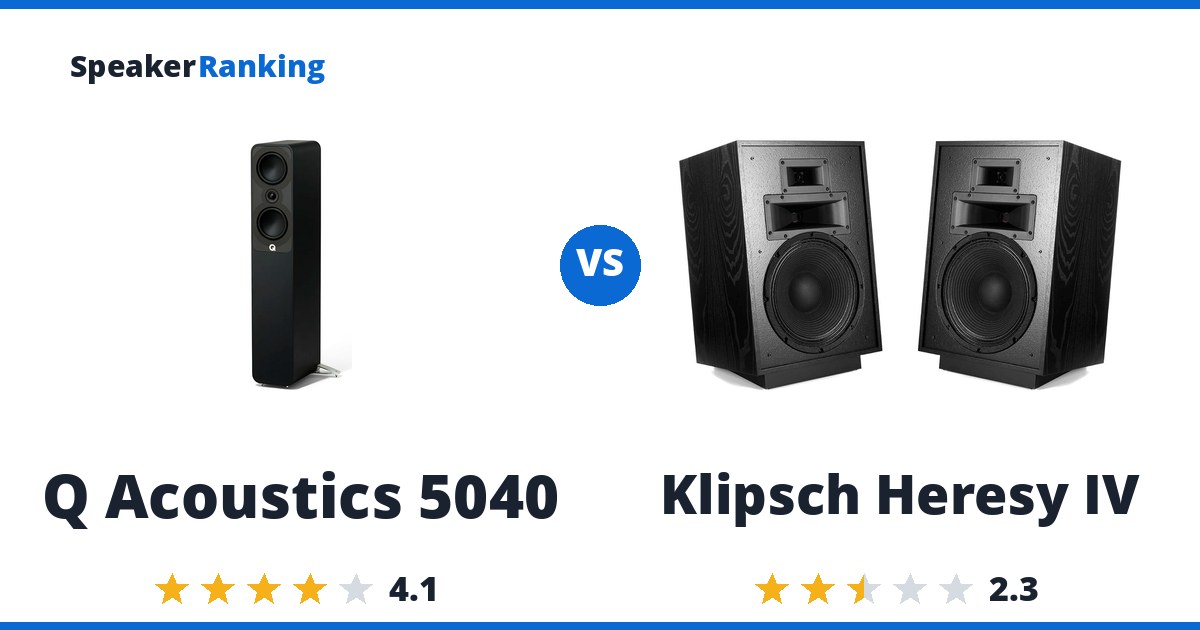
Buy the Q Acoustics 5040. It is rated higher for sound quality than the Klipsch Heresy IV and costs less, so only choose the other one for a particular feature it does better.
Still deciding? The full Passive Home rankings cover every ranked option.
Specifications Side By Side
| Q Acoustics 5040 | Klipsch Heresy IV | |
|---|---|---|
| Price | $2,472.98 per pair | $3,198 per pair |
| Ranked | #41 of 74 in Large Size Floorstanding Speakers | #72 of 74 in Large Size Floorstanding Speakers |
| Bass Extension (-10dB) | 39Hz (measured, Erin’s Audio Corner) | 50.0Hz (measured, Erin’s Audio Corner) |
| Bass Extension (-3dB) | 70Hz (measured, Erin’s Audio Corner) | 77Hz (measured, Erin’s Audio Corner) |
| Dimensions | 38.1”H x 11.5”W x 14.2”D (967 x 293 x 361 mm) | 24.8”H x 15.6”W x 13.3”D |
| Impedance | 6 ohms nominal (3.0 ohms minimum, measured by Erin’s Audio Corner) | Approximately 4 ohms minimum (measured, Erin’s Audio Corner) |
| Sensitivity | 91.5dB (measured average, Erin’s Audio Corner) | 94.5dB/2.83V/1m (measured, Erin’s Audio Corner) |
| Drivers | 0.88 in. decoupled dome tweeter, twin 5.0 in. C3 Continuous Curved Cone woofers | 1” horn-loaded tweeter; 1.75” horn-loaded midrange; 12” woofer |
| Weight | 39.7 lbs (18.0 kg) each | 45 lbs (20.4 kg) each |
| Woofer Cabinet | ported, rear | ported, rear |
| Spinorama Preference Score | 3.80 | 2.27 |
| Spinorama Preference Score with Perfect Sub | 6.41 | 5.02 |
| DIY Kit | No | No |
Related Speaker Comparisons
How Q Acoustics 5040 compares with other leading options:
- Q Acoustics 5040 vs KEF Blade Two Meta
- MoFi SourcePoint V10 Master Edition vs Q Acoustics 5040
- MoFi SourcePoint 888 vs Q Acoustics 5040
- Q Acoustics 5040 vs Revel F328Be
- Radiant Acoustics Clarity 66 vs Q Acoustics 5040
Prices on this page were last checked October 2, 2026 at 10:18 PM UTC. Product prices and availability are accurate as of that date/time and are subject to change; the price and availability shown on Amazon at the time of purchase will apply to the purchase of this product.
As an eBay Partner, we may be compensated if you make a purchase.
The Two Speakers In Full
 Q Acoustics 5040: $2,472.98 per pair Amazon eBay
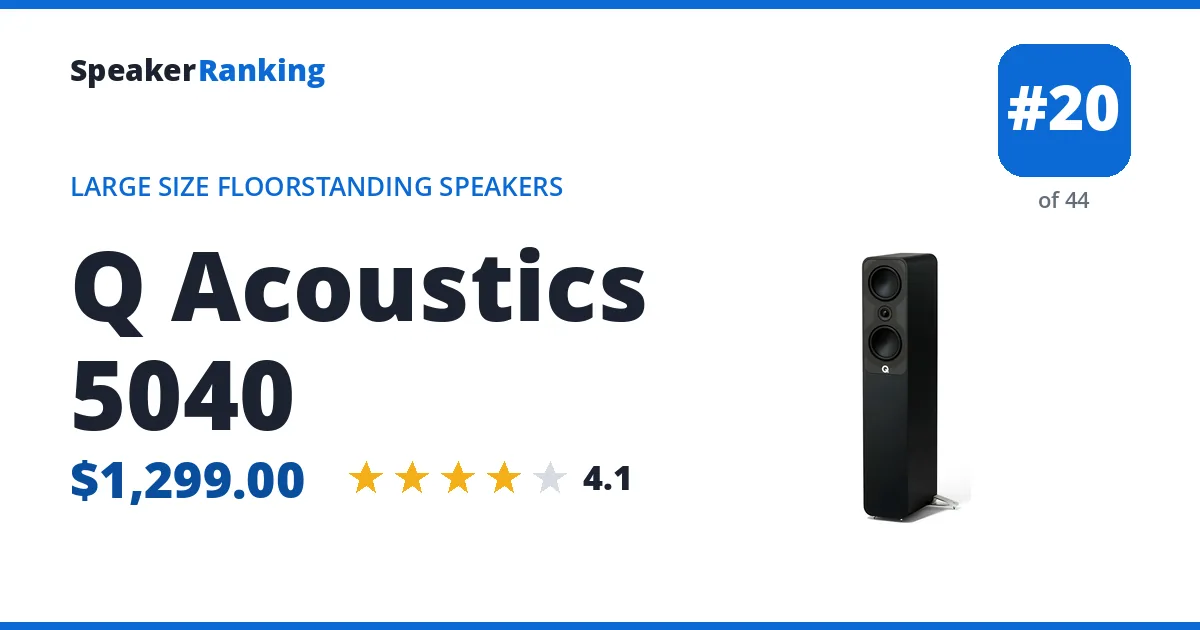
Pros: C3 (Continuous Curved Cone) driver profile technology provides smooth midrange integration, controlled cone breakup, and improved bass damping. High voltage sensitivity (91.5dB SPL at 2.83V/1m) allows loud listening with low-to-moderate amplifier wattage. Cabinet features Point-to-Point (P2P) internal bracing and Helmholtz Pressure Equalizer (HPE) tubes to suppress internal standing waves and panel vibrations. Measured bass extension of 70Hz (-3dB), with a measured sensitivity of 91.5dB.
Cons: Free-field frequency response exhibits a noticeable mid-bass scoop around 200Hz (~6dB lower than mean SPL), causing an F3 of 70Hz (F10 of 39Hz) in open space and requiring boundary placement (11-22 inches from front wall) to reinforce upper bass output. Measurements indicate an enclosure resonance near 300Hz visible in sound power data. Minimum impedance drops to 3.0 ohms, demanding a stable 4-ohm rated amplifier despite high sensitivity.
Full Q Acoustics 5040 review and specifications →
| Bass Extension (-10dB) | 39Hz (measured, Erin’s Audio Corner) |
|---|---|
| Bass Extension (-3dB) | 70Hz (measured, Erin’s Audio Corner) |
| DIY Kit | No |
| Dimensions | 38.1”H x 11.5”W x 14.2”D (967 x 293 x 361 mm) |
| Drivers | 0.88 in. decoupled dome tweeter, twin 5.0 in. C3 Continuous Curved Cone woofers |
| Impedance | 6 ohms nominal (3.0 ohms minimum, measured by Erin’s Audio Corner) |
| Sensitivity | 91.5dB (measured average, Erin’s Audio Corner) |
| Spinorama Preference Score | 3.80 |
| Spinorama Preference Score with Perfect Sub | 6.41 |
| Weight | 39.7 lbs (18.0 kg) each |
| Woofer Cabinet | ported, rear |
- Links
- Reviews, Comparisons and Sound Samples
- Head-to-Head Comparisons
- Q Acoustics 5040 vs Infinity Primus 360
- Q Acoustics 5040 vs Klipsch Forte IV
- Q Acoustics 5040 vs KEF Q11 Meta
- Q Acoustics 5040 vs Polk Reserve R500
- Q Acoustics 5040 vs ELAC Debut 3.0 DF63
- Q Acoustics 5040 vs Klipsch RP-5000F II
- Q Acoustics 5040 vs Emotiva Airmotiv T2+
- Q Acoustics 5040 vs PSB Imagine T65
- See all 41 comparisons
 Klipsch Heresy IV: $3,198 per pair Amazon Crutchfield eBay
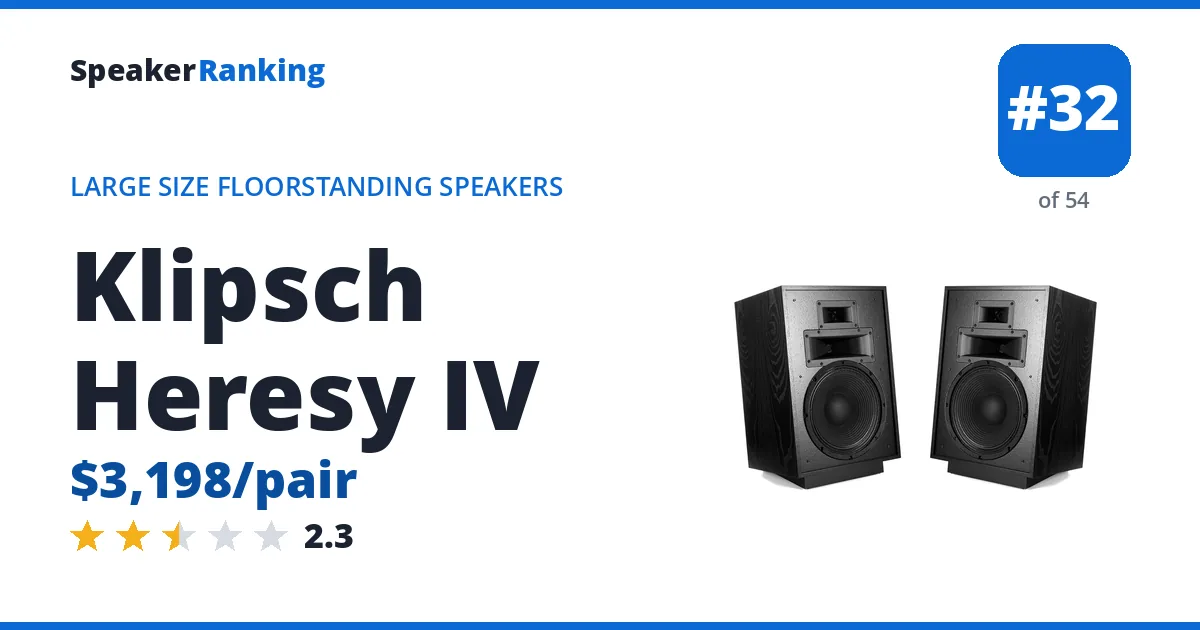
Pros: Very high 94.5dB/2.83V/1m sensitivity in Erin’s anechoic measurement (well below Klipsch’s 99dB in-room claim, but still excellent) and strong short-term output from a 12-inch woofer plus horn-loaded midrange and tweeter. The compact, furniture-grade Heritage cabinet is easier to place than most high-efficiency designs, and dynamics at moderate levels can sound lively. A stable four-ohm-capable amplifier can produce substantial SPL with relatively little voltage. Measured bass extension of 77Hz (-3dB), with a measured sensitivity of 94.5dB.
Cons: Erin measured a 77Hz F3 and response rolling away near 100Hz in-room, so a subwoofer is required for modern full-range reproduction. The impedance dips to about 4 ohms, reducing the practical amplifier advantage implied by its sensitivity. Pronounced directivity mismatch at the driver transitions, impedance/response resonances and elevated distortion spikes around the crossover remain audible concerns that EQ cannot fully solve. At 102dB Erin measured roughly 1.5dB midband compression; at 96dB distortion rises around crossover. Performance is difficult to justify at the price, and Erin explicitly did not recommend it.
Full Klipsch Heresy IV review and specifications →
| Bass Extension (-10dB) | 50.0Hz (measured, Erin’s Audio Corner) |
|---|---|
| Bass Extension (-3dB) | 77Hz (measured, Erin’s Audio Corner) |
| DIY Kit | No |
| Dimensions | 24.8”H x 15.6”W x 13.3”D |
| Drivers | 1” horn-loaded tweeter; 1.75” horn-loaded midrange; 12” woofer |
| Impedance | Approximately 4 ohms minimum (measured, Erin’s Audio Corner) |
| Sensitivity | 94.5dB/2.83V/1m (measured, Erin’s Audio Corner) |
| Spinorama Preference Score | 2.27 |
| Spinorama Preference Score with Perfect Sub | 5.02 |
| Weight | 45 lbs (20.4 kg) each |
| Woofer Cabinet | ported, rear |
- Links
- Reviews, Comparisons and Sound Samples
- Head-to-Head Comparisons
- Klipsch Heresy IV vs Rockville RockTower 68B
- Klipsch Heresy IV vs Sony SS-CS3
- Klipsch Heresy IV vs Atlantic Technology 8600eLR
- Klipsch Heresy IV vs JBL Stage 2 280F
- Klipsch Heresy IV vs Magnepan LRS+
- Klipsch Heresy IV vs Infinity Reference 253
- Klipsch Heresy IV vs Polk Audio XT60
- Klipsch Heresy IV vs Focal Aria Evo X N°2
- See all 43 comparisons