Short answer: the Power Sound Audio MT-110-M. It ranks #52 of 131 bookshelf speakers by sound quality, rated 4.1/5, at $1,350. The SVS Ultra Bookshelf ranks #62, rated 3.9/5, at $1,200, $150 cheaper, not enough of a saving to outweigh the sound-quality gap.
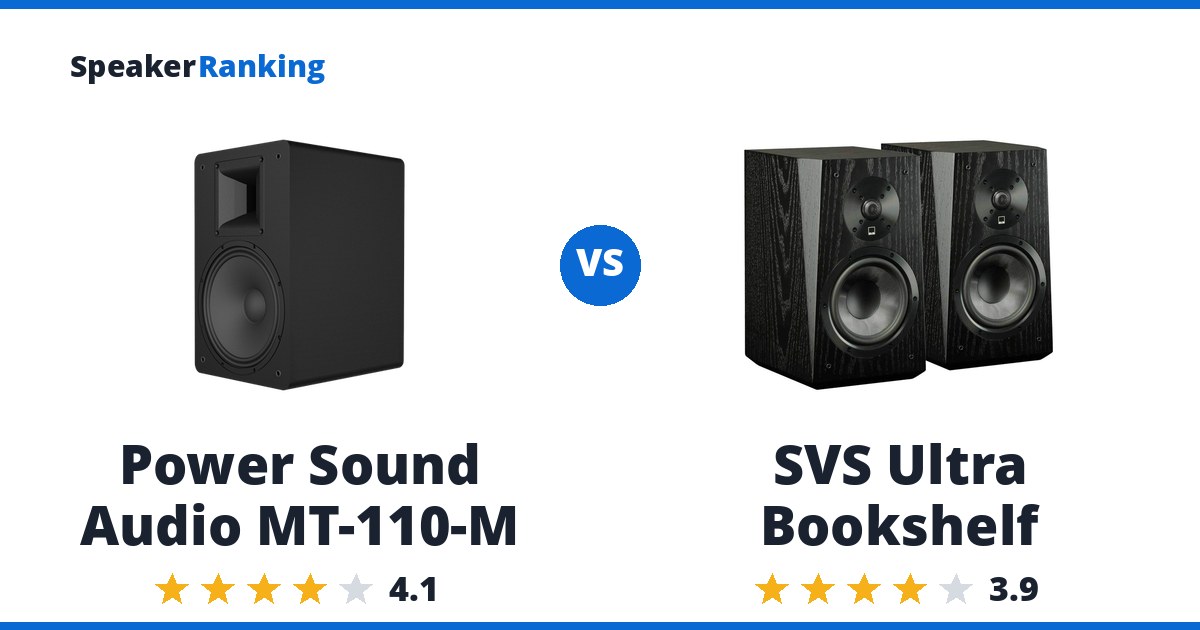
Why pick the Power Sound Audio MT-110-M: Made in the USA with a 1” polyimide compression tweeter on a cast aluminum exponential horn plus a 10” high-efficiency neodymium woofer, both BMS-made drivers. The tradeoff: A mid-range bump makes the tonal balance sound too thick and needs 2-3 bands of EQ to flatten out; correcting it also pulls measured sensitivity down to about 90-91dB in practice.
The case for the SVS Ultra Bookshelf: Noticeably more tonally neutral than the cheaper SVS Prime Bookshelf, with response staying within about -3dB/+1.5dB on average: a genuine step up in linearity for roughly double the price. The catch: Still has a boosted upper mid-range/mid-range area, though less severe than the Prime: the reviewer suspects a baffle-step or tweeter-level issue rather than a resonance, giving mixes a slightly forward, occasionally tinny character.
Worth knowing: the SVS Ultra Bookshelf is discontinued, though it still ranks #62 of 131 bookshelf speakers by sound quality, so a used unit beats most of what is still sold new.
Buy the Power Sound Audio MT-110-M. It is rated higher for sound quality, and the $150 saving on the SVS Ultra Bookshelf is not enough to make up the difference.
Looking for alternatives? See the complete Passive Home rankings.
Specifications Side By Side
| Power Sound Audio MT-110-M | SVS Ultra Bookshelf | |
|---|---|---|
| Price | $1,350 per pair | $1,200 per pair Discontinued |
| Ranked | #52 of 131 in Large Size Bookshelf Speakers | #62 of 131 in Large Size Bookshelf Speakers |
| Drivers | 1” polyimide compression tweeter with cast aluminum exponential horn, 10” high-efficiency neodymium woofer | 6.5” composite glass fiber cone woofer, 1” aluminum dome tweeter |
| Dimensions | 17.5”H x 11”W x 14”D (includes grille) | 14.9”H x 8.5”W x 10”D |
| Weight | 30 lbs (13.6 kg) each (unboxed) | 19 lbs (8.6 kg) each |
| Impedance | 8 ohms nominal (measured, Erin’s Audio Corner; matches manufacturer spec) | 8 ohms nominal, 3.8 ohms minimum (measured, Erin’s Audio Corner) |
| Sensitivity | 92.5dB (measured at 2.83V/1m, Erin’s Audio Corner; matches manufacturer spec) | 87.8dB (measured average, Erin’s Audio Corner) |
| Bass Extension (-3dB) | 113Hz (measured, Erin’s Audio Corner) | 69Hz (measured, Erin’s Audio Corner) |
| Bass Extension (-10dB) | 68Hz (measured, Erin’s Audio Corner) | 48Hz (measured, Erin’s Audio Corner) |
| Power Handling | 175W | - |
| Woofer Cabinet | sealed | - |
| Country | USA | - |
| Spinorama Preference Score | 2.53 | 5.63 |
| Spinorama Preference Score with Perfect Sub | 5.86 | 8.10 |
| DIY Kit | No | No |
| Frequency Response | - | 45Hz - 32kHz (manufacturer specified) |
| Recommended Power | - | 20-150W |
Related Speaker Comparisons
How Power Sound Audio MT-110-M compares with other leading options:
- ELAC Debut 3.0 DB63 vs Power Sound Audio MT-110-M
- Arendal 1723 Bookshelf S THX vs Power Sound Audio MT-110-M
- Arendal Sound 1723 Monitor THX vs Power Sound Audio MT-110-M
- Power Sound Audio MT-110-M vs ELAC Uni-Fi Reference UBR62
- Klipsch RP-600M II vs Power Sound Audio MT-110-M
Prices on this page were last checked September 29, 2026 at 3:43 PM UTC. Product prices and availability are accurate as of that date/time and are subject to change; the price and availability shown on Amazon at the time of purchase will apply to the purchase of this product.
As an eBay Partner, we may be compensated if you make a purchase.
The Two Speakers In Full
 Power Sound Audio MT-110-M: $1,350 per pair Power Sound Audio eBay
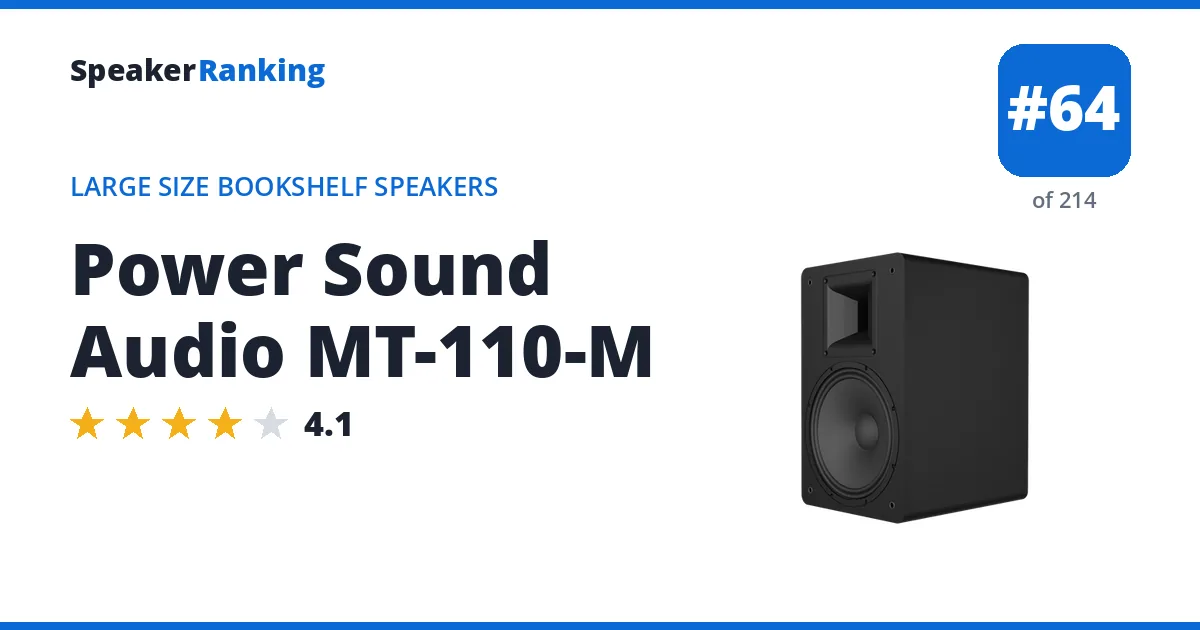
Pros: Made in the USA with a 1” polyimide compression tweeter on a cast aluminum exponential horn plus a 10” high-efficiency neodymium woofer, both BMS-made drivers. Reasonably high measured sensitivity (about 92.5dB at 2.83V/1m), so it doesn’t need much power to play loud. Excellent dynamic range: frequency response barely shifts (about 0.5dB deviation) from 76dB to 102dB output, which the reviewer calls completely acceptable headroom. Not fatiguing or bright despite the horn-loaded compression driver: the constant-directivity horn avoids the artificially flat, reflection-heavy in-room high-frequency buildup that some waveguide designs suffer from. Sealed cabinet design means placement near a wall is less of a bass-reinforcement concern than with a ported design. Solid build quality using threaded nutserts rather than screws driven directly into the cabinet wood. Measured bass extension of 113Hz (-3dB), with a measured sensitivity of 92.5dB.
Cons: A mid-range bump makes the tonal balance sound too thick and needs 2-3 bands of EQ to flatten out; correcting it also pulls measured sensitivity down to about 90-91dB in practice. F3 of 113Hz and F10 of 68Hz mean this doesn’t get low without a subwoofer: in the reviewer’s room it barely reached 70Hz with any real authority. Rising distortion in the upper mid-range, likely from woofer breakup, that lines up with anomalies seen in the impedance sweep above 500Hz: not a major concern but worth noting. The reviewer explicitly frames this as a home theater speaker rather than a stereo/music speaker.
Full Power Sound Audio MT-110-M review and specifications →
| Bass Extension (-10dB) | 68Hz (measured, Erin’s Audio Corner) |
|---|---|
| Bass Extension (-3dB) | 113Hz (measured, Erin’s Audio Corner) |
| Country | USA |
| DIY Kit | No |
| Dimensions | 17.5”H x 11”W x 14”D (includes grille) |
| Drivers | 1” polyimide compression tweeter with cast aluminum exponential horn, 10” high-efficiency neodymium woofer |
| Impedance | 8 ohms nominal (measured, Erin’s Audio Corner; matches manufacturer spec) |
| Power Handling | 175W |
| Sensitivity | 92.5dB (measured at 2.83V/1m, Erin’s Audio Corner; matches manufacturer spec) |
| Spinorama Preference Score | 2.53 |
| Spinorama Preference Score with Perfect Sub | 5.86 |
| Weight | 30 lbs (13.6 kg) each (unboxed) |
| Woofer Cabinet | sealed |
- Links
- Reviews, Comparisons and Sound Samples
- Head-to-Head Comparisons
 SVS Ultra Bookshelf: $1,200 per pair Discontinued eBay
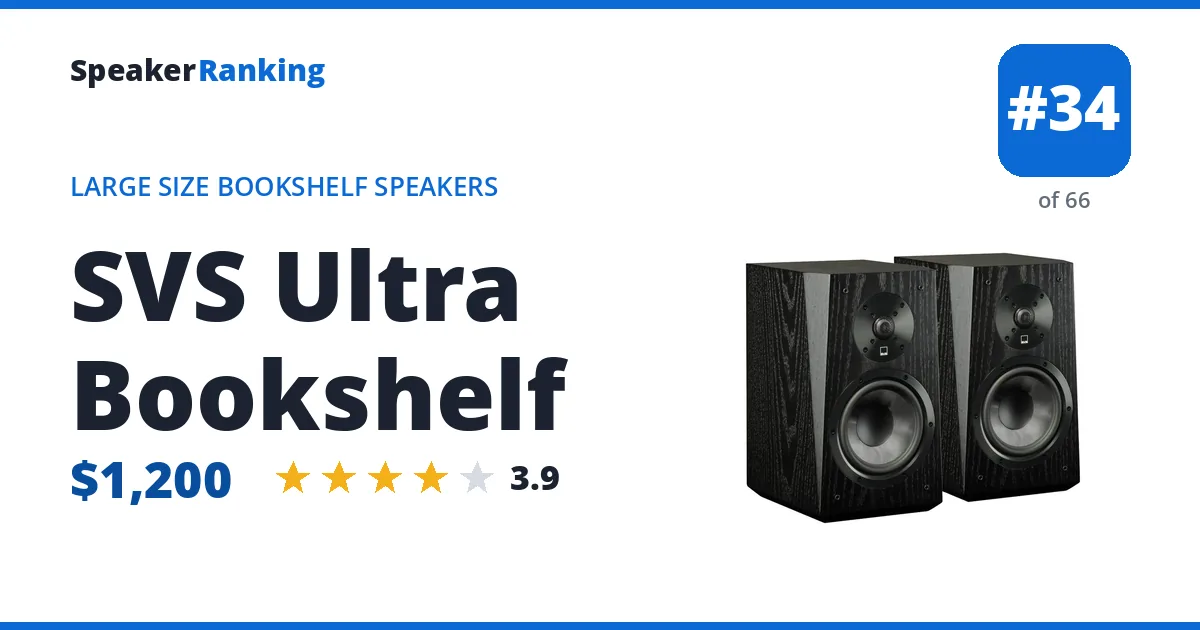
Newer model: the SVS Ultra Evolution Bookshelf. It’s likely to perform similarly, though we can’t confirm that yet.
Pros: Noticeably more tonally neutral than the cheaper SVS Prime Bookshelf, with response staying within about -3dB/+1.5dB on average: a genuine step up in linearity for roughly double the price. Slightly higher sensitivity than the Prime (about 87.8dB) with similarly wide, consistent horizontal radiation. Toeing the speakers out about 30 degrees smooths the in-room response nicely if the on-axis tonal balance runs a bit forward for your taste. Distortion and dynamics hold up well; this is a mature, well-regarded design (roughly a decade old at review time) that’s aged better than many contemporaries. Measured bass extension of 69Hz (-3dB), with a measured sensitivity of 87.8dB.
Cons: Still has a boosted upper mid-range/mid-range area, though less severe than the Prime: the reviewer suspects a baffle-step or tweeter-level issue rather than a resonance, giving mixes a slightly forward, occasionally tinny character. Bass extension is modest for the price (F3 69Hz, F10 48Hz measured): SVS is clearly counting on you pairing this with one of their subwoofers rather than expecting full-range performance from the bookshelf alone. Measured minimum impedance dips to about 3.8 ohms, so a 4-ohm-stable amplifier is recommended rather than a basic 8-ohm-only AVR. Radiation pattern is wide (around 80°), wider than the reviewer’s typical ~60° sweet spot preference, so acoustic treatment on nearby walls helps tame reflections and keep the off-axis response from diverging too much from on-axis. Discontinued; SVS replaced the Ultra line with the Ultra Evolution series.
Full SVS Ultra Bookshelf review and specifications →
| Bass Extension (-10dB) | 48Hz (measured, Erin’s Audio Corner) |
|---|---|
| Bass Extension (-3dB) | 69Hz (measured, Erin’s Audio Corner) |
| DIY Kit | No |
| Dimensions | 14.9”H x 8.5”W x 10”D |
| Drivers | 6.5” composite glass fiber cone woofer, 1” aluminum dome tweeter |
| Frequency Response | 45Hz - 32kHz (manufacturer specified) |
| Impedance | 8 ohms nominal, 3.8 ohms minimum (measured, Erin’s Audio Corner) |
| Recommended Power | 20-150W |
| Sensitivity | 87.8dB (measured average, Erin’s Audio Corner) |
| Spinorama Preference Score | 5.63 |
| Spinorama Preference Score with Perfect Sub | 8.10 |
| Weight | 19 lbs (8.6 kg) each |
- Links
- Reviews, Comparisons and Sound Samples
- Head-to-Head Comparisons
- SVS Ultra Bookshelf vs Dynaudio Contour 20i
- SVS Ultra Bookshelf vs Infinity Reference R162
- SVS Ultra Bookshelf vs Definitive Technology Demand D11
- SVS Ultra Bookshelf vs Yamaha NS-800A
- SVS Ultra Bookshelf vs ELAC DBR62
- SVS Ultra Bookshelf vs ELAC Uni-Fi Reference UBR62
- SVS Ultra Bookshelf vs Klipsch RP-600M II
- SVS Ultra Bookshelf vs Dynaudio Emit 20
- See all 11 comparisons