Short answer: the JBL XPL-90 for on-axis flatness, the Polk Reserve R100 for easier placement. The XPL-90 is nearly ruler-flat on-axis up to 1kHz with even horizontal directivity until the tweeter beams above 10kHz, but peaks around 3kHz and above 10kHz color the top end, and poor vertical directivity demands ear-level tweeters. The R100 costs $599 less, though about 85dB sensitivity and a 3.6-ohm dip make it the harder load.
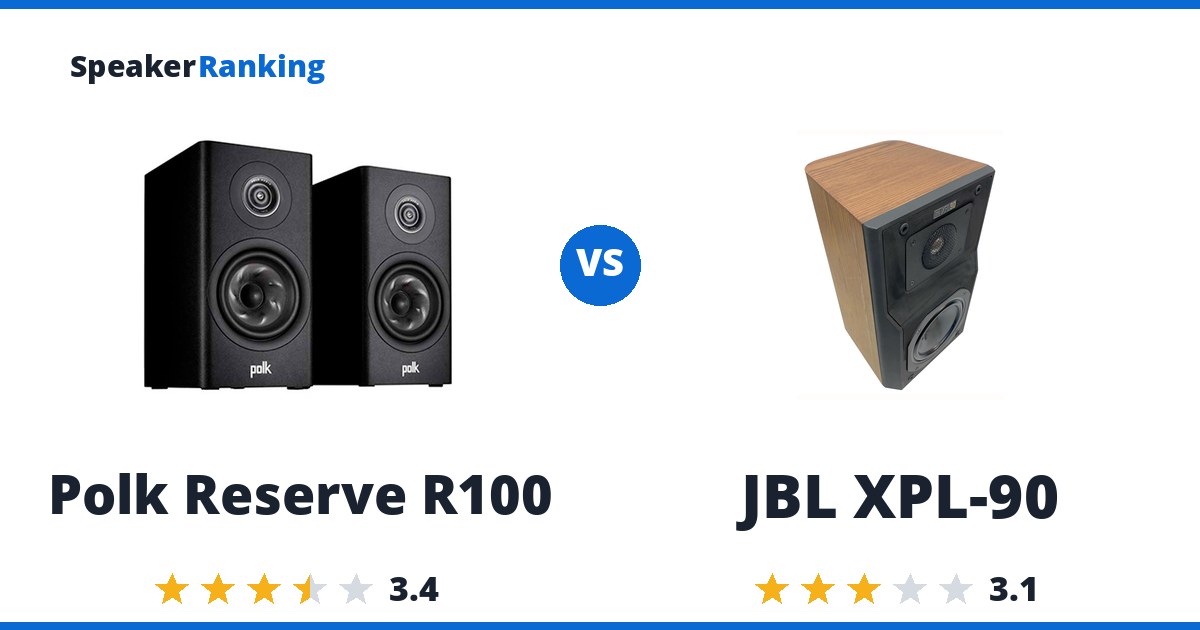
Buy the Polk Reserve R100. It is rated higher for sound quality and still sold new, while the JBL XPL-90 is discontinued.
Still deciding? The full Passive Home rankings cover every ranked option.
Specifications Side By Side
| Polk Reserve R100 | JBL XPL-90 | |
|---|---|---|
| Price | $699.00 per pair | $1,298 per pair used (vintage, late 1980s), Discontinued |
| Ranked | #96 of 134 in Large Size Bookshelf Speakers | #104 of 134 in Large Size Bookshelf Speakers |
| Bass Extension (-3dB) | 68Hz (measured, Erin’s Audio Corner) | 77.6Hz (measured, Audio Science Review) |
| Bass Extension (-10dB) | 49Hz (measured, Erin’s Audio Corner) | 48.7Hz (measured, Audio Science Review) |
| Sensitivity | 85dB/2.83V/1m (measured, Erin’s Audio Corner) | 85dB (2.83V/1m, measured, Audio Science Review) |
| Impedance | 3.6 ohms minimum (measured, Erin’s Audio Corner) | 6 ohms |
| Drivers | 1” Pinnacle ring-radiator tweeter; 5.25” Turbine Cone midwoofer | 6.5” bass/mid driver, 1” titanium dome tweeter |
| Dimensions | 12.8”H x 6.5”W x 10.2”D | 15.5”H x 9.5”W x 9.8”D (394 x 241 x 248 mm) |
| Weight | 12.1 lbs (5.5 kg) each | 20.1 lbs (9.1 kg) each |
| Woofer Cabinet | ported, rear X-Port | - |
| Spinorama Preference Score | 5.46 | 3.7 (spinorama.org) |
| Spinorama Preference Score with Perfect Sub | 7.93 | 6.31 (spinorama.org) |
| DIY Kit | No | No |
| Power Handling | - | 100W nominal, 400W max |
Related Speaker Comparisons
How Polk Reserve R100 compares with other leading options:
- AsciLab C6B vs Polk Reserve R100
- KEF R3 Meta vs Polk Reserve R100
- KEF Q Concerto Meta vs Polk Reserve R100
- KEF R3 vs Polk Reserve R100
- MoFi SourcePoint 8 vs Polk Reserve R100
Prices on this page were last checked October 2, 2026 at 10:18 PM UTC. Product prices and availability are accurate as of that date/time and are subject to change; the price and availability shown on Amazon at the time of purchase will apply to the purchase of this product.
As an eBay Partner, we may be compensated if you make a purchase.
The Two Speakers In Full
 Polk Reserve R100: $699.00 per pair Amazon Polk Audio eBay
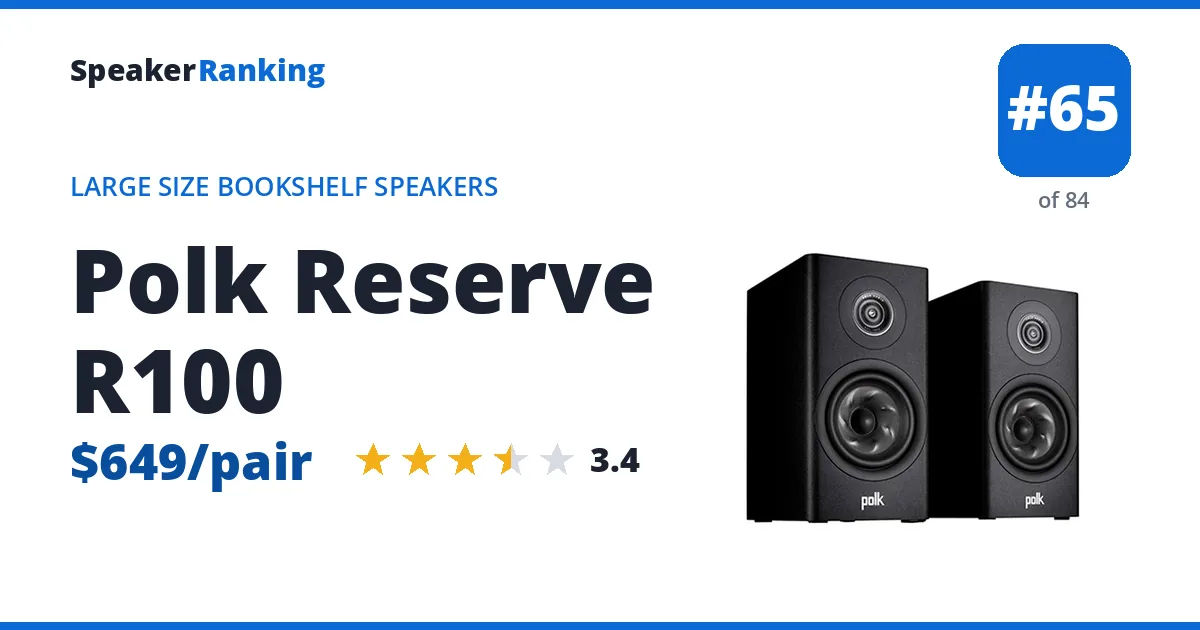
Pros: Compact cabinet, unusually useful bass for its size and well-controlled woofer breakup. Erin measured F3/F10 points of 68Hz/49Hz, and the X-Port vent avoids much of the chuffing and pipe resonance common to budget rear ports. The 5.25-inch Turbine Cone woofer and 1-inch Pinnacle ring-radiator tweeter produce good detail at moderate levels, while listening roughly 20° off-axis reduces part of the elevated top octave. Measured bass extension of 68Hz (-3dB), with a measured sensitivity of 85dB.
Cons: Erin measured only about 85dB sensitivity and the impedance reaches 3.6 ohms, so it is neither efficient nor an entirely benign AVR load. The treble runs roughly 3dB above the midrange and becomes aggressive above about 85dB SPL. A directivity discontinuity through the woofer/tweeter crossover means EQ cannot fully repair the power response, and a 400Hz impedance feature plus 500Hz-1kHz response irregularity suggests a cabinet or system resonance. Substantial low-frequency compression at higher playback levels limits clean dynamics.
Full Polk Reserve R100 review and specifications →
| Bass Extension (-10dB) | 49Hz (measured, Erin’s Audio Corner) |
|---|---|
| Bass Extension (-3dB) | 68Hz (measured, Erin’s Audio Corner) |
| DIY Kit | No |
| Dimensions | 12.8”H x 6.5”W x 10.2”D |
| Drivers | 1” Pinnacle ring-radiator tweeter; 5.25” Turbine Cone midwoofer |
| Impedance | 3.6 ohms minimum (measured, Erin’s Audio Corner) |
| Sensitivity | 85dB/2.83V/1m (measured, Erin’s Audio Corner) |
| Spinorama Preference Score | 5.46 |
| Spinorama Preference Score with Perfect Sub | 7.93 |
| Weight | 12.1 lbs (5.5 kg) each |
| Woofer Cabinet | ported, rear X-Port |
- Links
- Reviews, Comparisons and Sound Samples
- Head-to-Head Comparisons
- Polk Reserve R100 vs Focal Aria 906
- Polk Reserve R100 vs Revel Performa M22
- Polk Reserve R100 vs Sonus Faber Lumina II
- Polk Reserve R100 vs Polk Monitor XT20
- Polk Reserve R100 vs HSU Research MFL-6
- Polk Reserve R100 vs KEF Q3 Meta
- Polk Reserve R100 vs Polk R200
- Polk Reserve R100 vs SVS Prime Bookshelf
- See all 30 comparisons
 JBL XPL-90: $1,298 per pair used (vintage, late 1980s) Discontinued eBay
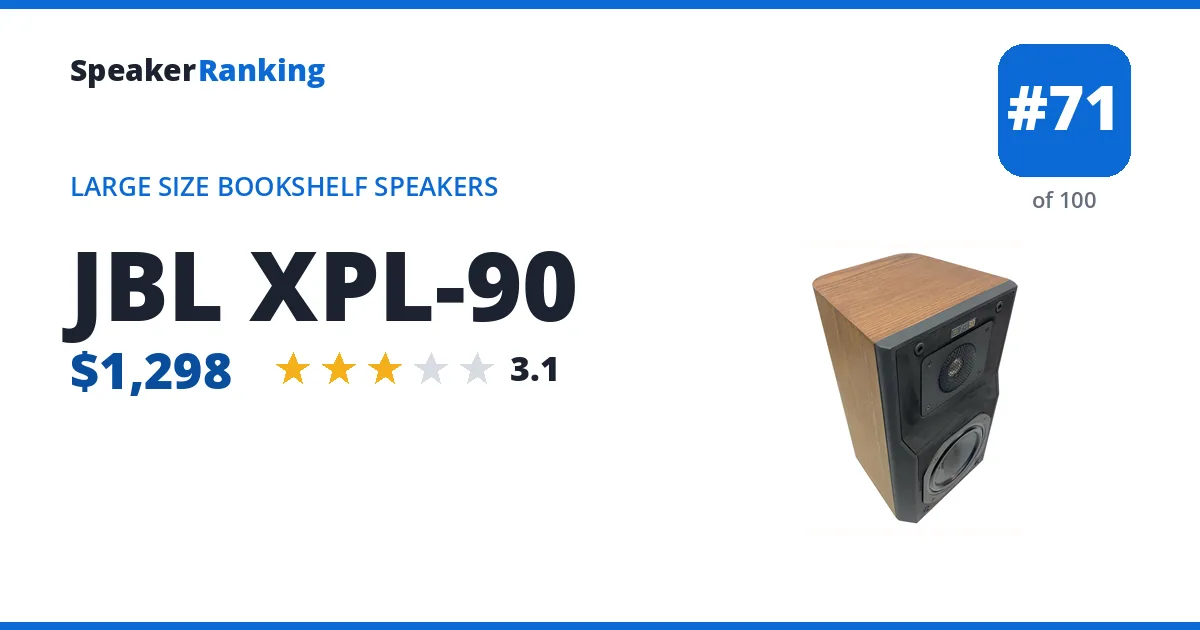
Pros: Nearly ruler-flat on-axis response up to 1kHz with even horizontal directivity until the tweeter beams above 10kHz. The reviewer found real strength with vocals and simpler instrumentation, calling it “the first speaker I have liked that has some clear response errors” and “an enjoyable speaker” despite the flaws. Titanium tweeter and internal Monster cable wiring reflect JBL’s higher-end late-1980s engineering. Measured bass extension of 77.6Hz (-3dB), with a measured sensitivity of 85dB.
Cons: Crossover region peaking around 3kHz and treble peaking above 10kHz color the top end, and poor vertical directivity means the tweeter needs to be at ear level. Distortion rises at 96dB SPL, especially around 3kHz. Long discontinued; only available on the used market.
Full JBL XPL-90 review and specifications →
| Bass Extension (-10dB) | 48.7Hz (measured, Audio Science Review) |
|---|---|
| Bass Extension (-3dB) | 77.6Hz (measured, Audio Science Review) |
| DIY Kit | No |
| Dimensions | 15.5”H x 9.5”W x 9.8”D (394 x 241 x 248 mm) |
| Drivers | 6.5” bass/mid driver, 1” titanium dome tweeter |
| Impedance | 6 ohms |
| Power Handling | 100W nominal, 400W max |
| Sensitivity | 85dB (2.83V/1m, measured, Audio Science Review) |
| Spinorama Preference Score | 3.7 (spinorama.org) |
| Spinorama Preference Score with Perfect Sub | 6.31 (spinorama.org) |
| Weight | 20.1 lbs (9.1 kg) each |
- Reviews, Comparisons and Sound Samples
- Head-to-Head Comparisons