Short answer: the Polk Reserve R100. It ranks #93 of 131 bookshelf speakers by sound quality, rated 3.4/5, at $699. The Emotiva Airmotiv B2+ ranks #104, rated 3.0/5, at $449, $250 cheaper, which does not close the gap in sound quality.
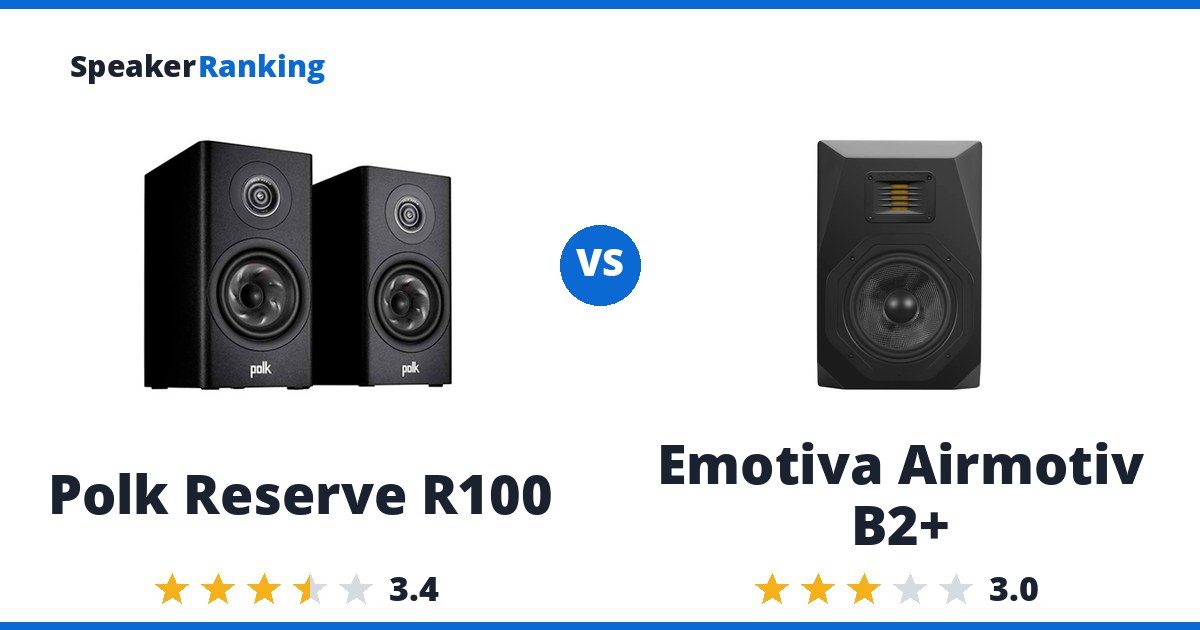
What the Polk Reserve R100 does well: Compact cabinet, unusually useful bass for its size and well-controlled woofer breakup. The catch: Erin measured only about 85dB sensitivity and the impedance reaches 3.6 ohms, so it is neither efficient nor an entirely benign AVR load.
The case for the Emotiva Airmotiv B2+: Erin measured a useful 86dB average sensitivity and strong midbass punch around 120Hz. The catch: The replacement B2+ did not deliver the neutral upgrade Erin expected.
Worth knowing: the Emotiva Airmotiv B2+ has been discontinued and is hard to find new at this point.
Buy the Polk Reserve R100. It is rated higher for sound quality, and saving $250 with the Emotiva Airmotiv B2+ does not make up for the sound-quality gap.
Want more options? Browse the full Passive Home rankings.
Specifications Side By Side
| Polk Reserve R100 | Emotiva Airmotiv B2+ | |
|---|---|---|
| Price | $699.00 per pair | $449.00 per pair Discontinued |
| Ranked | #93 of 131 in Large Size Bookshelf Speakers | #104 of 131 in Large Size Bookshelf Speakers |
| Bass Extension (-3dB) | 68Hz (measured, Erin’s Audio Corner) | 66Hz (measured, Erin’s Audio Corner) |
| Bass Extension (-10dB) | 49Hz (measured, Erin’s Audio Corner) | 43Hz (measured, Erin’s Audio Corner) |
| Sensitivity | 85dB/2.83V/1m (measured, Erin’s Audio Corner) | 86dB (measured average, Erin’s Audio Corner) |
| Impedance | 3.6 ohms minimum (measured, Erin’s Audio Corner) | 4 ohms nominal (manufacturer specified) |
| Drivers | 1” Pinnacle ring-radiator tweeter; 5.25” Turbine Cone midwoofer | 6.5” woven-fiber woofer, 32 x 25mm folded-ribbon tweeter |
| Dimensions | 12.8”H x 6.5”W x 10.2”D | 12.8”H x 8.5”W x 11.5”D (324 x 216 x 293 mm) |
| Weight | 12.1 lbs (5.5 kg) each | 15.7 lbs (7.1 kg) each |
| Woofer Cabinet | ported, rear X-Port | ported, rear |
| Spinorama Preference Score | 5.46 | 5.60 |
| Spinorama Preference Score with Perfect Sub | 7.93 | 7.96 |
| DIY Kit | No | No |
Related Speaker Comparisons
How Polk Reserve R100 compares with other leading options:
- AsciLab C6B vs Polk Reserve R100
- KEF R3 Meta vs Polk Reserve R100
- KEF Q Concerto Meta vs Polk Reserve R100
- KEF R3 vs Polk Reserve R100
- MoFi SourcePoint 8 vs Polk Reserve R100
Prices on this page were last checked September 29, 2026 at 3:43 PM UTC. Product prices and availability are accurate as of that date/time and are subject to change; the price and availability shown on Amazon at the time of purchase will apply to the purchase of this product.
As an eBay Partner, we may be compensated if you make a purchase.
The Two Speakers In Full
 Polk Reserve R100: $699.00 per pair Amazon Polk Audio eBay
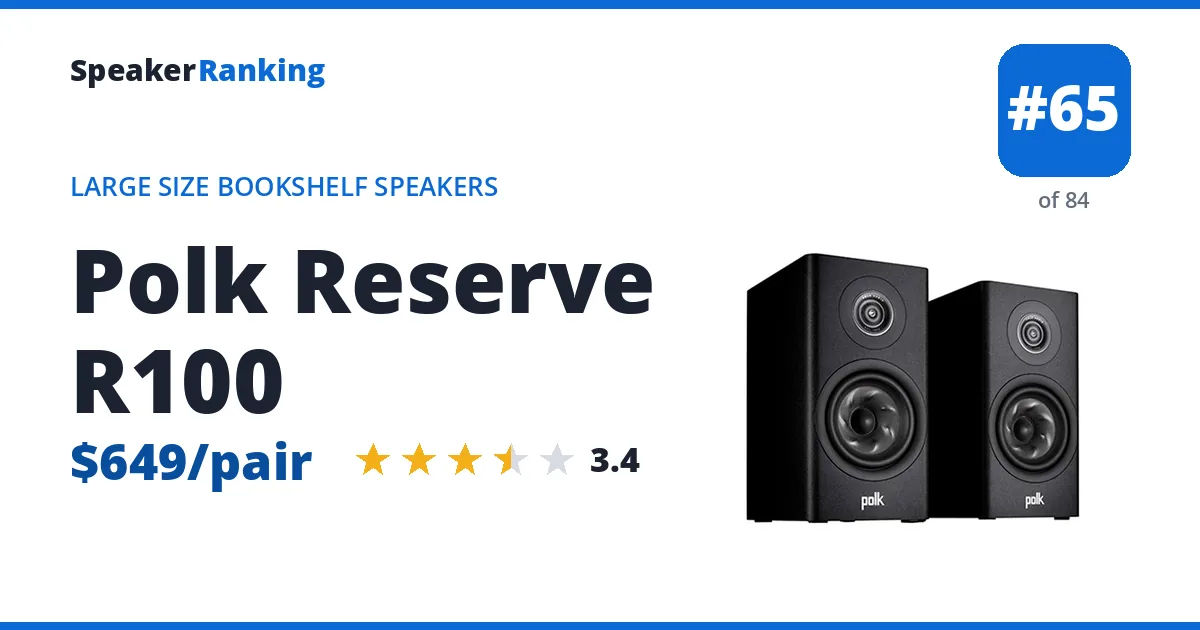
Pros: Compact cabinet, unusually useful bass for its size and well-controlled woofer breakup. Erin measured F3/F10 points of 68Hz/49Hz, and the X-Port vent avoids much of the chuffing and pipe resonance common to budget rear ports. The 5.25-inch Turbine Cone woofer and 1-inch Pinnacle ring-radiator tweeter produce good detail at moderate levels, while listening roughly 20° off-axis reduces part of the elevated top octave. Measured bass extension of 68Hz (-3dB), with a measured sensitivity of 85dB.
Cons: Erin measured only about 85dB sensitivity and the impedance reaches 3.6 ohms, so it is neither efficient nor an entirely benign AVR load. The treble runs roughly 3dB above the midrange and becomes aggressive above about 85dB SPL. A directivity discontinuity through the woofer/tweeter crossover means EQ cannot fully repair the power response, and a 400Hz impedance feature plus 500Hz-1kHz response irregularity suggests a cabinet or system resonance. Substantial low-frequency compression at higher playback levels limits clean dynamics.
Full Polk Reserve R100 review and specifications →
| Bass Extension (-10dB) | 49Hz (measured, Erin’s Audio Corner) |
|---|---|
| Bass Extension (-3dB) | 68Hz (measured, Erin’s Audio Corner) |
| DIY Kit | No |
| Dimensions | 12.8”H x 6.5”W x 10.2”D |
| Drivers | 1” Pinnacle ring-radiator tweeter; 5.25” Turbine Cone midwoofer |
| Impedance | 3.6 ohms minimum (measured, Erin’s Audio Corner) |
| Sensitivity | 85dB/2.83V/1m (measured, Erin’s Audio Corner) |
| Spinorama Preference Score | 5.46 |
| Spinorama Preference Score with Perfect Sub | 7.93 |
| Weight | 12.1 lbs (5.5 kg) each |
| Woofer Cabinet | ported, rear X-Port |
- Links
- Reviews, Comparisons and Sound Samples
- Head-to-Head Comparisons
- Polk Reserve R100 vs Focal Aria 906
- Polk Reserve R100 vs Revel Performa M22
- Polk Reserve R100 vs Sonus Faber Lumina II
- Polk Reserve R100 vs Polk Monitor XT20
- Polk Reserve R100 vs HSU Research MFL-6
- Polk Reserve R100 vs KEF Q3 Meta
- Polk Reserve R100 vs Polk R200
- Polk Reserve R100 vs SVS Prime Bookshelf
- See all 30 comparisons
 Emotiva Airmotiv B2+: $449.00 per pair Discontinued eBay
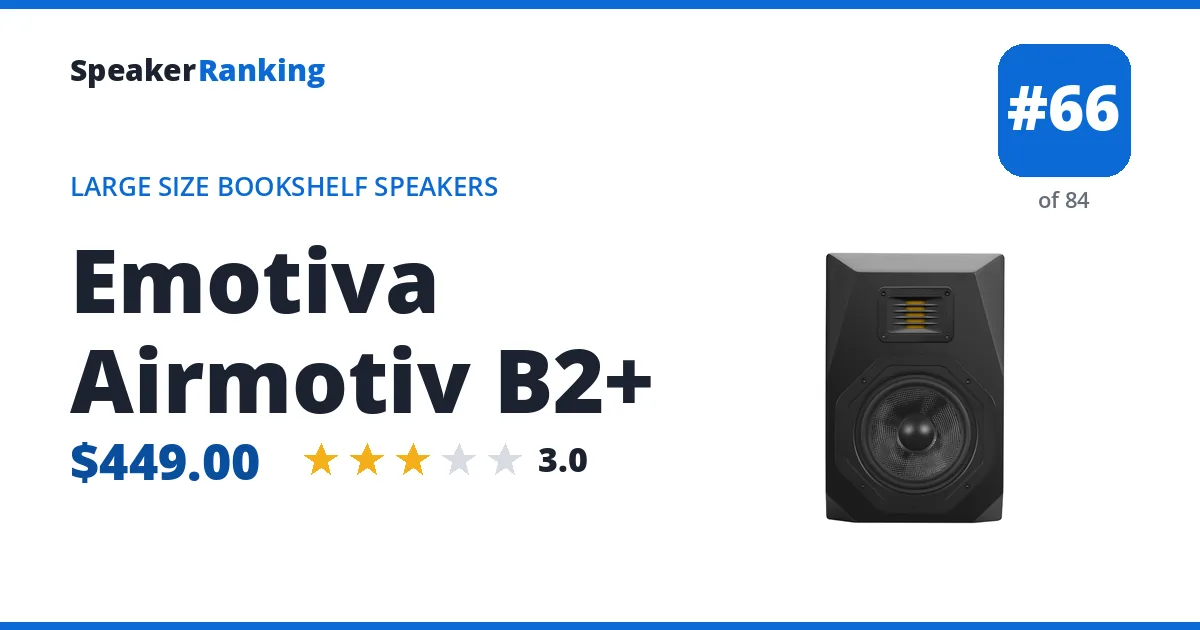
Newer model: the Emotiva Airmotiv XB2, ranked higher, rated 4.2/5.
Pros: Erin measured a useful 86dB average sensitivity and strong midbass punch around 120Hz. The folded-ribbon tweeter provides very broad upper-treble radiation, and the speaker can create a spacious presentation when positioned carefully. Response and directivity remain reasonably orderly below the roughly 2kHz crossover region. The 6.5-inch woofer offers more output capability than compact 5-inch competitors, while F3/F10 of 66/43Hz leave adequate overlap for a conventional 80Hz subwoofer crossover. Horizontal directivity data makes the broad baffle-step trend amenable to partial EQ below the crossover. Measured bass extension of 66Hz (-3dB), with a measured sensitivity of 86dB.
Cons: The replacement B2+ did not deliver the neutral upgrade Erin expected. A baffle-step loss around 500Hz depresses the lower midrange while the AMT’s much wider radiation above crossover injects excess room energy, yielding a bright, forward balance and false impression of cymbal detail. The directivity discontinuity near 2kHz cannot be completely equalized. Erin measured F3 at 66Hz and F10 at 43Hz, so meaningful kick-drum fundamentals and low bass still need a subwoofer. Vertical listening tolerance is roughly +/-10 degrees, with best results between the top of the woofer and tweeter axes. Broad lateral treble energy may require careful toe-out and sidewall absorption. Despite a large cabinet, it offers limited deep-bass advantage and was not Erin’s hoped-for successor to the more linear B1+. Discontinued.
Full Emotiva Airmotiv B2+ review and specifications →
| Bass Extension (-10dB) | 43Hz (measured, Erin’s Audio Corner) |
|---|---|
| Bass Extension (-3dB) | 66Hz (measured, Erin’s Audio Corner) |
| DIY Kit | No |
| Dimensions | 12.8”H x 8.5”W x 11.5”D (324 x 216 x 293 mm) |
| Drivers | 6.5” woven-fiber woofer, 32 x 25mm folded-ribbon tweeter |
| Impedance | 4 ohms nominal (manufacturer specified) |
| Sensitivity | 86dB (measured average, Erin’s Audio Corner) |
| Spinorama Preference Score | 5.60 |
| Spinorama Preference Score with Perfect Sub | 7.96 |
| Weight | 15.7 lbs (7.1 kg) each |
| Woofer Cabinet | ported, rear |
- Reviews, Comparisons and Sound Samples
- Head-to-Head Comparisons
- Emotiva Airmotiv B2+ vs Sonus Faber Sonetto II G2
- Emotiva Airmotiv B2+ vs KEF Q350
- Emotiva Airmotiv B2+ vs JBL XPL-90
- Emotiva Airmotiv B2+ vs Sonus Faber Lumina II Amator
- Emotiva Airmotiv B2+ vs Klipsch RP-600M
- Emotiva Airmotiv B2+ vs Polk R200
- Emotiva Airmotiv B2+ vs Wharfedale Diamond 9.1
- Emotiva Airmotiv B2+ vs Triangle Borea BR03
- See all 27 comparisons