Short answer: the Dynaudio Emit 20. It ranks #121 of 203 bookshelf speakers by sound quality, rated 3.6/5, at $1,049. The Polk R200 ranks #163, rated 3.2/5, at $639, $410 cheaper, not enough of a saving to outweigh the sound-quality gap.
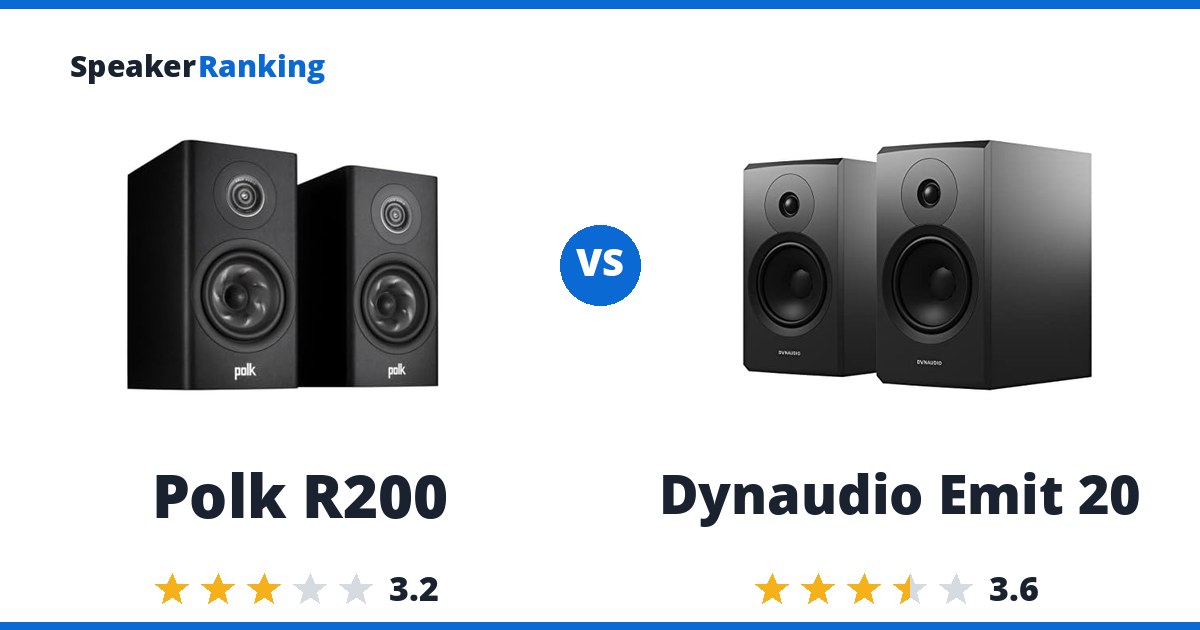
The Polk R200 is the more accurate option. Two-way design with a 6.5” midwoofer and 1” ring radiator tweeter, giving reasonably tight, well-defined imaging. Its measured preference score, a predictor of how neutral it sounds, is 5.09 against 4.22 for the Dynaudio Emit 20. The catch: A resonance and associated distortion increase around 800Hz-1kHz creates a “tinny,” occasionally glaring quality on certain instruments and vocals, confirmed both by ear and in the frequency-response and distortion measurements.
The Dynaudio Emit 20 is the better-sounding, deeper-bass option. Two-way design with a 28mm Esotar soft dome tweeter (Hexis-damped) and an 18cm mid-woofer, using a first-order crossover on the tweeter and second-order on the woofer. Its bass reaches about 54Hz before falling 3dB, against 74Hz for the Polk R200. The catch: A resonance around 600-800Hz gives snares and similar percussion a muffled, flat quality lacking impact: confirmed as originating in the woofer itself (isolated via measurements of the raw driver out of the cabinet), and attempts at constrained-layer damping didn’t resolve it.
Buy the Dynaudio Emit 20. It is rated higher for sound quality, and saving $410 with the Polk R200 does not make up for the sound-quality gap.
Looking for alternatives? See the complete Passive Home rankings.
Specifications Side By Side
| Polk R200 | Dynaudio Emit 20 | |
|---|---|---|
| Price | $639.00 per pair | $1,049.00 per pair |
| Ranked | #163 of 203 in Large Size Bookshelf Speakers | #121 of 203 in Large Size Bookshelf Speakers |
| Bass Extension (-10dB) | 50Hz (measured, Erin’s Audio Corner) | 33Hz (measured, Erin’s Audio Corner) |
| Bass Extension (-3dB) | 74Hz (measured, Erin’s Audio Corner) | 54Hz (measured, Erin’s Audio Corner) |
| Impedance | 4 ohms nominal, 3.8 ohms minimum (measured, Erin’s Audio Corner) | 6 ohms nominal (5.5 ohms minimum above 80Hz, measured, Erin’s Audio Corner) |
| Sensitivity | 85dB | 83.5dB (measured, Erin’s Audio Corner; 86dB manufacturer specified) |
| Drivers | 25mm soft dome + 165mm woofer | 7.1” Magnesium Silicate Polymer woofer, 1.1” Cerotar soft dome with Hexis tweeter |
| Weight | 31.3 lbs (14.2 kg) | 12.8 lbs (5.8 kg) |
| Dimensions | 14.1”H x 7.5”W x 13.9”D (359.0 x 190.0 x 353.8 mm) | 14.6”H x 8.1”W x 12.3”D (370.0 x 205.0 x 312.0 mm) |
| Woofer Cabinet | ported, rear | ported, rear |
| Spinorama Preference Score | 5.09 | 4.22 |
| Spinorama Preference Score with Perfect Sub | 7.61 | 5.92 |
| DIY Kit | No | No |
Related Speaker Comparisons
How Dynaudio Emit 20 compares with other leading options:
- Dynaudio Emit 20 vs Perlisten S4b
- KEF Reference 1 Meta vs Dynaudio Emit 20
- Dynaudio Emit 20 vs GR-Research NX-Studio
- Dynaudio Emit 20 vs AsciLab C6B
- Audio First Cadentia 3 vs Dynaudio Emit 20
Prices on this page were last checked October 7, 2026 at 9:25 PM UTC. Product prices and availability are accurate as of that date/time and are subject to change; the price and availability shown on Amazon at the time of purchase will apply to the purchase of this product.
As an eBay Partner, we may be compensated if you make a purchase.
The Two Speakers In Full
 Polk R200: $639.00 per pair Amazon eBay
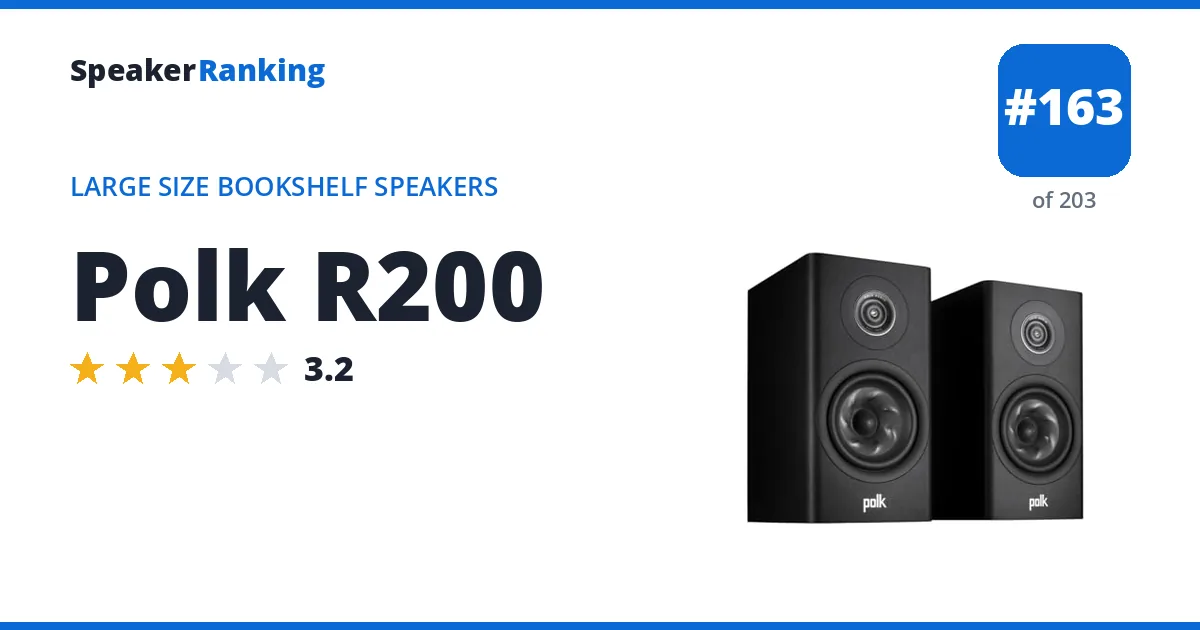
Same family: the Polk Reserve R100 (smaller bookshelf, ranked higher, rated 3.4/5), the Polk Reserve R500 (smallest floorstanding, rated 4.2/5), the Polk Reserve R600 (floorstanding, estimated 4.2/5), the Polk Audio Reserve R700 (largest floorstanding, rated 4.3/5), the Polk Audio Reserve R300 (smallest center, estimated 3.6/5), the Polk Audio Reserve R350 (center, rated 3.7/5) and the Polk Audio Reserve R400 (largest center, estimated 3.8/5).
Pros: Two-way design with a 6.5” midwoofer and 1” ring radiator tweeter, giving reasonably tight, well-defined imaging. Neutral through most of the midrange (roughly 200Hz-1kHz). On-axis response holds within about 1.5dB up to 10kHz. About 20dB of usable dynamic range (76dB to 96dB) before more significant compression sets in. Reasonably close to a 4-ohm nominal load, giving some flexibility with amplifier choice, though a dedicated 4-ohm-capable amp is still recommended. Measured bass extension of 74Hz (-3dB).
Cons: A resonance and associated distortion increase around 800Hz-1kHz creates a “tinny,” occasionally glaring quality on certain instruments and vocals, confirmed both by ear and in the frequency-response and distortion measurements. Above about 10kHz, the ring-radiator tweeter takes on an artificial, “digital-esque” quality, then falls off quickly above 16kHz. F3 of 74Hz and F10 of 50Hz mean there’s essentially no meaningful bass “thump” below about 60Hz: a subwoofer is strongly recommended even just to restore basic kick-drum presence. The ring radiator tweeter’s dispersion narrows sharply above about 8kHz, so the speaker should be aimed close to on-axis (no more than 5-10° of toe-out). Vertical listening position is fairly critical: moving more than a few degrees above or below the tweeter line causes a noticeable timbre shift due to a gap in the crossover region. Multitone distortion spikes substantially (to around 10%) in the 600Hz-1kHz region at higher output levels (around 96dB/1m), meaning the glare gets worse the louder it’s played. At the highest tested output (102dB, 26dB of dynamic range), the woofer shows clear signs of struggling; crossing to a subwoofer around 80-100Hz helps prevent bottoming out but doesn’t fully eliminate the compression.
Full Polk R200 review and specifications →
| Bass Extension (-10dB) | 50Hz (measured, Erin’s Audio Corner) |
|---|---|
| Bass Extension (-3dB) | 74Hz (measured, Erin’s Audio Corner) |
| DIY Kit | No |
| Dimensions | 14.1”H x 7.5”W x 13.9”D (359.0 x 190.0 x 353.8 mm) |
| Drivers | 25mm soft dome + 165mm woofer |
| Impedance | 4 ohms nominal, 3.8 ohms minimum (measured, Erin’s Audio Corner) |
| Sensitivity | 85dB |
| Spinorama Preference Score | 5.09 |
| Spinorama Preference Score with Perfect Sub | 7.61 |
| Weight | 31.3 lbs (14.2 kg) |
| Woofer Cabinet | ported, rear |
- Links
- Reviews, Comparisons and Sound Samples
- Head-to-Head Comparisons
 Dynaudio Emit 20: $1,049.00 per pair Amazon eBay
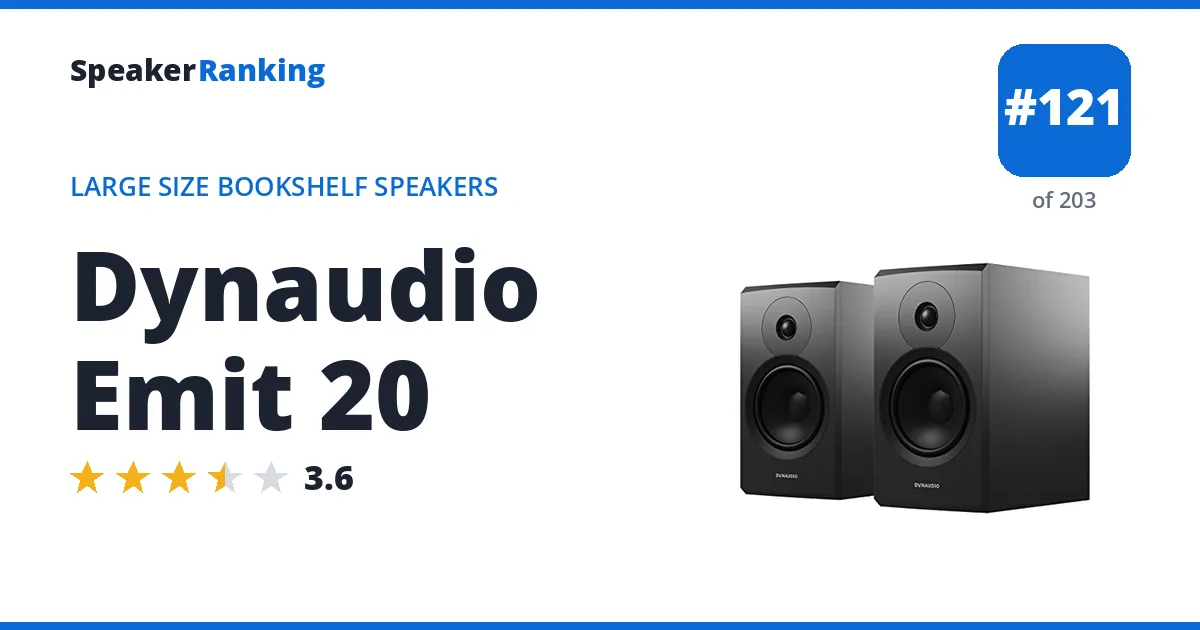
Same family: the Dynaudio Emit 10 (smaller bookshelf, estimated 3.2/5), the Dynaudio Emit 30 (smaller floorstanding, rated 3.9/5), the Dynaudio Emit 50 (larger floorstanding, estimated 4.2/5) and the Dynaudio Emit 25C (center, estimated 3.7/5).
Pros: Two-way design with a 28mm Esotar soft dome tweeter (Hexis-damped) and an 18cm mid-woofer, using a first-order crossover on the tweeter and second-order on the woofer. Exceptional bass extension for a bookshelf speaker: reaches a clean, authoritative 40Hz in-room, rare enough that the reviewer says most listeners could skip a subwoofer for typical music. Very low distortion across the board, staying below 1% THD down to 40Hz at 86dB and below 3% even at 96dB: unusually clean bass performance where most two-way bookshelf speakers start rising in distortion around 80Hz. Wide, remarkably consistent horizontal directivity (about ±50-60°) that holds steady up to roughly 13kHz: rare for a speaker in this format, thanks to a beveled tweeter edge that acts as a mild waveguide. Excellent compression and dynamic-range linearity at the frequency extremes, actually showing slight bass enhancement rather than the sharp low-end compression common in similarly-sized bookshelf speakers. Measured bass extension of 54Hz (-3dB), with a measured sensitivity of 83.5dB.
Cons: A resonance around 600-800Hz gives snares and similar percussion a muffled, flat quality lacking impact: confirmed as originating in the woofer itself (isolated via measurements of the raw driver out of the cabinet), and attempts at constrained-layer damping didn’t resolve it. A peak around 4kHz adds a sharp, edgy quality to some male vocals. A roughly 5dB boost above 10kHz gives cymbals and hi-hats excess shimmer that can sound unnatural, especially pointed directly on-axis. Vertical dispersion shows two separate crossover-related notches (above and below the tweeter reference line around 5kHz) rather than the usual single one, a direct consequence of the shallow crossover slopes used on both drivers. Multitone distortion is elevated in the midrange, possibly due to the woofer’s magnet structure lacking a shorting ring. Best aimed slightly off-axis (about 10-15° of toe-out) to tame the excess high-frequency shimmer, rather than pointed straight at the listener.
Full Dynaudio Emit 20 review and specifications →
| Bass Extension (-10dB) | 33Hz (measured, Erin’s Audio Corner) |
|---|---|
| Bass Extension (-3dB) | 54Hz (measured, Erin’s Audio Corner) |
| DIY Kit | No |
| Dimensions | 14.6”H x 8.1”W x 12.3”D (370.0 x 205.0 x 312.0 mm) |
| Drivers | 7.1” Magnesium Silicate Polymer woofer, 1.1” Cerotar soft dome with Hexis tweeter |
| Impedance | 6 ohms nominal (5.5 ohms minimum above 80Hz, measured, Erin’s Audio Corner) |
| Sensitivity | 83.5dB (measured, Erin’s Audio Corner; 86dB manufacturer specified) |
| Spinorama Preference Score | 4.22 |
| Spinorama Preference Score with Perfect Sub | 5.92 |
| Weight | 12.8 lbs (5.8 kg) |
| Woofer Cabinet | ported, rear |
- Links
- Reviews, Comparisons and Sound Samples
- Head-to-Head Comparisons
- Dynaudio Emit 20 vs Philharmonic BMR Monitor
- Dynaudio Emit 20 vs JBL Studio 630
- Dynaudio Emit 20 vs Behringer B2030P
- Dynaudio Emit 20 vs Mission LX-3 MKII
- Dynaudio Emit 20 vs Klipsch RP-600M II
- Dynaudio Emit 20 vs Polk Signature Elite ES20
- Dynaudio Emit 20 vs GR-Research X-LS Encore
- Dynaudio Emit 20 vs Infinity IL10
- See all 70 comparisons