Short answer: the KEF R3 Meta on measured sound quality, the Polk Monitor XT20 on price. The KEF R3 Meta ranks #10 of 203 bookshelf speakers, rated 4.6/5, at $2,499.99. The Polk Monitor XT20 ranks #143, rated 3.4/5, at $179, $2,320.99 cheaper.
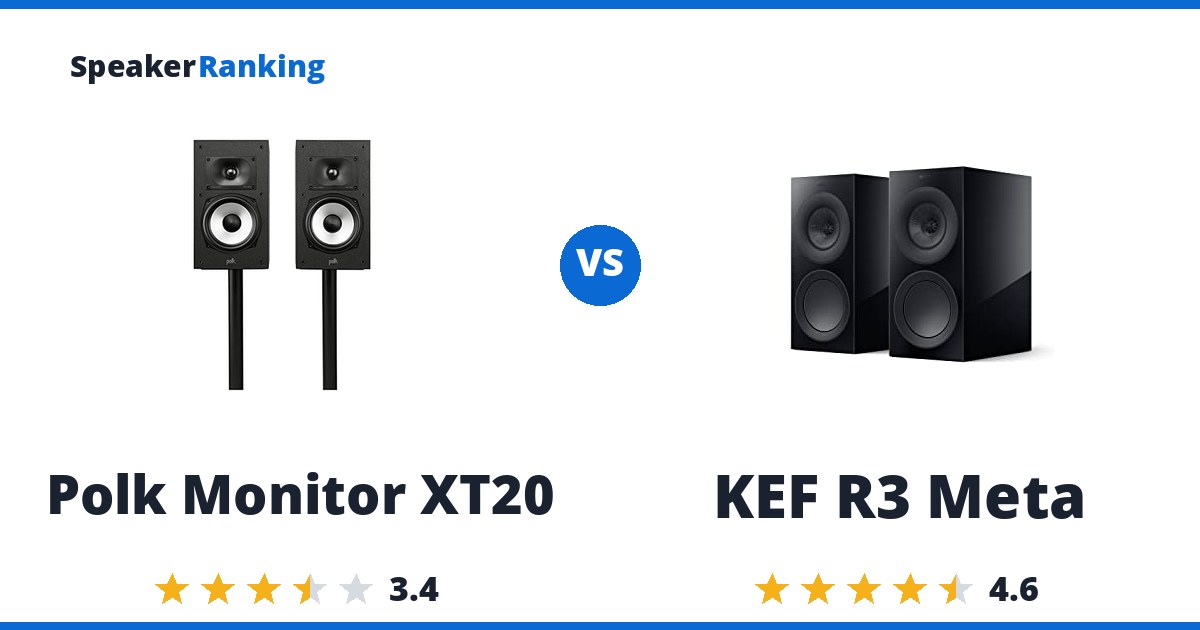
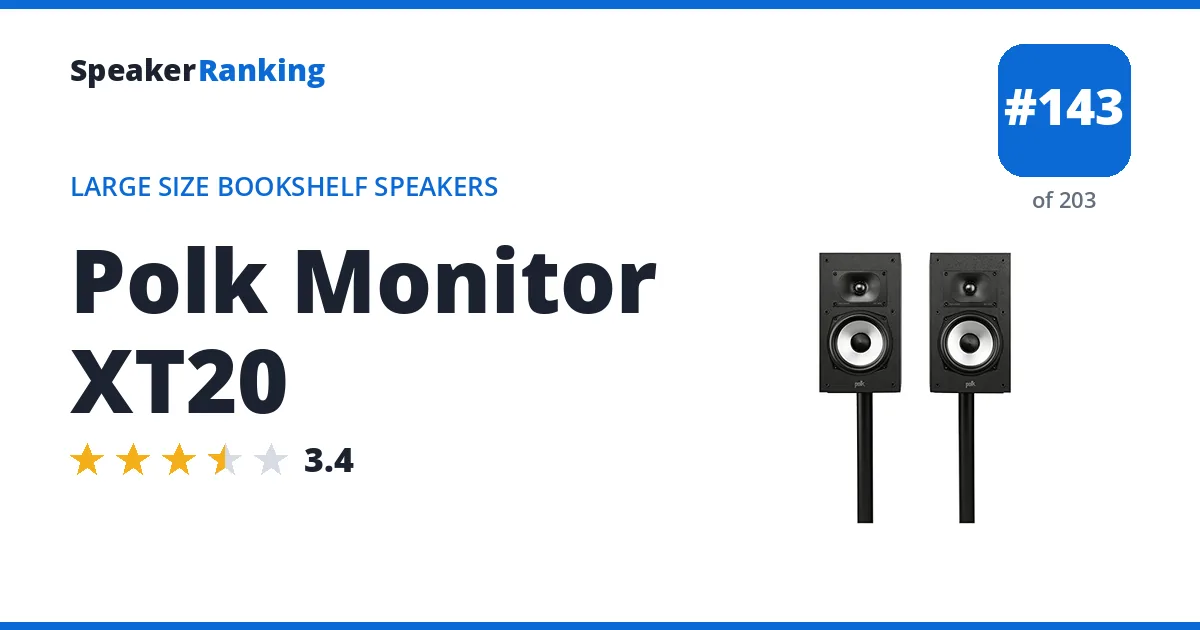
The Polk Monitor XT20 is the deeper-bass choice. Two-way bookshelf design with a 1” tweeter and 6.5” woofer, part of Polk’s budget-friendly XT lineup (spanning roughly $200-700 across the series). Its bass reaches about 64.5Hz before falling 3dB, against 76Hz for the KEF R3 Meta. Watch for: Notably bright treble, elevated roughly 1-5dB above the midrange depending on frequency: a characteristic shared across the whole Polk XT lineup, requiring either EQ or toe-out to tame.
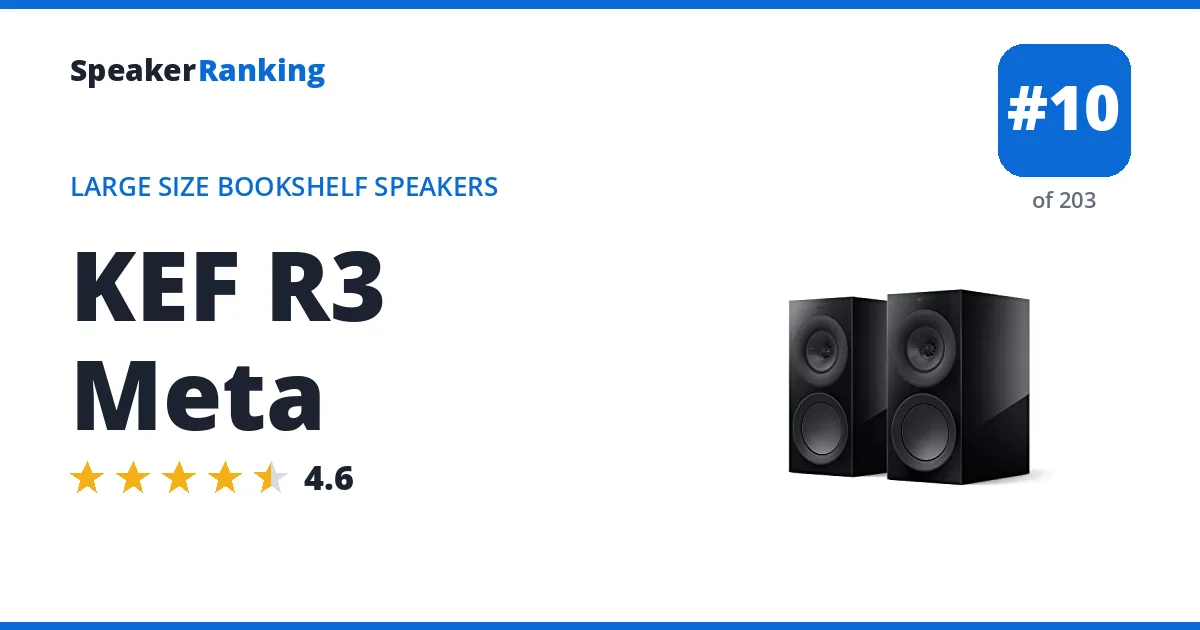
The KEF R3 Meta is the more accurate choice. Three-way design with an unconventional concentric layout: the 1” tweeter is recessed into the throat of the 5.25” midrange driver, deeper integration than a standard coaxial arrangement. Its measured preference score, a predictor of how neutral it sounds, is 6.10 against 4.71 for the Polk Monitor XT20. Watch for: Pointed straight on-axis, there’s a 1-2dB bump around 9kHz that stays consistent across angles thanks to the constant-directivity waveguide: only toeing the speaker out about 10° tames it.
Buy the Polk Monitor XT20 when the price outweighs sound quality for you, and the KEF R3 Meta when sound quality outweighs the price instead.
Want more options? Browse the full Passive Home rankings.
Specifications Side By Side
| Polk Monitor XT20 | KEF R3 Meta | |
|---|---|---|
| Price | $179.00 per pair | $2,499.99 per pair |
| Ranked | #143 of 203 in Large Size Bookshelf Speakers | #10 of 203 in Large Size Bookshelf Speakers |
| Bass Extension (-10dB) | 43.4Hz (derived, log-interpolated between spinorama.org -9dB/-12dB points) | 37Hz (measured, Erin’s Audio Corner) |
| Bass Extension (-3dB) | 64.5Hz (measured, Erin’s Audio Corner) | 76Hz (measured, Erin’s Audio Corner) |
| Dimensions | 13”H x 7.5”W x 11”D (330.2 x 190.5 x 279.4 mm) | 16.6”H x 7.9”W x 13.2”D (421.6 x 200.7 x 335.3 mm) |
| Impedance | 8 ohms nominal (measured, Erin’s Audio Corner) | 4 ohms nominal (3.2 ohms minimum above 80Hz, measured, Erin’s Audio Corner) |
| Sensitivity | 86dB (measured by Erin’s Audio Corner; 87dB manufacturer specified) | 85.9dB (measured, Erin’s Audio Corner; 87dB manufacturer specified) |
| Drivers | 6.5” bilaminate paper cone woofer, 1” Terylene dome tweeter | 6.5” Hybrid aluminum ported woofer, 5” aluminum cone midrange, 1” vented aluminium dome with MAT tweeter |
| Weight | 11.9 lbs (5.4 kg) each | 27.3 lbs (12.4 kg) each |
| Woofer Cabinet | ported | ported |
| Spinorama Preference Score | 4.71 | 6.10 |
| Spinorama Preference Score with Perfect Sub | 7.07 | 7.91 |
| DIY Kit | No | No |
Related Speaker Comparisons
More top alternatives to KEF R3 Meta:
- TAD Compact Reference One (CR1TX) vs KEF R3 Meta
- KEF R3 Meta vs Perlisten S4b
- KEF Reference 1 Meta vs KEF R3 Meta
- KEF R3 Meta vs GR-Research NX-Studio
- KEF R3 Meta vs March Audio Sointuva AWG
Prices on this page were last checked October 7, 2026 at 9:25 PM UTC. Product prices and availability are accurate as of that date/time and are subject to change; the price and availability shown on Amazon at the time of purchase will apply to the purchase of this product.
As an eBay Partner, we may be compensated if you make a purchase.
The Two Speakers In Full
 Polk Monitor XT20: $179.00 per pair Amazon Crutchfield eBay
Older model: the Polk Audio Monitor 40 Series II (rated 3.2/5).
Same family: the Polk Audio XT15 (smaller bookshelf, rated 3.7/5), the Polk Audio XT60 (smaller floorstanding, rated 3.5/5), the Polk Audio XT70 (larger floorstanding, rated 3.6/5), the Polk Audio XT30 (smaller center, rated 3.6/5), the Polk Audio XT35 (larger center, rated 4.1/5), the Polk Audio Monitor XT10 (smaller subwoofer, estimated 3.1/5) and the Polk Audio Monitor XT12 (larger subwoofer, estimated 3.3/5).
Pros: Two-way bookshelf design with a 1” tweeter and 6.5” woofer, part of Polk’s budget-friendly XT lineup (spanning roughly $200-700 across the series). Measures more linear and has fewer/smaller cabinet resonances than its smaller sibling, the XT15, making it (by the reviewer’s own assessment) probably the better of the two based on data alone. Reasonably good bass output for the price and size, with an F3 of 63Hz. Horizontal radiation of about ±50° gives a respectable, enjoyable soundstage width. Takes well to EQ correction: the early-reflections directivity trend is decently linear, meaning tonal adjustments can meaningfully improve the sound. Provides usable, respectable volume when paired with a subwoofer crossover, even though it isn’t intended to play extremely loud on its own. Measured bass extension of 64.5Hz (-3dB), with a measured sensitivity of 86dB.
Cons: Notably bright treble, elevated roughly 1-5dB above the midrange depending on frequency: a characteristic shared across the whole Polk XT lineup, requiring either EQ or toe-out to tame. Small resonances appear around 300Hz and 800Hz, with some of that energy leaking from the port area. Vertical listening window is narrow: best kept close to the tweeter axis, with only a couple of degrees of tolerance above or below before the sound changes. Still needs a subwoofer for real low-end extension despite the decent F3. Overall linearity isn’t state-of-the-art flat, and while the reviewer found it pleasant, some artificial brightness remains even after basic EQ correction in the crossover region.
Full Polk Monitor XT20 review and specifications →
| Bass Extension (-10dB) | 43.4Hz (derived, log-interpolated between spinorama.org -9dB/-12dB points) |
|---|---|
| Bass Extension (-3dB) | 64.5Hz (measured, Erin’s Audio Corner) |
| DIY Kit | No |
| Dimensions | 13”H x 7.5”W x 11”D (330.2 x 190.5 x 279.4 mm) |
| Drivers | 6.5” bilaminate paper cone woofer, 1” Terylene dome tweeter |
| Impedance | 8 ohms nominal (measured, Erin’s Audio Corner) |
| Sensitivity | 86dB (measured by Erin’s Audio Corner; 87dB manufacturer specified) |
| Spinorama Preference Score | 4.71 |
| Spinorama Preference Score with Perfect Sub | 7.07 |
| Weight | 11.9 lbs (5.4 kg) each |
| Woofer Cabinet | ported |
- Links
- Reviews, Comparisons and Sound Samples
- Erin’s Audio Corner: Polk’s new budget XT Speakers. Reviewed! More from Erin’s Audio Corner →
- Erin’s Audio Corner Website Polk Monitor XT20
- Erin’s Audio Corner: 10 Great (and Terrible) Speakers Under $300!
- Erin’s Audio Corner: Budget Stereo Systems You Will Love
- Erin’s Audio Corner Measurements (spinorama.org)
- Head-to-Head Comparisons
- Polk Monitor XT20 vs KEF Q3 Meta
- Polk Monitor XT20 vs Sonus Faber Lumina II
- Polk Monitor XT20 vs Polk Reserve R100
- Polk Monitor XT20 vs SVS Prime Bookshelf
- Polk Monitor XT20 vs ELAC Debut 2.0 B6.2
- Polk Monitor XT20 vs Focal Aria 906
- Polk Monitor XT20 vs Revel Performa M22
- Polk Monitor XT20 vs Dynaudio Special Forty
- See all 42 comparisons
 KEF R3 Meta: $2,499.99 per pair Amazon Crutchfield eBay
Older model: the KEF R3 (ranked lower, rated 4.5/5).
Same family: the KEF R5 Meta (smallest floorstanding, rated 4.6/5), the KEF R7 Meta (floorstanding, estimated 4.6/5), the KEF R11 Meta (largest floorstanding, rated 4.4/5), the KEF R2 Meta (smaller center, rated 4.3/5) and the KEF R6 Meta (larger center, rated 4.2/5).
Pros: Three-way design with an unconventional concentric layout: the 1” tweeter is recessed into the throat of the 5.25” midrange driver, deeper integration than a standard coaxial arrangement. A quasi sealed/ported bass alignment gives an extended low-end shelf tuned to match typical in-room gain, reaching about 50Hz for most content: deeper than recently-tested rivals like the Focal Aria 906, Polk R200, and an 8” Aperion design. Spinorama measurements show class-leading directivity and sound power, plus very linear on-axis response (at the recommended 10° toe-out) and early-reflections directivity, so it takes EQ exceptionally well. The vertical sweet spot extends to about ±20-30° off the reference axis with nearly identical tonality, unusually wide for a two- or three-way design. A clear upgrade over the earlier, non-Meta R3, eliminating the treble brightness the original had even when toed off-axis. Outperforms similarly-priced rivals (Revel M106, Wharfedale Linton, Philharmonic BMR V2, JBL HDI 1600) specifically on directivity and linearity in the reviewer’s measurements. At $2500/pair, called the best value in its class with near-reference-level anechoic performance. Measured bass extension of 76Hz (-3dB), with a measured sensitivity of 85.9dB.
Cons: Pointed straight on-axis, there’s a 1-2dB bump around 9kHz that stays consistent across angles thanks to the constant-directivity waveguide: only toeing the speaker out about 10° tames it. Minimum impedance dips to about 3.2 ohms nominal (EPDR as low as 1.9 ohms), so it needs a 4-ohm-stable amplifier; a standard AVR likely won’t cut it. Distortion crosses the reviewer’s 3% threshold around 80Hz at 96dB output and shows added deviation again near 50Hz, indicating it runs out of headroom at higher volumes: a subwoofer is recommended for loud listening. Horizontal radiation narrows from about ±70° at low frequency to ±40° at high frequency. Below about 100Hz, compression testing shows fairly wide deviations at both 86dB and 96dB output, though the reviewer notes this is typical for speakers in this size and price class. Current R3 owners who are already happy with that speaker have little reason to upgrade.
Full KEF R3 Meta review and specifications →
| Bass Extension (-10dB) | 37Hz (measured, Erin’s Audio Corner) |
|---|---|
| Bass Extension (-3dB) | 76Hz (measured, Erin’s Audio Corner) |
| DIY Kit | No |
| Dimensions | 16.6”H x 7.9”W x 13.2”D (421.6 x 200.7 x 335.3 mm) |
| Drivers | 6.5” Hybrid aluminum ported woofer, 5” aluminum cone midrange, 1” vented aluminium dome with MAT tweeter |
| Impedance | 4 ohms nominal (3.2 ohms minimum above 80Hz, measured, Erin’s Audio Corner) |
| Sensitivity | 85.9dB (measured, Erin’s Audio Corner; 87dB manufacturer specified) |
| Spinorama Preference Score | 6.10 |
| Spinorama Preference Score with Perfect Sub | 7.91 |
| Weight | 27.3 lbs (12.4 kg) each |
| Woofer Cabinet | ported |
- Links
- Reviews, Comparisons and Sound Samples
- Erin’s Audio Corner: KEF R3 Meta: The Speaker to Beat. More from Erin’s Audio Corner →
- Erin’s Audio Corner Website KEF R3 Meta Review
- Erin’s Audio Corner: Upgrade Your Sound with These 6 Surprisingly Affordable Speakers!
- Erin’s Audio Corner: My Personal Favorite Speakers Under $2500
- Erin’s Audio Corner: My Top Picks of 2023: Must-Haves Under $3000
- GR-Research: Finally… a Speaker Danny Doesn’t Have to Fix? More from GR-Research →
- New Record Day: The Gold Standard Of "Pretty Good" KEF R3 Meta Review
- Erin’s Audio Corner Measurements (spinorama.org)
- Erin’s Audio Corner: KEF R3 vs R3 Meta vs Reference 1 Meta. Why such a big price gap?
- Head-to-Head Comparisons