Short answer: the KEF Q Concerto Meta if sound quality matters most, the Polk Monitor XT20 if price matters most. The KEF Q Concerto Meta ranks #11 of 203 bookshelf speakers, rated 4.6/5, at $1,399.99. The Polk Monitor XT20 ranks #143, rated 3.4/5, at $179, $1,220.99 cheaper.
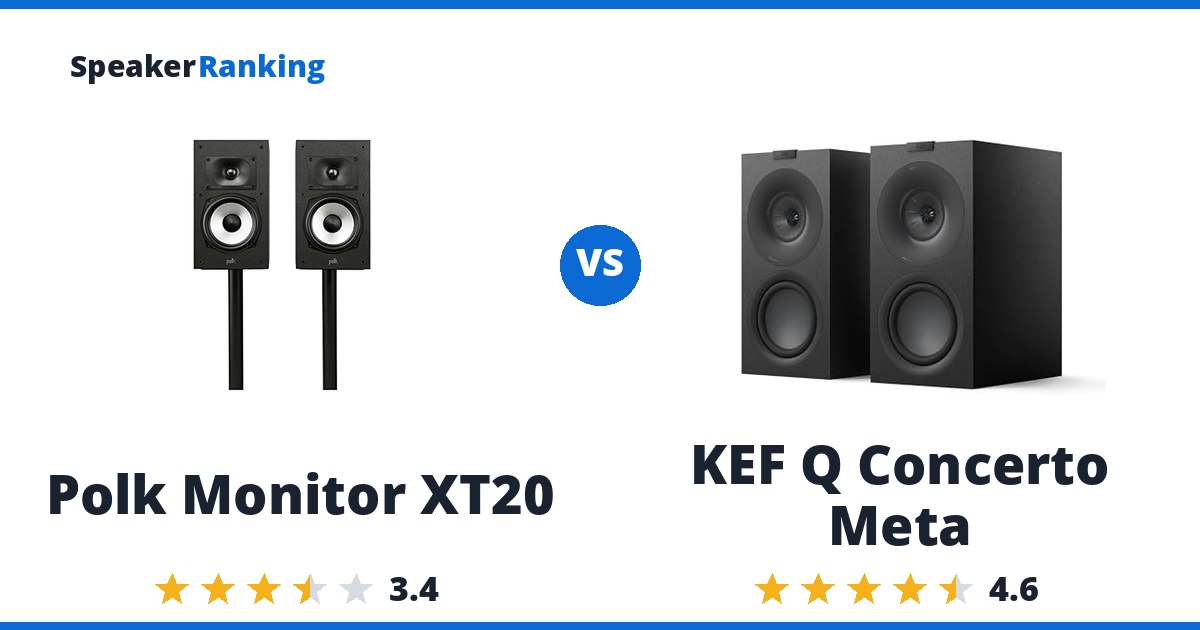
Why pick the Polk Monitor XT20: Two-way bookshelf design with a 1” tweeter and 6.5” woofer, part of Polk’s budget-friendly XT lineup (spanning roughly $200-700 across the series). Watch for: Notably bright treble, elevated roughly 1-5dB above the midrange depending on frequency: a characteristic shared across the whole Polk XT lineup, requiring either EQ or toe-out to tame.
The KEF Q Concerto Meta is the more accurate, deeper-bass choice. Really good in-room neutrality with consistent horizontal directivity from seat to seat. Its measured preference score, a predictor of how neutral it sounds, is 6.01 against 4.71 for the Polk Monitor XT20. Its bass reaches about 53Hz before falling 3dB, against 64.5Hz for the Polk Monitor XT20. The catch: Radiation pattern measures about ±50°, narrower than the reviewer’s preferred ±60° for a stronger sense of envelopment.
Buy the Polk Monitor XT20 when the price outweighs sound quality for you, and the KEF Q Concerto Meta when sound quality outweighs the price instead.
Looking for alternatives? See the complete Passive Home rankings.
Specifications Side By Side
| Polk Monitor XT20 | KEF Q Concerto Meta | |
|---|---|---|
| Price | $179.00 per pair | $1,399.99 per pair |
| Ranked | #143 of 203 in Large Size Bookshelf Speakers | #11 of 203 in Large Size Bookshelf Speakers |
| Bass Extension (-10dB) | 43.4Hz (derived, log-interpolated between spinorama.org -9dB/-12dB points) | 35Hz (measured, Erin’s Audio Corner) |
| Bass Extension (-3dB) | 64.5Hz (measured, Erin’s Audio Corner) | 53Hz (measured, Erin’s Audio Corner) |
| Dimensions | 13”H x 7.5”W x 11”D (330.2 x 190.5 x 279.4 mm) | 16.3”H x 8.3”W x 12.4”D (414 x 210.8 x 315 mm) |
| Impedance | 8 ohms nominal (measured, Erin’s Audio Corner) | 4 ohms nominal (3.3 ohms minimum above 80Hz, measured by Erin’s Audio Corner) |
| Sensitivity | 86dB (measured by Erin’s Audio Corner; 87dB manufacturer specified) | 84.2dB (measured average, Erin’s Audio Corner) |
| Drivers | 6.5” bilaminate paper cone woofer, 1” Terylene dome tweeter | 165 mm (6.5 in.) hybrid aluminium cone woofer, 100 mm (4 in.) aluminium cone midrange, 19 mm (0.75 in.) vented aluminium dome with MAT tweeter |
| Weight | 11.9 lbs (5.4 kg) each | 20.9 lbs (9.5 kg) each |
| Woofer Cabinet | ported | ported, rear |
| Spinorama Preference Score | 4.71 | 6.01 |
| Spinorama Preference Score with Perfect Sub | 7.07 | 7.71 |
| DIY Kit | No | No |
Related Speaker Comparisons
More worthwhile head-to-heads for KEF Q Concerto Meta:
- TAD Compact Reference One (CR1TX) vs KEF Q Concerto Meta
- KEF Q Concerto Meta vs Perlisten S4b
- KEF Reference 1 Meta vs KEF Q Concerto Meta
- KEF Q Concerto Meta vs GR-Research NX-Studio
- KEF Q Concerto Meta vs March Audio Sointuva AWG
Prices on this page were last checked October 7, 2026 at 9:25 PM UTC. Product prices and availability are accurate as of that date/time and are subject to change; the price and availability shown on Amazon at the time of purchase will apply to the purchase of this product.
As an eBay Partner, we may be compensated if you make a purchase.
The Two Speakers In Full
 Polk Monitor XT20: $179.00 per pair Amazon Crutchfield eBay
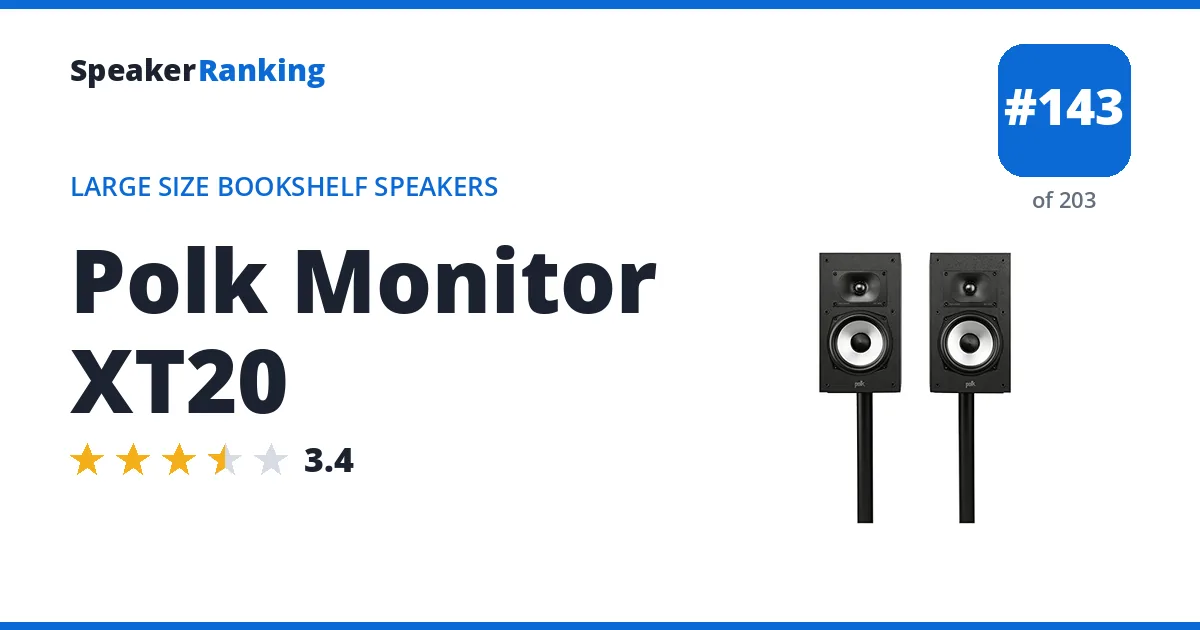
Older model: the Polk Audio Monitor 40 Series II (rated 3.2/5).
Same family: the Polk Audio XT15 (smaller bookshelf, rated 3.7/5), the Polk Audio XT60 (smaller floorstanding, rated 3.5/5), the Polk Audio XT70 (larger floorstanding, rated 3.6/5), the Polk Audio XT30 (smaller center, rated 3.6/5), the Polk Audio XT35 (larger center, rated 4.1/5), the Polk Audio Monitor XT10 (smaller subwoofer, estimated 3.1/5) and the Polk Audio Monitor XT12 (larger subwoofer, estimated 3.3/5).
Pros: Two-way bookshelf design with a 1” tweeter and 6.5” woofer, part of Polk’s budget-friendly XT lineup (spanning roughly $200-700 across the series). Measures more linear and has fewer/smaller cabinet resonances than its smaller sibling, the XT15, making it (by the reviewer’s own assessment) probably the better of the two based on data alone. Reasonably good bass output for the price and size, with an F3 of 63Hz. Horizontal radiation of about ±50° gives a respectable, enjoyable soundstage width. Takes well to EQ correction: the early-reflections directivity trend is decently linear, meaning tonal adjustments can meaningfully improve the sound. Provides usable, respectable volume when paired with a subwoofer crossover, even though it isn’t intended to play extremely loud on its own. Measured bass extension of 64.5Hz (-3dB), with a measured sensitivity of 86dB.
Cons: Notably bright treble, elevated roughly 1-5dB above the midrange depending on frequency: a characteristic shared across the whole Polk XT lineup, requiring either EQ or toe-out to tame. Small resonances appear around 300Hz and 800Hz, with some of that energy leaking from the port area. Vertical listening window is narrow: best kept close to the tweeter axis, with only a couple of degrees of tolerance above or below before the sound changes. Still needs a subwoofer for real low-end extension despite the decent F3. Overall linearity isn’t state-of-the-art flat, and while the reviewer found it pleasant, some artificial brightness remains even after basic EQ correction in the crossover region.
Full Polk Monitor XT20 review and specifications →
| Bass Extension (-10dB) | 43.4Hz (derived, log-interpolated between spinorama.org -9dB/-12dB points) |
|---|---|
| Bass Extension (-3dB) | 64.5Hz (measured, Erin’s Audio Corner) |
| DIY Kit | No |
| Dimensions | 13”H x 7.5”W x 11”D (330.2 x 190.5 x 279.4 mm) |
| Drivers | 6.5” bilaminate paper cone woofer, 1” Terylene dome tweeter |
| Impedance | 8 ohms nominal (measured, Erin’s Audio Corner) |
| Sensitivity | 86dB (measured by Erin’s Audio Corner; 87dB manufacturer specified) |
| Spinorama Preference Score | 4.71 |
| Spinorama Preference Score with Perfect Sub | 7.07 |
| Weight | 11.9 lbs (5.4 kg) each |
| Woofer Cabinet | ported |
- Links
- Reviews, Comparisons and Sound Samples
- Erin’s Audio Corner: Polk’s new budget XT Speakers. Reviewed! More from Erin’s Audio Corner →
- Erin’s Audio Corner Website Polk Monitor XT20
- Erin’s Audio Corner: 10 Great (and Terrible) Speakers Under $300!
- Erin’s Audio Corner: Budget Stereo Systems You Will Love
- Erin’s Audio Corner Measurements (spinorama.org)
- Head-to-Head Comparisons
- Polk Monitor XT20 vs KEF Q3 Meta
- Polk Monitor XT20 vs Sonus Faber Lumina II
- Polk Monitor XT20 vs Polk Reserve R100
- Polk Monitor XT20 vs SVS Prime Bookshelf
- Polk Monitor XT20 vs ELAC Debut 2.0 B6.2
- Polk Monitor XT20 vs Focal Aria 906
- Polk Monitor XT20 vs Revel Performa M22
- Polk Monitor XT20 vs Dynaudio Special Forty
- See all 42 comparisons
 KEF Q Concerto Meta: $1,399.99 per pair Amazon Crutchfield eBay
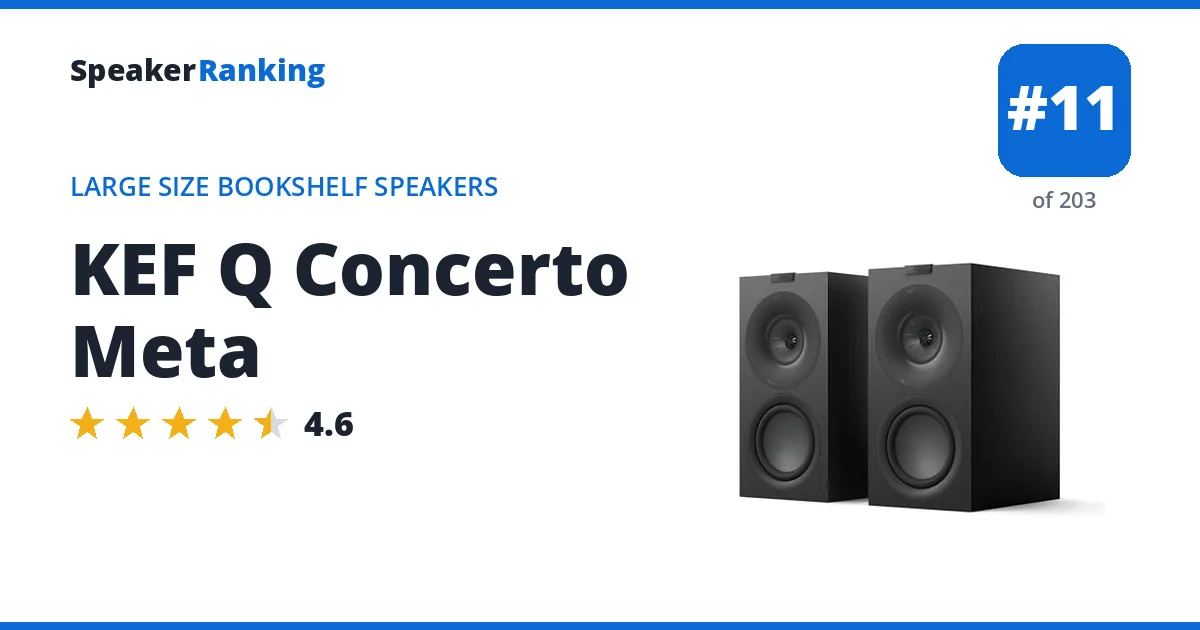
Same family: the KEF Q1 Meta (smaller bookshelf, rated 3.6/5), the KEF Q4 Meta (smaller bookshelf, estimated 3.4/5), the KEF Q3 Meta (smaller bookshelf, ranked lower, rated 3.4/5), the KEF Q7 Meta (smaller floorstanding, estimated 3.5/5), the KEF Q11 Meta (larger floorstanding, rated 4/5) and the KEF Q6 Meta (center, rated 3.9/5).
Pros: Really good in-room neutrality with consistent horizontal directivity from seat to seat. Directivity holds remarkably steady from lower treble into upper treble, where many similarly-priced speakers narrow sharply as frequency rises: one of the reviewer’s top 10 picks under $1,500. Measured bass extension of 53Hz (-3dB), with a measured sensitivity of 84.2dB.
Cons: Radiation pattern measures about ±50°, narrower than the reviewer’s preferred ±60° for a stronger sense of envelopment. Needs to be pointed closer to on-axis rather than heavily toed out: combined with its rolled-off, shelved-down top end, too much toe-out makes it sound noticeably dark.
Full KEF Q Concerto Meta review and specifications →
| Bass Extension (-10dB) | 35Hz (measured, Erin’s Audio Corner) |
|---|---|
| Bass Extension (-3dB) | 53Hz (measured, Erin’s Audio Corner) |
| DIY Kit | No |
| Dimensions | 16.3”H x 8.3”W x 12.4”D (414 x 210.8 x 315 mm) |
| Drivers | 165 mm (6.5 in.) hybrid aluminium cone woofer, 100 mm (4 in.) aluminium cone midrange, 19 mm (0.75 in.) vented aluminium dome with MAT tweeter |
| Impedance | 4 ohms nominal (3.3 ohms minimum above 80Hz, measured by Erin’s Audio Corner) |
| Sensitivity | 84.2dB (measured average, Erin’s Audio Corner) |
| Spinorama Preference Score | 6.01 |
| Spinorama Preference Score with Perfect Sub | 7.71 |
| Weight | 20.9 lbs (9.5 kg) each |
| Woofer Cabinet | ported, rear |
- Links
- Reviews, Comparisons and Sound Samples
- Erin’s Audio Corner: HiFi Perfection? KEF CONCERTO META Delivers! More from Erin’s Audio Corner →
- Erin’s Audio Corner Website KEF Q Concerto Meta
- Erin’s Audio Corner: I Tested 250 Speakers So You Don’t Have To!
- Erin’s Audio Corner: HiFi Perfection? KEF CONCERTO META Delivers!
- Erin’s Audio Corner: My Absolute Favorite Products of 2024 Revealed
- Erin’s Audio Corner Measurements (spinorama.org)
- Head-to-Head Comparisons
- KEF Q Concerto Meta vs KEF R3 Meta
- KEF Q Concerto Meta vs AsciLab F6B
- KEF Q Concerto Meta vs Wharfedale Aura 2
- KEF Q Concerto Meta vs Revel M106
- KEF Q Concerto Meta vs KEF R3
- KEF Q Concerto Meta vs Audio First Cadentia 3
- KEF Q Concerto Meta vs AsciLab C6B
- KEF Q Concerto Meta vs Buchardt Audio E50
- See all 104 comparisons