Short answer: the PMC result6. It ranks #67 of 68 powered bookshelf speakers by sound quality, rated 3.2/5, at $3,300; the Ocean Way Audio HR5 ranks #68, rated 2.5/5, and costs $5,598, so there is not much of a tradeoff to weigh.
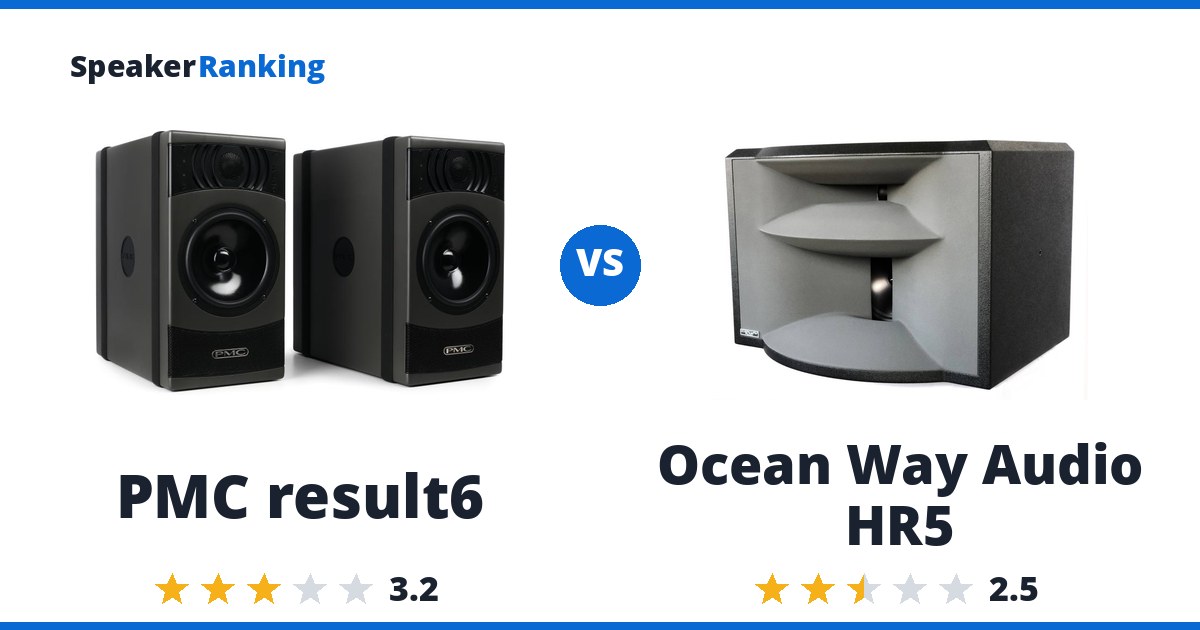
The case for the PMC result6: A self-powered professional monitor with straightforward analog connectivity. Watch for: The measured -3dB point is 67.4Hz, and preference scores of 2.86 standalone and 5.37 with an ideal subwoofer reveal limited native tonal accuracy.
Why pick the Ocean Way Audio HR5: The active format and substantial drivers can supply useful scale in a studio system. The catch: Scores of 1.78 standalone and 3.86 with an ideal subwoofer reflect substantial response unevenness, including severe upper-treble irregularities.
Buy the PMC result6. It is rated higher for sound quality than the Ocean Way Audio HR5 and costs less, which makes it the one to get unless you need something the other one does better.
Still deciding? The full Powered Home rankings cover every ranked option.
Specifications Side By Side
| PMC result6 | Ocean Way Audio HR5 | |
|---|---|---|
| Price | $3,300 per pair | $5,598 per pair |
| Ranked | #67 of 68 in Large Size Powered Bookshelf Speakers | #68 of 68 in Large Size Powered Bookshelf Speakers |
| Enclosure | Active 2-way Advanced Transmission Line | - |
| Drivers | 1-inch tweeter, 6.5-inch woofer | 7” low-frequency driver, 1” high-frequency driver (horn/waveguide) |
| Amplifier Power | 100W LF + 65W HF each | 215W total (125W LF, 90W HF) |
| Frequency Response | 45Hz-22kHz | 45Hz - 20kHz (Manufacturer specified) |
| Maximum SPL | 112dB | - |
| Inputs | Balanced XLR | XLR (analog), XLR AES3 (digital) |
| Weight | 17.6 lbs (8 kg) each | 37.9 lbs (17.2 kg) each |
| Spinorama Preference Score | 2.86 | 1.78 |
| Spinorama Preference Score with Perfect Sub | 5.37 | 3.86 |
| XLR Input | Yes | Yes |
| RCA Input | No | No |
| TRS Input | No | No |
| Optical Input | No | No |
| Coaxial Input | No | No |
| USB Input | No | No |
| HDMI Input | No | No |
| AES Input | No | Yes |
| Aux Input | No | No |
| Bluetooth | No | No |
| Dimensions | 15” x 7.8” x 14.2” (380 x 199 x 360 mm) (H x W x D) | 12H x 17.5W x 14.5D in |
| Bass Extension (-3dB) | - | 52.7Hz (measured, Audio Science Review) |
| Bass Extension (-10dB) | - | 42Hz (derived, log-interpolated between spinorama.org -9dB/-12dB points) |
| App | - | No |
| EQ | - | No |
| DSP | - | No |
Related Speaker Comparisons
More worthwhile head-to-heads for PMC result6:
- Adam Audio A7V vs PMC result6
- Focal Twin6 Be vs PMC result6
- Focal Alpha Twin Evo vs PMC result6
- PMC result6 vs EVE Audio SC305
- JBL 708P vs Ocean Way Audio HR5
Prices on this page were last checked September 29, 2026 at 3:43 PM UTC. Product prices and availability are accurate as of that date/time and are subject to change; the price and availability shown on Amazon at the time of purchase will apply to the purchase of this product.
As an eBay Partner, we may be compensated if you make a purchase.
The Two Speakers In Full
 PMC result6: $3,300 per pair Sweetwater eBay
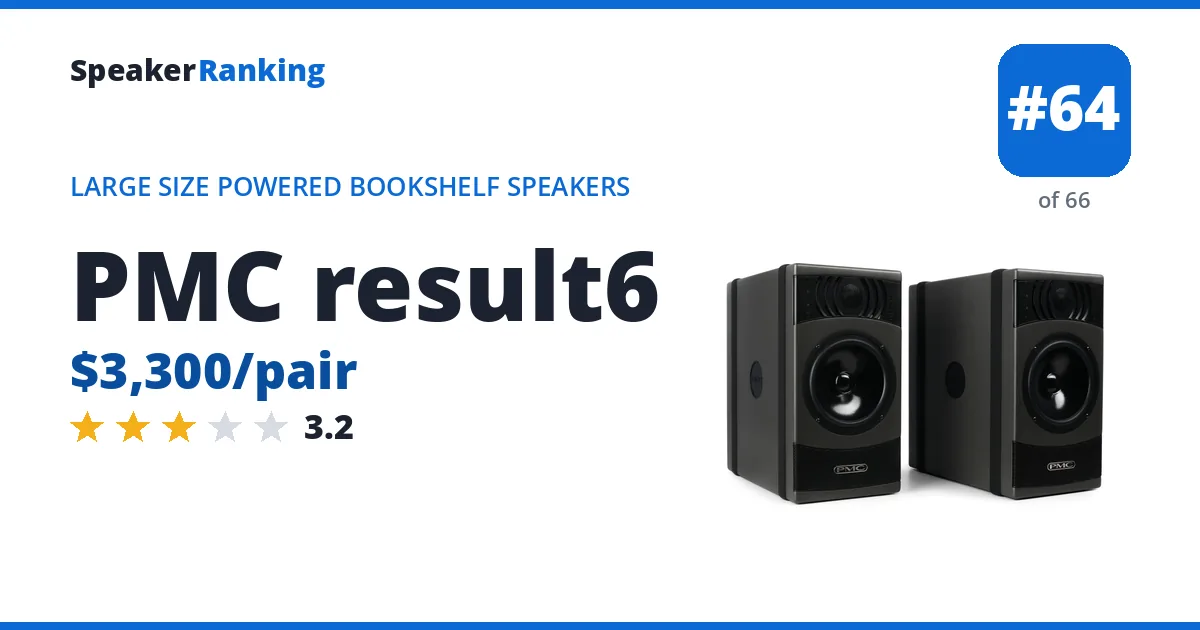
Pros: A self-powered professional monitor with straightforward analog connectivity. A subwoofer can extend its bandwidth, with the measured -6dB point at 55.7Hz providing a useful system-planning reference.
Cons: The measured -3dB point is 67.4Hz, and preference scores of 2.86 standalone and 5.37 with an ideal subwoofer reveal limited native tonal accuracy. Broad response and listening-window irregularities remain even when bass is accounted for. Its transmission-line construction does not overcome these measured limitations, and correction requires external equipment.
Full PMC result6 review and specifications →
| AES Input | No |
|---|---|
| Amplifier Power | 100W LF + 65W HF each |
| Aux Input | No |
| Bluetooth | No |
| Coaxial Input | No |
| Dimensions | 15” x 7.8” x 14.2” (380 x 199 x 360 mm) (H x W x D) |
| Drivers | 1-inch tweeter, 6.5-inch woofer |
| Enclosure | Active 2-way Advanced Transmission Line |
| Frequency Response | 45Hz-22kHz |
| HDMI Input | No |
| Inputs | Balanced XLR |
| Maximum SPL | 112dB |
| Optical Input | No |
| RCA Input | No |
| Spinorama Preference Score | 2.86 |
| Spinorama Preference Score with Perfect Sub | 5.37 |
| TRS Input | No |
| USB Input | No |
| Weight | 17.6 lbs (8 kg) each |
| XLR Input | Yes |
- Links
- Reviews, Comparisons and Sound Samples
- Head-to-Head Comparisons
 Ocean Way Audio HR5: $5,598 per pair Sweetwater eBay
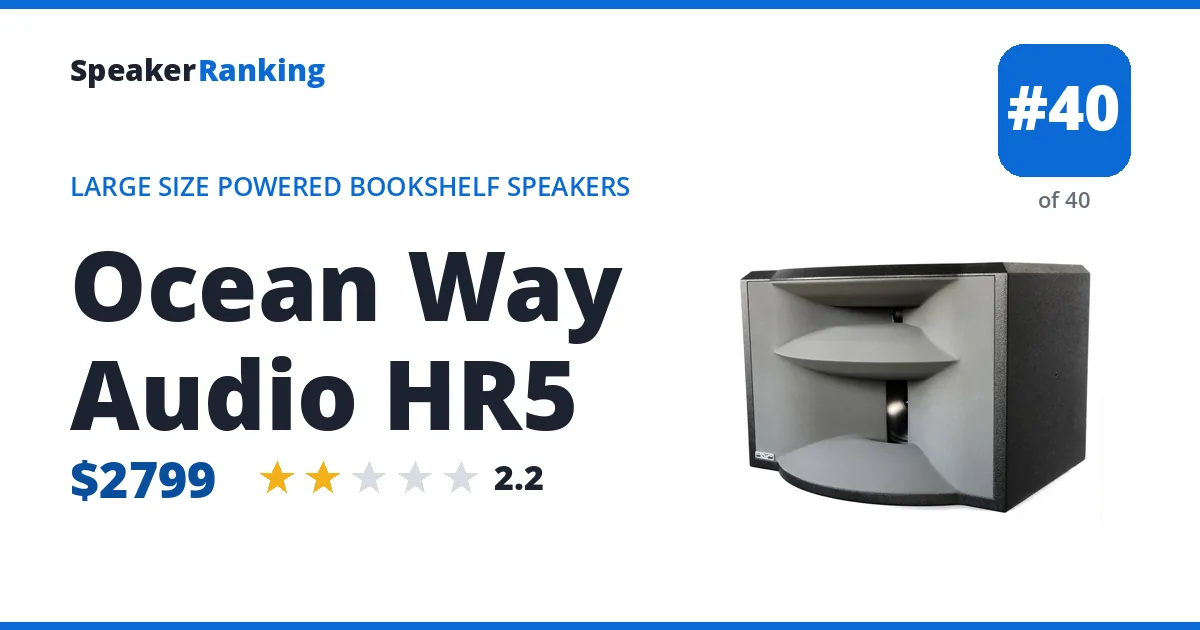
Pros: The active format and substantial drivers can supply useful scale in a studio system. Measured -3dB extension is 52.7Hz, so separate bass support would be appropriate for full-range work. Measured bass extension of 52.7Hz (-3dB).
Cons: Scores of 1.78 standalone and 3.86 with an ideal subwoofer reflect substantial response unevenness, including severe upper-treble irregularities. Narrowing high-frequency coverage further changes the balance across listening positions. Bass support cannot repair those midrange and treble problems, making this difficult to recommend for neutral monitoring.
Full Ocean Way Audio HR5 review and specifications →
| AES Input | Yes |
|---|---|
| Amplifier Power | 215W total (125W LF, 90W HF) |
| App | No |
| Aux Input | No |
| Bass Extension (-10dB) | 42Hz (derived, log-interpolated between spinorama.org -9dB/-12dB points) |
| Bass Extension (-3dB) | 52.7Hz (measured, Audio Science Review) |
| Bluetooth | No |
| Coaxial Input | No |
| DSP | No |
| Dimensions | 12H x 17.5W x 14.5D in |
| Drivers | 7” low-frequency driver, 1” high-frequency driver (horn/waveguide) |
| EQ | No |
| Frequency Response | 45Hz - 20kHz (Manufacturer specified) |
| HDMI Input | No |
| Inputs | XLR (analog), XLR AES3 (digital) |
| Optical Input | No |
| RCA Input | No |
| Spinorama Preference Score | 1.78 |
| Spinorama Preference Score with Perfect Sub | 3.86 |
| TRS Input | No |
| USB Input | No |
| Weight | 37.9 lbs (17.2 kg) each |
| XLR Input | Yes |
- Links
- Reviews, Comparisons and Sound Samples
- Head-to-Head Comparisons