Short answer: the AsciLab C6B. It ranks #6 of 131 bookshelf speakers by sound quality, rated 4.7/5, at $1,145; the MoFi SourcePoint 8 ranks #17, rated 4.5/5, and costs $2,594, so there is little reason to consider the other one.
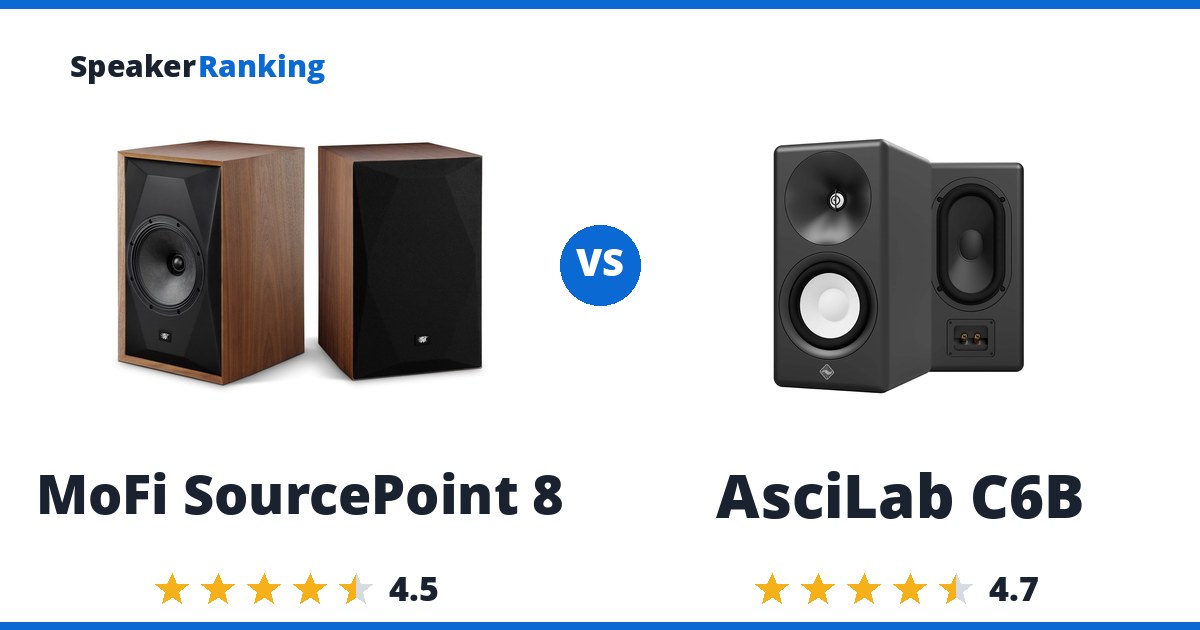
Why pick the MoFi SourcePoint 8: 8” twin-drive concentric driver paired with a 1.25” soft dome tweeter, in a diffraction-reducing baffle design; rated 47Hz-30kHz. The tradeoff: Like other coincident designs, produces diffraction dips around 4kHz and 7kHz when pointed directly on-axis; needs about 10-15° of toe-out to smooth those out.
The case for the AsciLab C6B: Two-way design pairing a 1” aluminum ceramic dome tweeter on a large waveguide with a 6” aluminum ceramic cone woofer, crossed over at 1.1kHz, plus a rear passive radiator. The tradeoff: Bass rolls off around 50Hz in-room (F3 54Hz, F10 35Hz), so a subwoofer is needed for real extension below that.
Buy the AsciLab C6B. It is rated higher for sound quality than the MoFi SourcePoint 8 and costs less, which makes it the one to get unless you need something the other one does better.
Still deciding? The full Passive Home rankings cover every ranked option.
Specifications Side By Side
| MoFi SourcePoint 8 | AsciLab C6B | |
|---|---|---|
| Price | $2594 per pair | $1145 per pair |
| Ranked | #17 of 131 in Large Size Bookshelf Speakers | #6 of 131 in Large Size Bookshelf Speakers |
| Bass Extension (-10dB) | 43Hz (measured, Erin’s Audio Corner) | 35Hz (measured, Erin’s Audio Corner) |
| Bass Extension (-3dB) | 52Hz (measured, Erin’s Audio Corner) | 54Hz (measured, Erin’s Audio Corner) |
| Dimensions | 18”H x 11.4”W x 13.2”D (457.2 x 289.6 x 335.3 mm) | 15.7”H x 8”W x 10.4”D (398.8 x 203.2 x 264.2 mm) |
| Impedance | 8 ohms nominal (8 ohms minimum above 80Hz, measured, Erin’s Audio Corner) | 4 ohms nominal, 2.6 ohms minimum (measured, Erin’s Audio Corner) |
| Sensitivity | 86.3dB (measured, Erin’s Audio Corner) | 85.6dB (measured, Erin’s Audio Corner) |
| Drivers | 8” woofer, 1.25-inch soft-dome tweeter | 6” Aluminium Ceramic Cone with cast Aluminium Chassis woofer, 1” Aluminium Ceramic Dome tweeter |
| Weight | 28 lbs (12.7 kg) each | 18.5 lbs (8.4 kg) each |
| Woofer Cabinet | ported, rear | passive radiator |
| Spinorama Preference Score | 5.15 | 6.33 |
| Spinorama Preference Score with Perfect Sub | 7.28 | 8.28 |
| DIY Kit | No | No |
Related Speaker Comparisons
More top alternatives to AsciLab C6B:
- AsciLab C6B vs Perlisten S4b
- AsciLab C6B vs KEF Reference 1 Meta
- AsciLab C6B vs GR-Research NX-Studio
- AsciLab C6B vs March Audio Sointuva AWG
- AsciLab C6B vs Audio First Cadentia 3
Prices on this page were last checked September 29, 2026 at 3:43 PM UTC. Product prices and availability are accurate as of that date/time and are subject to change; the price and availability shown on Amazon at the time of purchase will apply to the purchase of this product.
As an eBay Partner, we may be compensated if you make a purchase.
The Two Speakers In Full
 MoFi SourcePoint 8: $2594 per pair Crutchfield eBay
Pros: 8” twin-drive concentric driver paired with a 1.25” soft dome tweeter, in a diffraction-reducing baffle design; rated 47Hz-30kHz. Notably more neutral and true-to-source than its sibling SourcePoint 10, which the reviewer found a bit too bright in the treble by comparison: measured about 4-5dB less high-frequency output. Excellent imaging: passed multiple stereo-panning and depth tests, including smooth continuous left-to-right pans without wobble and correct front-to-back layering of vocals versus percussion. Wide horizontal dispersion of about ±60°, broader than the reviewer expected from a coaxial design, and forgiving enough in placement that about 10° of toe-out variance and moving above or below the tweeter axis both still sound good. Excellent dynamic range and compression linearity: about 26dB of headroom up to 102dB/1m equivalent, with issues only appearing below about 60Hz. 8-ohm nominal impedance made it easy to drive on everything from a budget Denon AVR to a high-end Macintosh amplifier. No significant evidence of woofer-cone modulation distortion affecting the tweeter, even at 96dB/1m. Measured bass extension of 52Hz (-3dB), with a measured sensitivity of 86.3dB.
Cons: Like other coincident designs, produces diffraction dips around 4kHz and 7kHz when pointed directly on-axis; needs about 10-15° of toe-out to smooth those out. The rear-ported cabinet (two ports) means it can’t be placed too close to a wall without the bass becoming overblown: the reviewer settled on about 2 feet of clearance. F3 of 52Hz and F10 of 43Hz mean genuine deep bass tops out in the mid-40s Hz in-room: a subwoofer is still needed for true low-end extension. Harmonic distortion crosses the reviewer’s 3% threshold at 96dB (though it’s second-order and less audibly significant), and multitone distortion becomes noticeably more audible at that same output level. Vertical response doesn’t perfectly mirror horizontal, since the cabinet is a rectangle rather than a perfect square around the driver.
Full MoFi SourcePoint 8 review and specifications →
| Bass Extension (-10dB) | 43Hz (measured, Erin’s Audio Corner) |
|---|---|
| Bass Extension (-3dB) | 52Hz (measured, Erin’s Audio Corner) |
| DIY Kit | No |
| Dimensions | 18”H x 11.4”W x 13.2”D (457.2 x 289.6 x 335.3 mm) |
| Drivers | 8” woofer, 1.25-inch soft-dome tweeter |
| Impedance | 8 ohms nominal (8 ohms minimum above 80Hz, measured, Erin’s Audio Corner) |
| Sensitivity | 86.3dB (measured, Erin’s Audio Corner) |
| Spinorama Preference Score | 5.15 |
| Spinorama Preference Score with Perfect Sub | 7.28 |
| Weight | 28 lbs (12.7 kg) each |
| Woofer Cabinet | ported, rear |
- Links
- Reviews, Comparisons and Sound Samples
- Erin’s Audio Corner: Why Do People Love the MoFi SourcePoint 8? More from Erin’s Audio Corner →
- Erin’s Audio Corner Website MoFi SourcePoint 8
- Erin’s Audio Corner: Upgrade Your Sound with These 6 Surprisingly Affordable Speakers!
- Erin’s Audio Corner: My Personal Favorite Speakers Under $2500
- Erin’s Audio Corner: My Top Picks of 2023: Must-Haves Under $3000
- GR-Research: Danny Tackles Andrews Jones: The Source Point 8! Spoiler Alert (It’s Really Good) More from GR-Research →
- Erin’s Audio Corner Measurements (spinorama.org)
- Head-to-Head Comparisons
- MoFi SourcePoint 8 vs Buchardt Audio E50
- MoFi SourcePoint 8 vs KEF R3
- MoFi SourcePoint 8 vs Epos ES14N
- MoFi SourcePoint 8 vs AsciLab F6Bs
- MoFi SourcePoint 8 vs Wharfedale Aura 2
- MoFi SourcePoint 8 vs Arendal 1528 Monitor 8
- MoFi SourcePoint 8 vs KEF Q Concerto Meta
- MoFi SourcePoint 8 vs Ascend Acoustics CMT-340 SE2
- See all 58 comparisons
 AsciLab C6B: $1145 per pair Ascilab eBay
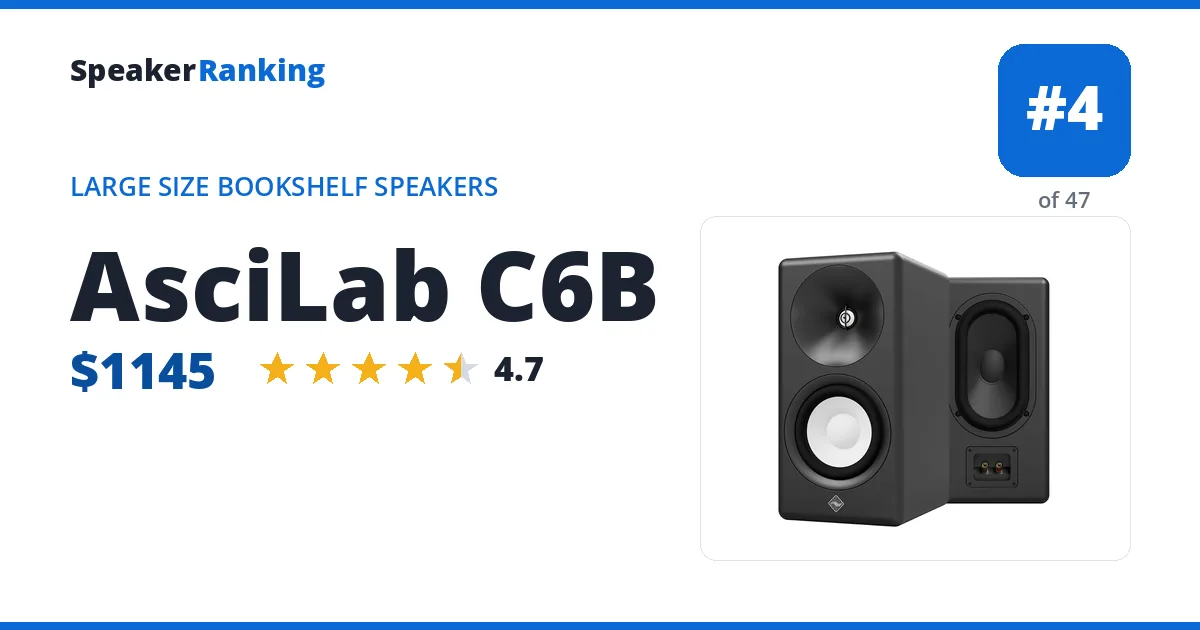
Pros: Two-way design pairing a 1” aluminum ceramic dome tweeter on a large waveguide with a 6” aluminum ceramic cone woofer, crossed over at 1.1kHz, plus a rear passive radiator. Unusual trait: horizontal radiation actually widens at higher frequencies instead of narrowing like most two-way designs, which keeps image focus and soundstage depth consistent whether you toe the speakers in or out (5-10° off-axis was the sweet spot in testing). Vertical radiation also stays wide straight through the 2kHz crossover region, so the sound doesn’t collapse when standing up: unusual at this price. CA2034 measurements show strong on-axis linearity, listening window, early reflections, and directivity. Midrange and tweeter distortion stay very low even at 96dB, holding up against a $5,900 Arendal speaker in that regard despite roughly a 5x price gap. At $1145 shipped to the US, the reviewer calls it the best-value bookshelf speaker he’s tested, rivaling speakers 2-5x the price. Measured bass extension of 54Hz (-3dB), with a measured sensitivity of 85.6dB.
Cons: Bass rolls off around 50Hz in-room (F3 54Hz, F10 35Hz), so a subwoofer is needed for real extension below that. Low-frequency harmonic distortion increases substantially at 96dB versus 86dB, though it’s second-order and less audible than it looks on paper. Minimum impedance dips to 2.6 ohms (EPDR as low as 1.2 ohms), so it wants an amplifier comfortable driving 4-ohm loads, ideally 100W or more. At 102dB, compression noticeably eats into midrange, bass, and some treble output. Shipping to the US adds roughly $200 on top of AsciLab’s list price. Against the reviewer’s reference Audiofirst Fidelia at a similar price, has slightly less lower-midrange body (about 1dB difference) and a smaller perceived soundstage size.
Full AsciLab C6B review and specifications →
| Bass Extension (-10dB) | 35Hz (measured, Erin’s Audio Corner) |
|---|---|
| Bass Extension (-3dB) | 54Hz (measured, Erin’s Audio Corner) |
| DIY Kit | No |
| Dimensions | 15.7”H x 8”W x 10.4”D (398.8 x 203.2 x 264.2 mm) |
| Drivers | 6” Aluminium Ceramic Cone with cast Aluminium Chassis woofer, 1” Aluminium Ceramic Dome tweeter |
| Impedance | 4 ohms nominal, 2.6 ohms minimum (measured, Erin’s Audio Corner) |
| Sensitivity | 85.6dB (measured, Erin’s Audio Corner) |
| Spinorama Preference Score | 6.33 |
| Spinorama Preference Score with Perfect Sub | 8.28 |
| Weight | 18.5 lbs (8.4 kg) each |
| Woofer Cabinet | passive radiator |
- Links
- Reviews, Comparisons and Sound Samples
- Head-to-Head Comparisons